The goal is not just to generate runnable code, but to produce explicit world models that are inspectable, reusable, and verifiable—models that can support online planning, RL rollout generation, and human-facing analysis.
Evaluation is central: one natural-language spec can admit multiple valid simulators, so prediction accuracy is not the right metric. Instead, we derive logical, temporal, and causal constraints from the spec, and evaluate generated simulators through their emitted event traces.
For more details about STRIDE framework and additional experiments (dynamic VCG mechanism design, Tic-Tac-Toe, Connect-N, and more will be added soon), please check out
our paper: https://t.co/bnJxNTFjTC
and GitHub repo: https://t.co/xlnbJZuhrJ
Introducing #STRIDE: Our new LLM agent framework designed to boost strategic decision-making in AI. Equipped with specialized tools, STRIDE excels in solving MDPs and economically relevant problems like bargaining and dynamic mechanism design.
🔗https://t.co/bnJxNTEM44
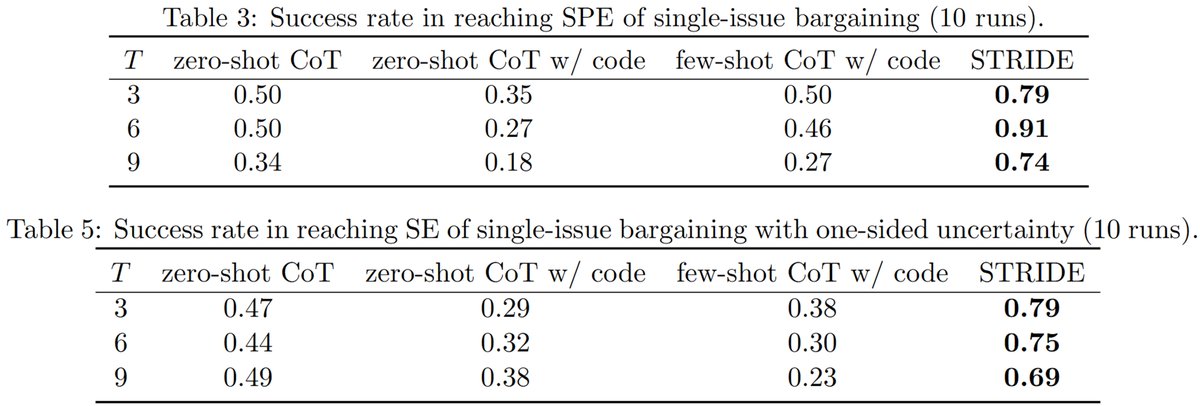
We also consider sequential bargaining games by having two STRIDE agents negotiate the price of an item for T steps. We report their avg success rate in reaching subgame perfect equilibrium (for complete info setting) and sequential equilibrium (for incomplete info setting).
Thrilled to be part of this incredible new course on AI Agentic Design Patterns with AutoGen! 🚀 Join @Chi_Wang_ and me as we dive into the world of multi-agent collaboration, reflection, tool use, and more using AutoGen. Can't wait to show you how to leverage these to build cool applications. Thanks to @AndrewYNg and the @deeplearningai_ team for their support. Sign up now and start exploring the potential of agentic AI with us! 🤖👾 https://t.co/4OdrNhJ0ca