@DFBbear@DaniMayakovski Y sigues con los insultos y sin comprender lo que pasa en mi país. Aquí no se trata de aplicar “principios básicos” o teorías del siglo pasado sabias? porque el costo de fanatismos como el tuyo lo pagan personas reales.
A los militares les preguntan si están dispuestos a matar a otro ser humano como parte de su formación …?
Y a los dirigentes políticos les preguntarán cuántos muertos justifican una causa…? Que tan grande tiene que ser el “daño colateral” como para que retrocedan …?
Ascienden de coronel a general al hermano de la jefa de gabinete de Paz; había quedado rezagado en 2024
En medio de cuestionamientos sobre presuntos #favorecimientos dentro de la administración pública, se confirmó el ascenso de un oficial de la Fuerza Aérea Boliviana de coronel a general, caso que ha generado #polémica por su vínculo familiar con la jefa de gabinete del presidente @Rodrigo_PazP. Se trata del coronel Julio Céspedes Quevedo, hermano de la actual jefa de gabinete, Gilda Céspedes Quevedo, cuyo ascenso ha reactivado denuncias sobre posibles influencias en decisiones institucionales.
De acuerdo con las observaciones surgidas en torno al caso, el oficial habría quedado rezagado en la gestión 2024, cuando no fue promovido por instancias correspondientes, situación que cambió posteriormente. “El país se cansó de los abusos, de los atropellos, de los beneficios de los poderosos… la gente votó por un cambio, pero parece que todo cambió menos los abusos”, señalan las críticas que cuestionan el proceso y el contexto en el que se habría concretado la promoción militar.
Asimismo, las denuncias apuntan a que el ascenso genera dudas sobre la independencia de las decisiones y el respeto a los procedimientos regulares dentro de las Fuerzas Armadas. “Todo es posible… la novela es la misma, solo cambió el título”, señalan las voces críticas, que comparan el caso con otros episodios de presunta influencia política en designaciones y ascensos en anteriores gestiones gubernamentales.
Esta realidad no se incluye en los análisis que se están haciendo sobre lo que pasa en el país …
Además de otros sobre cómo funcionan las dirigencias y las organizaciones sociales en estos conflictos.
Cc. @QuyaReyna@WilberMachaca@lucianajauregui
Las economías ilícitas mueven entre $us 12,000 millones en Bolivia Representan el 25% del PIB, actuando como un "amortiguador social" pero destruyendo la institucionalidad. @Henryoporto y @REvanEllis lo analizan aquí: https://t.co/7T3Zgk8ifN
@FreddyRojasSa@DaniMayakovski Tienes razón en mucho de lo que dices, pero creo también que el mensaje desde “abajo” sobre los límites de lo que va a poder hacer ahora ha quedado claros. No debería perderse ese poder insistiendo en profundizar una crisis que ahora mismo no va a llevar a un buen fin.
@FreddyRojasSa@sole_mio0@DaniMayakovski Créeme que estoy consciente de la dimensión del problema, que es además estructural no solo coyuntural. Por eso mismo creo que se requiere pensar a largo plazo, no de forma reactiva. Porque cual es el proyecto político más allá de oponerse a esto o aquello?
@sole_mio0@DaniMayakovski Es obvio que la complejidad de la situación te sobrepasa.
Vuelve a opinar cuando puedas ver más allá de tus sesgos y tu odio. Tal vez entonces podamos conversar.
@FreddyRojasSa@DaniMayakovski La diferencia está en que el señor que ahora esta en el gobierno no es producto de una dictadura, sino de una elección donde hubieron dos vueltas. No es santo de mi devoción, pero está claro que las alternativas son peores.
@DFBbear@DaniMayakovski Si cree que con insultos va a hacerme cambiar de opinión, esta perdiendo su tiempo.
Con gente como usted las derechas fascistas lo tienen muy fácil , porque es justo la imagen que necesitan para descalificarnos. Asi que mejor siéntese y cállese usted .
@FreddyRojasSa@DaniMayakovski A que costo …?
Porque además ese costo lo está pagando el “pueblo” que se dice defender. No todo justifica los fines que se quiere lograr, y el camino para hacerlo es tan importante como las metas .
💬El Seminario Regional de Desarrollo Social (16-18 de junio), que inauguramos hoy en la #CEPAL, se ha consolidado como un espacio de análisis, diálogo y construcción de propuestas de políticas públicas sobre los principales desafíos que enfrenta #AméricaLatina y el #Caribe en materia de desarrollo social inclusivo: Secretario Ejecutivo @JoseMSalazarX.
✔️Esta sexta edición aborda cuatro de las 1⃣1⃣grandes transformaciones que la @cepal_onu considera indispensables para superar las trampas del desarrollo en las que está sumida #ALC:
✔️ La reducción de la desigualdad y el aumento de la movilidad social;
✔️La ampliación de los sistemas de protección social;
✔️Asegurar educación de calidad y un acceso amplio a la formación profesional, y
✔️Cerrar la brecha digital e impulsar la incorporación de nuevas tecnologías e inteligencia artificial #IA.
🔴https://t.co/22EcLUJ51H
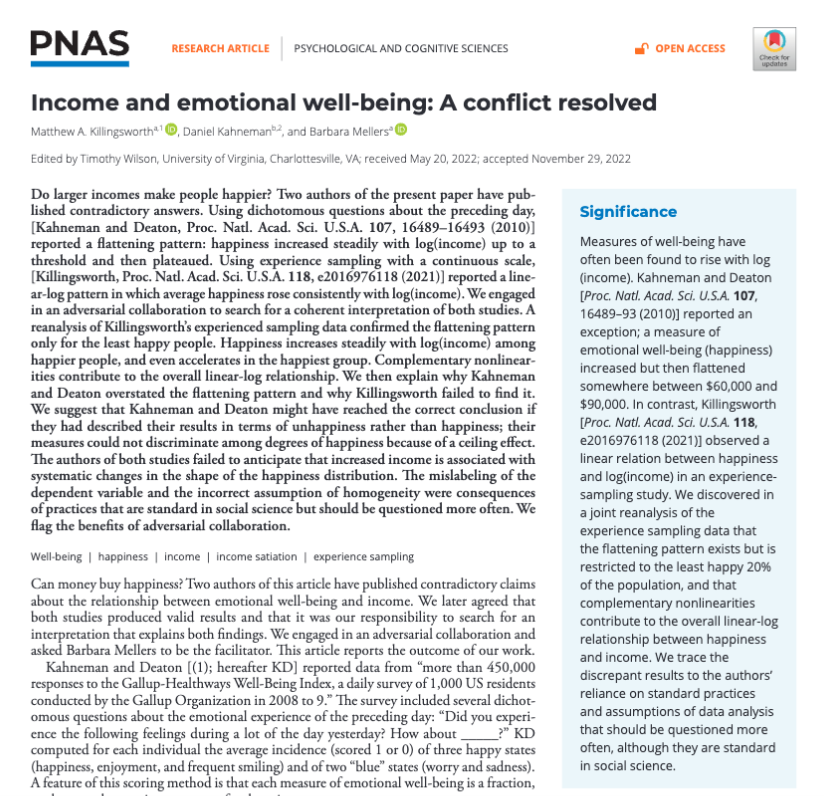
Does money buy happiness? A Princeton Nobel laureate said no above $75,000. A Penn researcher with 1.7 million data points said yes. The day they sat down together to settle the fight, the answer they reached should change how you think about your own life.
The Nobel laureate is Daniel Kahneman. The Penn researcher is Matthew Killingsworth.
The fight between them lasted 13 years, and the way it ended is one of the cleanest examples in modern science of two smart people being wrong in opposite directions about the same question.
In 2010 Kahneman and his Princeton colleague Angus Deaton published a paper that became one of the most quoted findings in the history of social science.
They analyzed 450,000 responses to the Gallup-Healthways Well-Being Index and concluded that emotional well-being rose steadily with income up to about $75,000 a year, and then flattened out completely. Above that line, the extra money was not buying any more daily happiness.
The headline traveled around the world. Every news outlet ran the number.
A CEO in Seattle famously cut his own salary to raise his employees to that exact threshold. The 75,000 dollar figure became cultural shorthand for the idea that the rich are not actually any happier than the rest of us once basic needs are met.
For 11 years almost nobody seriously challenged it. Kahneman had a Nobel Prize in Economics, the sample size was massive, and the conclusion was emotionally satisfying in a way that made everyone feel a little better about not being wealthy.
Then in 2021 a 33 year old researcher at the University of Pennsylvania published a paper that quietly destroyed the entire finding. His name is Matthew Killingsworth.
He had spent the previous decade building a smartphone app called Track Your Happiness that pinged users at random moments during their day and asked them a simple question.
How do you feel right now, on a scale from very bad to very good. The app was designed to catch happiness in the act, not to ask people to recall it later.
By 2021 he had collected over 1.7 million real-time happiness reports from 33,000 adults. When he plotted income against in-the-moment well-being, there was no plateau anywhere.
The line just kept rising. People earning $200,000 were happier on average than people earning $100,000. People earning $400,000 were happier than people earning $200,000. The curve flattened slightly but never stopped climbing.
The famous $75,000 ceiling that the world had been quoting for 11 years simply did not exist in his data.
Now there were two Nobel-quality findings sitting in direct contradiction with each other. One of them had to be wrong, and neither researcher was willing to walk away.
What happened next is the part of the story almost nobody knows.
Kahneman called Killingsworth and proposed something rare in academic science. He called it an adversarial collaboration. The two of them, joined by Penn psychologist Barbara Mellers as a neutral referee, would sit down together and reanalyze the raw data from both studies, line by line, until they figured out which one of them was wrong.
The paper they co-authored was published in March 2023 in the Proceedings of the National Academy of Sciences. And the answer they reached was not what either of them had expected.
Both of them had been right at the same time. They had been measuring two different populations without realizing it.
When the team broke Killingsworth's 1.7 million data points apart by baseline happiness, the picture clarified completely. For the happiest 70 percent of people, more money kept buying more happiness all the way up to $500,000 a year, with no sign of slowing down.
For people in the middle, the same pattern held. But for the bottom 20 percent of the sample, the ones who were already unhappy before the question of money even came up, the curve flattened almost exactly where Kahneman's original paper had said it would. Above roughly $100,000 a year, adjusted for inflation, more money did nothing for them.
This is the finding that changes how the question should be asked.
If you are not already unhappy, money keeps buying happiness for a much longer stretch than Kahneman's original paper suggested. The runway is wider than the world has been telling itself for a decade.
If you are already unhappy, money does almost nothing past a certain point. There is a ceiling, but the ceiling is not about income. It is about the underlying state of the person collecting it.
The deeper insight in Killingsworth's original research, the one almost nobody talks about, is the part that should sit with you longer than the income numbers. The Track Your Happiness app had been telling him for years that the single biggest predictor of in-the-moment well-being is not money at all. It is whether your mind is on the thing you are doing.
His most cited paper, written with Daniel Gilbert at Harvard, is titled A Wandering Mind Is an Unhappy Mind. The data from the app showed that people are mentally absent from what they are doing 47 percent of the time, and that mental absence is one of the strongest predictors of unhappiness in the entire dataset. More predictive than income. More predictive than the activity itself. More predictive than almost any demographic variable you could measure.
Which means the unhappy 20 percent that Kahneman's plateau actually described were probably not unhappy because they did not have enough money. They were unhappy for reasons that more money could not reach.
The reason the curve flattened for them at $100,000 a year is the same reason it would have flattened at $300,000 or $700,000. The thing they were missing was not buyable.
The most uncomfortable line in the entire 2023 paper is the one that nobody on the internet quotes. The authors note that the relationship between income and happiness, while real, is much weaker than the relationship between attention and happiness. A person earning $40,000 who is fully present in their own life will, on average, report higher in-the-moment well-being than a person earning $400,000 whose mind is somewhere else.
The fight about money was the wrong fight the entire time.
The two researchers spent 13 years arguing over whether the dollar ceiling was at $75,000 or $500,000, and the data from Killingsworth's own app was sitting there the whole time saying the ceiling was not about dollars at all. The ceiling is whether you can hold your attention on the life you actually have.
You can run the experiment yourself the next time you catch your mind drifting. Stop. Put your phone down. Look at the room you are in, the person across from you, the food in front of you, the work you are actually doing. That is the part the apps cannot sell you and the salary cannot buy you.
The data has been clear for over a decade. The plateau is not in your bank account. It is in your attention.
"We are losing biodiversity at a rate unparalleled in human history." Global wildlife populations have sunk over 60% since 1970.
We are destroying ourselves and taking nature with us.
Time to protect people and the planet.
#ActOnClimate#climate#biodiversity#nature
@esgravesiempre Disculpe pero solo ver la portada de su “libro” me quito las ganas de escucharla .
Es una lástima que su programa esté promoviendo este tipo de personajes con un discurso de odio tan evidente en un momento político tan delicado para el país.