Let’s start from the big news:
Haust has allocated more than 500,000,000 $HAUST for the BioGenesis NFT experiment.
⸻
🧪 How to Earn $HAUST
Here’s how rewards are earned in Haust’s dNFT experiment — and what participants can expect if they go all the way from collecting BioCultures to evolving their LifeForm.
Let’s walk through an example using a typical experiment participant 👇
⸻
🔬 Step 1: Mint the Essentials
The participant decides to join the BioGenesis experiment.
They start by visiting the Petri Dish and minting all the Essentials:
→ Lab Kit, Nutrition Medium, and Petri Dish
⸻
🧬 Step 2: Collecting Cultures
The participant becomes a collector. In their collection for example:
• 1x SA074
• 3x CA185
• 1x LA259
→ That’s 5 different BioCultures in total.
⸻
🚀 Step 3: Creating a LifeForm
When Haust launches on mainnet, the participant inoculates all components and mints their dNFT LifeForm —
which means combining all BioCultures in the Petri Dish with the Lab Kit and Nutrition Medium, giving birth to a new digital LifeForm.
⸻
💰 How Many $HAUST Can They Earn?
Each 1 BioCulture is valued at 66+ $HAUST,
with rarer ones reaching up to 700 $HAUST per 1 BioCulture.
The participant can claim this rewards immediately after minting their LifeForm and finish the experiment.
But that’s just the beginning. The rewards will multiply for those who continue the experiment.
⸻
🧬 How to Maximize Rewards?
The participant’s LifeForm begins to evolve over time.
→ Each day adds +0.5% to the total reward
→ Full maturation takes 180 days
They can exit the experiment at any time
— and receive a proportional reward based on the maturity level (we call this - ERS Current Value).
⸻
🎁 Example:
• Base reward: 1000 $HAUST
• Maximum reward (after 180 days): 10,000 $HAUST
If the participant exits after 30 days → they get ~25% → ≈ 2,500 $HAUST
If they wait the full 180 days → they get the full 10,000 $HAUST (we call this - ERS Full value)
⸻
🧬 BioGenesis is Art. It’s an Experiment. It’s a Reward System.
If you’re already in — congrats.
If not — there’s still time to start (but not much).
The show must go on.
https://t.co/GhSubqTLFz
Started. Failed. Completed.
Most onchain execution environments produce three statuses. Sometimes four, if you count "pending."
These statuses confirm that something happened. They do not tell you what actually happened.
Started - at which step? Quote generation, signing request, broadcast, confirmation? Was it a fee display issue? A slow quote? A UX moment where the user hesitated and left?
Failed - why? Route unavailable? Policy block? Connector timeout? User abort after seeing the final fee? Gas estimation error? Each of these requires a different fix. None of them are visible from "failed."
Completed - how? On the first attempt or the third? At what fee relative to what was quoted? Via which route? With what policy outcome? Completed transactions have quality too. That quality is invisible.
Three statuses built for monitoring are not the same as operational visibility.
Teams that operate execution know why flows fail, not just that they failed. They know where users drop, not just that conversion is low. They know which connector is underperforming on a specific asset pair, not just that route quality declined.
The difference between a status and a reason code is the difference between knowing something happened and knowing what to do about it.
What happened between started and failed? That's the question most teams can't answer.
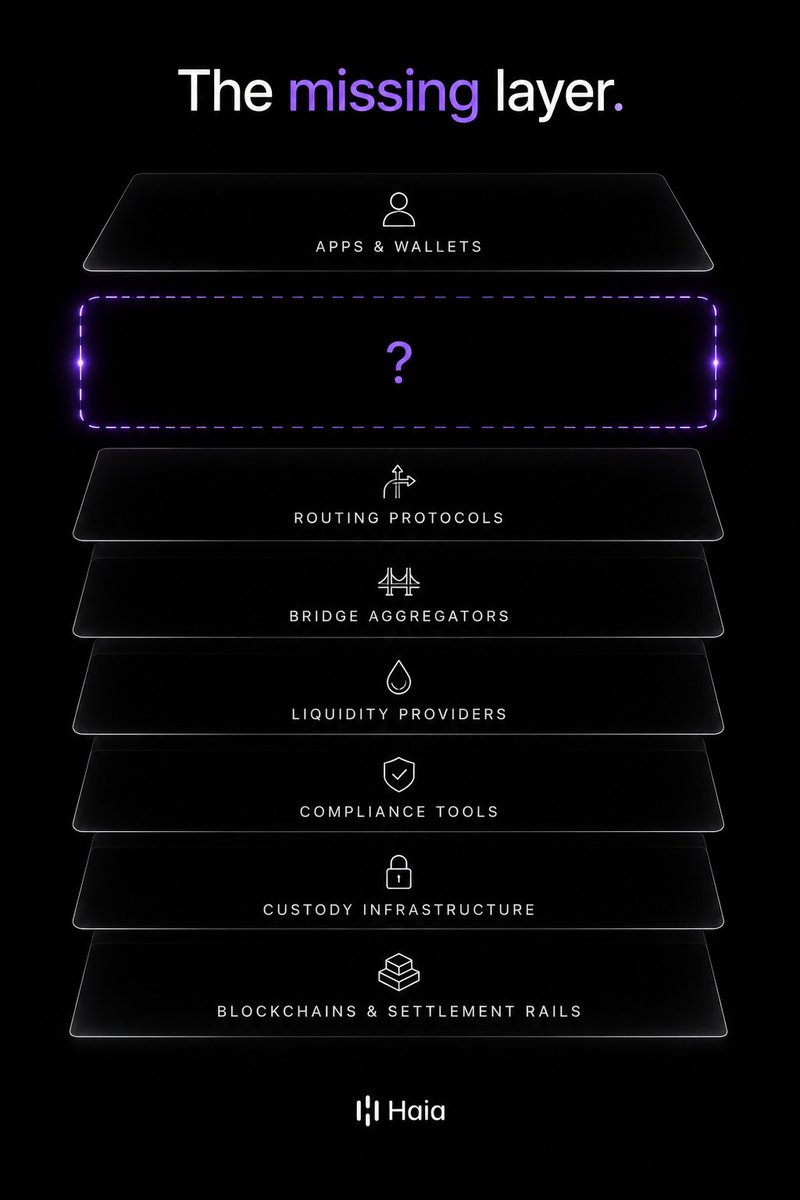
Draw the onchain payment stack.
At the bottom: blockchains and settlement rails. At the top: user-facing apps and wallets. In between: routing protocols, bridge aggregators, liquidity providers, compliance tools, custody infrastructure.
Each layer has multiple vendors. Each layer has established tooling. Each layer has investment.
Now draw the layer that watches the whole flow.
The layer that captures every execution event from intent to settlement. That enforces policy before money moves. That classifies what happened and why. That feeds signal back so the next flow is better. That gives ops teams readable data instead of raw logs. That gives product teams reason codes instead of status flags. That gives compliance teams an audit trail that exists before settlement.
That layer is not in the stack.
It is not routing - routing decides the path. It is not compliance screening - screening evaluates the counterparty. It is not a BI dashboard - BI explains historical data.
It is the operating layer. The control plane that sits above the data plane and makes the whole stack governable.
Every mature infrastructure category eventually produces this layer. Internet routing got traffic management. Cloud infrastructure got observability platforms. Payment rails got operations centers.
Onchain execution hasn't. Not yet.
The operator layer is the next category. It is not built yet. That is the opportunity.
Every onchain execution team has a blind spot.
Not a gap in their knowledge. Not a missing dashboard. A structural blind spot - a category of operational information that their current tooling cannot produce.
Here is where it lives.
A team can see that conversion dropped. They cannot see where users dropped in the flow - at quote, at signing, at confirmation - or why.
A team can see that a transaction failed. They cannot see whether it was a route failure, a policy block, a connector timeout, or a user decision.
A team can see that a policy fired. They cannot see the full distribution of policy events across chains and assets, or which policies are creating false positives.
A team can see aggregate metrics. They cannot see the specific connector that is underperforming on a specific asset pair in a specific corridor.
This is the execution blind spot. It is not the absence of data. It is the absence of readable, actionable, execution-level signal.
Dashboards show trends. The execution blind spot is in the events beneath the trends - the ones that explain why the trend is moving and what to do about it.
Every onchain execution team has one. The question is how large it is.
A transaction fails. Your team opens the logs.
You see: started. Failed. You don't see: which step. Which condition. Whether it was a route issue, a policy trigger, or the user who left after seeing the fee.
So you make a hypothesis. Push a change. Wait two weeks to see if the failure rate moved. It didn't. Make another hypothesis.
This is how most onchain execution teams operate , not because they want to, but because the data to answer "why did it break" either doesn't exist or is split across systems that don't talk to each other. Logs here. Policy configs there. Route data somewhere else.
The feedback loop is weeks. The blind spot compounds. The conversion loss accumulates quietly, line by line, flow by flow.
Teams that break out of this don't rebuild their stack. They add a layer between intent and settlement that captures every execution event and makes each one readable, governable, improvable.
What do you do right now when a transaction fails and you don't know why?
McKinsey's 2025 Global Payments Report named the infrastructure advances clearly.
Stablecoin issuance doubled since early 2024. Regulatory frameworks are converging across the US, EU, UK, Hong Kong, and Japan. Wallet technology and bank-grade custody are improving. On-chain analytics tools are enhancing compliance.
Then this line: stablecoins have not yet reached "the critical tipping point for widespread adoption."
The infrastructure is advancing. The operating layer is not.
There is a pattern here that is familiar from every prior infrastructure cycle. The rails get built. The settlement layer gets funded. The custody layer gets funded. The compliance tooling gets funded.
And then, at scale, teams discover they cannot operate the flows they built. They cannot see where execution drops. They cannot explain why flows fail. They cannot govern what happens between intent and settlement.
That is where the next budget goes - not into more rails, but into operating the ones that already exist.
The first era of onchain finance was about moving money. The next era is about operating it.
The infrastructure layer got funded. Which team is building the operating layer?
https://t.co/KZ07kic6HA
If you don't know where your execution flow breaks — you're already losing.
Not hypothetically. Right now, in your live environment, there are users abandoning flows for reasons your team can't see. Transactions failing at specific points your ops can't diagnose quickly. Policies firing with outcomes nobody's tracking. Routes underperforming in ways that don't show up in aggregate metrics.
This is the default state of most onchain execution environments today. The tooling to observe and control execution at this level didn't exist. Teams built what they could: good routing, reasonable policies, functional UX and accepted that some percentage of execution would leak without explanation.
The starting point isn't a platform migration. It's picking one flow the one where drop-off, failure, or policy uncertainty costs you most and running one improvement loop against it.
Connect signal. See what's actually happening. Test a change. Measure the delta.
Ten days. One flow. One loop.
Reach out if you want to run it
Haia is not a wallet. No key holding, no asset custody, no changes to user-signed execution. A signed transaction executes exactly as signed.
Haia is not a router. Your routing layer, your liquidity providers, your connector integrations all stay as they are.
Haia is not a compliance system. Your risk engine, your regulatory framework those are yours. Haia makes them more observable and more auditable, not different.
What Haia is: a control plane between intent and settlement. It reads every execution event, enforces the policies you define, and returns signal so you can improve outcomes over time.
No custody. No key handling. No core UI rebuild. Available through @gateway_eth
The most common question we get before integration: "what do we have to change?" The answer is: your existing stack stays. You add a layer on top of it that makes the whole thing visible.
What part of your execution environment would you most want to see clearly right now?
54% of financial institutions that don't yet use stablecoins expect to adopt within 6-12 months.
77% of corporates name cross-border supplier payments as their top use case.
The demand is real. The roadmaps are being built.
AlphaPoint put the failure point in plain language in their 2026 enterprise guide:
"The stablecoin payment flow from fiat to stablecoin and back represents the critical integration point where many implementations fail."
Not the wallet. Not the blockchain. Not the stablecoin itself.
The flow.
Teams build the integration. They test it. They ship it. Then a payment drops and nobody knows where. A flow fails and the ops team spends hours diagnosing from logs that were never designed to explain execution.
The off-ramp breaks in a specific corridor. The policy blocks a specific transaction type. The user aborts at a specific step.
None of that is visible from "started / failed / completed."
77% of corporates are planning to move serious B2B volume through these flows. The implementation problem is not going away by itself.
Which part of your stablecoin payment flow has the least visibility today?
https://t.co/VSTqcGjqkJ
Reason codes are one of the most underrated concepts in onchain execution.
In traditional payment rails, every failure has a code. Insufficient funds. Card expired. Velocity limit exceeded. Merchant category blocked. These aren't just logs , they're operational signals. They tell you exactly what fired, why, and what to do next.
Onchain execution mostly doesn't have this. When something breaks, you get a transaction hash and a status. Maybe an error message. Figuring out what actually happened , whether it was a route issue, a policy trigger, a user decision, or a connector failure, requires digging through multiple systems manually.
Reason codes change this. Instead of "transaction failed," you get "pre-sign abandonment fee exceeded user threshold." Instead of "policy block," you get "step-up triggered transaction amount above configured limit for this asset." Instead of "user abort," you get "signing abandoned after quote expiry - second attempt."
This changes debugging from investigation to diagnosis. It changes policy management from guesswork to audit. It changes product decisions from hypothesis to signal.
At Haia, reason codes are a core primitive , not an add-on. Every execution event gets context: why it stopped, where it stopped, what condition triggered it. That context is what turns execution data into something your product, ops, and compliance teams can actually act on.
Day 1 with Haia: you map the funnel. Intent, quote, sign, execute, settle. Tag failure events, policy triggers, guardrail fires. Every execution step starts emitting readable data instead of a pass/fail.
Day 2: Haia shows you the distribution. Not "conversion dropped 3%" , but "fee shock is causing 41% of your pre-sign abandonment on Ethereum mainnet." That's the first time most teams see this number.
Days 3–5: you test the top recommendation. Shadow replay. A/B policy check. Route trial. You see what the change would have done against real execution history before touching production.
Days 6–10: implement, measure, track. Did the change hold? Did it create new edge cases?
The point of the first sprint isn't to fix everything. It's to run the loop once on one real flow, with your actual data and see what comes out.
After that, you own the process.
Circle published their 2026 Internet Financial System report in January.
Three numbers stand out.
CPN - the Circle Payments Network - reached $3.4 billion in annualized volume less than eight months after launch.
Arc, Circle's purpose-built blockchain for financial institutions, now has over 100 companies across every region in its testnet.
Circle is in active discussions with Globally Systemically Important Banks on custody, treasury, collateral, and settlement.
The infrastructure is scaling faster than most teams expected.
Here is what the report does not address: what happens when a flow on that infrastructure breaks.
$3.4 billion annualized is not a small number. At that scale, every basis point of execution failure has a cost. Every failed flow is a reason code that most teams cannot read. Every dropped transaction is operating signal that most teams cannot act on.
Circle built the settlement network. Circle built the rails. Circle is signing the GSIB partnerships.
The operating layer - the one that governs what happens inside each flow before it settles - is not part of what Circle ships.
That layer has to be built separately. Most teams building on CPN have not started.
As your stablecoin volume scales, which part of execution becomes harder to see?
https://t.co/j5bEEQyA2Z
There's a sequence that matters in execution operations, and most teams try to skip to the end.
You can't optimize what you haven't governed. You can't govern what you can't see. So the work has to start with observation clean signal on where users drop, where routes break, where guardrails fire, what the failure distribution looks like across chains and assets.
Without that baseline, governance is fiction. You write policies against a system you don't understand. You tune routes based on aggregate metrics that don't show you which connector is quietly underperforming on a specific asset pair.
Once you have the signal, governance becomes precise. You define what happens under what conditions. Step-ups trigger where they should. Blocks fire with logged context. Fallbacks activate on actual route failure, not guesswork.
And then (only then) does optimization have something to work against. You run a test. You measure whether the change held. You see the edge cases it created. You loop.
The teams that skip straight to optimization are the ones that run A/B tests and can't explain the results.
$35 trillion in stablecoin transactions in 2025.
$390 billion in actual payments.
That's 1%.
The rest - trading, internal transfers, automated processes moved through systems most teams cannot explain, classify, or improve.
B2B stablecoin payments grew 733% year over year. Monthly volume went from $5B in January 2024 to $30B by early 2026.
The money is moving. Fast. But here is what the report does not say directly: volume growth is not the same as operational maturity.
Teams can route transactions. Most cannot tell you where a flow dropped, why it failed, what policy triggered, or what to fix next.
Settlement confirms that money moved.
It does not tell you how to operate the execution that got it there.
The first era of onchain finance was about moving money. The rails are here.
The next era is about operating them.
→ @McKinsey + Artemis Analytics 2026 https://t.co/GQXXjPscBD
Money is becoming software.
Not digital money - that's been true for decades. Software-mediated money: value that moves according to code, executes according to rules written in smart contracts, settles without requiring a human to approve each transaction.
When money becomes software, it inherits the properties of software. It can move at the speed of an API call. It can be programmed with conditions. It can execute autonomously, across chains, without geographic limits.
It also inherits software's failure modes.
Software fails in specific ways - at specific steps, under specific conditions, for specific reasons. It fails silently. It fails at scale. It fails in ways that aggregate metrics don't show.
Traditional financial infrastructure was built for a world where a human could intervene at each step. Approve the transaction. Review the policy. Escalate the exception.
Software-mediated money doesn't wait for that. It executes before anyone can intervene. Which means the operating layer - the one that governs what happens, captures what breaks, and improves the next execution - has to be built into the flow from the start.
The infrastructure that moves software-mediated money is being built. The infrastructure that operates it is not.
That is the gap.
Most execution infrastructure is built to move transactions. Almost none of it is built to understand them.
Wallets handle signing. Routers find paths. Compliance systems check rules. Liquidity providers fill orders. Each layer does its job and passes the transaction along.
But there's no layer that watches the whole flow, captures what happened at each step, understands why something broke, and feeds that back so you can improve the next one.
In backend systems, this is called a control plane. It sits on top of your data plane, adds observability, policy enforcement, and optimization without replacing the infrastructure underneath. You don't swap your stack. You make it visible.
Onchain execution doesn't have this yet. Teams are running live financial flows with production-grade stakes and minimal operational visibility.
Haia is that layer. Between intent and settlement. No custody, no key handling, no changes to how user-signed execution works.
You keep your rails. You get to see what's happening on them.