What can a robot hand learn from seconds of human motion?
It turns out: dexterous skills that generalize!
Excited to share AdaDex: Learning Adaptable Dexterous Skills via Hybrid Dexterous Mimicking.
From one short hand–object clip per skill, AdaDex learns an adaptable dexterous skill, with skills spanning functional grasping, object reposing, in-hand reorientation, and throw-and-catch.
Project page: https://t.co/C7HRvtgbnL
🧵👇 (1/8)
We found a way to scale humanoid control that reduces GPU-hours by more than 1000×.
Across 129,514 motions, SuperMimic surpasses the state of the art (128 GPUs, 7 days) with 1 GPU in 3 hours.
Project: https://t.co/6gc9WKm9qY
Demo: https://t.co/OHRvx5ogQY
Amazing work on RAX! Great to see the potential of scaling online exploration for self-improving robot agents.
Huge congrats to @xczhangxx@RunhanH and the whole team!
Robotics has spent years scaling demonstration data and model size. What happens when we scale EXPLORATION for robot agents?
We're incredibly excited to share RAX, an agentic robotics system that learns by scaling online exploration.
A coding agent connects directly to the robot’s perception and control APIs, learns from feedback, and builds programs that perceive, plan, and act. The model stays frozen. As exploration scales, the agent improves its programs and builds up reusable skills.
The results:
• ZERO teleoperation or action demonstrations on real robots—from insertion with 0.1 mm clearance and air-fryer manipulation to deformable objects and long-horizon mobile whole-body control.
• +37 percentage points on average over leading learned policies across five simulation benchmarks: RoboDojo, BEHAVIOR-1K, HumanoidArena, DexJoCo’s bimanual tasks, and LIBERO-Pro.
• One framework spanning single-arm, bimanual, dexterous, humanoid, and mobile robots, with new embodiments connected through APIs.
The craziest part: on each real-world embodiment, going from scratch to mastering the tasks took roughly two hours. No teleop. No model finetuning.
We’re open-sourcing the full framework AND every experiment session. We can’t wait to see what people build with it!
Project + sessions: https://t.co/O04Z5PUgqY
Paper: https://t.co/sd66qnYZWB
GitHub: N
Project fully led by @RunhanH and @xczhangxx who are absolutely awesome.
How it works, experiments, and robot videos below 🧵
(1/N)
Can you sample a robot policy the way you sample an image? 🎲
No RL run. No reward. No fine-tuning.
We train a diffusion model on the 𝘄𝗲𝗶𝗴𝗵𝘁𝘀 of thousands of RL policy networks, then sample brand-new ones that walk 🚶, dance 🕺, and spin-kick 🦵 on a real Unitree G1 🤖
The best part? The 𝘄𝗲𝗶𝗴𝗵𝘁𝘀 have a secret 👀 Every network, no matter the motion, pays the most attention to the hips and waist — embodiment comes first; motion comes second. 🦾
📄 arXiv: https://t.co/iC8g2eAzYB
🌐 Website: https://t.co/xH5bdm9TZs
#Robotics #HumanoidRobots #DiffusionModels #RobotLearning #EmbodiedAI
We gave tactile sensors goosebumps and helped robots feel friction. 🤖🦾
👉 Using ordinary cabinet bumpers.
Meet TacGooseBumps (TacGB), a passive add-on that sticks directly onto existing normal-only tactile sensors, with no changes to their electronics.
How does it work? Under tangential loads, the bumps tilt and redistribute pressure, creating patterns that a robot policy can learn from directly, with no explicit force reconstruction.
Across four manipulation tasks, TacGB improves insertion success by up to 36 percentage points, enables gentler egg placement, and produces more continuous, straighter drawing.
🌐 Project: https://t.co/vumTiYlAQw
📄 Paper: https://t.co/xIfpRG3uYi
Can we learn whole-body intelligence from UMI data alone? Whole-Body UMI: collect task skills robot-free data with UMI, then connect them to a reusable mocap-trained motion prior for humanoid whole-body manipulation. No task-specific whole-body demos.
🔗 https://t.co/klgk2OuB0G
The used key is always bright.
Just released an agentic robot project RPG, where self-improving embodied agents play a heavy role. Wrote a blog on what motivated the project, what we learned, and some vision about what the future is like.
https://t.co/ykUJrCJf5d.
Practice makes perfect. A truly agentic robot shouldn’t just know what to do. It should also figure out how to get better.
What if a robot could watch a demonstration, figure out what it needs to practice, and learn how to get better through practice?
Introducing RPG: Guided Self-Improvement for Embodied Agents, a real-to-sim-to-real pipeline that turns real-world demonstrations into targeted practice.
RPG reconstructs practice tasks from demonstrations, uses demo videos to guide skill improvement, and continually updates a shared skill system from failures.
On real robots, RPG achieves 30/30 successes across 3 tasks. In simulation, it reaches 95.0% success across 22 manipulation tasks after 15 rounds of self-improvement.
Demo → Reconstruct → Guided Practice → Self-Improve → Go Real
Can a humanoid learn robust whole-body loco-manipulation directly from a human? No robot, no teleop, no retargeting.
Meet Workhorse 🐴: our G1 topples and climbs a suitcase, catches a thrown box, and sorts boxes with hands and a kick. Fully autonomous.
More videos at https://t.co/HrxCv199F7
As robot learning leans more and more toward scaling, it can seem like there is less and less left for academic labs to do. I think humanoid ball sports is a topic especially well suited to academia: it doesn't need huge amounts of compute or data, but it does take a lot of effort and ingenuity.
And it's moving fast: my timeline has been full of humanoid robots playing ball lately.
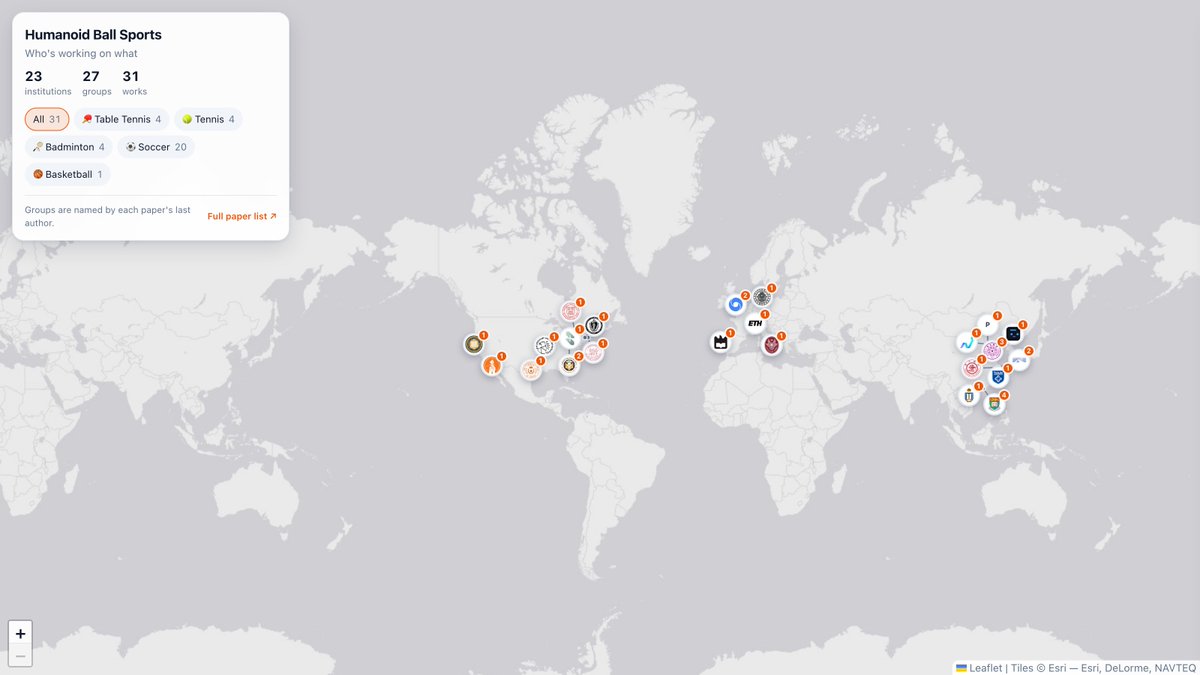
So I made Awesome Humanoid Ball Sports 🏓🎾🏸⚽🏀, a curated list of research on humanoid table tennis, tennis, badminton, soccer and basketball, to make literature review easier and help everyone keep track of the latest work. It also comes with an interactive map of which groups work on which sport.
A robot can follow a reasonable interpretation of an instruction and still fail the benchmark.
Meet BenchMend: we use GPT-6-Astra to uncover instruction–verifier gaps in robotics benchmarks, then repair the wording while preserving success checkers and recorded demonstrations.
Key takeaways:
📝 Instructions matter. Small edits can substantially improve alignment between task language and benchmark verdicts.
🤖 Even strong agents have limits when performing zero-shot robot control. Tasks requiring precise contact, placement, and coordination remain challenging for agents.
🛠️ An imperfect policy can still help debug benchmarks. Agents that diagnose gaps, propose fixes, and test them could enable self-improving benchmarks and potentially support recursive self-improvement (RSI).
Read the blog: https://t.co/nbYo5rOgtU
Watch the rollouts: https://t.co/Lk8axNRfpN
Fast dribbling. Tight turns. Repeated direction changes. Human-like motion. ⚽️
We present a Unitree G1 system for sustained humanoid dribbling beyond simple straight-line ball pushing.
The robot continuously controls the ball while running through slalom courses and large direction changes, using natural whole-body motions.
Ball perception is fully onboard with LiDAR — no mocap, no external tracking.
The policy is trained in simulation with a human-motion prior and transfers zero-shot to hardware.
Safety tether stays slack during operation and provides no assistance.
Paper coming soon. Stay tuned!