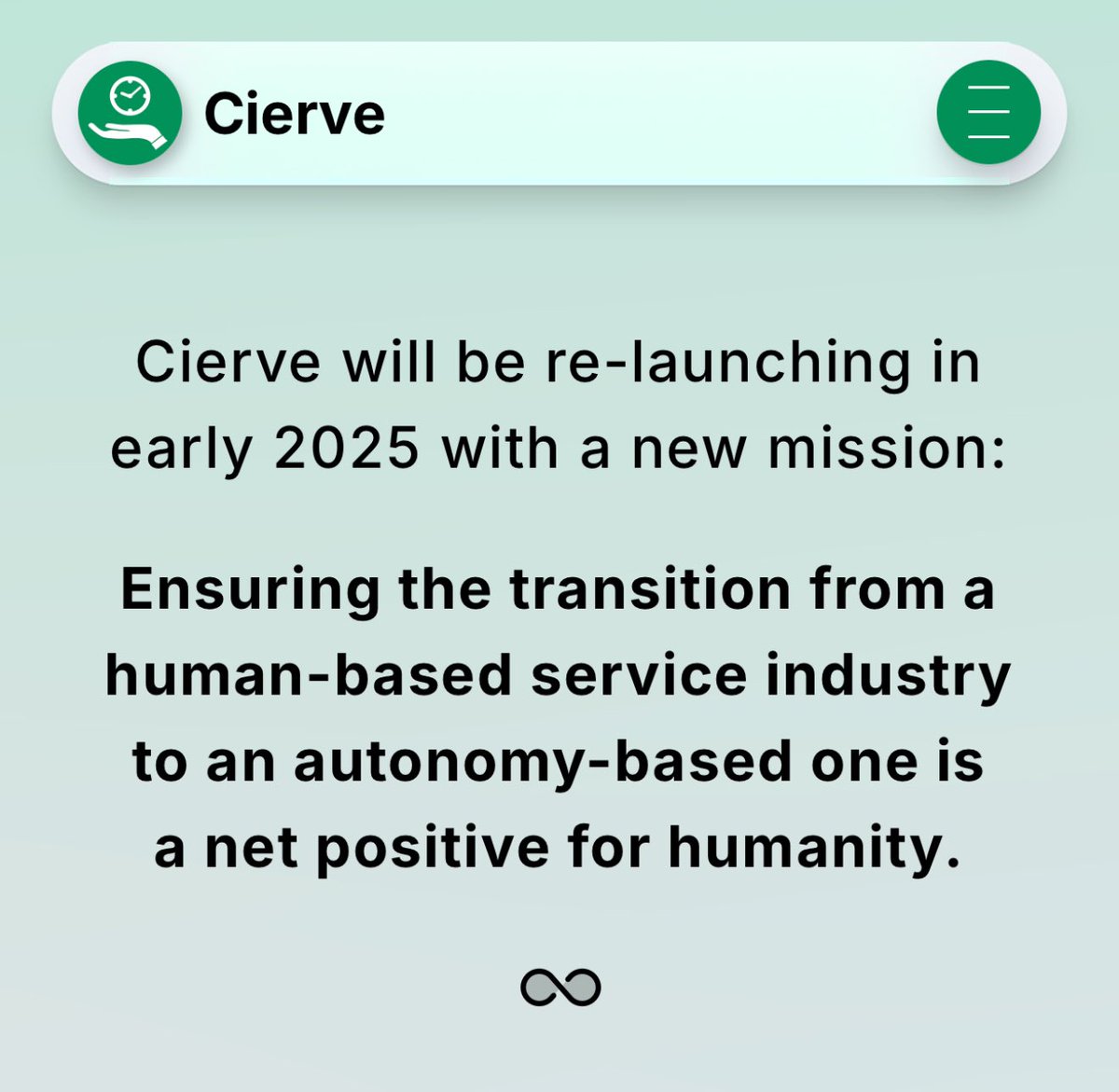
In the meantime, our core service is still operational and will remain so!
Get started with an elite assistant today and reclaim your time: https://t.co/JhiXUgzt1Z
Interested in freeing up 10+ hours of your time each week?
At Cierve (@CierveCo), we aim to give time back to busy professionals and their families. We'll match you with an elite assistant to take care of life’s time-consuming details so you can focus more on whatever matters most to you.
We’re confident that Cierve is the best assistant solution on the market:
- Top-tier talent (top 1%)
- Affordable plans (starting at $119/wk)
- Local or virtual (it's your choice)
- Robust support (AI tools, team of specialists)
Founders, partners, and executives from Microsoft, GM, CacheFly, and Activision trust Cierve to be a reliable source of delegation as we help them reclaim valuable time in both their work and personal lives.
Want to find out if our service is right for you? Take our client onboarding questionnaire: https://t.co/SrQc4rmuI2 (it only takes 10 minutes and will tell us everything we need to know to get you started)
"The most important skill to getting rich is being a perpetual learner."
- Naval Ravikant (Entrepreneur, Investor, Philosopher)
Naval approaches learning with a focus on leveraging the compounding nature of knowledge and skills.
Here's a 7-step breakdown of his learning method:
1. Leverage Modern Tools: Naval emphasizes the importance of using modern tools, mainly the internet, to access a nearly unlimited range of information.
Internet, YouTube, Tutorials > Traditional education (college)
2. Pursue Specific Knowledge: He advocates for pursuing knowledge that is specific and personalized, often not teachable in a traditional sense but learnable through personal experiences, interests, and innate curiosity.
This type of knowledge is highly valued because it will be directly tied to your unique capabilities and perspectives.
3. Continuous Learning: Naval is a proponent of lifelong learning, suggesting that staying curious and continuously updating one’s knowledge base are crucial for success in rapidly changing modern economies.
Never lose your curiosity.
4. Learn to Love Reading: He suggests that reading is a fundamental skill for acquiring knowledge. Through reading, one can learn from the best minds of history, gaining insights that are both timeless and applicable across various aspects of life.
5. Use the Internet for Scale: Naval points out that the internet has massively broadened the possible space of careers and learning paths. It allows individuals to learn almost anything they want, whenever they want, which can be turned into opportunities for creating value.
Not only can you learn anything you want on the internet, you can also start anything you want on the internet.
6. Follow Intellectual Curiosity: He believes that following your genuine intellectual curiosity, rather than pursuing what is currently popular or lucrative, is a more solid foundation for a career and personal growth.
This leads to developing unique skills and insights that are often more valuable in the long run.
7. Embrace the Basics: Naval stresses the importance of understanding foundational concepts over accumulating a lot of advanced, niche knowledge.
Foundations are more adaptable and provide the groundwork for understanding more complex ideas.
Overall, Naval's learning strategy is about maximizing efficiency, focusing on what aligns with personal skills and interests, and utilizing modern technology to access and scale knowledge. This approach not only fosters personal growth but also positions individuals to take advantage of emerging opportunities in a dynamic world.
---
p.s. Want to spend more time learning? We built the ultimate personal assistant service:
- Top-tier talent
- Affordable plans
- Local or virtual (it's your choice)
- Robust support
Reclaim your time and start delegating tasks to an elite assistant.
Take our client onboarding questionnaire: https://t.co/vkiMmGs65O
Embrace change because it's the only constant in branding.
Platforms will evolve, media will shift, packaging will transform, and even you will change. To stay relevant and thrive, you must be willing to adapt.
Change isn't always easy, but it's essential for growth.
Being rigid and resistant to change can lead to stagnation and, eventually, irrelevance. Successful brands understand this and continuously innovate to meet new challenges and opportunities.
So, stay curious, be adaptable, and always be ready to pivot.
Embracing change keeps you ahead of the curve and ensures that your brand remains dynamic and vibrant in an ever-changing landscape.
---
p.s. We built the ultimate personal assistant service:
- Top-tier talent
- Affordable plans
- Local or virtual (it's your choice)
- Robust support
Reclaim your time and start delegating tasks to an elite assistant.
Take our client onboarding questionnaire: https://t.co/vkiMmGs65O
p.s. We built the ultimate personal assistant service:
- Top-tier talent
- Affordable plans
- Local or virtual (it's your choice)
- Robust support
Reclaim your time and start delegating tasks to an elite assistant.
Take our client onboarding questionnaire: https://t.co/vkiMmGs65O
The #1 Mental Growth Hack from @AlexHormozi:
When you meet someone who is making more money than you, you must believe they are better at business than you in some way.
Look at the situation as an opportunity to grow. There's something you can learn from them.
Don't do what most people do and tell yourself, "They had it easy," "they had a shortcut," or "they probably broke some moral code."
Even if any of those things are true, it doesn't serve you to think like that.
None of those beliefs make you better. Only a watchful eye for what learnings can be extracted will make you better.
We created the ultimate personal assistant service.
Take your time back, and start delegating to an elite assistant.
Get started with our client onboarding questionnaire, it only takes 10 minutes and will determine if our service is a good fit for you: https://t.co/G1OhkNm3UB
Find this content useful? Repost it and share it with your network.
Want to reclaim your time by delegating tasks to an elite assistant? Check us out: https://t.co/IxXS4xO7Nz
The key to being a good leader is actually simple:
See it as a responsibility rather than a reward.
According to Patrick Lencioni, the bestselling author of multiple books on business, whose teachings have helped numerous Fortune 500 companies, professional sports teams, non-profits, and educational institutions...
There are two types of leaders:
• Reward-centered leader: the belief that being a leader is the reward for hard work; therefore, the experience of being a leader should be pleasant and enjoyable, free to choose what they work on and avoid anything mundane, unpleasant, or uncomfortable.
• Responsibility-centered leader: the belief that being a leader is a responsibility; therefore, the experience of leading should be difficult and challenging (though certainly not without elements of personal gratification).
No leader is purely reward-centered or responsibility-centered.
We all struggle at times, and we all rise up to do the right thing at times.
But one of these two motives for leadership will be predominant, and that motive will have a profound impact on the success of the leader and the organization he or she serves.
Hopefully, it's obvious to you that responsibility-centered leaders will always have more success than reward-centered leaders.
To get the most out of life, you need to embrace risk.
Balancing risk and reward is essential for achieving your fullest potential. 🌟
Taking calculated risks opens doors to growth and new opportunities.
Whether you're starting a new venture, scaling your business, or exploring innovative ideas, stepping out of your comfort zone is crucial.
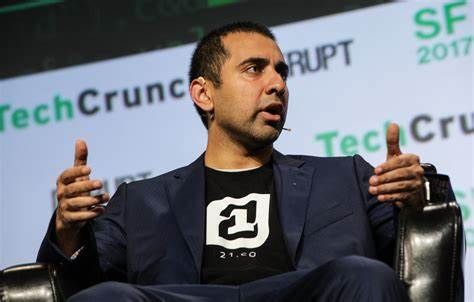
Balaji Srinivasan (@balajis) has a net worth of 150+ Million USD.
He was the CTO at Coinbase, co-founded Counsyl (which was sold for 375 million), and authored 'The Network State.'
Here are his views on balancing sleep and productivity:
"Losing sleep for a night isn’t the end of the world. Losing sleep for a year will affect your long-term health.
Even from a pure dollars-and-cents perspective, losing too much sleep is going to affect your wealth-generating capacity and your capacity to provide value for your employees and your shareholders.
Even if sacrificing sleep seems like the selfless thing to do on a daily basis, on a long-term basis, you want to take care of your health for the health of those around you.
Before I started my first company, I was about as jacked as it’s possible to be with my South Asian physiology.
I lifted, ran, and worked out all the time. Doing that while operating a startup was difficult because there was always the temptation to make that short-term sacrifice, to stay up late or skip the workout to take a sales call.
I would tell myself I have a responsibility to my employees, and I believed my small health goals or hour of sleep wasn’t as important as the team’s outcome. I had a fiduciary responsibility to them.
After all, I had them quit their jobs and move across the country. I didn’t want to say, “Oh, we didn’t get that deal because I went on a run.”
It took me a while to realize this was actually a false dichotomy. Sacrificing your physical fitness or health will also impoverish your team in the medium run.
You can tap into that short-term health sacrifice for only so long. In the same way that a short-term optimization in engineering means taking on technical debt, you are taking on physical debt if you are not working out and eating right each day."
(from 'The Anthology of Balaji' by @EricJorgenson)
Most people overthink first, act later.
Every successful entrepreneur, acts first, figures it out later.
Any analysis ahead of action is purely speculation.
You really do not understand something until you've done it.
Rather than trying to plan your way into the confidence to act, just start acting.
- @noahkagan
How Jeff Bezos produces unique insights:
“Jeff has an uncanny ability to read a narrative and consistently arrive at insights that no one else did, even though we were all reading the same narrative.
After one meeting, I asked him how he was able to do that.
He responded with a simple and useful tip that I have not forgotten:
He assumes each sentence he reads is wrong until he can prove otherwise.
He's challenging the content of the sentence, not the motive of the writer.
Jeff, by the way, was usually among the last to finish reading.”
Elon Musk on recruiting:
"I really just ask them to tell me the story of their career and some of the tougher problems that they have dealt with, how they dealt with those, and how they made decisions at key transition points.”
Richard Feynman once said that he could only determine whether he understood something if he could give an introductory lecture on it.
Note to self: If you cannot give an introductory lecture on a topic, you don't understand it.
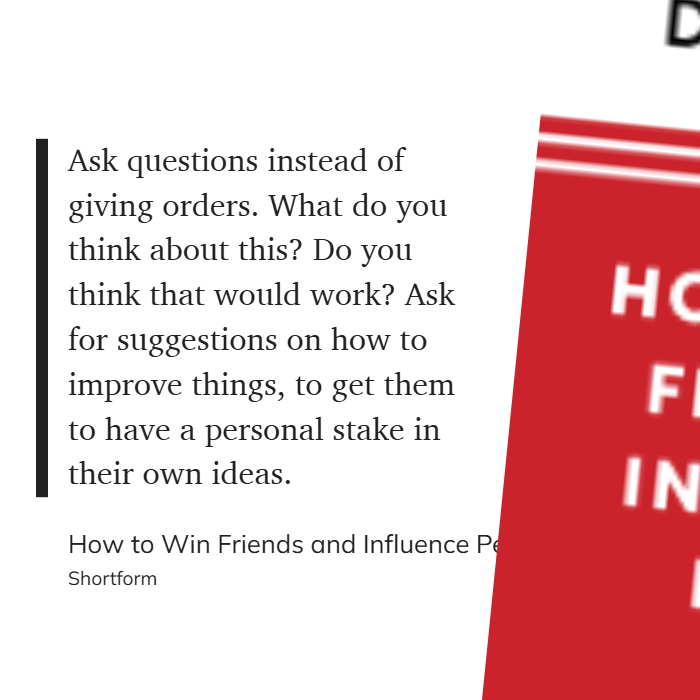
Great leaders ask questions instead of giving orders. Try these:
"What do you think about this?"
"Do you think that would work?"
By seeking input, you empower your team and foster a sense of ownership in their ideas.
This not only boosts morale but also drives innovation and improvement.