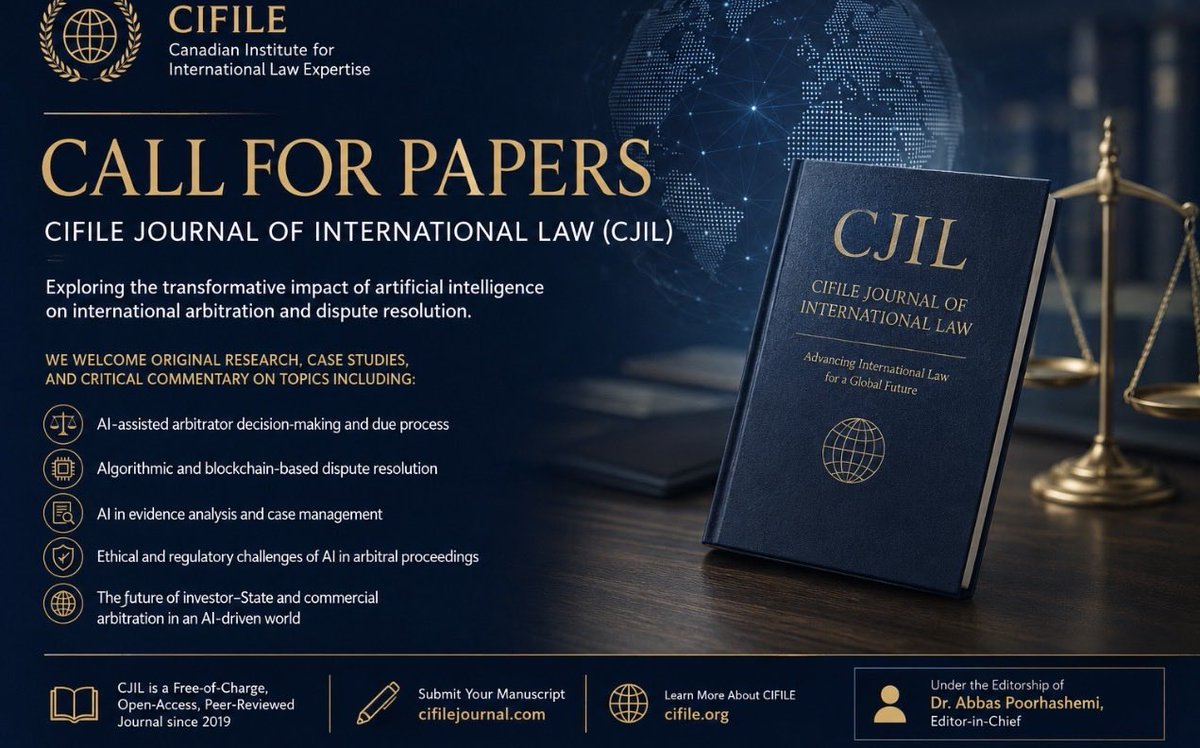
CIFILE Journal of International Law (CJIL) is a peer review & interdisciplinary journal of the Canadian Institute for International Law Expertise (CIFILE).
Submit a manuscript to the CIFILE Journal of International Law (CJIL) through the Portal <https://t.co/kRsMEWci8Z>.
For more about the journal and manuscript submission guidelines: https://t.co/4YPLs9NhEm
#UN#ICC#ICCBA#Cifile#internationallaw
Vient de finaliser le projet d’une Charte nouvelle pour les Nations Unies, conçue pour remplacer celle de 1945.
Ce n’était pas une simple réécriture. Il a fallu analyser en profondeur les cadres existants, identifier les lacunes structurelles et élaborer un instrument cohérent et moderne, adapté aux réalités d’aujourd’hui.
Codylex a rendu le processus plus rigoureux, plus rapide et nettement plus précis que les méthodes traditionnelles seules.
Si vous êtes un professionnel du droit travaillant en droit international, sur des traités ou des instruments transfrontaliers complexes, vous devez voir ce que cette plateforme peut accomplir.
Découvrez Codylex → https://t.co/6AmGhOTnqH
Les outils sont déjà là. La prochaine génération du travail juridique international commence maintenant.
https://t.co/Mh3cH9fb6w
#CIFILE #Codylex #DroitInternational #AbbasPoorhashemi #ONU #IntelligenceArtificielle #RédactionDeTraités #Arbitrage #Gouvernance #Justice #CJIL #Canada #Avocats #DéveloppementProfessionnel
Just finished drafting a completely new Charter for the United Nations , built to replace the 1945 version.
This wasn’t a simple rewrite. It demanded deep analysis of existing frameworks, identification of structural gaps, and the creation of a coherent, modern instrument fit for today’s world.
Codylex made the process sharper, faster, and far more precise than traditional methods alone.
If you’re a legal professional working with international law, treaties, or complex cross-border instruments, you need to see what this platform can do.
The tools are already here. The next generation of international legal work starts now.
https://t.co/oyDZEcpAQC
#CIFILE #Codylex #InternationalLaw #AbbasPoorhashemi #UN #ArtificialIntelligence #TreatyDrafting #Arbitration #Governance #Justice #CJIL #Canada #Lawyers #ProfessionalDevelopment
If you study or practice international law and want to see how AI can support and improve your work, Codylex offers a free trial with no commitment.
Sign up at no cost and explore the platform at your own pace:
https://t.co/6AmGhOTVgf
#CIFILE#Codylex#InternationalLaw #AbbasPoorhashemi #UN #ArtificialIntelligence #EnvironmentalLaw #Governance #Justice #CJIL #Canada #Lawyers #Lawyer #ImmigrationCanada #ICC #professionaldevelopment
Volunteer Opportunity
Looking for law students, junior lawyers, and trainers to volunteer and test Codylex platform.
Sign up at https://t.co/kShoZpV89o, log in, and explore the platform. (CIFILE). Certificate of completion available, send confirmation email to [email protected].
I am pleased to share that I have joined the ICC Canada Arbitration Committee, Canadian Chamber of Commerce
@CdnChamberofCom
The Committee represents Canada within the global network of the International Chamber of Commerce and advises the ICC International Court of Arbitration on matters relating to Canadian arbitrators, Canadian law, and Canadian parties in ICC proceedings.
I look forward to contributing to the Committee’s work and to engaging further with Canada’s arbitration community, alongside my practice in public international law, investor-state dispute settlement, treaty interpretation, and international environmental arbitration.
Thank you to the Committee's leadership, Craig Chiasson and Alison FitzGerald, for the warm welcome.
For more information about ICC Canada please visit : https://t.co/xWMSiNzhsz
#InternationalArbitration #ICC #DisputeResolution #ArbitrationCanada #CIFILE #Codylex #InternationalLaw #AbbasPoorhashemi #UN #ArtificialIntelligence #TreatyDrafting #Arbitration #Governance #Justice #CJIL #Canada #Lawyers #professionaldevelopment
@A_Poorhashemi The transition in the Office of the Prosecutor provides an opportunity to reinforce safeguards, clarify governance mechanisms, and strengthen confidence in the Court’s role within the international legal order.
On the Removal of ICC Prosecutor Mr. Karim Khan
The Assembly of States Parties has voted to remove Karim Khan as Prosecutor of the International Criminal Court, pursuant to Article 46 of the Rome Statute, following an investigation into allegations of misconduct.
Whatever one’s views of Mr. Khan or of the Court’s recent jurisprudence, this decision represents a significant institutional moment for international criminal justice. It also raises important questions about governance, accountability, and the resilience of international legal institutions.
It is important to distinguish between established facts and broader political perceptions. The Assembly of States Parties formally based its decision on the findings of a misconduct investigation conducted under the Rome Statute’s removal mechanism. At the same time, the timing of the proceedings has led some observers to question whether the Prosecutor’s pursuit of arrest warrants against senior Israeli officials contributed to the broader political environment surrounding his removal. Whether or not that perception is justified, it illustrates how legal processes within international institutions can become intertwined with geopolitical realities.
Beyond the individual case, the episode highlights several institutional challenges that deserve careful reflection:
1. Strengthening procedural safeguards.
The ICC would benefit from a clearer, more transparent, and independent framework for investigating and adjudicating allegations of misconduct against its most senior officials. Such safeguards are essential to protect complainants, preserve due process, and maintain public confidence in the Court.
2. Reinforcing institutional culture.
Creating a professional, respectful, and accountable workplace is indispensable for the legitimacy of any international judicial institution. Leadership must be measured not only by legal achievements but also by ethical governance.
3. Selecting the next Prosecutor.
The next Prosecutor must possess not only exceptional legal expertise and prosecutorial experience but also the “high moral character” required by Article 42 of the Rome Statute. Integrity, independence, impartiality, and sound institutional leadership will be critical to restoring confidence in the Office.
This transition comes at a particularly challenging time for the Court. The ICC continues to face unprecedented political pressure, including sanctions against Court personnel, criticism from powerful states, and increasing polarization over its investigations. Preserving the Court’s independence while ensuring accountability within its own institutions will be essential for maintaining its legitimacy and effectiveness.
The credibility of international criminal justice depends not only on holding individuals accountable for international crimes but also on ensuring that its own institutions operate with the highest standards of integrity, transparency, and respect for the rule of law.
The true test of the ICC is not whether it can prosecute difficult cases, but whether it can uphold the same principles of accountability within its own institution that it seeks to enforce globally.
#InternationalLaw #ICC #RomeStatute #InternationalCriminalLaw #RuleOfLaw #HumanRights #Justice #InternationalJustice
Artificial Intelligence is no longer just assisting lawyers.
It is beginning to reshape the very architecture of international law.
From predictive analysis of treaty obligations to automated drafting of complex arbitration clauses and real-time monitoring of compliance with international judgments , AI is moving faster than most legal institutions.
The real question is not whether AI will transform international law.
It is who will control the rules of this transformation.
Will we allow powerful states and private tech platforms to define the new legal standards by default?
Or will the international legal community actively shape ethical, transparent, and accountable frameworks before the technology outpaces the law?
At CIFILE and Codylex, we are working precisely on this intersection combining deep expertise in international law with practical AI applications for arbitration, treaty analysis, and dispute resolution.
The next decade will decide whether international law remains a system of rules or becomes a system of algorithms controlled by a few.
Follow for rigorous, independent analysis on the future of international law in the age of AI.
What concerns you most about AI entering international legal decision-making?
#InternationalLaw #ArtificialIntelligence #Arbitration #CIFILE #Codylex #LegalTech #RuleOfLaw
The 2026 Us-Israel war against Iran exposed the biggest double standard in modern international law.
Article 2(4) of the UN Charter still prohibits the threat or use of force against the territorial integrity of any state.
Article 51 still requires an actual or imminent armed attack for self-defence.
Yet when powerful states act first and invent the legal justification later, the system stays silent, or worse, invents new exceptions.
If international law only binds the weak, it is no longer law. It is preference.
I have spent years teaching, writing, and advising on these exact rules (CIFILE, Codylex). The erosion we are watching is not abstract. It will decide whether other states have any real protection left.
Follow for clear, unfiltered analysis of international law as it is actually practiced, not as it is sold in textbooks.
What do you think: is the Charter still alive, or is it already a historical document?
#InternationalLaw #UNCharter #RuleOfLaw #CIFILE #Accountability
Treaty Analysis: Mastering Strategic Interpretation in International Law
International treaties form the cornerstone of global governance, cross-border commerce, human rights protection, environmental stewardship, investment and cooperation.
#CIFILE#Codylex#InternationalLaw
CIFILE is proud to announce that Dr. Abbas Poorhashemi, (@A_Poorhashemi) our President, has been appointed to the Advisory Board of the School of Legal Studies at Chandigarh University, Uttar Pradesh.
This appointment strengthens international legal expertise and collaboration.
Artificial Intelligence will change legal professionals. It aims to fundamentally transform the legal profession, reshaping how we approach complex challenges in international law. From automating routine tasks to enhancing predictive analytics and facilitating cross-border dispute resolution, AI offers unprecedented opportunities for greater efficiency and precision in legal practice.
As the intersection of technology and law continues to evolve, staying informed about these developments is essential for legal professionals, policymakers, and scholars alike.
If you are interested in exploring the profound impact of artificial intelligence on international law—including emerging regulatory frameworks, ethical considerations, and practical applications—I invite you to follow this page for regular insights, analysis, and thoughtful discussions.
For more info: https://t.co/s7t7rKPF5y
#CIFILE #Codylex #InternationalLaw #AbbasPoorhashemi #UN #ArtificialIntelligence #TreatyDrafting #Arbitration #Governance #Justice #CJIL #Canada #Lawyers #ProfessionalDevelopment
From AI and cyber governance to climate challenges and global security, it turns conflict into cooperation and chaos into order.
As @A_Poorhashemi said:
"International law is not merely a set of rules—it is the foundation for peace, justice, and sustainable development."
If you are interested in Legal Perspectives on the Possibility of Imposing Tariffs and Fees in the Strait of Hormuz, please see my comment on Analysis of the Legal Regime of Transit, Sovereign Rights and Challenges of International Law regarding the Strait of Hormuz.
Key Focus Areas:
•The legal framework governing transit passage in international straits
•The scope and limits of coastal states’ sovereign rights
•The legality of imposing tariffs, tolls, or fees under international law
•Emerging challenges and geopolitical implications in the Strait of Hormuz
This work contributes to ongoing debates in international law regarding the balance between freedom of navigation and state sovereignty, offering practical insights for legal scholars, policymakers, and practitioners.
For more details please see: https://t.co/fTUw2rEXjQ
#InternationalLaw #LawOfTheSea #StraitOfHormuz #MaritimeLaw #LegalResearch #Geopolitics #CIFILE #InternationalLaw #SustainableDevelopment #ArtificialIntelligence #ClimateChange #EnvironmentalLaw #Governance #Justice #CIFILEJournalOfInternationalLawCJIL #Canada #Lawyers #Codylex #AbbasPoorhashemi #Lawyer #ImmigrationCanada #ICC #UN #ProfessionalDevelopment
International Law Experts Condemning the US and Israeli War Against Iran
The war launched by the United States and Israel against Iran on 28 February 2026 constitute a flagrant violation of the foundational principles of international law.
These actions, conducted without the authorisation of the United Nations Security Council, breach Article 2(4) of the United Nations Charter, which unequivocally prohibits the threat or use of force against the territorial integrity or political independence of any State.
No credible evidence has been presented to demonstrate that Iran was engaged in an armed attack against the United States or Israel at the time the strikes commenced. Consequently, this war cannot be justified as an exercise of the inherent right of self-defence under Article 51 of the Charter.
Customary international law, as affirmed in the Caroline incident and subsequent jurisprudence, requires that any claim of anticipatory self-defence respond to an imminent threat that is instant, overwhelming, and leaves no alternative means or time for deliberation. Preventive strikes aimed at long-term strategic objectives such as the degradation of nuclear or missile capabilities fall outside this narrow exception and represent an impermissible use of force.
This war further engage individual criminal responsibility under Article 8 bis of the Rome Statute of the International Criminal Court as an act of aggression. The scale of the airstrikes, targeting sovereign territory and resulting in significant civilian casualties, also raises serious questions of compliance with international humanitarian law, including the principles of distinction and proportionality enshrined in the Geneva Conventions and Additional Protocol I.
The international community must unequivocally condemn this unilateral resort to armed force, which undermines the post-1945 legal order designed to prevent precisely such illegal war.
The aggressors are urged to cease hostilities immediately and return to diplomatic negotiations within the framework of the United Nations Charter.
Respect for international law remains the only legitimate basis for the peaceful resolution of disputes between States.
#CIFILE #InternationalLaw #SustainableDevelopment #ArtificialIntelligence #ClimateChange #EnvironmentalLaw #Governance #Justice #Immigration #CIFILEJournalOfInternationalLawCJIL #Canada #Lawyers #Codylex #AbbasPoorhashemi #Lawyer #ImmigrationCanada #ICC #UN #ProfessionalDevelopment #HumanRights
Announcing CIFILE Journal of International Law Vol. 7, Issue 13 (Feb 2026) is out! Open access, peer-reviewed articles on international law.
For access: https://t.co/1fCpffbwvf
#InternationalLaw#HumanRights#abbaspoorhashemi#CIFILE