NON-THEOREM ANNOUNCEMENT: As someone struggling with depression/isolation, one reason I opened this account is to get some sense of belonging with the math community. I would appreciate if you can refrain from "that is obvious duh", "you miss the point" type of comments. Thanks.
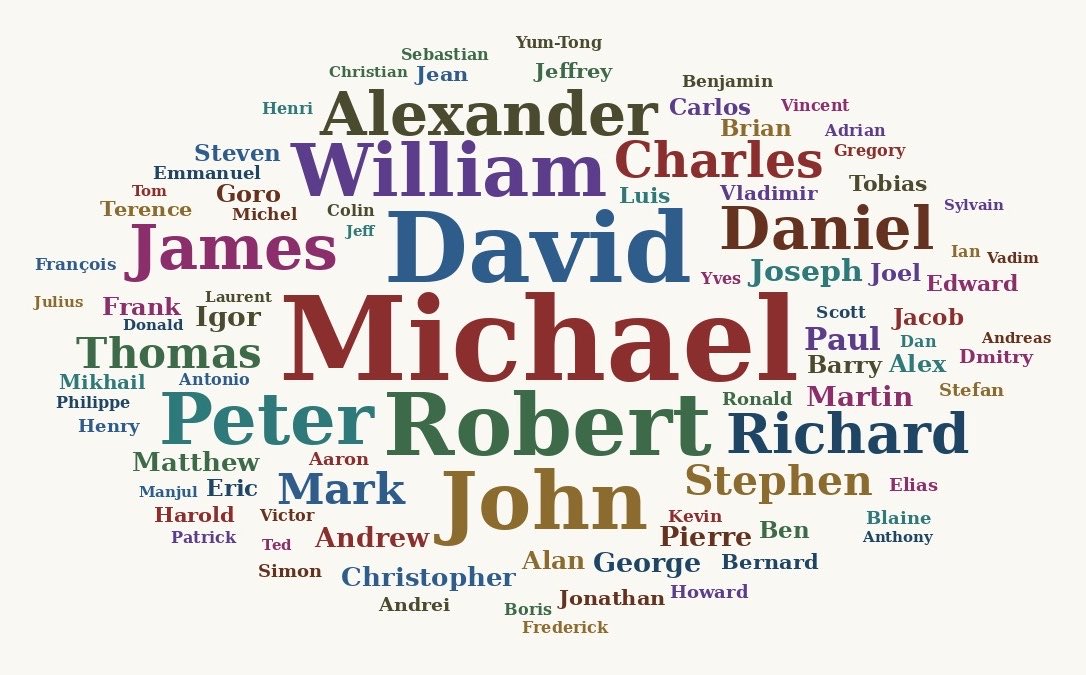
I asked Claude to generate a word cloud image based on the first names appearing in the list here (weighted by number of papers):
https://t.co/X4JW1uuZVB
The recent LLM news and achievements in math are of course impossible to ignore. However, I take every "omg what now" think piece penned by people (including mathematicians) getting paid by the involved companies with a grain of salt.
Up to oriented diffeomorphism,
- There is a unique smooth structure on the 61-sphere.
- There are exactly 24 smooth structures on the 62-sphere.
- There are exactly 142211872163171481167115958878208 smooth structures on the 63-sphere.
Up to oriented diffeomorphism,
- There is a unique smooth structure on the 61-sphere.
- There are exactly 24 smooth structures on the 62-sphere.
- There are exactly 142211872163171481167115958878208 smooth structures on the 63-sphere.
The "look and say sequence" {L[n]} goes 1, 11, 21, 1211, 111221, 312211, 13112221, ...
[Conway 1986]: Writing d[n] for the number of digits in L[n], the limit of the ratio d[n+1]/d[n] exists, and is an algebraic integer of degree 71.
The quadratic integer ring ℤ[√14] is a Euclidean domain, but 𝐍𝐎𝐓 with respect to the natural norm
N(a + b√14) := a² - 14b².
The first unconditional proof of the Euclidean-ness of ℤ[√14] was by Harper in 2004.
The maximum number of colors necessary to properly color a map drawn on a closed connected surface with Euler characteristic χ is
⌊½(7 + sqrt(49-24χ))⌋,
with a single exception: for the Klein bottle it is 6 (not 7).
The 2-sphere case is the Four Color Theorem.
@LukePaulPL In some sense, this is an "acceptable surprise" since it is essentially bootstrapped from the set bijection ℕ² ≅ ℕ.
More disturbing are the existence of rings R with R² ≇ R but R³ ≅ R !!
Given a ring R with the invariant basis number (IBN) property, every fin-gen stably free (left) R-module M has a well-defined rank r(M): whenever
R^a ⊕ M ≅ R^b
we have b – a = r(M).
[Cohn 1966]. There exists a ring R with IBN and a stably free R-module M such that
r(M) < 0.