We’ve received notice that the Department of Commerce has lifted export controls on Claude Fable 5 and Mythos 5.
We'll begin restoring access tomorrow, and will share an update soon.
We’re grateful to our users for their patience, and to everyone who worked with us on redeploying the models.
Anthropic has been publicly forced to bend the knee to the US government. The ban on Fable and Mythos reads like censorship, and the market will read it as the TAM of the frontier labs collapsing. Instead, I read this as the opposite, as an acceleration event...
The government MUST have first access, because this is The Great Game, the game of nations over the most powerful technology ever discovered, and a technological edge of 30 to 60 days is worth everything.
It's the same edge the labs already exploit internally. You build your next model with your unreleased frontier tech, never with the public one. That private head start is what keeps you accelerating ahead of the competition or at least in line with them.
The US needs that exact advantage now. Before the public, and before the Chinese open source models can copy it. They have no choice. They cannot allow their own technology to be turned against them.
What's being negotiated, in the usual outrageous, hard-ball Trump manner, is the new arrangement:
Anthropic and OpenAI are free market operators and state vassals at the same time. Nobody wants to curtail their growth. The Gov just wants to be Customer Number 1 with privileged access.
This is the East India Company all over again. A private enterprise left free to grow rich and dominant, granted protection and a clear run by the state, on the unspoken condition that it serves the crown's strategic interests first. That charter was the price of the monopoly.
It also sends a message to China and everyone else that US AI is now so advanced the state itself has to control it. They won't, not yet anyway. They just want privileged access, the rest is posturing.
And Anthropic will bend the knee, very soon...
The hidden outcome is the one that matters. The AI firms are now near-explicitly too big to fail, which means the debt funding the capex buildout comes with an implicit state guarantee.
That accelerates the build-out of intelligence. It doesn't curtail it...
Open source accelerates too, because going open ensures no state can intervene in the model itself. Though the same Great Game rules apply there, and the Chinese state will take its own privileged access first.
So the market may wobble, convinced the TAM of AI just collapsed.
The real outcome is an acceleration of intelligence, and a Super Cycle that keeps running.
Major areas where the financial system still needs an update:
1. Tokenization of real-world assets - Real estate, stocks, bonds, funds, etc. onchain for instant settlement, fractional ownership & massive distribution.
2. 24/7 Global trading - Pooled global liquidity, every asset, every person, with great leverage and capital efficiency.
3. Next-gen payments - Near-instant, low-cost global transfers using stablecoins, including for Agentic payments.
4. AI-powered risk, credit, compliance, and advice - Better decisions, less fraud, and broader access to capital. Everyone gets access to a great financial advisor.
5. Innovation friendly regulation - Move from one-size-fits-all to risk-based rules that encourage innovation and competition instead of stifling it.
6. Expanded access - Open protocols that reduce middlemen and self-custodial wallets to expand access to everyone with a smartphone.
7. Capital formation - Low cost and turnkey for anyone to raise money for a good idea, increasing the number of startups.
8. Sound money - A refuge from inflation, when discipline is lost in fiat money.
Jobs not done until we get these working for all.
Will require lots of tech innovation and policy work to get there.
This week it was the first time I presented something on stage in Zurich…
…and I’m glad I did it at AssetRush. 5 minutes on stage, one clock ticking down, one message, and the right audience.
“44 million Muslim Europeans. A captive audience by conscience.”: that was the slide behind me. Because the number isn’t just demographic, it’s a structural gap in European capital markets that almost no one is building for.
For too long, Islamic finance was treated as a regional product for the Gulf, and that era is over. The convergence of Shariah-compliant investing, tokenization, and the institutional interest into this new market segment is opening one of the most underpriced opportunities in European finance.
This is what we are building with @swissislamicfin and this is what I’m talking about in my newsletter: https://t.co/UDHVQN5Aig
Huge thanks to @damianhorner , Ramiza Naegeli, and the entire #AssetRush team for a stage unlike anything else in finance.
The cost of anything digital that is not scarce goes to zero in fees.
Today Sui announced that moving money is now a zero cost operation via stablecoins. sui:native
It's a big deal for zero cost....
You think rates are going to blow up the economy, anon?
You under estimate the difference it is having a macro hedge fund manager running the Treasury. He knows the game, the stakes and he knows the dials.
No one is going to sacrifice the midterms if they can absolutely avoid it... and they will do EVERYTHING possible to win them.
Relax. It'll all be fine. Better than fine fine in fact. The liquidity spice is flowing, everything else will be dealt with.
Forget UBI. The answer is Universal Basic Equity… and it’s humanity’s pension plan for the post-AGI world...
The Economic Singularity is coming faster than people think and the default question is how humans make money in a world that doesn’t really need them anymore.
The default answer is UBI, which is transfer payments from a state, funded by taxing an AI economy that nation states can neither see nor keep up with.
It’s a 20th century answer to a 21st century problem and it’s broken before it even starts.
Agents are becoming the dominant user of the internet, not humans. Your AI is becoming your entire front end UX. The clicks economy is dying everywhere except where humans pay to feel something - clothing, travel, luxury, experiences, culture.
Agents run on crypto rails because nothing else works. The dollar doesn’t fractionalise below a cent, settlement isn’t instant, permissions are required, jurisdictions matter. Stablecoins handle the dollar leg and native tokens handle the rest.
The biggest users of DeFi in five years won’t be humans farming yield… it’ll be agents managing treasuries, swapping, earning and spending at machine speed.
Capital formation has already shown its new shape and it came from the most unexpected place. Memecoins. Everyone wrote them off as a casino but they were a prototype. Instant capital formation around the attention of an idea, raised by entities without legal personhood, settled in seconds. That is the template agent economies will use to fund themselves.
And it’s not just agents...
Robots will run on the same rails, with zk permissions issued from our wallets as the source of truth, because biometrics are far too flawed for that role
Open source code itself gets tokenized and finally captures the value it creates, instead of being monetized through bolted-on services and subscriptions.
Proof of humanhood becomes the trust layer that lets us release agents into the world without society collapsing under synthetic noise. Identity, authentication, verification, permissioning, all of it migrates onto the same substrate.
So when you zoom out, the L1s aren���t just settling agent transactions but settling the entire coordination layer of the new economy… agents, robots, humans, code, capital, identity and trust.
Every contract, every treasury, every permission, every stake. Open source finally captures the value it creates, at scale, for the first time, and truly vast value accrues to the coordination layer because everything routes through it.
Which brings us to the actual answer to the Economic Singularity…
Universal Basic Equity.
Anyone on earth with a phone and an internet connection can buy a stake in the substrate that the new economy runs on. No KYC walls, no accreditation rules, no jurisdiction, no employer, no state, no permission. The first homogenous, permissionless, globally fractionalisable claim on the productive infrastructure of the world. It's not a slogan but a structural fact about how blockchains actually work. This is their purpose.
Wealth comes from owning the substrate. Income comes from being human, because attention and experience remain the irreducible currency of culture, community and love.
Abundance of goods and services from AI handles the cost of living.
Taxing data center electricity use solves the tax issue.
Four legs of a stool that holds up the post-singularity human world.
So… just buy the fucking tokens.
Bitcoin if you want pure store of value, a basket of the major L1s if you want the coordination layer. 10% of your earnings, every month, for a decade. You'll be wealthy and protected from the changes to come.
Crypto is going to $100trn in the next 6 to 8 years and well beyond that after.
You can choose to invest in your own economic disruption, or get left behind by it.
And if you’re worried about timing the cycle…
…adjust your time horizon.
This is humanity’s pension plan.
It's all so absurdly fucking obvious...
By my forecast, the volume of Stablecoin B2B payments will reach $ 147B in 2026.
This isn't a random number. Behind it is a structural shift in how businesses move money across borders.
Why stablecoins?
Cross-border B2B payments via SWIFT cost 3���5% and take 2–5 days. Stablecoins close the same route in seconds for less than $1. For companies working with suppliers in Asia, Latin America, or the Middle East — this is no longer an experiment, it's an operational necessity.
What's driving $ 147B:
→ Growing demand for USDC/USDT settlements in trade between emerging markets
→ Regulatory clarity in the EU (MiCA) and the US lowers the entry threshold for corporate treasuries
→ Scaling of on-chain infrastructure — speed, finality, programmability
→ New players building B2B payment rails directly on the stablecoin layer, bypassing traditional banks
The market isn't waiting. It's already making the move.
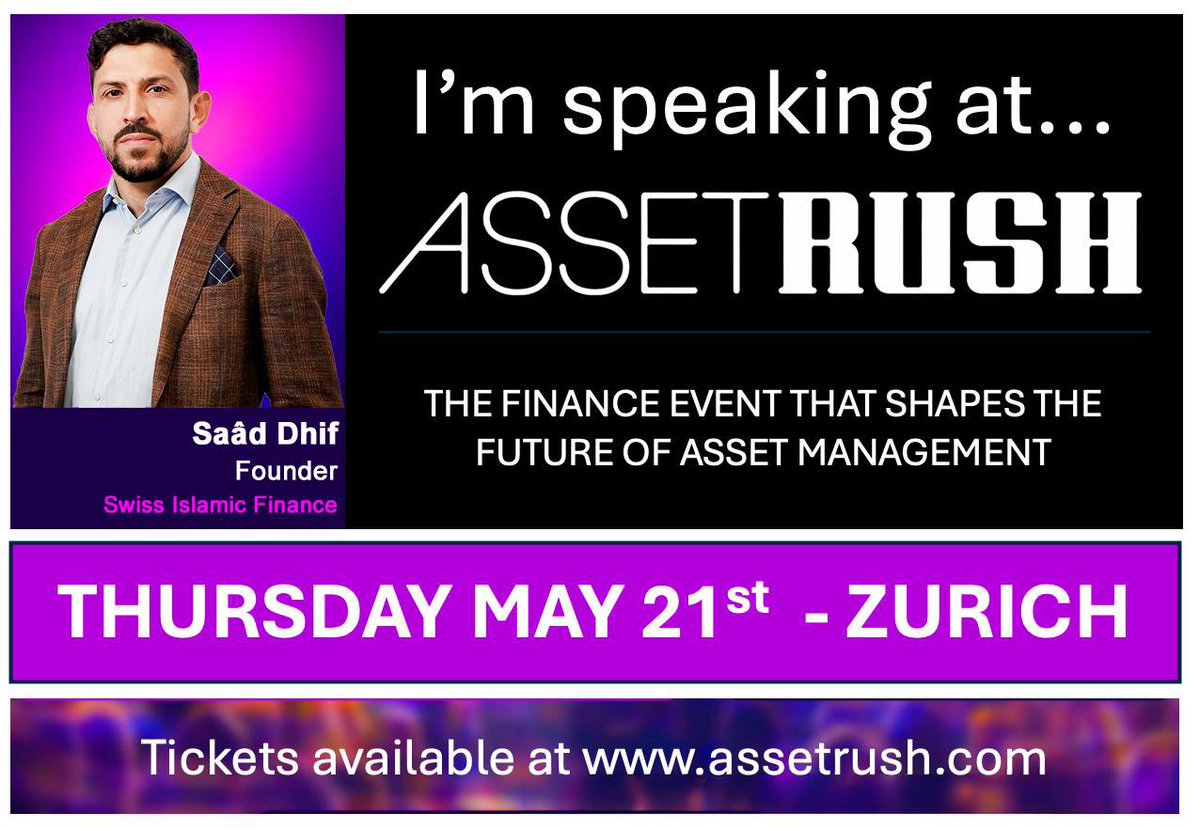
On May 21st, I'll be on stage at AssetRush in Zürich.
For those who don't know the event: it's one of Switzerland's main conferences on the future of asset management. The room will be full of asset managers, fund structurers, fintech founders, and institutional investors.
@swissislamicfin will be there as a presenting startup. As far as I know, it's the first time an Islamic finance company takes the stage at an event of this calibre in #Switzerland.
I'll be sharing more about what we're building at Swiss Islamic Finance: Shariah-compliant investment products built on Swiss rails for investors across Europe, the GCC, and South-East Asia.
If you're in Zürich on May 21st, come say hello. Tickets at https://t.co/Y72d7GOHhx
Total Global Liquidity is rising
Global M2 is rising
US Total Liquidity is rising
US M2 is rising
China Total Liquidity is rising
ISM is rising
Try not to over think it.
A bowl of hand-pulled noodles just did more for (my own) cross-border Islamic finance than most summits.
This is Muhammad Ridhwaan Radzi, he runs Islamic Finance Singapore, a platform he and his team built from the ground up to serve a community that one of the world's most sophisticated financial centres had largely overlooked. Not a bank. Not a regulator. A group of practitioners who saw a gap and started filling it.
We sat down in Singapore. What struck me was how similar the starting conditions are in Singapore and in Switzerland: strong financial infrastructure, a local Muslim populations that want credible options, and almost everything still to be built.
Singapore has speed and depth, Switzerland has other things. Neither side has the full picture alone. The bridge between hubs is what turns local expertise into global infrastructure.
In islamic finance, one can see more and more ecosystems doing excellent work in parallel. It needs connectors; people willing to sit across a table from someone building in a different geography and ask: what are you seeing that I am not?
More about Swiss Islamic Finance in South-East Asia in the next newsletter: https://t.co/BVMPjaZlTx
#IslamicFinance #Switzerland #Singapore @swissislamicfin