I’ve been following the conversations around the recent @binance security incident
And after watching @_RichardTeng latest interviews with Fox and CNBC 👇🏻
I think there’s a much bigger discussion here than just one security incident
It’s about:
how quickly cyber threats are evolving
how platforms respond when things go wrong
and what the entire crypto industry needs to do to protect users.
Richard openly acknowledged that this incident should not have happened and apologized to users.
He explained that it was a highly sophisticated, multi-month attack attributed by the FBI to North Korea, involving fake recruitment interviews, malicious software disguised as developer tools and AI techniques.
A few things from his interviews really caught my attention.
1 - Accountability and protecting users come first
Binance has taken responsibility for the full financial impact of the incident.
According to Richard:
More than 100% of the affected amount was set aside
98% of the impacted assets have already been replenished
The remaining 2% involves less-liquid tokens being procured through OTC arrangements to avoid disrupting market prices
Users can independently verify their balances through Binance’s Proof of Reserves.
He also explained that withdrawals have resumed and activity has returned to normal levels.
2 - Security improvements are already underway.
Binance has closed all identified entry points used in the attack and rebuilt or replaced affected systems.
Additional measures include:
Tighter device controls.
Enhanced wallet-service risk controls.
Expanded AI-powered anomaly detection.
I think this is particularly important because security cannot remain static when attackers are constantly finding new ways to get around existing systems.
3 - The threats go beyond one incident.
Another detail worth highlighting is that Binance detected and prevented 57 other suspected cyberthreat cases linked to North Korea this year.
That’s a reminder of how persistent and sophisticated these threats have become.
4 - Recovery requires collaboration.
Approximately $2.85 billion has been frozen or intercepted through cooperation with law enforcement, issuers and blockchain intelligence firms.
What stands out here is the speed of coordination across different organizations. Richard highlighted how difficult it would be to match this kind of coordination speed in traditional finance.
5 - AI is accelerating cyberattacks.
This was probably one of the most interesting parts of the interviews for me.
Richard described how attack frequency has escalated from one hack a month, to one a week, and even four exchanges in a single day.
AI is compressing attack timelines and making attacks increasingly sophisticated.
That changes the entire cybersecurity landscape.
6 - AI-powered defence is becoming essential.
One message from Richard was particularly clear:
The only defence that can scale against AI-powered attacks is AI-powered security.
Crypto companies need to:
Work more closely with leading AI and cybersecurity companies.
Invest in more security engineers.
Adopt advanced AI security tools.
Build AI-powered security directly into their infrastructure.
The industry needs defences that can operate at the same speed as the threats it faces.
My personal takeaway 👇🏻
I don’t think security is something any crypto platform can ever afford to become comfortable with.
Incidents like this are serious, and accountability matters.
But so does what comes afterward: protecting users, being transparent, learning from mistakes and making meaningful improvements.
I also appreciate the importance of sharing detailed incident reports so that the wider industry can learn and strengthen its own security.
The crypto ecosystem is growing, but the threats are growing with it.
We need to make sure security keeps pace.
$BTC is facing some selling pressure, and market sentiment looks weak right now
But this is also a reminder that markets don’t always move in one direction. Interest rates, liquidity, and ETF outflows can affect short term prices
I believe it’s important to stay calm and look at the bigger picture.
Short-term fear comes and goes
But Bitcoin’s long-term journey is still worth watching.
GM
Why are crypto prices down?
No one knows for sure. Correlation does not prove causation. Here are some potential reasons.
Money shifting to the Anthropic IPO: https://t.co/4WXOMfH9Th
ETF outflows: U.S. spot Bitcoin ETFs saw about $1.9 billion in outflows over seven trading sessions through November 13. Ether funds also saw withdrawals. https://t.co/RxhYaaOMAU
Security fears: the Binance hack, iPhone-linked crypto wallets drained, Chrome exploit, Microsoft down. These security incidents could make some people less willing to keep funds in crypto.
Hot U.S. inflation has raised expectations of another Fed rate hike. Higher yields and a stronger dollar can weigh on "riskier assets" such as crypto.
Political uncertainty: Midterm results have raised concerns about potentially stricter U.S. crypto policy.
No, Binance did not sell crypto.
I bought crypto in the past few days, as I got some stablecoins recently. (maybe this is the cause 🤣)
Mid-long term, crypto will continue to grow.
Views are my own. Not financial advice.
For future reference, price of BTC hit a low of $62,006 today.
But there’s a difference between investigating an allegation and presenting speculation as fact.
Binance’s business depends on liquidity, trading activity, user confidence and the long-term health of its ecosystem.
A deliberate market-wide dump would carry serious commercial and reputational consequences.
Also, sourcing replacement tokens through market or OTC channels to cover assets affected by a security incident is not the same as dumping tokens into the market.
If someone claims Binance caused this sell-off, let’s see the actual wallet transactions, verified market-selling activity, timestamps and evidence connecting those movements to the price decline.
That’s a much more meaningful discussion than repeating accusations.
My point is simple.
We have several things happening simultaneously:
Significant U.S.-related BTC selling pressure.
Major institutional Bitcoin sales by miners like MARA.
Changing corporate treasury and capital-allocation strategies.
ETF flows and broader investor positioning.
Geopolitical uncertainty and interest-rate expectations.
Tightening liquidity and higher funding costs.
A changing AI investment narrative and competing capital demands.
Why would we ignore all these factors and reduce an entire market correction to one convenient explanation?
I’m not asking anyone to blindly trust Binance.
I’m asking people to apply the same standards of evidence to every institution, every exchange and every market participant.
Crypto needs transparency. It needs accountability. But it also needs a community willing to look beyond headlines.
Follow the money.
Check the data.
Question the narratives.
Not everything is FUD, but not every accusation is a fact either.
Let’s have conversations based on evidence, not emotions.
I’ve been seeing a lot of discussion lately about @binance supposedly dumping tokens to cover losses and triggering the broader crypto market decline.
Honestly, I think we’re too quick to find someone to blame whenever the market turns red.
Before accepting that narrative, I’d rather step back and look at what’s actually happening across the market.
Because there are some important numbers and developments that I don’t think we’re discussing enough.
Let’s start with the actual selling pressure 👇🏻
There are indications that significant BTC selling pressure is coming from U.S. market activity.
That’s an important part of the picture, and it deserves attention instead of automatically pointing fingers at Binance.
And then there’s MARA Holdings.
I think its recent activity tells us quite a lot about the institutional selling taking place in this market.
According to MARA’s Q3 2026 shareholder letter:
13,597 BTC sold after September.
Approximately $1.1 billion generated from those sales.
Average selling price of approximately $81,039 per BTC.
$750 million used to fully repay Bitcoin-backed loans.
17,477 BTC released from collateral after repayment.
Approximately 26,984 BTC already sold during the first nine months of 2026, generating around $1.9 billion.
And here’s something worth thinking about:
MARA mined just 2,247 $BTC during Q3, yet sold approximately six times that amount in the following six weeks.
That’s substantial institutional selling.
But why is MARA doing this?
Because its business strategy is changing.
The company is moving beyond simply accumulating Bitcoin and is increasingly monetizing its treasury to fund growth, reduce debt and invest in AI and digital infrastructure.
Look at some of its other numbers:
Q3 revenue fell 35% to $164.2 million, compared with $252.4 million a year earlier.
Q3 net income reached $632.1 million, including approximately $884.3 million in Bitcoin fair-value gains.
Adjusted EBITDA reached $857.7 million, also substantially influenced by fair-value gains.
MARA reduced its total debt by $1.4 billion, or 37%, during 2026.
Its board authorized up to $500 million in share repurchases.
The AI transition is another major part of this story.
MARA is pursuing the Long Ridge acquisition, involving a power facility authorized to sell 485 MW of electricity.
It also has development rights to a Texas site with potential capacity of up to 2 GW.
The company is targeting two new data-center leases before year-end, although negotiations could extend into 2027.
In other words, we’re watching a major Bitcoin miner sell accumulated BTC, repay debt and redirect capital toward AI infrastructure.
These are real institutional decisions, and they matter when discussing market supply.
Now, let’s look beyond crypto.
The macroeconomic environment isn’t making things any easier.
Geopolitical tensions, including Israel-related and U.S.-related developments, are weighing on investor confidence.
Higher interest-rate expectations and tightening liquidity can increase funding costs and reduce appetite for risk assets.
When investors become defensive, Bitcoin is affected alongside technology stocks and other speculative investments.
There’s also the AI narrative to consider.
The market is becoming more conscious of the enormous capital requirements behind AI infrastructure.
Companies like Anthropic are attracting significant financing, and large funding rounds and potential IPOs can influence how institutional capital is allocated.
I’m not claiming that Anthropic or AI financing directly caused Bitcoin’s decline. That would require actual capital-flow evidence. But the wider liquidity and capital-allocation picture deserves attention.
AND NOW BACK TO BINANCE 👇
I don’t believe any exchange should be above scrutiny.
If Binance has engaged in improper market activity, the evidence should be examined.
This is the kind of real world adoption the crypto industry needs
A Japan listed company bringing $BNB directly into its shareholder benefits program
It’s a significant step toward bridging traditional finance and Web3
What’s even more exciting is the bigger vision:
The tokenizing Japanese real estate through RWA on @BNBCHAIN , bringing real-world assets on-chain and opening new opportunities for investors
No lottery
No hype
Only promises
A structured shareholder distribution backed by a company’s participation in the BNB ecosystem
Markets may be bleeding, sentiment may be weak, but innovation doesn’t stop.
While others panic, builders keep building.
Japan is making moves.
Traditional businesses are exploring blockchain.
And BNB Chain continues expanding its real-world utility.
This is how adoption happens:
One real-world use case at a time.
The future isn’t just about holding crypto
It’s about bringing the real world on-chain.
GM 💛
Japan's first, world's first!
Japan-listed ASIAN STAR to distribute ¥8 million worth of BNB to eligible shareholders and tokenize Japanese real estate on BNB Chain.
More ways for traditional businesses and their shareholders to participate in crypto. 🔶
The market is a bloodbath, but builders build...
This is what taking responsibility looks like 🫶🏻
@Binance has confirmed that it has completed coverage of all assets impacted by the security incident
And has now published a fresh Proof of Reserves snapshot
But here’s the part I really appreciate:
Once the zero-knowledge proof is generated, users will be able to independently verify that their assets are backed at a minimum of 1:1
Incidents can happen, even in the biggest platforms.
What matters is how a company responds, protects its users, and rebuilds confidence.
Respect to the @binance team for prioritizing user protection and transparency. 🤝
@cz_binance respect.
Binance has completed coverage of assets impacted in the security incident and we have published a new Proof of Reserves snapshot. Once the zero-knowledge proof is generated, users can independently verify that their assets are backed at a minimum of 1:1 - https://t.co/2cKzTtWddW.
To our users and community: thank you for your patience and understanding.
Bangkok is slowly becoming one of the places I’ll have my eyes on this November
@binance has just announced the first wave of speakers for Binance Blockchain Week 2026
And honestly, there’s a really interesting mix of people coming together this time.
A few names immediately caught my attention:
→ @cz_binance, Arthur Hayes, @_RichardTeng and @heyibinance
→ Leaders from BlackRock, Franklin Templeton, Visa, Tether and Mirae Asset Securities
→ Representatives from Ondo Finance, PayPay, @BNBCHAIN and Alpaca
→ Policymakers from Kazakhstan and Bhutan
→ Research and data voices from Nansen, Kaiko, CoinDesk, Coin Bureau and DeFiLlama
Binance leadership will also be represented across product, trading, payments, compliance and institutional business.
What I personally find interesting is the range of perspectives this brings together.
Crypto and traditional finance are getting closer
And conversations around institutional adoption, regulation, tokenization, real-world assets and digital payments are becoming more relevant than ever.
It’s good to see these different sides of the industry sharing the same stage.
🔻 Bangkok, Thailand
Queen Sirikit National Convention Center
November 28–29, 2026
The theme this year is Evolve and this is only the first wave of speakers.
I'm so ready for this
Anyone planning to be in Bangkok?
See you all there
🎟️ Tickets: https://t.co/u0bOBny94G
🫶🏻
This is a serious milestone for the RWA space
👏
Taking a $125B Saudi SME credit market onchain with institutional players like Laser Digital involved shows how quickly the gap between TradFi and DeFi is closing.
What makes this interesting is the actual utility behind it
Capital isn’t just moving around in crypto, it’s being connected to real businesses and real financing needs.
More real-world adoption → more utility for the ecosystem.
That’s the direction we need to see
LFG.
@ZIGFinance@ARafayGadit
Introducing zEMS.
Saudi SME private credit onchain, launched with @LaserDigital_, Nomura’s digital assets subsidiary, as risk framework advisor.
Saudi SMEs face a financing gap of more than $80 billion. zEMS opens a new onchain access point to that market: a diversified pool of Saudi SME financing, delivered as a single token on @BNBCHAIN.
Saudi Arabia is the first market.
Something interesting is happening at the intersection of crypto and traditional finance
And I think we’re starting to see where things could go 👇🏻
For years, bringing traditional assets on-chain was mostly a conversation about potential
Now, the numbers are showing that people are actually embracing it
Just look at what’s happening:
• Tokenized equities have reached a record $4.8B in AUM, up 164% since June
• Binance bStocks crossed $1.5B in just 145 days, reaching a 31.4% market share and becoming the largest issuer by AUM
• 56% of bStocks trading volume happens outside regular US market hours
• Eligible investors can access fractional exposure to US equities starting from just $5
• Every token is backed 1:1 by real shares and ETFs, with reserves reconciled and published daily for anyone to verify
Another interesting detail: users now hold over $3B in traditional financial assets across Direct Stocks and bStocks on @binance
What I find particularly interesting isn’t just the growth.
It’s what these numbers say about changing investor behavior.
People want more flexibility, easier access to global markets, and the ability to interact with traditional assets beyond the usual market schedule.
Of course, tokenized equities are still a small part of the overall stock market.
We’re still early, but the direction is worth watching ngl 💛
@bstocksfinance
BNB Chain isn’t slowing down
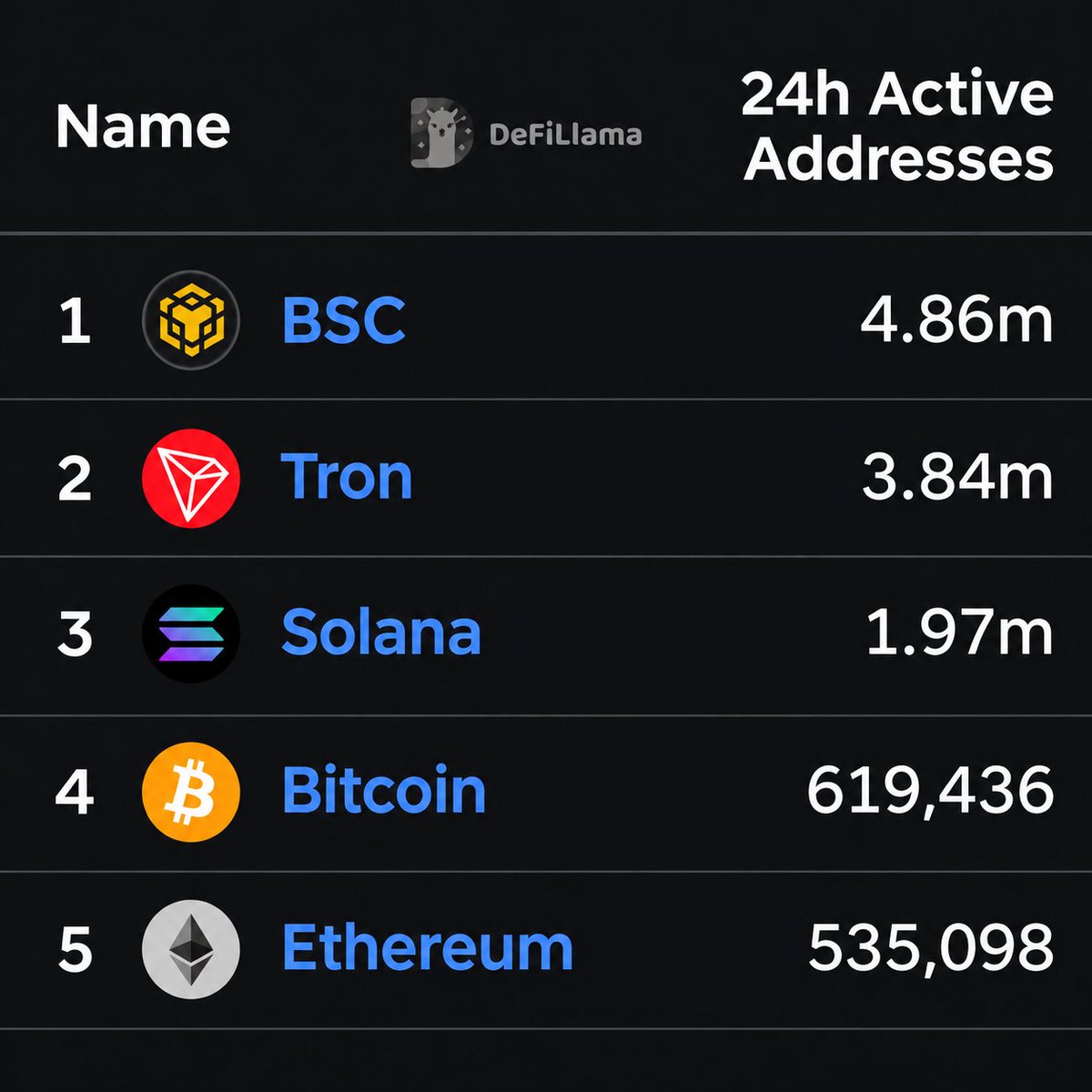
With 4.86M active addresses in just 24 hours
@BNBCHAIN is leading the entire network rankings by over 1M addresses ahead of its closest competitor
Strong on-chain activity, growing adoption, and a thriving ecosystem.
The numbers speak for themselves.
BNB continues to show why it’s a major player in Web3. 💛
GM.
BNB Smart Chain recorded 4.86M active addresses in 24 hours, taking the top spot in the ranking 🥇
Over 1M addresses ahead of the next network in the snapshot.
Source: @DefiLlama
One thing I strongly believe is that trust is built when investors know their capital isn’t just going in
But also how they can get it back when the time comes
That’s why liquidity deserves much more attention in the tokenization conversation.
It’s not just about bringing assets on-chain it’s about building something investors can genuinely feel confident being part of.
Looking forward to hearing this conversation at the Tokenisation Leaders Summit in London
And 11.11 is another big thing loading
See you all there 💙
Investors commit capital when they know how they will get it back. For tokenized products, that means liquidity has to be designed in before launch.
Our co-founder @ARafayGadit joins @Grayscale and @Elysium_Tech at @KAIO_xyz’s Tokenisation Leaders Summit in London on 11 November to discuss what investors want from tokenized products.
What stands out about @BNBCHAIN latest developments is the focus on building infrastructure
And that can support the next phase of blockchain adoption
There are three important takeaways:
🔹 Stronger infrastructure:
Continued BSC upgrades are laying the groundwork for more reliable on-chain activity.
🔹 Greater utility:
Better payment execution and token management capabilities open up new possibilities for developers and applications.
🔹 Long-term vision:
The development of a new L1 alongside BSC demonstrates a commitment to scaling the ecosystem beyond immediate demands.
The real value of these advancements lies in what they make possible for the builders, businesses, and users who will shape the ecosystem.
Sustainable growth comes from building the right foundations
Not simply chasing the next milestone. 💛
There’s plenty to look forward to across BNB Chain, from the new L1 in development to continued upgrades on BNB Smart Chain (BSC).
Jenner is now on BSC testnet, bringing changes to payments, app timing and token tools.
Here’s what you need to know 🧵 👇
I think BNB Chain’s new L1 has a lot of potential.
But what matters most is how it delivers in real-world usage.
I’d love to see a strong focus on:
Scalability
Lower transaction costs
Smooth developer onboarding
And better support for the growing ecosystem.
One thing I’d really like to know is how this new L1 will complement the existing @BNBCHAIN rather than fragmenting liquidity and users across multiple networks.
The technology is important.
But long-term adoption, real utility, and a strong community will ultimately make the difference.
This is a huge milestone for @BNBCHAIN 💛
949 million addresses and counting
Almost 1 billion!
What really caught my attention is the pace of growth.
More than 587K new addresses in just 24 hours.
That’s incredible to see.
BNB Chain is getting closer to joining Bitcoin as the second blockchain to reach this historic milestone
And there’s more to this than just a big number. Behind this growth is an expanding ecosystem of developers, users, applications, DeFi, gaming, and real on-chain activity.
I love seeing how far the ecosystem has come.
The progress speaks for itself, and being this close to 1 billion feels like a special moment for the entire BNB community.
One billion is almost here.
@cz_binance@heyibinance@binance
This is the kind of growth I love to see 🔥
Gold and Forex onchain opens up a whole new level of opportunities.
What makes Meridian interesting is its long/short approach, meaning it doesn’t have to rely on markets only going up to find opportunities.
70% Gold
30% FX
Curated by ZIG Markets
Now live on Valdora
More ways to trade
More opportunities for users
More potential value flowing back into the $ZIG ecosystem
LFG 👏
Gold has been the trade of the year. Meridian brings a new way to access it on Valdora.
Curated by ZIG Markets, Meridian is a systematic long short strategy with a current allocation of 70% gold and 30% FX. It takes positions in both directions, seeking opportunities as markets rise and fall.
An active approach to gold and FX. Now accessible onchain through Valdora.
https://t.co/WvWGdrAgyx
October had some serious highlights for @BNBCHAIN
2M+ RWA holders
$25.6B in tokenized equity trading
$75.7B in spot DEX volume
And a $1.197B $BNB burn.
Not to mention new integrations, growing adoption, and builders pushing the ecosystem forward.
A lot happened in just one month.
$BNB Chain keeps delivering 💛
October was a busy month at BNB Chain. So if you missed anything, there's a lot to catch up on.
With new integrations, ecosystem milestones and builders bringing more of their ideas to life.
If you missed a few updates along the way, this thread is for you 🧵 👇
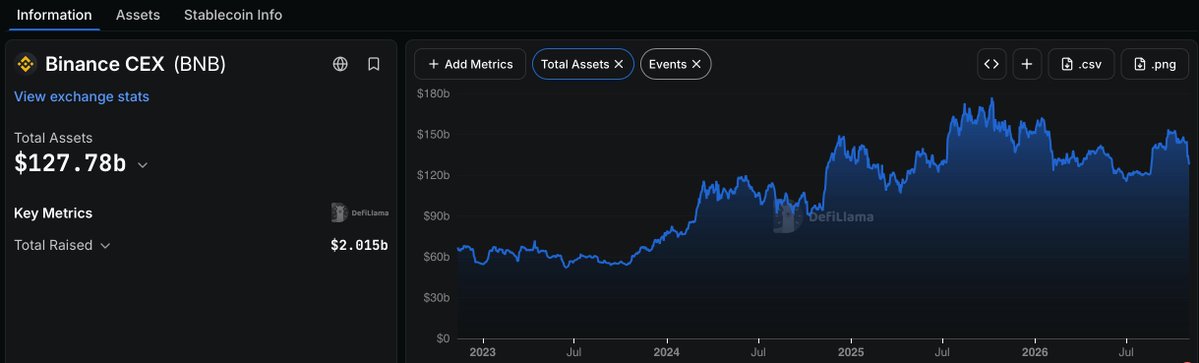
Everyone was quick to criticize Binance and make a big deal out of the situation.
But now look at the numbers.
Outflows are down by over 50%, deposits are recovering, and things are getting better.
Where is all that noise now?
Sometimes it’s better to wait and see before judging.
@binance@cz_binance 🫶🏻
I’ve been following the conversations around the recent @binance security incident
And after watching @_RichardTeng latest interviews with Fox and CNBC 👇🏻
I think there’s a much bigger discussion here than just one security incident
It’s about:
how quickly cyber threats are evolving
how platforms respond when things go wrong
and what the entire crypto industry needs to do to protect users.
Richard openly acknowledged that this incident should not have happened and apologized to users.
He explained that it was a highly sophisticated, multi-month attack attributed by the FBI to North Korea, involving fake recruitment interviews, malicious software disguised as developer tools and AI techniques.
A few things from his interviews really caught my attention.
1 - Accountability and protecting users come first
Binance has taken responsibility for the full financial impact of the incident.
According to Richard:
More than 100% of the affected amount was set aside
98% of the impacted assets have already been replenished
The remaining 2% involves less-liquid tokens being procured through OTC arrangements to avoid disrupting market prices
Users can independently verify their balances through Binance’s Proof of Reserves.
He also explained that withdrawals have resumed and activity has returned to normal levels.
2 - Security improvements are already underway.
Binance has closed all identified entry points used in the attack and rebuilt or replaced affected systems.
Additional measures include:
Tighter device controls.
Enhanced wallet-service risk controls.
Expanded AI-powered anomaly detection.
I think this is particularly important because security cannot remain static when attackers are constantly finding new ways to get around existing systems.
3 - The threats go beyond one incident.
Another detail worth highlighting is that Binance detected and prevented 57 other suspected cyberthreat cases linked to North Korea this year.
That’s a reminder of how persistent and sophisticated these threats have become.
4 - Recovery requires collaboration.
Approximately $2.85 billion has been frozen or intercepted through cooperation with law enforcement, issuers and blockchain intelligence firms.
What stands out here is the speed of coordination across different organizations. Richard highlighted how difficult it would be to match this kind of coordination speed in traditional finance.
5 - AI is accelerating cyberattacks.
This was probably one of the most interesting parts of the interviews for me.
Richard described how attack frequency has escalated from one hack a month, to one a week, and even four exchanges in a single day.
AI is compressing attack timelines and making attacks increasingly sophisticated.
That changes the entire cybersecurity landscape.
6 - AI-powered defence is becoming essential.
One message from Richard was particularly clear:
The only defence that can scale against AI-powered attacks is AI-powered security.
Crypto companies need to:
Work more closely with leading AI and cybersecurity companies.
Invest in more security engineers.
Adopt advanced AI security tools.
Build AI-powered security directly into their infrastructure.
The industry needs defences that can operate at the same speed as the threats it faces.
My personal takeaway 👇🏻
I don’t think security is something any crypto platform can ever afford to become comfortable with.
Incidents like this are serious, and accountability matters.
But so does what comes afterward: protecting users, being transparent, learning from mistakes and making meaningful improvements.
I also appreciate the importance of sharing detailed incident reports so that the wider industry can learn and strengthen its own security.
The crypto ecosystem is growing, but the threats are growing with it.
We need to make sure security keeps pace.
We can really feel how much the space has evolved over the past year
100+ institutions
$100M+ capital at work
And now another major gathering in Dubai
@ZIGFinance 🙏
And I think that’s why gatherings like ZIG Summit matter
The conversations happening today could shape how capital moves tomorrow.
LFG.
ZIG Summit 2027 returns to Dubai on March 25.
Finance has a new address. Allocators, institutions and builders, all in one room.
Hosted by ZIG Finance. Nothing compounds alone.
Spots are limited. Apply to attend: https://t.co/lqtPxZ3dMO