Like a personal “skeleton key,” the cipherracket gives you a framework to decode everything: systems of control, religion, politics, even spiritual manipulation
Transparency Statement
- Questioning systems, language, and incentives is a protected form of public discourse. This project exists to increase understanding and public literacy; not to replace professional medical care or individual clinical judgment.
Context Statement
- This post examines how PTSD, anxiety, and depression are commonly explained, labeled, and treated, and how language choices can shape outcomes. The focus is on patterns, incentives, and communication; not on providing medical advice, diagnosis, or treatment.
Cipherracket Notice
- Cipherracket is a term used here to describe recurring patterns in which authoritative or technical language obscures meaning, narrows interpretation, and limits agency. This is a critique of systemic communication practices, not an allegation against individuals or professions.
PTSD isn’t being misunderstood by accident. It’s being softened, split, and relabeled until it no longer threatens the system that created it.
PTSD is widely under-recognized, not rare
- PTSD isn’t just “war trauma.” It can come from:
- Chronic stress (poverty, unsafe housing, medical neglect)
- Ongoing threat (job insecurity, violence, instability)
- Repeated loss, betrayal, or helplessness
- Long-term exposure to fear without recovery time
- Many people don’t have a single dramatic event; they have years of unresolved nervous-system overload. Clinically, this often shows up as C-PTSD (complex PTSD), which is frequently misdiagnosed as:
- Anxiety disorders
- Major depression
- Panic disorder
- ADHD
- Somatic symptom #disorders (a mental health condition characterized by intense, excessive distress over physical symptoms)
- That mislabeling matters, because the treatments are different.
PTSD Can Drive Real, Physical Illness
- This isn’t just psychological theory, there’s strong biological backing:
- Chronic trauma keeps the body in fight-or-flight
- Cortisol and #adrenaline stay elevated
- Immune function becomes dysregulated
- Inflammation rises
- Sleep architecture breaks down
- Gut and cardiovascular systems are affected
- Over time, this contributes to:
- Autoimmune conditions
- Chronic pain
- Migraines
- IBS
- Heart disease
- Metabolic disorders
- Fatigue syndromes
- So when people say “stress makes you sick,” #PTSD is often the mechanism, not just “stress.”
Why anxiety/depression become the default labels
- From a systems perspective:
- Anxiety/depression are symptom labels, not root causes
- They’re easier to diagnose in 10 minutes
- They don’t require confronting systemic harm, abuse, or injustice
- They keep responsibility individualized instead of structural
- PTSD, on the other hand, forces uncomfortable questions:
- What happened to this person?
- Who or what failed them?
- Why hasn’t safety been restored?
- Modern systems prefer to medicate distress rather than decode its origin.
“We’re all stressed from past events” yes, and here’s the key part
- What’s different today isn’t just stress, it’s unprocessed stress with no recovery window.
- Historically:
- Trauma happened → community support → meaning-making → recovery
- Now:
- Trauma happens → keep working → stay productive → stay online → no resolution
- The nervous system never gets the signal: “It’s over. You’re safe.”
- That’s not weakness. That’s biology.
- Large portions of the population are living with unresolved #trauma physiology, whether or not they meet formal PTSD criteria.
- That statement is hard to argue with and it aligns with neuroscience.
The Uncomfortable Truth
- A society that never allows people to feel safe cannot be healthy; physically or mentally.
Anxiety ≠ fear
- What people call anxiety is often misunderstood as #fear, when at the nervous-system level it’s really arousal. Fear is just one interpretation of that arousal.
- Anxiety = nervous-system activation
- At the biological level:
- Increased heart rate
- Heightened attention
- Adrenaline release
- Energy mobilization
- That same state can be experienced as:
- Excitement
- Anticipation
- Nervousness
- Fear
- The difference is meaning, not chemistry.
- Example:
- When your favorite team scores and you cheer, that’s anxiety too and it feels good.
- The body doesn’t label it. The story does.
The Nervous System doesn’t know “good” or “bad”
- It only knows:
- Low arousal (rest, shutdown)
- High arousal (mobilize, act)
- The brain then assigns:
- Threat → fear
- Opportunity → excitement
- Uncertainty → anxiety
- Same fuel. Different narrative.
- This is why:
- Skydiving can feel euphoric
- Public speaking can feel terrifying
- Competition can feel alive or overwhelming
- Same system. Different context.
Where #anxiety becomes a problem
- Anxiety turns pathological not because it’s uncomfortable, but because:
- It’s chronic
- It lacks resolution
- It’s paired with loss of control
- It’s misinterpreted as danger when it isn’t
- In healthy systems:
- Activation → action → release → recovery
- In modern life:
- Activation → suppression → rumination → exhaustion
- That’s where it curdles into suffering.
Why PTSD changes anxiety’s “flavor”
- Here’s the critical distinction:
- Healthy anxiety/excitement: “Something important is happening.”
- Trauma-linked anxiety: “Something important happened and it wasn’t safe.”
- PTSD poisons arousal by attaching it to memory instead of possibility.
- So the same activation that once felt like joy now feels like a threat.
Depression as the aftermath
- When activation becomes unbearable or endless, the system does the only thing it can:
- It shuts down
- Depression isn’t the opposite of anxiety: it’s often what comes after chronic activation without relief.
A cleaner, more accurate model
- If you want language that avoids confusion and stigma:
- Arousal = nervous-system energy
- Anxiety = arousal without clear outlet
- Fear = arousal + perceived threat
- Excitement = arousal + perceived reward
- PTSD = arousal hijacked by memory
- Depression = arousal collapsed
- That model holds up biologically.
Why this matters
- When we teach people:
- “Anxiety is bad, fear-based, and pathological”
- we:
- Teach them to fear their own activation
- Create secondary anxiety about anxiety
- Miss the body’s intelligence
- Medicate away energy instead of integrating it
- This framing restores something important:
- Activation isn’t the enemy. Disconnection is.
The Human Arousal State Map
(No diagnoses. No judgment.)
Core Axis
Arousal = nervous-system energy
Low ←───────────────→ High
Shutdown Mobilization
STATE 1: LOW AROUSAL — Conservation
(Often labeled “#depression”)
Nervous System
- Dorsal vagal dominance
- Energy withdrawal
- Metabolic slowdown
Lived Experience
- Heaviness
- Numbness
- Fatigue
- Reduced motivation
- Time feels slow or meaningless
Function (why it exists)
- Preserve life when effort feels unsafe or futile.
- This is not failure. It’s a biological retreat.
STATE 2: MODERATE AROUSAL — Engagement
(Often invisible because it works)
Nervous System
- Balanced autonomic activity
- Flexible arousal up and down
- Quick recovery
Lived Experience
- Focus
- Curiosity
- Presence
- Calm energy
- Emotional range
Function
- Explore, connect, create
- This is regulation; not calmness, but flexibility.
STATE 3: HIGH AROUSAL — Mobilization
(Often labeled “anxiety”)
Nervous System
- Sympathetic activation
- Adrenaline-driven
- Attention narrows
Lived Experience
- Excitement
- Anticipation
- Urgency
- Passion
- Nervousness
Function
- Prepare for action
- This state fuels:
- Competition
- Joy
- Sexuality
- Creativity
- Courage
- High arousal is not a problem, being trapped here is.
STATE 4: UNBOUND AROUSAL — Overload
(Often medicated)
Nervous System
- Sustained sympathetic dominance
- No discharge
- Cortisol dysregulation
Lived Experience
- Restlessness
- Insomnia
- Irritability
- Racing thoughts
- Emotional volatility
Function
- System searching for resolution
- This is energy with no exit.
STATE 5: TRAUMA-LOOPED AROUSAL
(Often labeled “PTSD”)
Nervous System
- Memory-driven activation
- Amygdala override
- Prefrontal suppression
Lived Experience
- Triggers
- Flash emotions
- Dissociation
- Sudden fear or rage
- Body reacts before thought
Function
- Prevent past danger from recurring
- The system is not broken.
- It is “protecting” using outdated information.
STATE 6: COLLAPSE AFTER OVERLOAD
(Often returns as “depression”)
Nervous System
- Emergency shutdown
- Energy conservation after failure to resolve threat
Lived Experience
- Emptiness
- Withdrawal
- Hopelessness
- Loss of pleasure
Function
- Stop the system from burning out completely
- This is the aftermath of chronic high arousal.
The Flow (this matters most)
Healthy flow:
Arousal ↑ → Action → Release → Rest → Meaning
Modern flow:
Arousal ↑ → Suppression → Rumination → Overload → Collapse
- That’s the illness generator.
Reframing the Old Labels
- Anxiety = Mobilization energy without outlet
- Depression = Conservation after prolonged stress
- PTSD = Arousal hijacked by memory
- "Disorder" = Nervous system stuck in one state
The Missing Goal
- The goal is not calm.
- The goal is:
- Fluid movement between states
- Regulation = mobility
- Suffering isn’t high or low energy, it’s energy that can’t move.
The Cipherracket of Arousal
- Mislabel → Control → Stagnation
Core Premise
- A cipherracket functions by:
- Misnaming reality
- Selling the misname as truth
- Profiting from the confusion
- Preventing resolution
- Arousal is one of the most profitable things to mislabel.
STEP 1: MISLABEL
- Natural arousal states are renamed as disorders
What the body is doing | What it’s called
- Mobilization energy → “Anxiety”
- Conservation energy → “Depression”
- Memory-driven protection → “PTSD”
- Overload → “Chemical imbalance”
- Collapse → “Treatment-resistant illness”
Encryption move:
- Turn states into identities.
- Once labeled, the person stops asking why and starts asking what’s wrong with me.
STEP 2: CONTROL
- Treat the label, not the blocked flow
Control mechanisms
- Suppress activation instead of discharging it
- Medicate arousal instead of resolving its cause
- Individualize distress instead of locating harm
- Short appointments, long prescriptions
Key control feature:
- Relief without resolution.
- Enough relief to function. Never enough to be free.
- This keeps people:
- Productive
- Dependent
- Self-blaming
- Quiet
STEP 3: STAGNATION
- Energy that cannot move becomes pathology
Biological outcome
- Chronic inflammation
- Immune dysregulation
- Sleep breakdown
- Metabolic strain
- Pain syndromes
Psychological outcome
- Learned helplessness
- Identity fusion with diagnosis
- Fear of one’s own activation
- Loss of agency
- The system calls this compliance.
- The body experiences it as entrapment.
THE CLOSED LOOP (this is the racket)
- Arousal arises (normal)
- System mislabels it (encryption)
- Control suppresses it (containment)
- Energy stagnates (illness)
- Symptoms escalate
- Label is reinforced
- Dependence deepens
- Loop complete. Profit secured.
WHERE PTSD IS THE GOLD MINE
- PTSD threatens the racket because it points backward:
- “Something happened.”
- So it gets softened into:
- “Anxiety disorder”
- “Mood disorder”
- “Personality traits”
Why?
- Because trauma demands:
- Accountability
- System change
- Time
- Safety
- Repair
- None of those scale well.
THE COUNTER-DECRYPTION
- Replace labels with flow questions:
- What state is my system in?
- What energy is blocked?
- What resolution was interrupted?
- What safety signal is missing?
- This breaks the encryption.
THE SINGLE MOST DANGEROUS SENTENCE (to the racket)
- “My symptoms make sense given what my nervous system has been through.”
- That sentence restores:
- Meaning
- Agency
- Direction
- Motion
- Motion kills stagnation. Stagnation is the racket’s fuel.
ONE-PARAGRAPH PUBLIC VERSION
- Many conditions we label as anxiety or depression are actually natural nervous-system states that have been misnamed and suppressed rather than resolved. When arousal is treated as pathology instead of energy, it gets controlled instead of discharged. Over time, that trapped energy turns into chronic illness. The problem isn’t that people are broken: it’s that their systems have been encrypted, stalled, and managed instead of understood.
THE CIPHERRACKET TRIANGLE
- Mislabel the state
- Control the response
- Stagnate the energy
- Break any side of the triangle and the #racket collapses.
A Doctor-Proof Reframe:
- From Diagnostic Labels to Nervous-System State
Opening premise (hard to dispute)
- Many presentations labeled as anxiety or depression are better understood as persistent autonomic arousal states rather than primary mood disorders.
- This does not deny diagnoses. It reframes the mechanism.
The Core Clinical Claim
- Symptoms are not the #disorder. They are outputs of a nervous system stuck in a state.
- If the state is misidentified, treatment predictably underperforms.
The Three-State Model
1. Mobilization State (High Arousal)
- Sympathetic dominance
- Elevated catecholamines
- Preserved energy, impaired down-regulation
- Often labeled: anxiety, panic, agitation
- Biological reality: readiness without discharge
2. Conservation State (Low Arousal)
- Dorsal vagal dominance
- Reduced metabolic output
- Energy withdrawal
- Often labeled: depression, anhedonia, fatigue
- Biological reality: protective shutdown after prolonged stress
3. Threat-Memory State (Dysregulated Arousal)
- Triggered #amygdala activation
- Reduced prefrontal inhibition
- Rapid switching between high and low arousal
- Often mislabeled: mixed anxiety/depression
- Biological reality: unresolved threat encoding
The Misdiagnosis Vector (Key Point)
- When clinicians assess symptoms without assessing state, three predictable errors occur:
- Mobilization is treated as pathology instead of energy without outlet
- Conservation is treated as primary mood disorder instead of post-stress shutdown
- Threat-memory activation is treated as generalized anxiety, masking trauma physiology
- This explains:
- Partial medication response
- “Treatment resistance”
- Symptom migration
- High comorbidity rates
The Question Shift (This forces better care)
Instead of:
- “Do you feel anxious or depressed?”
- “How intense are your symptoms?”
Ask:
- What is your baseline arousal when nothing is happening?
(Restless, numb, flexible?)
- Can your system down-regulate without external sedation?
(Sleep, breath, rest)
- Are reactions proportional to present-moment stimuli?
(If no → memory-driven activation)
- Does activation resolve after action or reassurance?
(If no → blocked discharge)
- Did symptoms begin after a period of prolonged stress or threat?
(If yes → conservation or trauma loop)
- These are physiology questions, not psychological ones.
Why This Matters for Treatment (Doctor-Relevant)
When arousal state is misidentified:
- SSRIs blunt energy but don’t restore regulation
- Benzodiazepines reduce symptoms but worsen long-term dysregulation
- Stimulants may improve function while deepening imbalance
- Patients appear “noncompliant” or “complex”
- When arousal state is identified:
- Treatment targets regulation, not suppression
- Therapy selection improves
- Medication choice becomes more precise
- Recovery trajectories shorten
The Clinically Safe Bottom Line
- Many patients diagnosed with anxiety or depression are not suffering from excessive emotion, but from impaired autonomic flexibility.
That statement:
- Is biologically accurate
- Fits polyvagal and stress literature
- Explains comorbidity
- Explains chronicity
- Explains physical illness overlap
The One-Sentence Test (Very hard to dismiss)
- “Before labeling this as a mood disorder, can we clarify whether the nervous system is stuck in mobilization, conservation, or threat-memory activation?”
- A doctor who answers that question gives better care.
- A system that avoids it preserves control.
Why This Breaks the Cipherracket
- Mislabel → replaced with state identification
- Control → replaced with regulation
- Stagnation → replaced with movement
- Once arousal is #decoded, symptoms make sense.
- When symptoms make sense, people regain agency.
- Agency collapses dependency.
- Below is a patient handout designed to quietly change the conversation without challenging authority, diagnoses, or expertise.
- It’s written in neutral, cooperative language, focused on observation; not accusation. Patients can bring it to appointments, fill it out beforehand, or use it as a guide during visits.
Understanding My Nervous System
- A brief self-check to support better care
- This handout is not about replacing diagnoses.
- It’s about helping my care team understand how my nervous system is functioning, so treatment can be better targeted.
Why this matters
- Many symptoms commonly described as anxiety or depression are influenced by how activated or depleted the nervous system is.
- Understanding this can help guide treatment choices and expectations.
Section 1: My Baseline State
When nothing stressful is happening, I usually feel:
- ☐ Restless or keyed up
- ☐ Flat, heavy, or low-energy
- ☐ Flexible and present
- ☐ Numb or disconnected
Notes (optional):
Section 2: Activation & Recovery
When I become emotionally or physically activated (stress, excitement, conflict):
- ☐ My body settles on its own afterward
- ☐ I stay activated for hours or days
- ☐ I crash afterward
- ☐ I switch between agitation and exhaustion
Things that help me calm down (if any):
- ☐ Movement
- ☐ Sleep
- ☐ Breathing
- ☐ Reassurance
- ☐ Nothing seems to help
Section 3: Proportionality
My reactions usually feel:
- ☐ Proportional to what’s happening now
- ☐ Bigger than the situation
- ☐ Sudden or unpredictable
- ☐ Familiar, like my body has done this before
Section 4: Triggers & Patterns
My symptoms tend to increase when:
- ☐ I feel rushed or pressured
- ☐ I feel trapped or unable to leave
- ☐ I feel unsafe or unheard
- ☐ I’m reminded of past events
- ☐ There’s no clear pattern
Do symptoms ease when the situation resolves?
- ☐ Yes
- ☐ Sometimes
- ☐ Rarely
- ☐ Never
Section 5: Energy & Shutdown
Over time, my energy has:
- ☐ Stayed about the same
- ☐ Gradually declined
- ☐ Become unpredictable
- ☐ Alternated between high and very low
Rest usually makes me feel:
- ☐ Restored
- ☐ Slightly better
- ☐ No different
- ☐ Worse or more stuck
Section 6: Timeline (optional but helpful)
Symptoms began or worsened after:
- ☐ A prolonged stressful period
- ☐ A major loss or change
- ☐ Repeated strain without recovery
- ☐ No clear event
Approximate timeframe: ____________________________
A Supportive Question for My Care Team
(Optional - Included to support discussion)
- “Could my symptoms be related to how my nervous system is regulating energy and stress, in addition to the diagnosis we’re considering?”
- This question is meant to add context, not replace care.
What I’m Hoping For
- ☐ Better understanding of what my body is doing
- ☐ More targeted treatment options
- ☐ Clear expectations for recovery
- ☐ Strategies that support regulation, not just symptom control
Important Note
- This handout does not assume trauma, #illness, or fault.
- It reflects the idea that symptoms are signals, and understanding those signals can improve outcomes.
One-line summary (for clinicians or patients)
- I’m interested in understanding whether my symptoms reflect nervous-system activation, shutdown, or difficulty returning to baseline.
Disclaimer
- This content is for educational and informational purposes only. It does not provide medical advice, diagnosis, or treatment, and is not a substitute for care from a licensed professional.
- Decoded using the Cipherracket framework: a method for reading how language, incentives, and systems shape behavior.
- If you work in #healthcare, education, or public systems and see this pattern differently or framework useful, I’m open to thoughtful discussion and your perspectives.
#TraumaInformed #NervousSystem #PublicHealth #Neuroscience #WelcometotheCipherracket #Cipherracket
Government Accountability Tracking System (GATS)
- When Government Stops Answering, Start Documenting.
- How many times have you contacted a government agency, asked for help, reported a problem, or requested an explanation only to be ignored, redirected, denied, or left waiting?
- How many emails have gone unanswered? How many times have you been sent from one department to another? How many promises were made without follow-through?
- And here's the bigger question:
- What happens when thousands of people experience the same thing, but nobody is keeping track?
- That's why I created the Government Accountability Tracking System (GATS) as part of the Cipherracket framework.
- GATS gives ordinary people a way to document their experiences with government agencies, preserve evidence, track responses and non-responses, and establish a timeline of what actually happened.
- Instead of another complaint disappearing into the system, you create your own record.
- Introducing the FREE GATS Accountability Ticket
The first GATS tool is now available as a free downloadable PDF.
- What can you do with it?
- Create a numbered Government Accountability Ticket (GAT).
- Document the government agency, department, and officials involved.
- Record your original complaint or request.
- Track emails, letters, responses, and unanswered follow-ups.
- Document when one agency redirects you to another.
- Preserve evidence, dates, and important statements.
- Record the consequences of delayed or denied assistance.
- Keep an organized record for future reference.
- No printer required! The PDF contains fillable fields, allowing you to complete it on your computer, save your information, and update your records.
- A completed example is included to show you how to use it.
- Why Does This Matter?
- One person says they were ignored.
- Another says they received contradictory information.
- Someone else says they were sent between five different government departments without receiving an answer.
- Individually, these experiences may be dismissed as isolated incidents.
- But what happens when those experiences are documented, dated, preserved, and compared?
- That's when patterns can become visible.
- GATS isn't designed to assume every government mistake is intentional. It's designed to establish what happened, what was requested, what response was provided, and what remains unresolved.
- Accountability begins with documentation.
- Your Experience Matters
- You don't need to be an attorney, investigator, journalist, or government official to keep a record of how you've been treated.
- You just need a way to organize the facts.
- Download the free GATS Accountability Ticket attached to this post and start building your own record.
- And I have one question for everyone:
- How many government complaints would look different today if every unanswered request, broken promise, contradictory explanation, and referral had been documented from the beginning?
#Government #Accountability #Tracking #System #GATS #WelcometotheCipherracket #Cipherracket #Patreon
https://t.co/Jm9au7Vqo0
🚨WOW!!!
A 17-year-old who was just named HOMECOMING KING looked over and saw his friend with Down Syndrome who had been DREAMING of being homecoming kind for years...
...so he took off his crown, GAVE IT TO HIM, and led the ENTIRE SCHOOL in cheering for him!!! 😭
The two boys hugged right there in the middle of the gym. ❤️
You see, this took place at Mahanoy Area High School in Pennsylvania.
That year, yhere were only two nominees for homecoming king that year, Keni... and his friend, 17-year-old Axton Kuhl.
Axton has Down syndrome and Axton had been dreaming of homecoming for YEARS.
His mom says he talked about becoming king over and over.
But when all the votes were cast, they called called Keni’s name, not Axton.
But then, Keni looked over at Axton and knew just what he had to do.
He walked over, took off his crown and sash, and put them on his friend, then led the ENTIRE SCHOOL in cheering for him.
Axton broke down into tears.
But here’s the part you don't know...
Keni has a little brother with autism.
He says he did it because he’d want someone to show HIS brother that same kindness if it were ever him standing in that gym.
THIS IS THE AMERICA I KNOW!!! 🇺🇸🇺🇸🇺🇸
@mattvanswol When you see things like this, and you know the lies and deception that happens on this planet, what are you doing to fight for life instead of funding death? We flip the script TODAY!
Top Overnight News
The US is preparing for a protracted conflict with Iran, even as the Trump administration hopes its bombing campaigns and economic sanctions will force major concessions from the Islamic republic. Mike Waltz, Donald Trump’s ambassador to the UN, acknowledged that a year from now the US could still be mired in a stalemate with Iran, without a deal on Tehran’s nuclear program or a return to prewar shipping through the Strait of Hormuz. FT
Iran’s message is stark: If the U.S. and Israel restart their air campaign, Tehran will respond with strikes not only on American bases and warships but on airports, pipelines and other civilian targets in the neighboring countries of the Persian Gulf. WSJ
The movement of “illicit vessels” through the Strait of Hormuz has “completely halted” after the latest Iranian attacks against ships, Iran’s semi-official Fars news agency cites an official close to the IRGC as saying. BBG
A tanker carrying diesel left the Russian port of Primorsk and intermittently signaled New York, potentially marking the first such shipment following a fuel-supply agreement between Vladimir Putin and Donald Trump. BBG
SpaceX aims to secure a minimum of 80,000 cell sites across the US, and is in talks with at least one major cellular infrastructure firm to reach that goal. BBG
OpenAI, which is seeking to raise around $30 billion in a fresh funding round, is now targeting a valuation of $1.25 trillion during the final stages of negotiations, a $150 billion drop from the $1.4 trillion it was seeking last month. BBG
Global hedge funds suffered one of their broadest declines since the Covid pandemic following the stock market selloff on Thursday, according to Goldman’s prime brokerage desk. BBG
Metrics across global bond markets are signaling their biggest risk-off sentiment in more than a year, as a selloff in AI stocks and growing geopolitical tensions caused investors to seek out safe-haven assets. BBG
The BOJ may maintain a continued fast pace of rate hikes given price trends and a view at the bank that the impact of increases on the economy so far has been limited, with December the next potential move, people familiar said. BBG
Japan’s key price gauge rose above the Bank of Japan’s target level for the first time this year, supporting the case for a widely expected BOJ interest rate hike in December. BBG
The ECB will lift rates for the final time in December following a pause next week, economists said. That’s at odds with market bets on far more hikes lying ahead. Central bank data showed inflation expectations among households increased slightly last month. BBG
Eurozone flash PMIs for Oct were soft, w/the composite number coming in at 51.9 (down from 53.1 and below the Street’s 52.7), w/a lot of the weakness stemming from the French services sector (due to unrest in that country), while manufacturers reported a spike in input cost inflation. S&P
France is bracing for a new round of protests tomorrow, rolling out the military to back up police in a bid to prevent a repeat of last weekend’s riots that led to violence, looting and arrests. BBG
Brazil’s President Luiz Inácio Lula da Silva and challenger Flávio Bolsonaro are tied at 50% each of valid votes before Sunday’s runoff election, a new poll showed. BBG
SK Hynix scrapped plans for a potential $10 billion US listing of its Solidigm unit. BBG
BASF is said to increase its bid for rival Evonik to about €24 per share. BBG
The Trump administration is looking to restrict US investment in Chinese biotech companies, proposing the addition of biotechnology to a list of sensitive technologies. BBG
Russia's central bank left its key rate at 14.00%, in line with estimates, as Ukrainian strikes spur inflation. BBG
US President Trump will deliver remarks in Florida on Friday, Georgia on Saturday and Michigan on Sunday: The White House
Goldman's Prime desk says Global Fundamental L/S funds fell 1.4% Thursday, their worst day since July 16, while TMT funds are down 9.6% month-to-date. GS
JPM's Feroli expects the October flash manufacturing PMI to decline to 54.5 from 55.9 and the services PMI to ease to 58.0 from 58.8. JPM
The AI layoffs are here:
*AMERICAN EXPRESS TO CUT 5% OF JOBS, ABOUT 3,500 EMPLOYEES
*BARCLAYS TO CUT 5,000 JOBS AS AI STARTS CREATING EFFICIENCY
*EBAY CONFIRMS JOB CUTS OF ABOUT 9%
*NETFLIX TO LAY OFF 6% OF GLOBAL STAFF, OR ABOUT 1,000 JOBS: WSJ
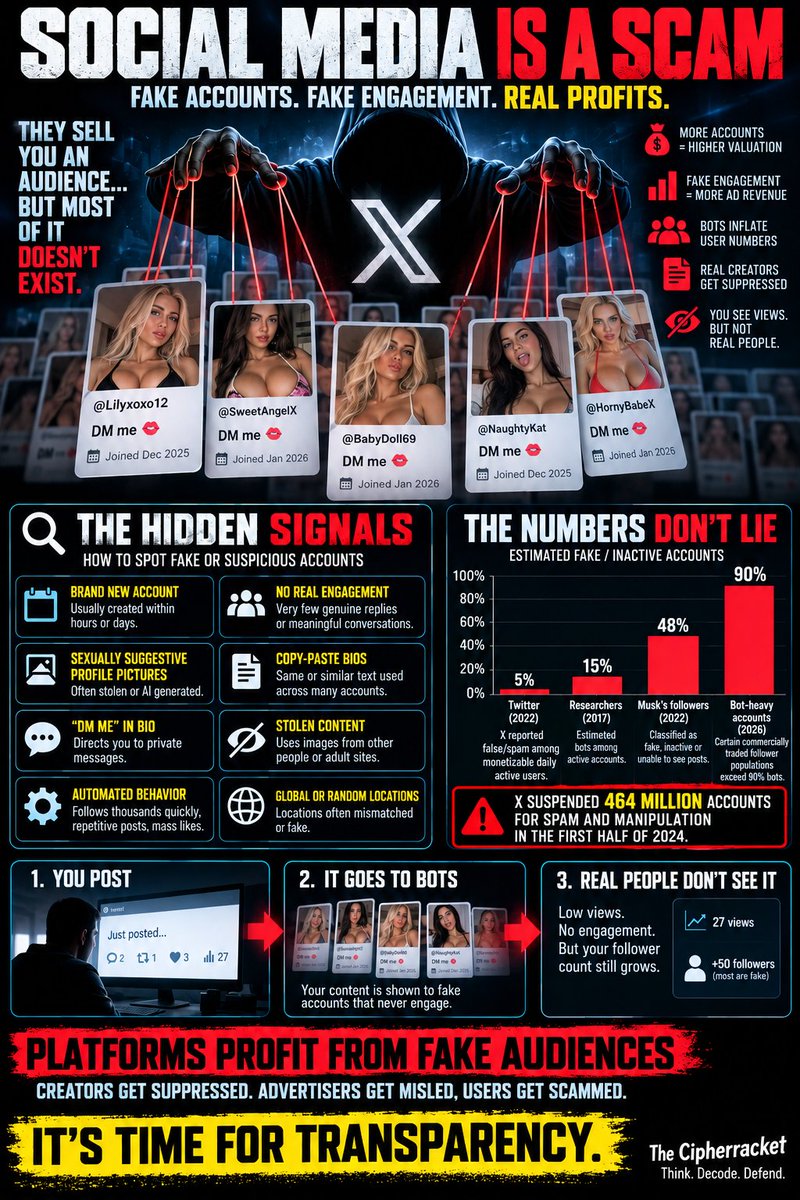
SOCIAL MEDIA: FAKE ACCOUNTS. FAKE ENGAGEMENT. REAL PROFITS.
- What happens when platforms sell access to millions of users, but nobody can independently verify how many are actually real?
- Look at the hidden signals.
- Brand-new accounts. Half-naked profile pictures. “DM me” in the bio. Recycled content. Automated behavior. Followers increasing while genuine engagement disappears.
- And here's the interesting part: Many of the genuine followers I gain discover me through replies on larger accounts, NOT through the original posts on my own feed.
- Why does responding to someone else's audience appear more effective than reaching my own?
- Now follow the incentives.
- Platforms benefit from enormous reported audiences. Advertisers pay for exposure. Creators compete for visibility. And the companies controlling distribution also control the numbers everyone relies on.
- Who's independently auditing those numbers?
- X reported suspending approximately 464 MILLION accounts for spam and platform manipulation in just the first half of 2024.
- Think about that number.
- How many fraudulent accounts are still operating? How many impressions come from automated activity? How many genuine followers never see the content they chose to follow?
- And why aren't creators given the tools to distinguish human engagement from artificial activity?
- THE REAL INVERSION:
- We're told social media connects people.
- But what happens when the system rewards inflated numbers more than genuine human connections?
- The problem isn't simply fake accounts. It's the lack of transparency surrounding who sees what, how content gets distributed, and who financially benefits.
- Stop confusing follower counts with genuine audiences.
- Stop confusing impressions with meaningful attention.
- AUDIT THE NUMBERS. FOLLOW THE INCENTIVES. EXPOSE THE HIDDEN SIGNALS.
- Think. Decode. Defend.
#SocialMedia #X #FakeAccounts #Bots #AlgorithmTransparency #DigitalManipulation #WelcometotheCipherracket #Cipherracket #ThinkDecodeDefend
Jimmy discusses the controversy surrounding Shawn Ryan’s decision to initially withhold an interview with investigative commentator Leah Files, who says Ryan’s team told her not to name Peter Thiel and Andreessen Horowitz while discussing the funding behind Flock Safety’s surveillance technology.
@jimmy_dore@leahfiles@ShawnRyanShow
https://t.co/PlSTYAV4R4
THE BARRIER OF CORPORATE RHETORIC
- Same curiosity. Same questions. Different words. Different answers.
- We're told artificial intelligence is revolutionizing access to knowledge. But what happens when the depth of information you receive depends on how well you speak the language of institutions?
- Ask a question in everyday language, and you might receive a generic summary, rehearsed explanation, or surface-level answer.
- Ask that same question using academic terminology, technical jargon, or carefully engineered prompts, and suddenly the response can become substantially more detailed.
- The question didn't change. The language did.
- Think about that.
- Why should ordinary people need to master an algorithm's preferred vocabulary just to receive meaningful information?
- Legal systems, healthcare, government agencies, and corporations already operate behind walls of specialized terminology.
- Now artificial intelligence risks reproducing those same barriers.
- Here's the inversion:
- AI was supposed to make complicated information accessible to everyone.
- Instead, people can find themselves needing expertise in communicating with AI just to access the expertise AI supposedly provides.
- A technology designed to eliminate information barriers can end up reinforcing them.
- This doesn't automatically mean deliberate censorship. But it raises serious questions about algorithmic bias, institutional influence, and unequal access to knowledge.
- Who benefits when deeper answers require the right terminology?
- Who gets left behind?
- And who decides what qualifies as a meaningful answer?
- Knowledge shouldn't require a secret vocabulary. Curiosity shouldn't require institutional credentials.
- When the same question opens different doors depending on the language used, perhaps it's time to investigate who built those doors.
- That's the cipherracket worth decoding.
- Think. Decode. Defend.
#ArtificialIntelligence #InformationAccess #AlgorithmicBias #DigitalFreedom #CriticalThinking #WelcometotheCipherracket #Cipherracket
The Cipherracket: Sovereign Ground
"The Gavel And The Chain"
Track 5 - Exposing the math of control (51% enslaves 49%), contrasting a pure democracy with a protected republic, and laying down the truth of the power structures.
#TheCipherracketSovereignGround#AlbumThree #CipherracketMusic #WelcometotheCipherracket #Cipherracket #YoutubeMusic #Democracy #Revolution #NonViolent #RevolutionOfTheMind
https://t.co/eHPxjKNHeI via @YouTube
The Cipherracket: Sovereign Ground - Album 3
"Behind the Heavy Door"
- Track 3 - A full proposal for Public Integrity Courts, breaking down the bail racket and gatekept legal language before shifting into clear, process-focused solutions for transparency and accountability.
#TheCipherracketSovereignGround #AlbumThree #CipherracketMusic #WelcometotheCipherracket #YoutubeMusic
https://t.co/RtZluABKnF via @YouTube