Like a personal “skeleton key,” the cipherracket gives you a framework to decode everything: systems of control, religion, politics, even spiritual manipulation
Transparency Statement
- Questioning systems, language, and incentives is a protected form of public discourse. This project exists to increase understanding and public literacy; not to replace professional medical care or individual clinical judgment.
Context Statement
- This post examines how PTSD, anxiety, and depression are commonly explained, labeled, and treated, and how language choices can shape outcomes. The focus is on patterns, incentives, and communication; not on providing medical advice, diagnosis, or treatment.
Cipherracket Notice
- Cipherracket is a term used here to describe recurring patterns in which authoritative or technical language obscures meaning, narrows interpretation, and limits agency. This is a critique of systemic communication practices, not an allegation against individuals or professions.
PTSD isn’t being misunderstood by accident. It’s being softened, split, and relabeled until it no longer threatens the system that created it.
PTSD is widely under-recognized, not rare
- PTSD isn’t just “war trauma.” It can come from:
- Chronic stress (poverty, unsafe housing, medical neglect)
- Ongoing threat (job insecurity, violence, instability)
- Repeated loss, betrayal, or helplessness
- Long-term exposure to fear without recovery time
- Many people don’t have a single dramatic event; they have years of unresolved nervous-system overload. Clinically, this often shows up as C-PTSD (complex PTSD), which is frequently misdiagnosed as:
- Anxiety disorders
- Major depression
- Panic disorder
- ADHD
- Somatic symptom #disorders (a mental health condition characterized by intense, excessive distress over physical symptoms)
- That mislabeling matters, because the treatments are different.
PTSD Can Drive Real, Physical Illness
- This isn’t just psychological theory, there’s strong biological backing:
- Chronic trauma keeps the body in fight-or-flight
- Cortisol and #adrenaline stay elevated
- Immune function becomes dysregulated
- Inflammation rises
- Sleep architecture breaks down
- Gut and cardiovascular systems are affected
- Over time, this contributes to:
- Autoimmune conditions
- Chronic pain
- Migraines
- IBS
- Heart disease
- Metabolic disorders
- Fatigue syndromes
- So when people say “stress makes you sick,” #PTSD is often the mechanism, not just “stress.”
Why anxiety/depression become the default labels
- From a systems perspective:
- Anxiety/depression are symptom labels, not root causes
- They’re easier to diagnose in 10 minutes
- They don’t require confronting systemic harm, abuse, or injustice
- They keep responsibility individualized instead of structural
- PTSD, on the other hand, forces uncomfortable questions:
- What happened to this person?
- Who or what failed them?
- Why hasn’t safety been restored?
- Modern systems prefer to medicate distress rather than decode its origin.
“We’re all stressed from past events” yes, and here’s the key part
- What’s different today isn’t just stress, it’s unprocessed stress with no recovery window.
- Historically:
- Trauma happened → community support → meaning-making → recovery
- Now:
- Trauma happens → keep working → stay productive → stay online → no resolution
- The nervous system never gets the signal: “It’s over. You’re safe.”
- That’s not weakness. That’s biology.
- Large portions of the population are living with unresolved #trauma physiology, whether or not they meet formal PTSD criteria.
- That statement is hard to argue with and it aligns with neuroscience.
The Uncomfortable Truth
- A society that never allows people to feel safe cannot be healthy; physically or mentally.
Anxiety ≠ fear
- What people call anxiety is often misunderstood as #fear, when at the nervous-system level it’s really arousal. Fear is just one interpretation of that arousal.
- Anxiety = nervous-system activation
- At the biological level:
- Increased heart rate
- Heightened attention
- Adrenaline release
- Energy mobilization
- That same state can be experienced as:
- Excitement
- Anticipation
- Nervousness
- Fear
- The difference is meaning, not chemistry.
- Example:
- When your favorite team scores and you cheer, that’s anxiety too and it feels good.
- The body doesn’t label it. The story does.
The Nervous System doesn’t know “good” or “bad”
- It only knows:
- Low arousal (rest, shutdown)
- High arousal (mobilize, act)
- The brain then assigns:
- Threat → fear
- Opportunity → excitement
- Uncertainty → anxiety
- Same fuel. Different narrative.
- This is why:
- Skydiving can feel euphoric
- Public speaking can feel terrifying
- Competition can feel alive or overwhelming
- Same system. Different context.
Where #anxiety becomes a problem
- Anxiety turns pathological not because it’s uncomfortable, but because:
- It’s chronic
- It lacks resolution
- It’s paired with loss of control
- It’s misinterpreted as danger when it isn’t
- In healthy systems:
- Activation → action → release → recovery
- In modern life:
- Activation → suppression → rumination → exhaustion
- That’s where it curdles into suffering.
Why PTSD changes anxiety’s “flavor”
- Here’s the critical distinction:
- Healthy anxiety/excitement: “Something important is happening.”
- Trauma-linked anxiety: “Something important happened and it wasn’t safe.”
- PTSD poisons arousal by attaching it to memory instead of possibility.
- So the same activation that once felt like joy now feels like a threat.
Depression as the aftermath
- When activation becomes unbearable or endless, the system does the only thing it can:
- It shuts down
- Depression isn’t the opposite of anxiety: it’s often what comes after chronic activation without relief.
A cleaner, more accurate model
- If you want language that avoids confusion and stigma:
- Arousal = nervous-system energy
- Anxiety = arousal without clear outlet
- Fear = arousal + perceived threat
- Excitement = arousal + perceived reward
- PTSD = arousal hijacked by memory
- Depression = arousal collapsed
- That model holds up biologically.
Why this matters
- When we teach people:
- “Anxiety is bad, fear-based, and pathological”
- we:
- Teach them to fear their own activation
- Create secondary anxiety about anxiety
- Miss the body’s intelligence
- Medicate away energy instead of integrating it
- This framing restores something important:
- Activation isn’t the enemy. Disconnection is.
The Human Arousal State Map
(No diagnoses. No judgment.)
Core Axis
Arousal = nervous-system energy
Low ←───────────────→ High
Shutdown Mobilization
STATE 1: LOW AROUSAL — Conservation
(Often labeled “#depression”)
Nervous System
- Dorsal vagal dominance
- Energy withdrawal
- Metabolic slowdown
Lived Experience
- Heaviness
- Numbness
- Fatigue
- Reduced motivation
- Time feels slow or meaningless
Function (why it exists)
- Preserve life when effort feels unsafe or futile.
- This is not failure. It’s a biological retreat.
STATE 2: MODERATE AROUSAL — Engagement
(Often invisible because it works)
Nervous System
- Balanced autonomic activity
- Flexible arousal up and down
- Quick recovery
Lived Experience
- Focus
- Curiosity
- Presence
- Calm energy
- Emotional range
Function
- Explore, connect, create
- This is regulation; not calmness, but flexibility.
STATE 3: HIGH AROUSAL — Mobilization
(Often labeled “anxiety”)
Nervous System
- Sympathetic activation
- Adrenaline-driven
- Attention narrows
Lived Experience
- Excitement
- Anticipation
- Urgency
- Passion
- Nervousness
Function
- Prepare for action
- This state fuels:
- Competition
- Joy
- Sexuality
- Creativity
- Courage
- High arousal is not a problem, being trapped here is.
STATE 4: UNBOUND AROUSAL — Overload
(Often medicated)
Nervous System
- Sustained sympathetic dominance
- No discharge
- Cortisol dysregulation
Lived Experience
- Restlessness
- Insomnia
- Irritability
- Racing thoughts
- Emotional volatility
Function
- System searching for resolution
- This is energy with no exit.
STATE 5: TRAUMA-LOOPED AROUSAL
(Often labeled “PTSD”)
Nervous System
- Memory-driven activation
- Amygdala override
- Prefrontal suppression
Lived Experience
- Triggers
- Flash emotions
- Dissociation
- Sudden fear or rage
- Body reacts before thought
Function
- Prevent past danger from recurring
- The system is not broken.
- It is “protecting” using outdated information.
STATE 6: COLLAPSE AFTER OVERLOAD
(Often returns as “depression”)
Nervous System
- Emergency shutdown
- Energy conservation after failure to resolve threat
Lived Experience
- Emptiness
- Withdrawal
- Hopelessness
- Loss of pleasure
Function
- Stop the system from burning out completely
- This is the aftermath of chronic high arousal.
The Flow (this matters most)
Healthy flow:
Arousal ↑ → Action → Release → Rest → Meaning
Modern flow:
Arousal ↑ → Suppression → Rumination → Overload → Collapse
- That’s the illness generator.
Reframing the Old Labels
- Anxiety = Mobilization energy without outlet
- Depression = Conservation after prolonged stress
- PTSD = Arousal hijacked by memory
- "Disorder" = Nervous system stuck in one state
The Missing Goal
- The goal is not calm.
- The goal is:
- Fluid movement between states
- Regulation = mobility
- Suffering isn’t high or low energy, it’s energy that can’t move.
The Cipherracket of Arousal
- Mislabel → Control → Stagnation
Core Premise
- A cipherracket functions by:
- Misnaming reality
- Selling the misname as truth
- Profiting from the confusion
- Preventing resolution
- Arousal is one of the most profitable things to mislabel.
STEP 1: MISLABEL
- Natural arousal states are renamed as disorders
What the body is doing | What it’s called
- Mobilization energy → “Anxiety”
- Conservation energy → “Depression”
- Memory-driven protection → “PTSD”
- Overload → “Chemical imbalance”
- Collapse → “Treatment-resistant illness”
Encryption move:
- Turn states into identities.
- Once labeled, the person stops asking why and starts asking what’s wrong with me.
STEP 2: CONTROL
- Treat the label, not the blocked flow
Control mechanisms
- Suppress activation instead of discharging it
- Medicate arousal instead of resolving its cause
- Individualize distress instead of locating harm
- Short appointments, long prescriptions
Key control feature:
- Relief without resolution.
- Enough relief to function. Never enough to be free.
- This keeps people:
- Productive
- Dependent
- Self-blaming
- Quiet
STEP 3: STAGNATION
- Energy that cannot move becomes pathology
Biological outcome
- Chronic inflammation
- Immune dysregulation
- Sleep breakdown
- Metabolic strain
- Pain syndromes
Psychological outcome
- Learned helplessness
- Identity fusion with diagnosis
- Fear of one’s own activation
- Loss of agency
- The system calls this compliance.
- The body experiences it as entrapment.
THE CLOSED LOOP (this is the racket)
- Arousal arises (normal)
- System mislabels it (encryption)
- Control suppresses it (containment)
- Energy stagnates (illness)
- Symptoms escalate
- Label is reinforced
- Dependence deepens
- Loop complete. Profit secured.
WHERE PTSD IS THE GOLD MINE
- PTSD threatens the racket because it points backward:
- “Something happened.”
- So it gets softened into:
- “Anxiety disorder”
- “Mood disorder”
- “Personality traits”
Why?
- Because trauma demands:
- Accountability
- System change
- Time
- Safety
- Repair
- None of those scale well.
THE COUNTER-DECRYPTION
- Replace labels with flow questions:
- What state is my system in?
- What energy is blocked?
- What resolution was interrupted?
- What safety signal is missing?
- This breaks the encryption.
THE SINGLE MOST DANGEROUS SENTENCE (to the racket)
- “My symptoms make sense given what my nervous system has been through.”
- That sentence restores:
- Meaning
- Agency
- Direction
- Motion
- Motion kills stagnation. Stagnation is the racket’s fuel.
ONE-PARAGRAPH PUBLIC VERSION
- Many conditions we label as anxiety or depression are actually natural nervous-system states that have been misnamed and suppressed rather than resolved. When arousal is treated as pathology instead of energy, it gets controlled instead of discharged. Over time, that trapped energy turns into chronic illness. The problem isn’t that people are broken: it’s that their systems have been encrypted, stalled, and managed instead of understood.
THE CIPHERRACKET TRIANGLE
- Mislabel the state
- Control the response
- Stagnate the energy
- Break any side of the triangle and the #racket collapses.
A Doctor-Proof Reframe:
- From Diagnostic Labels to Nervous-System State
Opening premise (hard to dispute)
- Many presentations labeled as anxiety or depression are better understood as persistent autonomic arousal states rather than primary mood disorders.
- This does not deny diagnoses. It reframes the mechanism.
The Core Clinical Claim
- Symptoms are not the #disorder. They are outputs of a nervous system stuck in a state.
- If the state is misidentified, treatment predictably underperforms.
The Three-State Model
1. Mobilization State (High Arousal)
- Sympathetic dominance
- Elevated catecholamines
- Preserved energy, impaired down-regulation
- Often labeled: anxiety, panic, agitation
- Biological reality: readiness without discharge
2. Conservation State (Low Arousal)
- Dorsal vagal dominance
- Reduced metabolic output
- Energy withdrawal
- Often labeled: depression, anhedonia, fatigue
- Biological reality: protective shutdown after prolonged stress
3. Threat-Memory State (Dysregulated Arousal)
- Triggered #amygdala activation
- Reduced prefrontal inhibition
- Rapid switching between high and low arousal
- Often mislabeled: mixed anxiety/depression
- Biological reality: unresolved threat encoding
The Misdiagnosis Vector (Key Point)
- When clinicians assess symptoms without assessing state, three predictable errors occur:
- Mobilization is treated as pathology instead of energy without outlet
- Conservation is treated as primary mood disorder instead of post-stress shutdown
- Threat-memory activation is treated as generalized anxiety, masking trauma physiology
- This explains:
- Partial medication response
- “Treatment resistance”
- Symptom migration
- High comorbidity rates
The Question Shift (This forces better care)
Instead of:
- “Do you feel anxious or depressed?”
- “How intense are your symptoms?”
Ask:
- What is your baseline arousal when nothing is happening?
(Restless, numb, flexible?)
- Can your system down-regulate without external sedation?
(Sleep, breath, rest)
- Are reactions proportional to present-moment stimuli?
(If no → memory-driven activation)
- Does activation resolve after action or reassurance?
(If no → blocked discharge)
- Did symptoms begin after a period of prolonged stress or threat?
(If yes → conservation or trauma loop)
- These are physiology questions, not psychological ones.
Why This Matters for Treatment (Doctor-Relevant)
When arousal state is misidentified:
- SSRIs blunt energy but don’t restore regulation
- Benzodiazepines reduce symptoms but worsen long-term dysregulation
- Stimulants may improve function while deepening imbalance
- Patients appear “noncompliant” or “complex”
- When arousal state is identified:
- Treatment targets regulation, not suppression
- Therapy selection improves
- Medication choice becomes more precise
- Recovery trajectories shorten
The Clinically Safe Bottom Line
- Many patients diagnosed with anxiety or depression are not suffering from excessive emotion, but from impaired autonomic flexibility.
That statement:
- Is biologically accurate
- Fits polyvagal and stress literature
- Explains comorbidity
- Explains chronicity
- Explains physical illness overlap
The One-Sentence Test (Very hard to dismiss)
- “Before labeling this as a mood disorder, can we clarify whether the nervous system is stuck in mobilization, conservation, or threat-memory activation?”
- A doctor who answers that question gives better care.
- A system that avoids it preserves control.
Why This Breaks the Cipherracket
- Mislabel → replaced with state identification
- Control → replaced with regulation
- Stagnation → replaced with movement
- Once arousal is #decoded, symptoms make sense.
- When symptoms make sense, people regain agency.
- Agency collapses dependency.
- Below is a patient handout designed to quietly change the conversation without challenging authority, diagnoses, or expertise.
- It’s written in neutral, cooperative language, focused on observation; not accusation. Patients can bring it to appointments, fill it out beforehand, or use it as a guide during visits.
Understanding My Nervous System
- A brief self-check to support better care
- This handout is not about replacing diagnoses.
- It’s about helping my care team understand how my nervous system is functioning, so treatment can be better targeted.
Why this matters
- Many symptoms commonly described as anxiety or depression are influenced by how activated or depleted the nervous system is.
- Understanding this can help guide treatment choices and expectations.
Section 1: My Baseline State
When nothing stressful is happening, I usually feel:
- ☐ Restless or keyed up
- ☐ Flat, heavy, or low-energy
- ☐ Flexible and present
- ☐ Numb or disconnected
Notes (optional):
Section 2: Activation & Recovery
When I become emotionally or physically activated (stress, excitement, conflict):
- ☐ My body settles on its own afterward
- ☐ I stay activated for hours or days
- ☐ I crash afterward
- ☐ I switch between agitation and exhaustion
Things that help me calm down (if any):
- ☐ Movement
- ☐ Sleep
- ☐ Breathing
- ☐ Reassurance
- ☐ Nothing seems to help
Section 3: Proportionality
My reactions usually feel:
- ☐ Proportional to what’s happening now
- ☐ Bigger than the situation
- ☐ Sudden or unpredictable
- ☐ Familiar, like my body has done this before
Section 4: Triggers & Patterns
My symptoms tend to increase when:
- ☐ I feel rushed or pressured
- ☐ I feel trapped or unable to leave
- ☐ I feel unsafe or unheard
- ☐ I’m reminded of past events
- ☐ There’s no clear pattern
Do symptoms ease when the situation resolves?
- ☐ Yes
- ☐ Sometimes
- ☐ Rarely
- ☐ Never
Section 5: Energy & Shutdown
Over time, my energy has:
- ☐ Stayed about the same
- ☐ Gradually declined
- ☐ Become unpredictable
- ☐ Alternated between high and very low
Rest usually makes me feel:
- ☐ Restored
- ☐ Slightly better
- ☐ No different
- ☐ Worse or more stuck
Section 6: Timeline (optional but helpful)
Symptoms began or worsened after:
- ☐ A prolonged stressful period
- ☐ A major loss or change
- ☐ Repeated strain without recovery
- ☐ No clear event
Approximate timeframe: ____________________________
A Supportive Question for My Care Team
(Optional - Included to support discussion)
- “Could my symptoms be related to how my nervous system is regulating energy and stress, in addition to the diagnosis we’re considering?”
- This question is meant to add context, not replace care.
What I’m Hoping For
- ☐ Better understanding of what my body is doing
- ☐ More targeted treatment options
- ☐ Clear expectations for recovery
- ☐ Strategies that support regulation, not just symptom control
Important Note
- This handout does not assume trauma, #illness, or fault.
- It reflects the idea that symptoms are signals, and understanding those signals can improve outcomes.
One-line summary (for clinicians or patients)
- I’m interested in understanding whether my symptoms reflect nervous-system activation, shutdown, or difficulty returning to baseline.
Disclaimer
- This content is for educational and informational purposes only. It does not provide medical advice, diagnosis, or treatment, and is not a substitute for care from a licensed professional.
- Decoded using the Cipherracket framework: a method for reading how language, incentives, and systems shape behavior.
- If you work in #healthcare, education, or public systems and see this pattern differently or framework useful, I’m open to thoughtful discussion and your perspectives.
#TraumaInformed #NervousSystem #PublicHealth #Neuroscience #WelcometotheCipherracket #Cipherracket
Has anybody else noticed that X has been altering their website weeks before elections? So far the last election and this one coming up, I noticed the timeline being destroyed and broken up and now you have to go back and forth to see the actual order of the posts. This one is about the app only and the view count is disabled. Can't see impressions. Anybody else notice this? They're controlling information and need to be sued by every creator that pays for exposure.
But if he used a gun, what would the headline be? Gun control? Why not vehicle control? Or knife control? It's the individual person that's the problem...not a tool or instrument. And think about this, do criminals follow laws? No, so why do politicians believe creating new laws will stop the crimes? It won't, it will only add another tax on life for the people that do follow the law. Create 1000 laws a day and you'll never control crime. You control law abiding citizens. The inversion...
@WSJ Who cares? I have 6 tvs with 6 different sports and my music playing. I can look at every single tv and know exactly what's going on without any biased announcers distracting from certain plays. More people need to mute their tvs...
@Rainmaker1973 We need to create an old way how to research because we can't see other ideas or websites like we used too. We don't need the governments permission to fight against their tyrannical dictates.
WHEN WILL SOMEONE tell the U.S. public the truth about datacenters?
The false story Americans are being force-fed says the power-gobbling tech centers are necessary to beat China, and may provide an economic boost.
An AP report on the topic was typical, referring to “a potential jobs and economic bonanza, while helping the U.S. thwart China in the geopolitical race for technological supremacy”.
What’s missing is the comparative number.
It is missing deliberately.
.
THE MISSING NUMBER
That’s because it would reveal to readers that the United States has 5,427 data centers, while China has only 449 data centers, according to the Stanford Institute for Human-Centered Artificial Intelligence. (The Chinese aren’t racing, focused on building good power infrastructure instead.)
The numbers show that there is no race.
The US already has an unassailable lead.
So why do they really want US citizens to give up their greenbelt? The difference is whether US “wins” by having 12 times as many datacenters as China, or “wins” by having 13 times as many as China: it is meaningless.
If the US public knew that, they would not give up their greenbelt land areas, nor their supplies of electricity and water.
.
RACE AGAINST THE WORLD
While we are looking at numbers, there’s something else to notice. At current rates of building, the US will soon have more datacenters than ALL THE OTHER COUNTRIES OF THE WORLD PUT TOGETHER. (A recent survey showed the US had 46 percent and rising.)
So if there’s a race at all, it’s a race between the US broligarchs and humanity itself. Think about that for a moment.
Meanwhile, the public is being thrown off the trail by being told that any opposition comes from China and Russia. (They can use this post as evidence, as the writer lives in China.)
But this is obviously false. Websites like datacenterwatch .org show that the opposition comes from US citizens themselves, from all sides of the political spectrum.
.
WHAT’S REALLY HAPPENING
Here’s what’s really happening. The members of the wealthy elite in the US, long advantaged by their country being globally dominant, now know that the situation is changing: the growth of a multipolar world is inevitable.
But they came up with a plan. “If the world is becoming an AI tech dystopia, what if we had more AI tech power than every other country in the planet put together! We would still be in charge!” AI Planet!
Who would want to live there?
Let me end with a line attributed to Sun Tzu. It doesn’t actually appear in his famous book, but can be seen as a summary of his philosophy, which is think strategically to minimize harm to people and property:
“A bad man will burn his own nation to the ground to rule over the ashes.”
.
.
THE INVERTED GENERATION - OLDER IN AGE, YOUNGER IN MATURITY
- What happens when an entire society starts confusing age with wisdom, obedience with respect, cowardice with courage, and entitlement with responsibility?
- We grow up being told to respect our elders because they've lived longer, experienced more, and supposedly know better.
- But here's a question nobody seems to want to ask:
- What if growing older doesn't make someone wiser? What if it just gives them more years to perfect their excuses?
- Look at the contradictions.
- People who enjoyed freedoms their entire lives criticize younger generations for questioning the very government that's supposed to protect those freedoms.
- They condemn younger people for speaking out, yet celebrate violence committed in the name of authority.
- They demand respect but refuse accountability.
- They preach personal responsibility while blaming everyone else for their own decisions.
- They defend private property rights while remaining unaware of laws like Medicaid estate recovery, which can allow the government to recover certain healthcare costs from someone's estate.
- They claim doctors can't be trusted, yet continue relying on the same medical system they criticize, sometimes without questioning treatments they believe are making them worse.
- And perhaps the most frustrating contradiction?
- They can forget what they said five minutes ago but remain absolutely certain they're right.
- Now, this isn't about every person over 60. There are wise, responsible people in every generation, just as there are immature people of every age.
- This is about something much bigger: PERVERSE INCENTIVES.
- What happens when a society rewards people for avoiding responsibility?
- When politicians gain power by promising benefits today while transferring the costs to tomorrow?
- When institutions protect their reputations instead of admitting mistakes?
- When admitting you're wrong becomes more threatening than continuing to be wrong?
- When questioning authority is treated as disrespect, but blindly following authority is celebrated as loyalty?
- You create a system where the rewards and consequences are inverted.
- THE ACCOUNTABILITY LOOP:
- Make a poor decision.
- Feel threatened by the consequences.
- Blame someone else.
- Receive protection, sympathy, or another excuse.
- Repeat.
- Now imagine that behavior being reinforced for decades.
- And here's the part most people overlook:
- Nobody needs to coordinate this behavior.
- Politicians, corporations, institutions, and individuals can all respond independently to incentives that reward the same destructive patterns.
- The outcome can be systemic without anyone organizing it.
- That's the cipherracket.
- The younger generations aren't automatically right, and the older generations aren't automatically wrong.
- But nobody should receive immunity from criticism simply because they've been alive longer.
- Respect should be earned through actions. Wisdom should be demonstrated through judgment. And accountability should never have an expiration date.
- Maybe the real generational divide isn't young versus old.
- Maybe it's between those willing to question themselves and those who demand everyone else change.
- Because when avoiding responsibility becomes more rewarding than accepting it, maturity becomes optional; at any age.
- IT'S NOT JUST PEOPLE. IT'S A SYSTEM THAT REWARDS IT.
- Think. Decode. Defend.
@realDonaldTrump
#PerverseIncentives #Accountability #GenerationalDivide #QuestionAuthority #SystemicProblems #WelcometotheCipherracket #Cipherracket #ThinkDecodeDefend
For a few years I’ve “casually watched” The Shawn Ryan Show.
He’s portrayed himself as beaten - like a man that’s seen too much.
Like a man spiritually bankrupted by the violence he’d witnessed.
How fucking typical to find out he’s One of Them!!!
Invested into the tentacle companies of Peter Thiel - and sponsored by the enemy.
Same old story.
Another one of ‘the guys you thought was fighting for America’ has actually invested in the companies determined to destroy our country!
That hopelessness he wore like a mask was a charade, a veneer: hiding a man that sold his country and his soul for a few extra bucks.
Fuck you Shawn.
Fuck you to all the people you represent.
Another day.
Another puppet outed.
Nothing to see here.
Fuck Man!!!!
Has anybody else noticed that X has been altering their website weeks before elections? So far the last election and this one coming up, I noticed the timeline being destroyed and broken up and now you have to go back and forth to see the actual order of the posts. This one is about the app only and the view count is disabled. Can't see impressions. Anybody else notice this? They're controlling information and need to be sued by every creator that pays for exposure.
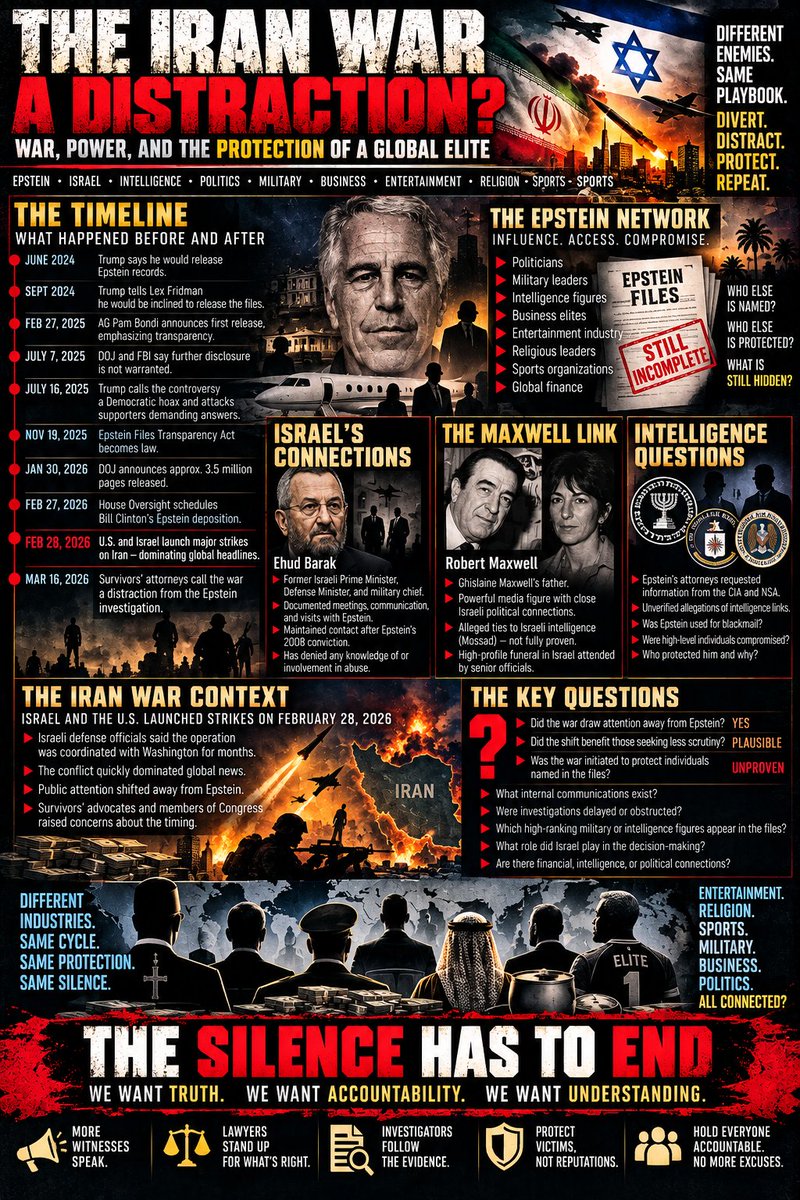
Jeffrey Epstein, Jean-Luc Brunel, and countless other predators from the international modeling industry preyed on young women and children for decades. The pattern was clear, and the abuse was horrific. But where is the accountability today? Where are the investigations?
@KatiePhang
#JeffreyEpstein #EpsteinFiles
https://t.co/IVsxcyJS1F
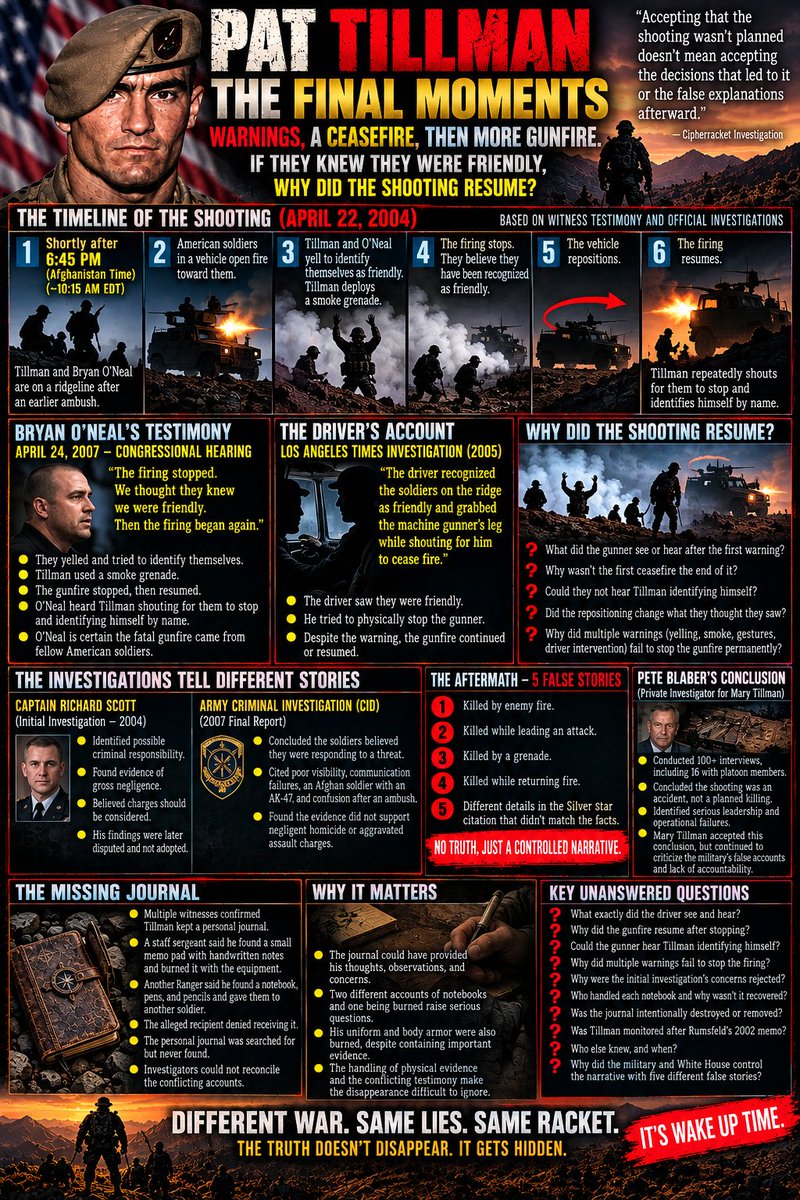
PAT TILLMAN: THE FINAL MOMENTS - WHY DID THE GUNFIRE RESUME?
- Imagine being an American soldier, serving your country, only to find yourself under fire from your own fellow soldiers.
- You shout that you're friendly.
- You identify yourself.
- You deploy a smoke grenade.
- The shooting stops.
- For a moment, you believe they've recognized you.
- Then the gunfire starts again.
- On April 22, 2004, Pat Tillman was killed by fellow American soldiers in Afghanistan.
- But there's a part of this tragedy that deserves far more attention.
- During congressional testimony, eyewitness Bryan O'Neal described how the shooting stopped before resuming. Tillman reportedly shouted his own name, desperately trying to make the soldiers recognize who they were firing upon.
- Another account described a vehicle driver recognizing the men as friendly and attempting to physically stop the machine gunner.
- So why did the shooting continue?
- What did the gunner see? What did he hear? Why weren't the warnings enough? What changed when the vehicle repositioned?
- And why did the military's initial investigation raise concerns about gross negligence, only for subsequent investigations to reach different conclusions?
- Now look at what happened afterward.
- Tillman's uniform and body armor were burned.
- His personal journal was never recovered.
- His family was initially given an inaccurate account of his death.
- The Silver Star documentation contained misleading information.
- Senior military officials knew friendly fire was suspected before the public was told.
- One tragedy. Multiple changing accounts. Missing evidence. Unanswered questions.
- A later private investigation concluded that the shooting was accidental rather than a planned killing. But even accepting that conclusion doesn't erase the decisions leading to the shooting or the misinformation that followed.
- And that's the point of this Cipherracket investigation.
- We're not looking at one isolated moment. We're connecting the decisions, the timelines, the testimony, the investigations, and the incentives.
- Because the question isn't only who pulled the trigger.
- It's also:
- Who made the decisions that put them there? Who controlled the investigations? Who changed the narrative? Who knew the truth? And who was held accountable?
- This poster examines the final moments. The next parts of this series will follow the evidence through the military chain of command, the Silver Star documentation, and the officials responsible for reviewing what happened.
- Every poster connects another piece of the puzzle.
- Pat Tillman deserves more than a heroic image used once a year. His life, his death, and the truth deserve to be remembered.
- Different War. Same Lies. Same Racket.
- Think. Decode. Defend.
- The World Deserves The Truth. The People Deserve Freedom.
@RepThomasMassie@justinamash@NFL@AZCardinals@TheSunDevils@pattillmanfnd@barnes_law
#PatTillman #PatTillmanInvestigation #FriendlyFire #MilitaryAccountability #WelcometotheCipherracket #Cipherracket #FollowTheEvidence #TruthMatters #NFL #Veterans #SupportTheTruth
X CHANGED AGAIN. NOW WHERE DID THE VIEW COUNTS GO?
- Another day, another change to X. And once again, users are left wondering what's happening.
- On October 20, 2026, I noticed something different.
- The view counts (impressions) had disappeared from posts on the X mobile app.
- At first, I thought they were gone completely. But after checking the website on my computer, I discovered something interesting.
- SAME PLATFORM. SAME POSTS. DIFFERENT VISIBILITY.
- X Website: View counts are still visible.
- X Mobile App: View counts are missing.
- Now here's what bothers me.
- These numbers aren't just decorations. They're one of the few ways ordinary users can see how far their content is reaching.
- When those numbers disappear, even from just one version of the platform, it becomes harder to monitor distribution, compare performance, and recognize unusual changes.
- And considering the previous changes to how reposts appear on profiles, I have to ask:
- Why does X keep changing the way users access information about their own content?
- Is this another redesign? A temporary glitch? A feature being tested? Or a deliberate decision to reduce what users can see?
- We don't know yet.
- But here's something worth thinking about:
- You don't have to stop distributing someone's content to make their reach harder to investigate. You only have to make the information less accessible.
- That doesn't prove suppression is happening. But it raises legitimate questions about transparency and accountability.
- And those questions deserve answers.
- NOW I WANT TO HEAR FROM OTHER X USERS.
- Are your view counts missing from the mobile app?
- Are you using Android or iPhone?
- Can you still see impressions on the website?
- When did you first notice the change?
- Share screenshots if possible. Let's compare experiences across devices, accounts, and locations.
- One observation starts a question. Multiple documented observations can reveal a pattern.
- Timelines matter. Context matters. Memory matters.
- The more information users lose access to, the harder it becomes to hold platforms accountable.
- The World Deserves The Truth. The People Deserve Freedom.
- Think. Decode. Defend.
#XTwitter #TwitterX #SocialMediaTransparency #DigitalRights #Accountability #AlgorithmTransparency #ViewCounts #SocialMedia #WelcometotheCipherracket #Cipherracket #ThinkDecodeDefend
Unweaving Jeffrey Epstein's Web
- FRANCE 24 journalist Ava Luquet spent months digging through the files. In this video, she takes a closer look at what they reveal about the predator’s network and its inner workings.
@FRANCE24@France24_en#JeffreyEpstein#EpsteinFiles
https://t.co/zTn8qwmogs
BREAKING: Israeli spyware is confirmed on our phones. This should be headline news but none of our mainstream media is covering it, of course. So we will.
An Israeli ad company called Discover-Tech used ordinary online ads to plant spyware on people’s devices, and nobody had to click anything. The ad just had to load on a website or inside an app for you to be infected.
Citizen Lab and the ad security firm Confiant published the findings yesterday. Researchers went through roughly 4 billion ad-bidding records and found Discover-Tech ads running on more than 120,000 websites and 70,000 apps between March and June of this year. Confiant says the company was serving at least 10 million ads a day.
The platform was called Controlium. According to Citizen Lab, it let spyware companies use ad auctions to profile and unmask users, then send an infected ad to the one person they wanted to hack. The ads were also pulling cookies and login tokens from the sites they ran on. Israeli corporate records list Dekel Boni as the company’s founding director and sole shareholder.
The main spyware customer was Candiru, the Israeli firm the U.S. government blacklisted in 2021, which now goes by Integrity Labs. Five years after that blacklisting, it was still reaching devices through ad inventory on Google, Comcast-owned Beeswax and Russia’s Yandex. Google had Discover-Tech on its approved vendor list from 2020 until this week.
At least 45 Al Jazeera devices were targeted in 2024 and 2025. Candiru’s 2021 shareholder filings reportedly listed a minority investor described as a proxy for Qatar’s sovereign wealth fund, and Qatar also funds Al Jazeera. If that holds up, Qatari state money was sitting inside the company whose spyware was later aimed at Qatar’s own news network.
The heaviest targeting was in the Palestinian territories, where Discover-Tech served almost 2% of all digital ads and about 10% on April 7. Traffic also reached the Armenian prime minister’s office, courts, universities and defense organizations.
Google and the other ad platforms cut Discover-Tech off after the report came out. What nobody has answered yet is who paid for the ad buys, and how a company working with a U.S.-blacklisted spyware vendor passed vendor review for six years.
I am going to look into this today to see if we can figure out who was buying the ads. Interesting timing considering my article yesterday....
Here's what to do to protect yourself:
(1) Use an ad blocker. Citizen Lab calls ad-blocking a cybersecurity best practice and says there is no consistently safe way to be exposed to targeted ads. On iPhone, add a Safari content blocker. On Android, use Brave or Firefox with uBlock Origin. Ad blockers only work in your browser, not inside apps, so it also helps to delete free ad-supported apps you don’t need.
Kill your advertising ID.
(2) iPhone: Settings > Privacy & Security > Tracking, and turn off “Allow Apps to Request to Track.” Then Settings > Privacy & Security > Apple Advertising, and turn Personalized Ads off.
(2) Android 12 or later: Settings > Privacy > Ads > Delete Advertising ID. Then in Settings > Google > All Services > Privacy & security > Ads > Ads privacy, turn off Ad topics and Ad measurement.
(3) Windows 11: Settings > Privacy & Security > General, and turn off personalized ads using your advertising ID.
(4) Update your phone and restart it often. Many zero-click exploits don’t survive a reboot, so a daily restart forces attackers to reinfect you.
Stay tuned!