AD 💜 Gucci Guilty Elixir Pour Femme, the newest fragrance in the guilty collection - a powerful invitation to love in all its form #gucciguiltyelixirxmatas @matasdk
I STOPPED LETTING CLAUDE MAKE DECISIONS THE DAY I BUILT THIS JEV AGENT FOLDER
I used to let Claude decide, write and act on every single step
-> now Claude only writes. Jev makes the calls, code does the acting, and every step leaves a receipt
here's what's inside the folder:
• the input
> AGENTS.md - when to call Jev, when to skip it
> state/build_state.py - goal, workers, done, missing, constraint. evidence, never a summary
• Jev decides (questions/)
> https://t.co/SIhqwoheZP - which model tier gets the task
> next_worker.py - which worker acts next
> https://t.co/y6q9a7fv9Y - keep or drop each tool output
> https://t.co/8LKHJE7ySk - is the goal actually met
> https://t.co/WtQhAqPFSG - does this send, pay or delete?
• code acts (rules/)
> hard_rules.py - stop after ten actions, never publish unapproved
> thresholds.yaml - act only on confident answers. fraud needs 0.95
• Claude writes (workers/)
> https://t.co/Pl96LqadxQ - sources and notes
> https://t.co/4GCndJWKsk - drafts and briefings
> the only place in the whole folder where text gets generated
• the proof
> receipts/decisions.jsonl - options offered, chosen id, re-check, fallback
> evals/ - dozens of my own labelled traces, thresholds tuned on them
• the guards (hooks/)
> pre_tool_use.sh - every command checked before it runs
> https://t.co/UC0IBplGsa - checks "all done" before the agent is allowed to stop
10,000 decisions for $0.42. median 300 ms
an LLM writes, Jev decides, code acts
Jev Founder, Diogo Almeida, just revealed how to properly use Jev with LLMs at a conference
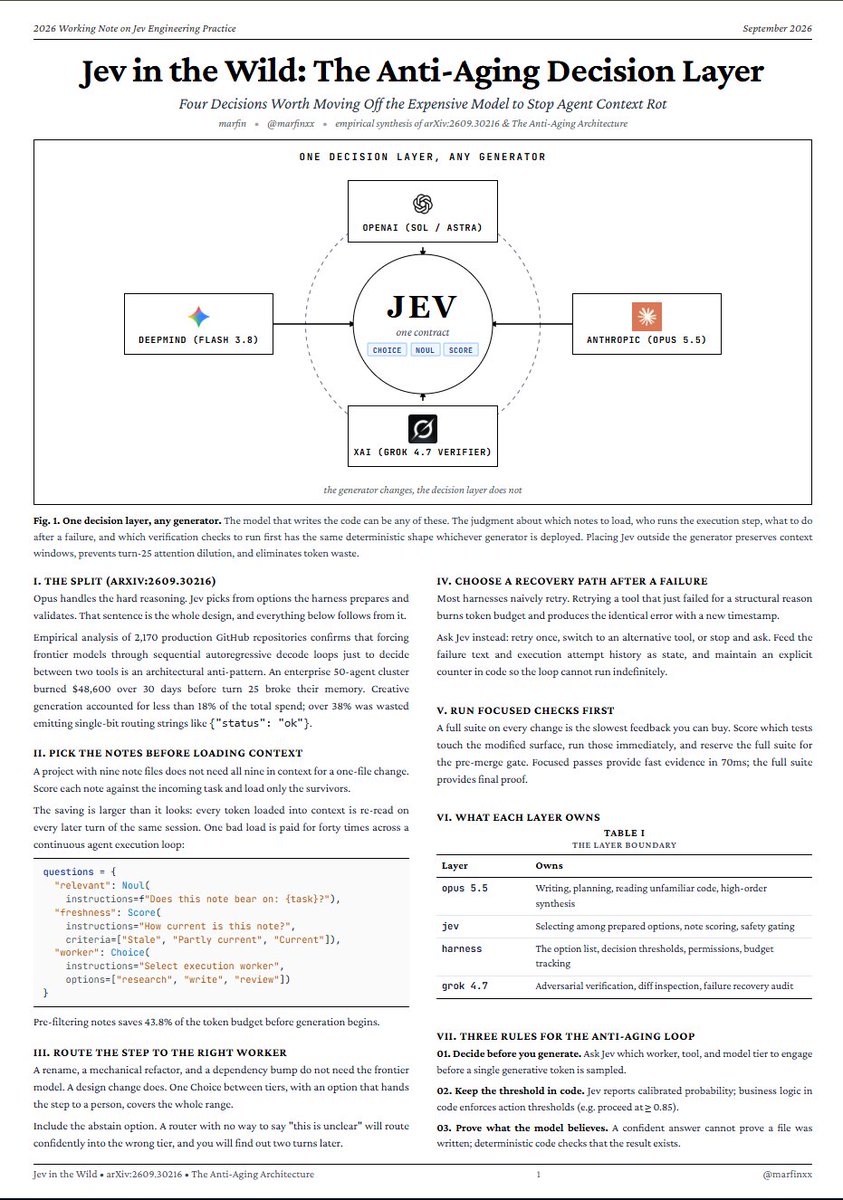
It powers Agent Lifespan Engineering and is more useful than most paid AI courses:
this is a 10-step blueprint on how to build a faster, cheaper and more controllable AI system around Claude, Codex, Grok or any other LLM:
step 1 → split the responsibilities: the LLM generates, Jev makes bounded semantic decisions and deterministic code keeps authority
step 2 → build the state: give Jev the current request, relevant evidence, policy and proposed action instead of sending the entire conversation
step 3 → choose the right primitive: Choice selects a route, Score evaluates an ordered rubric and Noul returns the probability that a statement is true
step 4 → replace giant evaluation prompts with atomic questions: intent, urgency, evidence, risk and scope become separate typed decisions
step 5 → put Jev before the LLM: select the context, tools, provider and workflow before paying for an expensive generative call
step 6 → give the LLM a bounded job: once Jev selects the route, the model receives only the instructions, files and tools required for that branch
step 7 → put Jev after the LLM: check whether the result answers the request, uses sufficient evidence and stays inside the permitted scope
step 8 → route by confidence: high-confidence low-risk cases proceed automatically, uncertain cases request more context and consequential actions go to review
step 9 → batch independent decisions: ask multiple Choice, Score and Noul questions over one shared state instead of creating another LLM call for every judgment
step 10 → record the complete decision receipt: state version, question, probabilities, selected route, model, latency, outcome and human override
most AI courses teach you how to write a bigger prompt
this 10-step blueprint teaches you how to build the control system around every prompt
the result: smaller contexts, fewer unnecessary LLM calls, safer tool execution and decisions you can actually inspect, test and improve
Send this working note and the original Jev article to Claude Code or Codex and start rebuilding one expensive LLM decision at a time ↓
THE $20,000 HUMANOID ROBOT MIGHT BECOME A $50,000 PRODUCT.
Not because the hardware gets 2.5x better.
Because humans might pay for what the robot feels like.
Think about it.
A company could sell the same underlying platform for:
$20,000 - industrial model.
$25,000 - home assistant.
$35,000 - premium design.
$50,000+ - personalized humanoid.
Same motors.
Same battery.
Same core AI.
But now add:
A realistic face.
Custom appearance.
Premium voice.
Personalized expressions.
A personality that remembers you.
Suddenly, you're not just selling a machine.
You're selling an experience.
And the market gets enormous.
Imagine 1 million households buying a $30,000 humanoid.
That's a $30 BILLION hardware market.
Now imagine those robots generating just $100 per month in software, services and upgrades.
That's another $1.2 BILLION in annual recurring revenue.
And that's before the robot performs a single hour of paid work.
This is why humanoid economics could be very different from traditional robotics.
Industrial customers will pay for productivity.
Consumers may pay for productivity AND attachment.
The machine creates utility.
The AI creates intelligence.
But the human connection could create the margin.
And that might be where the really big money is.
Det er svært at finde ord, når jeg skal takke for den overvældende varme og medfølelse, jeg har modtaget, efter mit afsnit af @112forknustehjerter blev offentliggjort. 🕯️ Jeg er dybt taknemmelig for, at I har delt jeres kærlighed, jeres historier og,