🌞🌊🚣1 scientifique + 1 barque + 20 minutes de balade = la formule des conférences embarquées ! Rendez-vous le samedi 31/08 au lac du Parc de la Tête d'Or à #Lyon pour des rencontres insolites...👇
https://t.co/fvNJcIs0qC
[Appel à candidatures 📢] Vous êtes étudiant·e en thèse ou post-doc? Vous souhaitez participer à l’organisation d’événements scientifiques et développer votre réseau?
Notre Bureau des Jeunes Chercheur·e·s est à la recherche de nouveaux membres!
➕ d'infos: https://t.co/NG9eaJRqcf
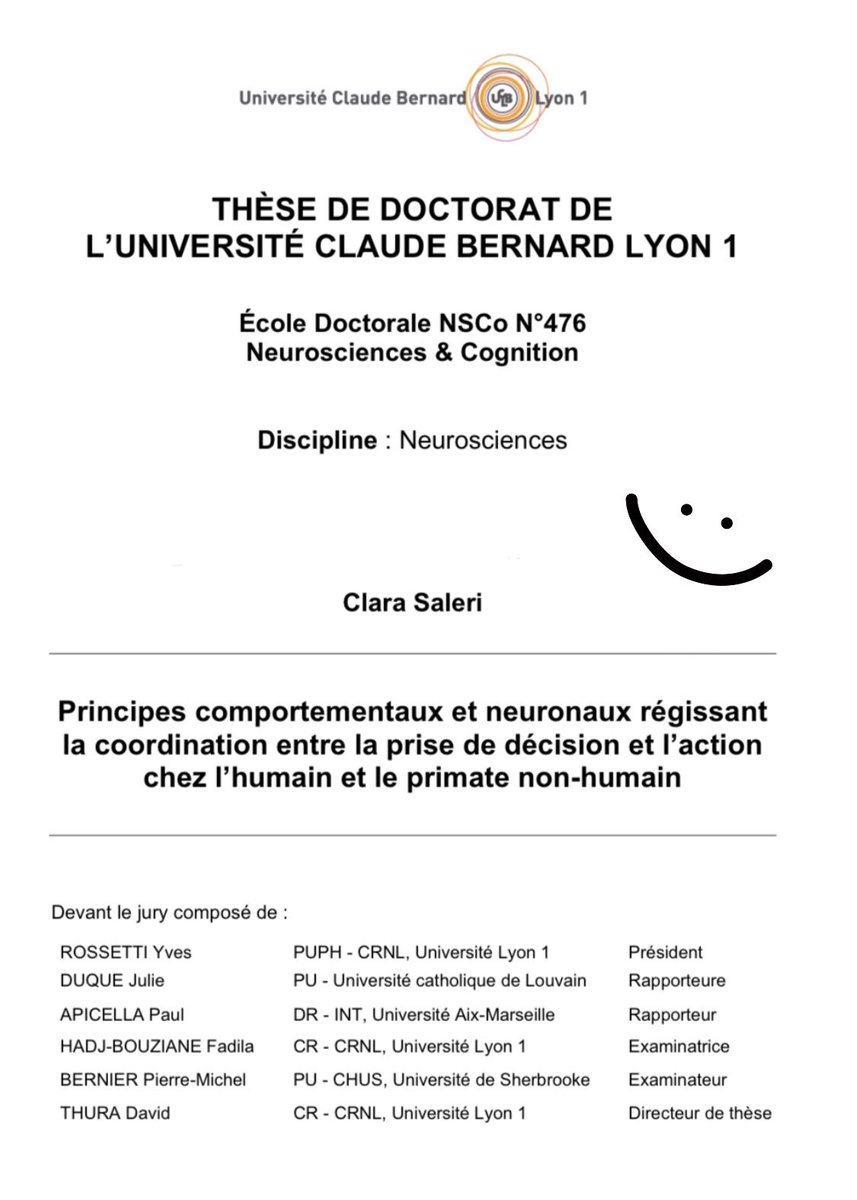
One step closer to the end of my PhD journey…
1285 days after becoming a PhD student, I finally submitted my thesis 🥳
Huge thanks to the best supervisor David (@Actarus25) for his unwavering support throughout this wild adventure!
📢 Wondering how to find a grant to finance your PhD/postdoc?
Don't miss our next NeuroMentoring session with @NguyenBaKT & Jean-Christophe Sandoz!
🗓️ 29/03/2024, 4:30pm on Zoom (link sent to Society members)
This important observation deepens our understanding of the control of decisions and actions during interactive behavior and makes the inference of the neural mechanisms of decision/action coordination in humans from electrophy. recordings in monkeys highly relevant.
[end]
Crucially, we propose that time is the most important factor determining this mode of coordination. We show that the regulation of decisions and actions evolve from a co-regulation to a compensation mode as the overall duration of monkey’s decision increases across sessions
[6/8]
We propose that such temporal compensation allows monkeys to limit the decline in reward value due to time-consuming processes, just as human subjects do.
[7/8]
In the present study conducted in monkeys, we reconcile these seemingly contradictory results by demonstrating for the first time that both modes of control occur in the same individual: decision duration and action vigor can co-vary but also compensate for each other.
[5/8]
It's now well established that decision and action are highly intertwined processes. Yet the mechanism underlying their coordination remains unclear.
[2/8]
However, our recent human studies indicate a decoupled control of choice duration and movement vigor, suggesting a more complex and context-dependent regulation of both processes.
[4/8]
I am extremely happy to share our latest study: Evidence for interacting but decoupled controls of decisions and movements in non-human primates (https://t.co/HgKh8KvZQo ) carried out as part of my doctorate under the supervision of @Actarus25 (David Thura).
Here is its story ⬇️







![SocNeuro_Tweets's tweet photo. [Appel à candidatures 📢] Vous êtes étudiant·e en thèse ou post-doc? Vous souhaitez participer à l’organisation d’événements scientifiques et développer votre réseau?
Notre Bureau des Jeunes Chercheur·e·s est à la recherche de nouveaux membres!
➕ d'infos: https://t.co/NG9eaJRqcf https://t.co/YQYY9bEmMv](https://pbs.twimg.com/media/GMF6vl2WMAAQitz.jpg)