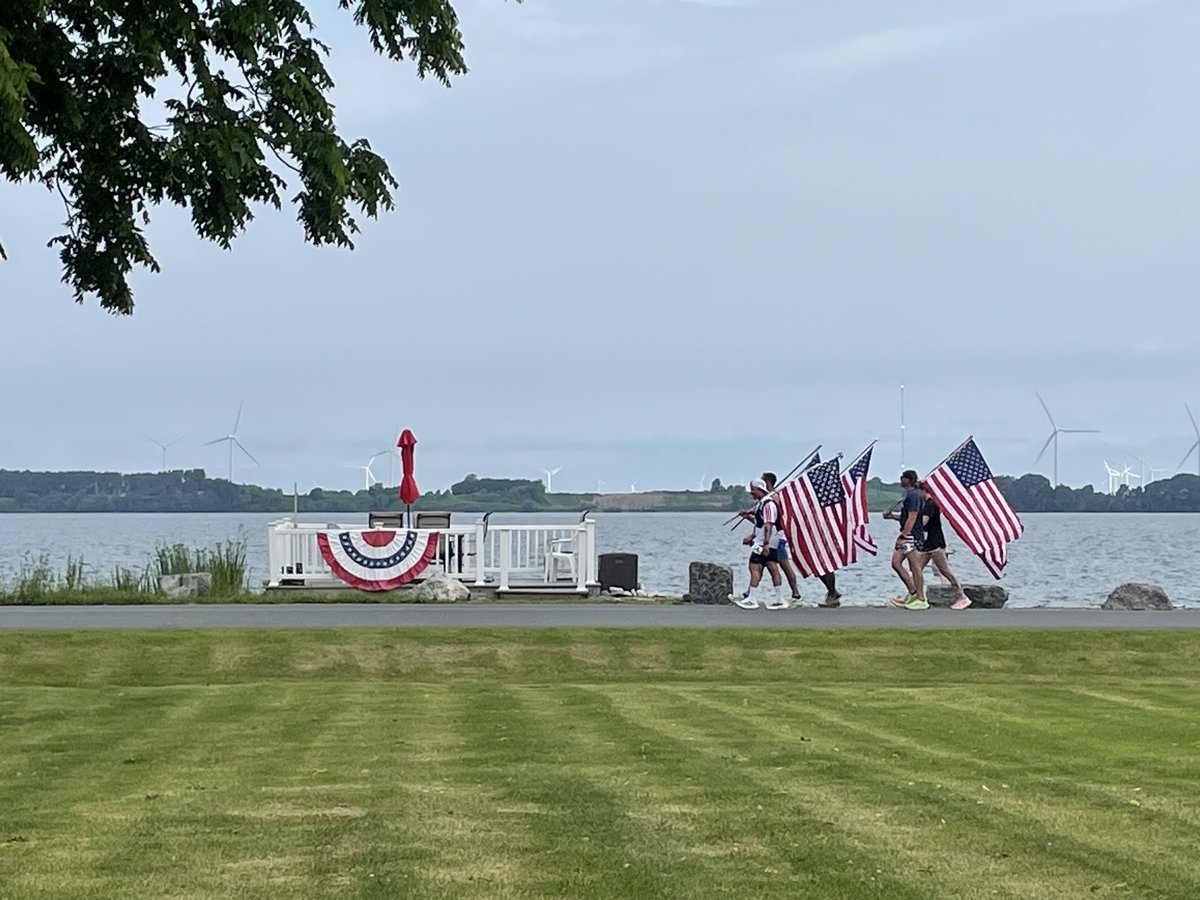
I revealed my method book for clarinet, flute, or violin entitled, "Bumblebee Loops: A Practice Guide to Performing a Lightning Fast Flight of the Bumblebee" last November. Now, the book is available via Amazon Kindle as well. The benefits to the Kindle…https://t.co/BpLmxTExu1
This video of Latvians singing The Lord's Prayer is so unbelievably moving and beautiful that I am going to pin it for a quick and easy timeline cleanse when needed. Bookmark this.
> Be Jonny Kim
> Born to South Korean immigrants in Los Angeles
> Grows up in an intensely abusive household, constantly full of fear
> The night before he graduates high school, his father threatens the family with a gun
> Police arrive, a shootout happens, and his father is killed
> Decides he wants to protect people so he enlists in the Navy at 18
> Survives Hell Week and becomes a Navy SEAL
> Deploys to Iraq twice as a combat medic, sniper, and point man
> Completes over 100 combat operations under fire
> Earns a Silver Star and a Bronze Star for saving wounded comrades
> Watches his close friends die in battle and realizes he wants to heal people, not just fight
> Leaves active duty to get a degree in Mathematics from USD
> Auditions for medical school and gets accepted into Harvard
> Graduates from Harvard Medical School as an M.D. in 2016
> Starts his residency in emergency medicine at Massachusetts General Hospital
> Gets bored of being a regular doctor and applies to NASA
> Selected as 1 of only 12 candidates out of 18,300 applicants
> Becomes a NASA Astronaut in 2020
> Decides space isn't enough, so he joins Navy flight school to face his fear of flying
> Earns his wings as a fully certified military pilot and naval flight surgeon
> Launches into space on a rocket to the International Space Station
> Logs 245 days in orbit, traveling 104 million miles around the Earth before returning home
> Returns to Earth as a SEAL, a Harvard Doctor, an Aviator, and an Astronaut at just 41 years old
And Jonny Kim is still the most humble guy on the planet who makes everyone else's resume look blank.
Jonny Kim is badass.
USA. Yellowstone. I met a warrior of two thousand pounds, and I was the only one who bowed.
He stood in the meadow like a hill that had decided to grow fur. The bison. Horned. Ancient. Wearing winter on his shoulders in the middle of June.
The visitors adore him. "Look at the fluffy cow!" said a woman, with real love in her voice. Fluffy cow. They speak of him the way one speaks of a beloved dog. I understand the affection. I cannot share the familiarity.
Because I have read the sign. The sign says he runs three times faster than a man. The sign says stay back twenty-five yards. That is not a warning. That is a herald, announcing a lord.
"In my land," I told the park ranger, "we would not call him fluffy. We would give him a name with thirteen syllables and build him a small shrine."
"Twenty-five yards works too," she said.
So I paid my respects from twenty-five yards. I planted my feet. I bowed — the full bow, the one for generals. The bison chewed, and watched me, and chewed.
My heart was not calm. The sign also says he can charge without warning. I bowed efficiently. Dignity has gears.
"He acknowledged you," said the ranger.
"He did not."
"No, he did not," she agreed. "But you did the right thing anyway."
That is the whole art, is it not. He owes me nothing. He fought wolves and winters and centuries, and won, and he does not need my bow. The bow was never for him to accept. It was for me to give.
Respect does not need to touch. It bows from twenty-five yards, and the meadow understands.
I will return every year. Same meadow. Same distance. He will not remember me.
That changes nothing. One does not bow to be remembered.
USA. A Mexican restaurant. We had not yet ordered anything, and the food was already arriving.
Chips. Salsa. Unrequested. Free.
I stopped the waiter. "We have not earned these."
"They just come with the table, man."
They come with the TABLE. In my land, hospitality is a debt. Every gift creates an obligation, weighed carefully, returned in the proper season with interest of feeling. Here, the gift arrives before you have even proven you can pay for dinner.
This is not an appetizer. This is a declaration: we trust you. Eat.
I ate with the gravity the moment deserved. And then — I must report this calmly — the basket emptied, and a new one appeared.
"Did we…?"
"Refill," the waiter said. "It's bottomless."
Bottomless. They have wells of salsa. The supply lines of this nation are beyond anything my ancestors imagined.
My friend warned me. "Don't fill up on chips, dude."
Too late. I had accepted three baskets. Honor demanded each one be finished — an unfinished gift is an insult. By the time my actual food arrived, I was a ruined man.
I was not hungry. I was not comfortable. I had been defeated by a courtesy.
Generosity that arrives before the request cannot be repaid. It can only be survived.
I know the rule now. I have made my peace with the basket. One basket. Two at the most.
Who am I deceiving. There is no number of baskets I would refuse. The trust of a nation is in that salsa, and I intend to honor all of it.
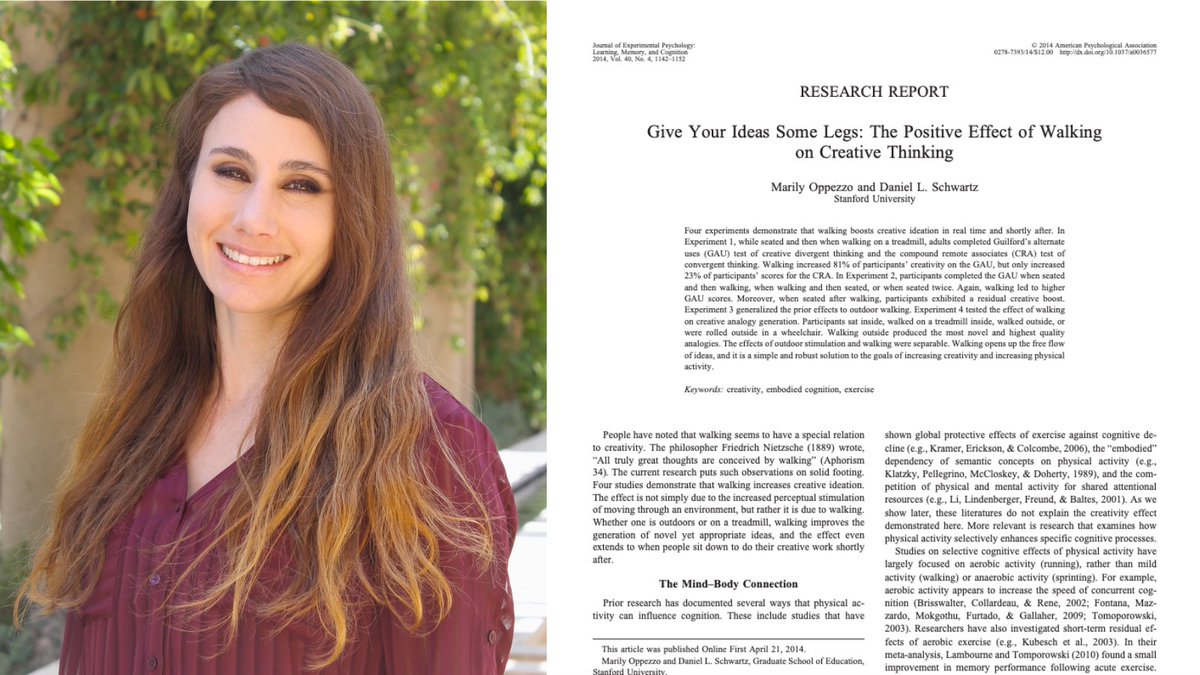
A Stanford psychologist spent 4 years proving that the simple act of walking generates 60% more creative ideas than sitting, and the experiment she designed to kill every alternative explanation is one of the most decisive findings in modern psychology.
Her name is Marily Oppezzo.
She got the idea for the study while walking with her advisor at Stanford to discuss her thesis topic, and the paper she eventually published in the Journal of Experimental Psychology in 2014 is sharp enough that it should have ended the seated meeting on the day it came out.
She ran 4 experiments on 176 people. Same person tested twice. Once sitting, once walking. The creativity tasks were the standard ones psychologists have used for decades to measure how good a brain is at generating novel useful ideas.
The result was almost too clean to publish.
81% of participants in the first experiment produced more creative ideas while walking than while sitting. In the second experiment, 88%. In the third, 100%. Every single person walked into a more creative version of themselves.
On average, people generated 60% more novel useful ideas the moment their legs started moving.
The skeptical question is the obvious one. Maybe it was the fresh air. Maybe it was the scenery passing by. Maybe it was the change of environment doing the work, not the walking itself.
Oppezzo killed every one of those explanations with one experimental decision.
She put people on a treadmill facing a blank wall. No scenery. No fresh air. No environmental change. Just legs moving in place while staring at white drywall. The 60% boost held.
Then she ran the experiment that closed the case completely. She took participants outside in two conditions. Half of them walked through a Stanford courtyard. The other half were pushed through the exact same courtyard in a wheelchair. Same outdoor stimulation. Same scenery passing at the same speed. The only difference was whether the legs were moving.
The walkers produced dramatically more novel high-quality ideas than the wheelchair group. The outdoors did almost nothing on its own. The walking did everything.
This is the part of the study that hit hardest when I read it the first time.
She also tested the opposite kind of thinking. Convergent thinking. The kind where there is one right answer and you have to narrow down to it.
Word puzzles where 3 words share a hidden fourth word that connects them. The seated participants did slightly better on these. Walkers got slightly worse.
Walking is not a general intelligence enhancer. It does one specific thing. It opens up the divergent search inside your brain. The part that generates options. The part that produces unexpected connections. The part that takes a problem and finds five ways into it instead of one.
When you need to converge on the single right answer, sit down. When you need to find the answer in the first place, get up.
The mechanism is now well understood. Walking selectively activates what neuroscientists call the default mode network, the system inside your brain that runs when you are not consciously focused on anything. The DMN is where mind-wandering happens. Where memories cross-reference each other. Where ideas that have been sitting in separate folders inside your head finally bump into each other.
When you sit at a desk and force yourself to concentrate, you suppress the DMN. When you walk at a natural pace, the executive part of your brain gets just busy enough handling the walking that the DMN comes online and starts doing the work that focus was blocking.
The most useful finding in the entire paper is the one almost nobody quotes.
The boost did not turn off the moment people stopped walking. Participants who walked first and then sat back down stayed elevated. Their next round of seated creativity work was still significantly better than people who had been sitting the whole time. The rest lingered for at least several minutes after the legs stopped moving.
You do not need to do creative work while walking. You need to walk before the creative work. The brain holds the state.
The history of this is the part that should haunt anyone who still does meetings in chairs.
Charles Darwin built a gravel loop behind his house in Kent called the Sandwalk and walked it 3 times a day for the rest of his life. The theory of evolution was developed one lap at a time on that path.
Nietzsche walked up to 10 hours a day during the years he wrote his most important books and openly said the work was conceived on his feet.
Beethoven composed for the morning and walked for 5 hours every afternoon with a pencil in his pocket for when something landed.
Kahneman said the best thinking of his Nobel Prize-winning career happened on leisurely walks with Amos Tversky. Steve Jobs refused to take important conversations sitting down. He held them on foot.
Every one of them was using the system Oppezzo would not measure until 2014. They just did not know what to call it.
The question worth sitting with is the one almost nobody asks.
Every meeting you have ever attended sitting around a table was a meeting held at a fraction of the brain power that was actually available to the people in the room. Every brainstorm that got stuck inside a conference room. Every problem you tried to solve at a desk and gave up on. Every idea you could not quite get to.
The intervention is the easiest one in modern science. No supplement. No app. No subscription. No training program. Just a pair of legs and 15 minutes.
The Stanford lab proved it. The philosophers knew it. The neuroscience explains it.
And almost everyone reading this is still trying to think their way out of problems sitting completely still.