New blog post out: what we learned running a 1024-validator devnet
In this post, we go through what running our largest Lean Ethereum devnet so far taught us about where the bottlenecks are, and how we can move forward.
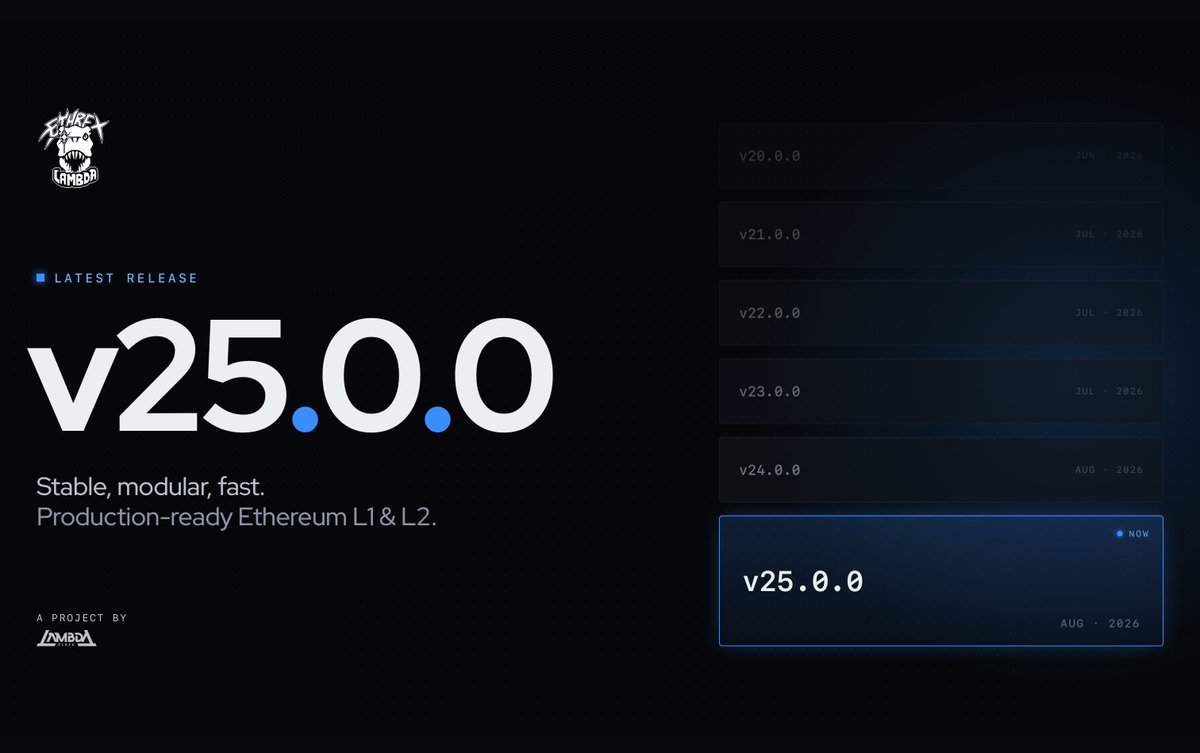
ethrex v25.0.0 ships an initial implementation for EIP-8079, native rollups, optional historical chain backfill, signed stateless-validator artifacts, a mempool default change, and more.
Learn more about what's changed 👇
Nico, an engineer at @class_lambda, showing teachers at a school in Buenos Aires how to use one of the many products we've been deploying across Argentina over the last few months. The product is already used in production and we're deploying multiple AI based solutions on top of it.
We're growing across multiple industries. EdTech is just one of them.
I don't talk about this side of what we do very often, but I'm proud of everything we're building.
Sometimes I feel we're going too slowly and that I'm not doing enough. I think that's what makes me wake up every morning, to do more and more. I want to deploy all this products in all LATAM and the world.
two billion dollars have already been traded through the infrastructure we built with @class_lambda and @gattacahq for @ethereum L1.
three months ago it existed only in a few people's heads.
what do we do? we provide the infrastructure that lets propAMMs offer better prices to traders. today they are already quoting tighter spreads than @binance and much tighter than @Uniswap.
a propAMM is basically a digital market where professional market makers continuously update their buy and sell prices in real time, so traders can get prices closer to what an asset is actually worth right now. binance has to run the entire financial marketplace itself. on ethereum, thousands of applications share the same underlying financial infrastructure, so a market maker can focus almost entirely on offering the best possible price.
there are three ways a product grows:
1. better marketing (Liquid Death, Red Bull)
2. better product (macOS/iOS, Claude)
3. better technology that creates better economics
we are doing the third. we just connect companies with better tech and since we provide better technology people just use us.
ethereum produces a block every 12 seconds, but markets move in milliseconds. our infrastructure lets market makers continuously update their prices while the block is being built. this dramatically reduces the risk of trading against stale prices, which lets them quote tighter spreads and gives traders better execution.
better technology changes the economics of the market.
we will soon do $100 billion through this infrastructure without marketing and without a consumer facing product. we don't need to convince people to use it. since the price is better, the flow follows.
for now we're doing mostly stablecoins, BTC and ETH are being traded through it. eventually real-world assets will be traded on top of the same infrastructure. i'm convinced that in a few years we will have banks using it too.
we are making ethereum the best place on earth to trade assets. we're upgrading Ethereum and the whole financial world.
thanks @kubimensah/@gattacahq, @rj_aligned/@alignedlayer and my team at @class_lambda for letting me be part of this journey.
the last few weeks i've been thinking a lot about products and things i want to build outside of crypto/finance, more in the real world, that i hope can achieve the same kind of impact on a similarly short timeline. i will be sharing more in the upcoming weeks.
Supply chain PSA: you may have seen that the Rust crates arrayref and append-only-vec were compromised via a malicious dependency that executed code at build time.
ethrex is NOT affected.
Building ethrex from source is safe.
a few weeks ago, we sat down with @therollupco with my boss and partner @kubimensah from @gattacahq.
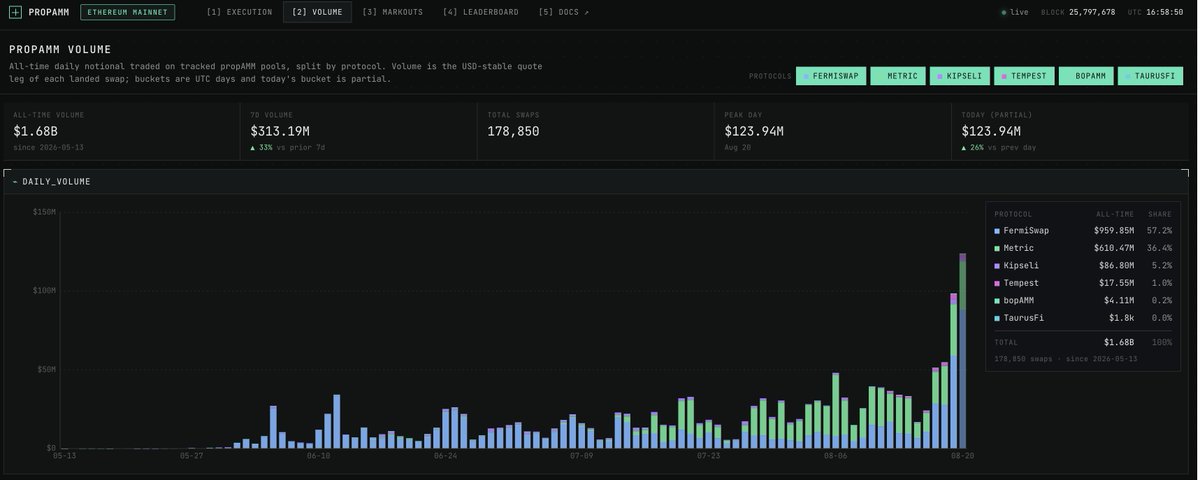
we explained how we’re rebuilding the entire infrastructure for propAMMs, and why we expected volume to keep growing: we offer cheaper execution than the alternatives. Volume would follow.
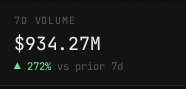
today, $123M in volume has already gone through propAMMs and the infrastructure we’re building on @ethereum L1.
and the day is far from over.
up only. @gattacahq × @class_lambda × @ethereum.
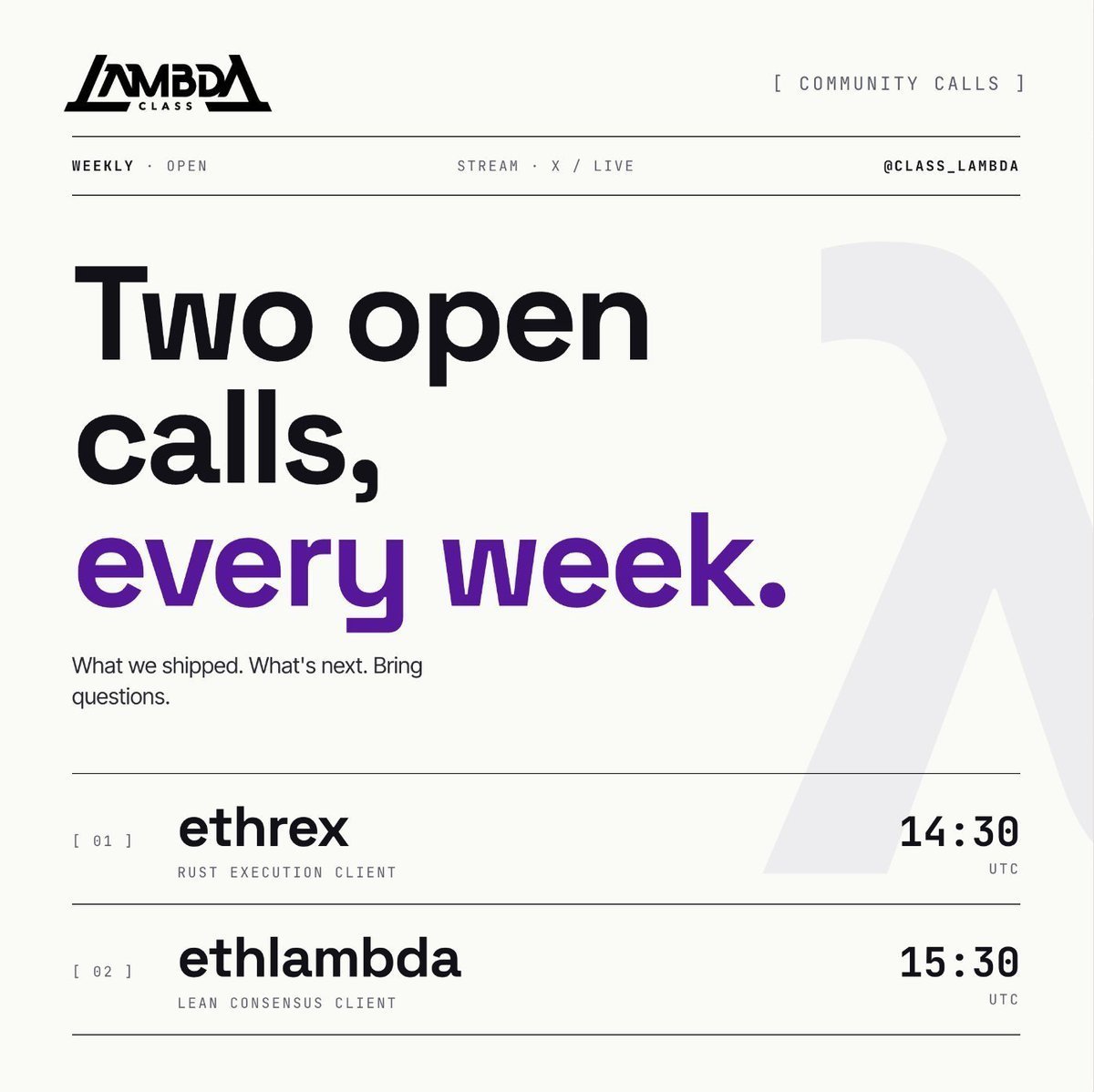
Tomorrow we're going live with two community calls. @ethrex_client at 2:30 PM UTC and @ethlambda_lean at 3:30 PM UTC. Come hear what we've both been building.
Metric is now live on our propAMM router.
@metricxyz and FermiSwap are the two largest pAMM venues on Ethereum. You can now reach both through one interface, with no extra integration work.
Integrate in a few lines:
https://t.co/L5lSdRso3W
ethrex is now the first client running the initial Frame Transactions Hive tests suite!
We are currently working on fixing the current failing tests and also making the test suite more robust.
More news on the frames front 🔜
While a big contribution to the future of Ethereum, ethlambda is only a piece of what Lambda contributes to the ecosystem.
In this post, we write about what we worked on and what we're building, including ethlambda, @ethrex_client, and Lambda VM.
Since reaching production readiness, ethrex has doubled as a playground for prototyping the future of Ethereum.
Over the last few months, alongside hardening the client and preparing the next fork, we've been working with EF researchers and EIP authors to turn their proposals into running code:
- zkEVM: EIP-8025 (Optional Execution Proofs)
- Account Abstraction: EIP-8141 (Frame Transactions)
- Privacy: EIP-8250 (Keyed Nonces), EIP-8272 (Recent Roots)
- Censorship resistance: EIP-7805 (FOCIL)
- Security: EIP-7906 (Transaction Assertions), the foundation for Trustless Clear Signing
- Payments: Native UTXOs
The post below covers the whole arc, from ethrex's beginnings to what we're building now. Deep dives on each feature are coming.
New blog post about our contribution to the core of Ethereum is out!
Go check out the development status of @ethrex_client, @ethlambda_lean, and Lambda VM.