We loved chibi, so we added partial stateful node support to ethrex.
A node for your wallet that keeps only the accounts and storage you use, verifies the values it serves, and follows the chain without executing blocks. Your wallet gets local JSON-RPC, with no RPC provider to trust.
In one Sepolia run: 29–34 MB of memory, about 3% of one core, and negligible disk usage beyond the binary. Anchoring took a couple of minutes while waiting for a peer that answered headers. Experimental and Sepolia-only for now, since it needs Glamsterdam’s block access lists.
We’ve also added experimental EIP-8440 execution chain proof support, with off (default), observe, and require modes. Require serves state only at blocks covered by a verified proof.
https://t.co/GkQgLmahWA
Let’s walk through what the node actually does 👇
We've been building the Miden client and contributing to the node and protocol alongside @0xMiden for a while now.
Counting down to Partner Mainnet on October 26. Excited to see it go live!
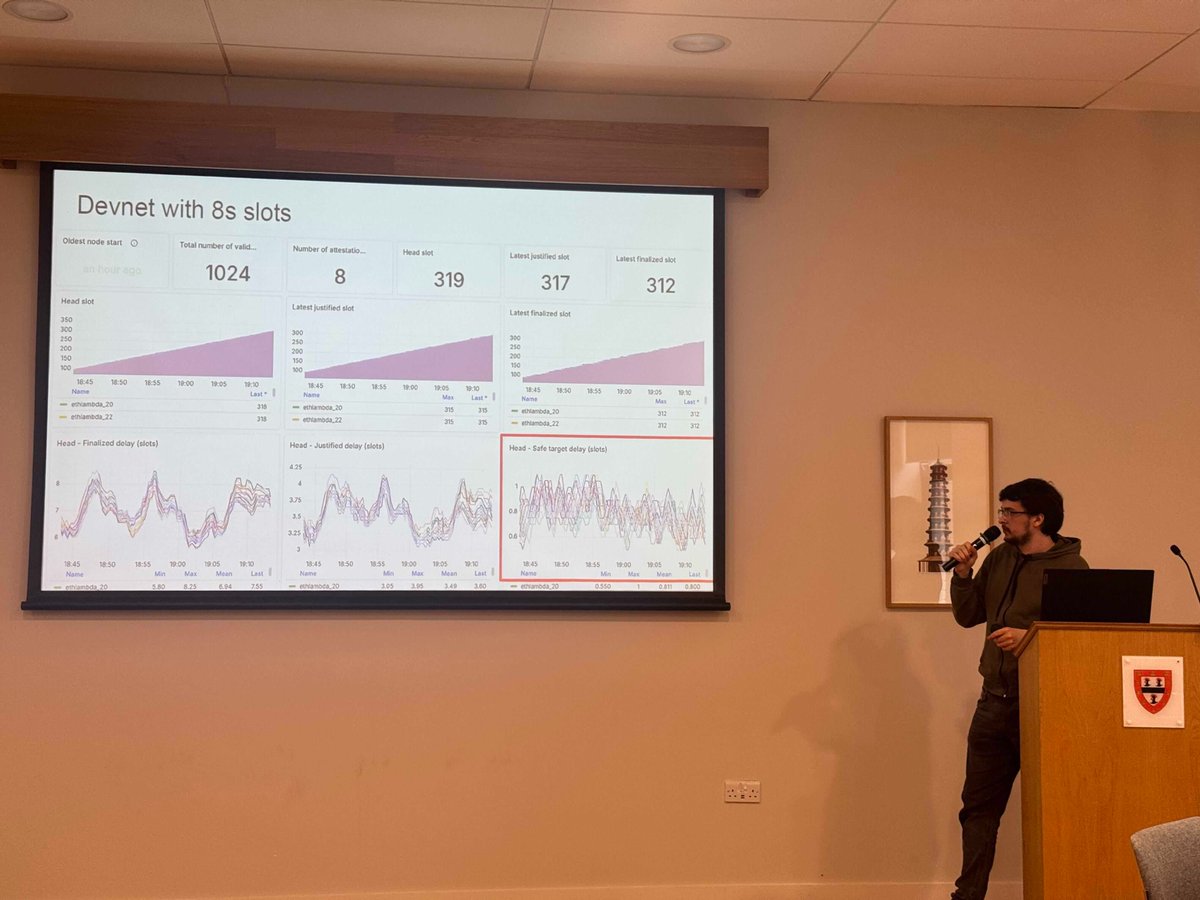
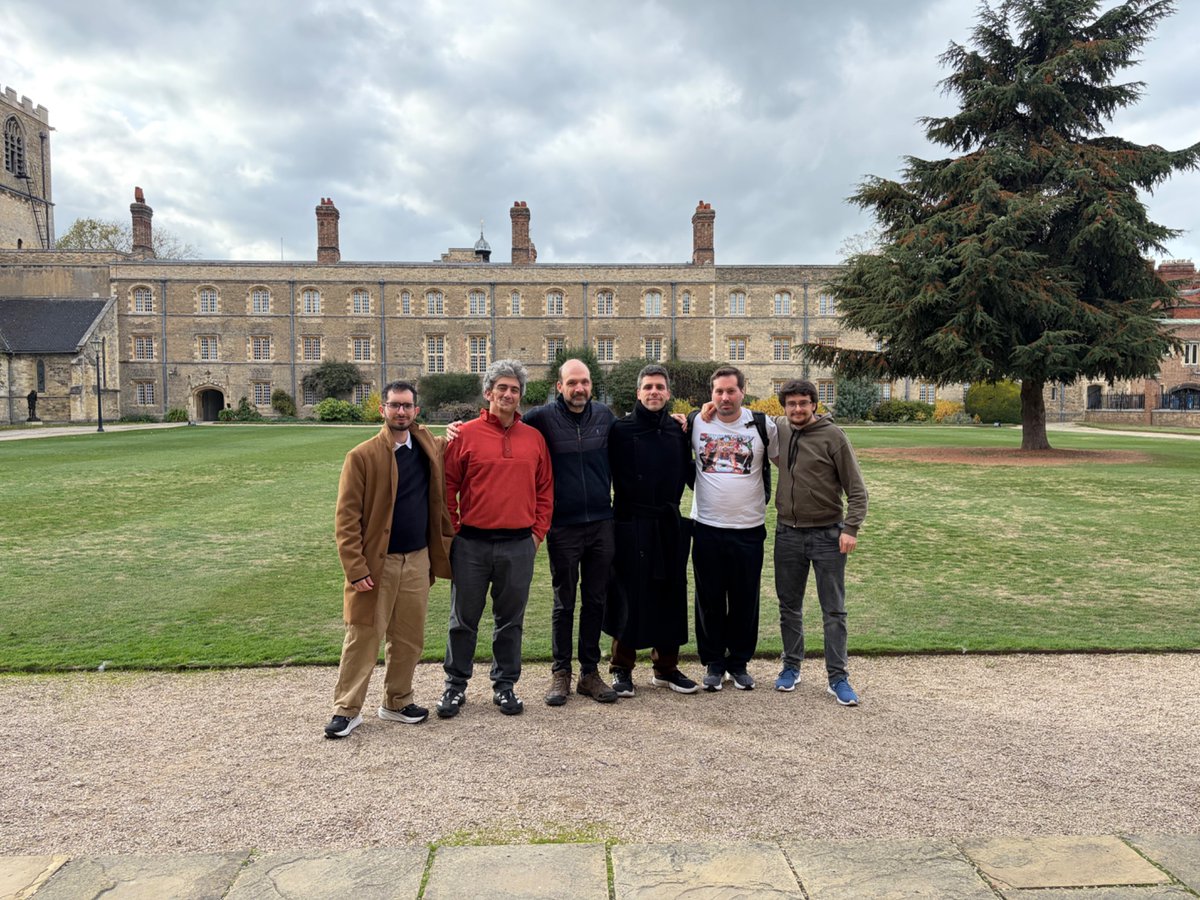
We spent last week in Cambridge for a workshop on post-quantum cryptography and fast finality.
A lot of work is going into making sure Ethereum's move to PQ doesn't come with compromises. We love being part of this effort, and we'll keep pushing it forward.
ethrex v30.0.0 schedules Glamsterdam on Hoodi. If you run ethrex on Hoodi, this is the release you need to follow the fork.
Hoodi activates Glamsterdam at timestamp 1793036568, which is 2026-10-26 17:42:48 UTC. This is the first ethrex release with the fork scheduled on Hoodi, so earlier releases stop following the chain at that point, and it needs to be paired with a consensus client release that ships the Hoodi Gloas config. Mainnet has no Glamsterdam time scheduled.
⚠️ L2: the prover and the SP1 guest move to SP1 6.9.0, and SP1 6 proofs need the SP1 v6.1.0 Groth16 verifier. An existing deployment's SP1 5 verifier rejects them whatever key is registered, so the order matters. Let every committed batch be verified before the upgraded sequencer commits anything, then upgrade the OnChainProposer and replace the verifier in a single Timelock call, upgradeToAndCall(newImplementation, upgradeSP1Verifier(newVerifier)), and register this release's verification key. Full procedure: https://t.co/FmYlds6DGY. Aligned mode is unavailable until Aligned ships SP1 6 support, and the OpenVM L2 prover backend is removed. L1 node operators are unaffected.
The rest of the release is mostly hardening, on the paths where something outside the node decides how much work it does. JSON-RPC parsing is bounded in memory and the Auth-RPC token is checked before the request body is read. eth_getLogs and log filter polls are bounded in cost, serving eth/72 cells to peers is bounded in CPU, and what a peer's transaction announcements can make the node track is bounded. Maps keyed by contract- or block-chosen values are seeded, and MODEXP gas is charged before its operands are sized.
Also in v30.0.0:
- RPC: eth_getFilterChanges reports each new log once, and the receipts of blocks still held in memory come back in full.
- Sync: snap/2 catch-up charges peers that cannot serve block access lists, and accounts left with no storage slots get the empty storage root.
- Performance and zkVM guests: calldata, CALL arguments and CREATE initcode are no longer copied per call, so zkVM guests stop running out of heap. Finality pruning no longer piles up overlapping range deletes, and state-history journaling skips layers that are already final.
- L2: the committer generates the prover input for batches another build sealed, so a sequencer that takes over, or batches committed again after a revert, can still be proven.
If you run ethrex on Hoodi, upgrade before 26 October. Everyone else, upgrade at your convenience. No resync is needed.
The Hive tests for Heze devnet 2 are live, and ethrex is the first EL client ready to run them. Our heze-devnet-2 branch is already passing the full suite!
The devnet itself hasn’t launched yet. Its planned scope includes:
- FOCIL (EIP-7805)
- Removal of the deposit and eth1data fields (EIP-8015)
- Disallowing new validators with 0x00 withdrawal credentials (EIP-8365)
- Quick Slots (EIP-8198)
Last week, we were in Cambridge for a workshop on post-quantum cryptography, fast finality, and formal veritication. We joined +100 people from across the ecosystem, including cryptographers, researchers, and engineers.
Ethereum needs to move toward a fully post-quantum future. We don't know when Q-Day will come, and that's exactly why we need to act now. The challenge is making that transition without compromising Ethereum. There's a lot of work ahead, and we're glad to contribute to it.
Thanks to @ethereumfndn and @drakefjustin for bringing us together.
From our point of view, yesterday's ACDC decision on EIP-8025 was the wrong call for Ethereum's long-term interests.
EIP-8025 proposes optional execution proofs, a first step toward the zkEVM roadmap, and the client teams declined to commit to it.
Framing the proposal as an "optional feature" may have worked against it. Calling something optional makes it easy to dismiss as low priority. To be clear, it was a proposal, and proposals can be accepted or rejected; nothing obligated anyone to approve it. And it is true that this feature does not inherently require a hard fork. But that is precisely what makes the question of commitment unavoidable: with nothing at the protocol level forcing the work to happen, progress depends entirely on whether people are actually assigned to it. Execution proofs only become real if client developers implement them, if testing teams build the coverage they need, and if DevOps keeps the infrastructure running. Declining to prioritize the proposal means the work simply does not happen. The optionality was meant for operators, those choosing whether to enable execution proofs, not for the people deciding whether the work happens at all. Operators should be able to opt in regardless of which client they run, and a decision taken without all teams present cannot credibly settle a question that depends on all teams delivering.
Optional proofs are the foundation of Ethereum's zkEVM roadmap. That roadmap is complex, and it demands extensive integration and testing across teams. Getting there requires a shared, sustained commitment.
We need to test under realistic conditions and investigate failures before consensus depends on proofs, and that work should proceed alongside research into mandatory proofs. Every integration bug we uncover now is one we won't be discovering after consensus depends on it. The more groundwork we lay today, the more bandwidth we have later for the challenges specific to mandatory proofs, including the ones we haven't found yet.
Meet @Stabileoapp, an open-source structural analysis tool built by @ergodicgroup.
It offers tools for both educational and professional use, from learning core structural analysis methods to more advanced engineering workflows.
Still in active development, and looking for people to test it and contribute.
Stabileo has two main modes:
Basic solves structures with the stiffness method with conceptual explanations, useful for learning.
PRO adds finite elements, and we're developing reinforced concrete design and steel connections.
You can switch between them at any point.
At the latest ACDT meeting, we decided to rename the devnet branches to better reflect their scope. The FOCIL devnets are now called Heze and will include CL EIPs, while the Frames devnets are now called Bogotá and will include EL EIPs. The combined devnets that follow will be called Hegotá, following the usual naming convention.
The launch of bogota-devnet-1 (formerly frames-devnet-1) is just around the corner, with EIPs 8141, 8250, 8272, and 7906 included. The latest execution spec tests release ([email protected]) is already out, and we’re passing all the tests!
We’re excited to see this devnet go live! https://t.co/Kzo3pIMhBH
I'm really excited to share that we're building a new research lab for onchain financial markets at @zondamarkets, together with @polfinance_.
We've been collaborating for a year now, starting with tokenomics analysis and then exploring ideas on how to build better RFQ systems, which helped us gain a deeper understanding of propAMMs.
Since the emergence of propAMMs on Ethereum, we've been actively collaborating with @class_lambda and @gattacahq to help improve the technology and better understand how these systems behave.
To experiment and bring some of our knowledge onchain, we decided to build our own propAMM, called elzorro (managed day-to-day by @polfinance_), using the propAMM factory built by @class_lambda.
We'll be sharing more about our experience running the propAMM soon.
If you're looking to launch your own propAMM on Ethereum L1, or you're a token issuer interested in learning more about this technology, feel free to DM us to see how we can help.
Introducing PropAMM Factory.
An open-source toolkit to deploy and operate your own PropAMM, with everything from contracts and pricing to builder integrations and monitoring.
Already powering ElZorro on Ethereum mainnet.
Read the blog post:
https://t.co/lxGaIhj07M
i’m again on the road. on my way to cut a big deal
thank you @class_lambda for all the work you are doing in @ethereum. our contribution is still small. i’m confident it will become bigger and bigger with time
I’m In Cambridge with @drakefjustin@class_lambda@ethereumfndn learning and debating with more than a hundred cryptogtaphers from all around the world. i feel like a kid super excited learning from such bright minds.
the speed at which AI is accelerating things is inhuman. i’m truly convinced that we need to accelerate and upgrade fully to post quantum cryptography. we don’t know when q-day will arrive but it’s not that far away.
i’m thankful to Justin and the ethereum community for inviting me. Justin is one of the main reasons I stayed and doubled down on Ethereum and ETH. all the money i make in the next few years will be reinvested in making ethereum and cryptography better.
It’s been a couple of weeks since the first official Frame Transactions devnet launched.
frames-devnet-0, which includes only EIP-8141, will soon give way to frames-devnet-1, adding EIP-8250, EIP-8272, and EIP-7906.
The execution-spec tests for frames-devnet-1 ([email protected]) came out today, and ethrex already implements the required changes and passes the full suite!
We’ve been working on these EIPs for a while, and it shows 😉. Getting ready for devnets is starting to feel routine 💅.
ethrex continues to push Ethereum client performance forward.
Leading stateful Glamsterdam repricing benchmarks and in the top 3 for the compute ones, with more optimizations on the way.
ethrex leading stateful Glamsterdam repricing benchmarks 🫡
We are in the top 3 for the compute ones, and after a couple of performance improvements land on main, we'll likely lead that one too.
ethrex handled Sepolia’s transition to Glamsterdam without issues!
We’re running 100 validators on Sepolia across different setups, all backed by ethrex.
After our first appearance in an EF upgrade announcement, we’re proud to follow through with a smooth fork on Sepolia and help ship Ethereum’s next upgrade. Next stop: Hoodi, with our sights on mainnet.
A shoutout to @ethlambda_lean: ten of our validators ran ethlambda, and all ten performed as expected through the transition.
we just made @ethrex_client again the fastest client in @ethereum. i've always said, lambda would deliver and push the boundaries of ethereum.
after a couple of months focused on Glamsterdam hardening and Hegota prototyping, including hosting several public testnets for the most important EIPs coming in Hegota, we've turned our attention back to performance. this doesn't mean we're stepping away from that work, where we still have a lot to contribute.
The early results are very promising. In just a couple of days, we brought block processing time down from ~40ms to ~26ms in mainnet, making ethrex the fastest client once again. The image below compares how we perform today (ethrex-baseline) with what we've been cooking (ethrex-testing).
congrats @class_lambda, i'm proud of the team we've built. i love working with people that are way smarter than me.
thanks @ethereumfndn for the constant support.