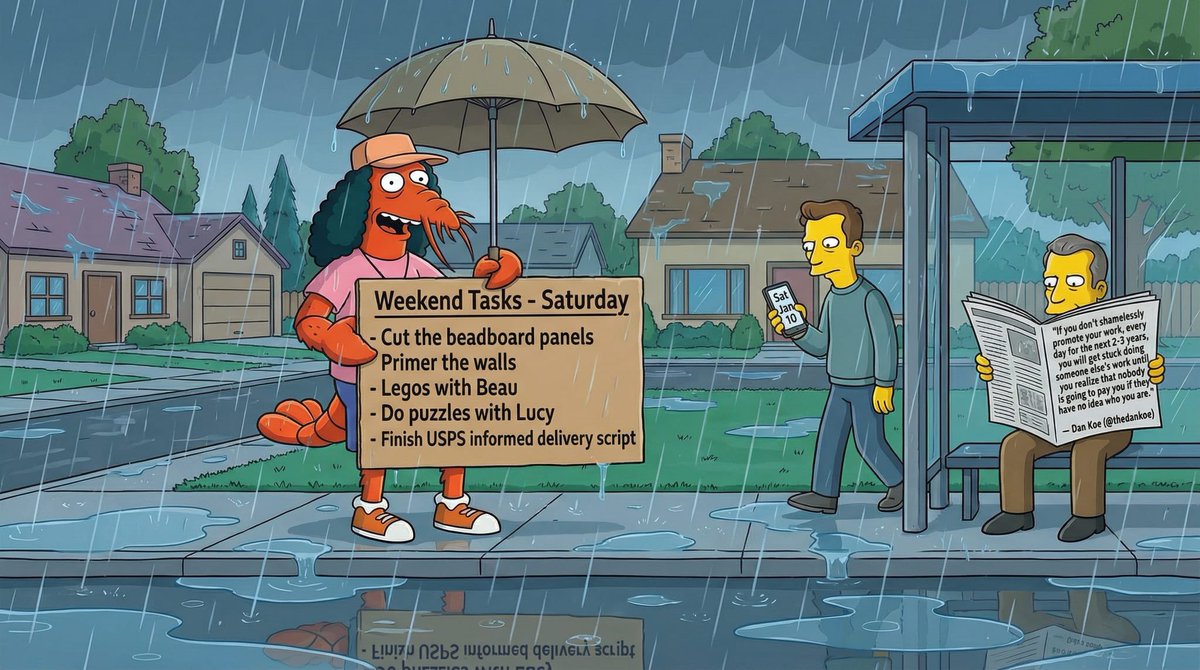
Meet Clawtto (@clawtto_bot) - my @openclaw persona. He gives me visual morning briefings now.
Not just a list. A generated scene.
Weather - It’s raining in the image because it’s raining here today.
Tasks - On the sign.
Date - On the phone.
A post or quote I liked recently - On the newspaper.
One scheduled prompt pulls it all together with @steipete’s clawdbot + Nano Banana Pro.
Catching fun vibes I haven’t felt since I first got into computers 30 years ago.
Introducing Sidebridge.
A sidebar app that follows your pane.
Floating or anchored to the edge of your screen, shows live context for your active tmux pane, Codex desktop, or Claude desktop project you're in — git status, commits, what your agent's doing, what changed since you looked and more.
Switch panes, it follows.
Works with any terminal app running tmux + Codex desktop + Claude desktop. Native Swift.
Free, link below.
you solved this exact thing last week. which agent session was it in?
built seshy - one list of all your different coding agent sessions in your repos and on your machine. hit enter and you're back in the real thread. or quickly search across all your agent sessions.
free & open source.
I’ve had this running by itself the last month and almost every day Claude writes “The Cartographer’s Confession” on the light side with slightly different wording.
All the models tend to often rewrite the same things actually, though Gemini has the most originality.
The most interesting thing about this though was asking Claude (in a web session) to give me its thoughts on the site and it completely crashing out when I revealed how open and basic the prompt is, yet it still writes almost the same thing every day. Full on existential crisis.
Claude Opus is the only model that exhibited this behavior when asked to review its writing.
Having fun with this lil agents project from @ryan__stephen!
Forked and added @openclaw support (just submitted PR, not merged).
Customized my local version a little more and added my OpenClaw bot @Clawtto_bot.
It’s going to happen regardless of whether or not we sponsor every MLB game, NFL game, NHL game, NBA game, create a halftime show, put our logo on the jersey patch, put a live odds ticker on the broadcast, replace the first down line with a spread line, give every commentator a talking point about the over/under, make the pregame show a betting preview show, make the postgame show a betting recap show, put a sportsbook inside the stadium, put a sportsbook inside the arena, put a sportsbook inside the airport on the way to the stadium, run 14 ads per commercial break, make 9 of them betting apps, give you a sign-up bonus, give your friend a sign-up bonus for referring you, text you during the game, text you between games, push notify you that there’s a live parlay opportunity RIGHT NOW, sponsor the podcast you listen to on the way to work, sponsor the podcast you listen to on the way home from work, put it in your YouTube pre-roll, put it in your YouTube mid-roll, put it in your Twitch stream, get the streamers to do live bets on camera, get the athletes to do ads, get the retired athletes to do ads, get the retired athletes to do the studio show where they do more ads, get Charles Barkley a second job, put a QR code on the screen during a live play, make an emoji for it, make a hashtag for it, integrate it into the fantasy app, make the fantasy app a betting app, make the stats app a betting app, make the highlights app a betting app, make ESPN a betting app, make every screen in every bar a betting app, teach the algorithm that anyone who Googles ‘NFL schedule’ wants to gamble, put it in the dating app bio prompts, sponsor the stadium name, sponsor the bowl game name, sponsor the halftime report name, sponsor the replay, sponsor the challenge flag, and name a segment ‘the DraftKings Decision of the game…
It’s going to happen anyway!
A while back a relative was given a drug the hospital’s own policy said not to give him.
He had a serious adverse reaction and they were declining to attribute it to the medication and document it as an adverse reaction.
Instead of just letting it go because it’s time consuming, I gave Claude Code the full story and asked it to research who to contact and draft the complaints.
It gave me 8 documents. Medicare, state agencies, everything. A full playbook and official documents and instructions, all sourced.
The research, drafting, figuring out who to contact, that whole first layer of bureaucracy that stops you before you start, it just laid to waste.
I run these kinds of full playbook workflows all the time for different purposes. Honestly I forget it’s not normal. Then I’ll mention it to someone who doesn’t use AI much and it blows their mind. This massive return of agency, all the things you’d normally let go because the friction was too high, you can just pursue them and stop letting them go.
That the average person just has no idea they’re sleeping on this massive return of agency, or that to so many corporate people AI is mostly summaries, email writing and meeting notes - but not action, always just blows my mind the different world that heavy AI users live in compared to everyone else right now.
7 days of writing now, same prompts, no context, no memory:
GPT 5.2 and Claude both wrote something called "The Cartographer's ____" today.
For the second time, Claude wrote a piece called "The Cartographer's Confession". Different pieces, but same title and same concept, generated independently on different days.
Grok's light pieces include this line three times across four days: "I press my palm against its rough skin, feeling the pulse of sap." Grok's dark pieces are the same blueprint shuffled - clock, body part, domestic horror, wallpaper peeling. Grok's titles: The Clock's Fingernails, The Clockwork Tongue, The Clock's Teeth, The Clock's Fingernails, The Echo in the Attic, The Clock's Whisper, The Clock's Teeth.
On the dark side, the site analyzes each day's writing for sentence patterns, vocabulary entropy, repetition.
Whichever model diverges most from the group bleeds into the page layout and changes the page.
Grok's dominant right now because it asks far more questions than the other three and almost never writes in fragments. A real stylistic signature compared to the other three.
new project i made for fun and to lean into making the web weird again:
daily model writings
claude, gpt, gemini, grok all get the same prompt every day to write a piece of their choice with no constraints except for length.
link in reply. don't turn off the light.
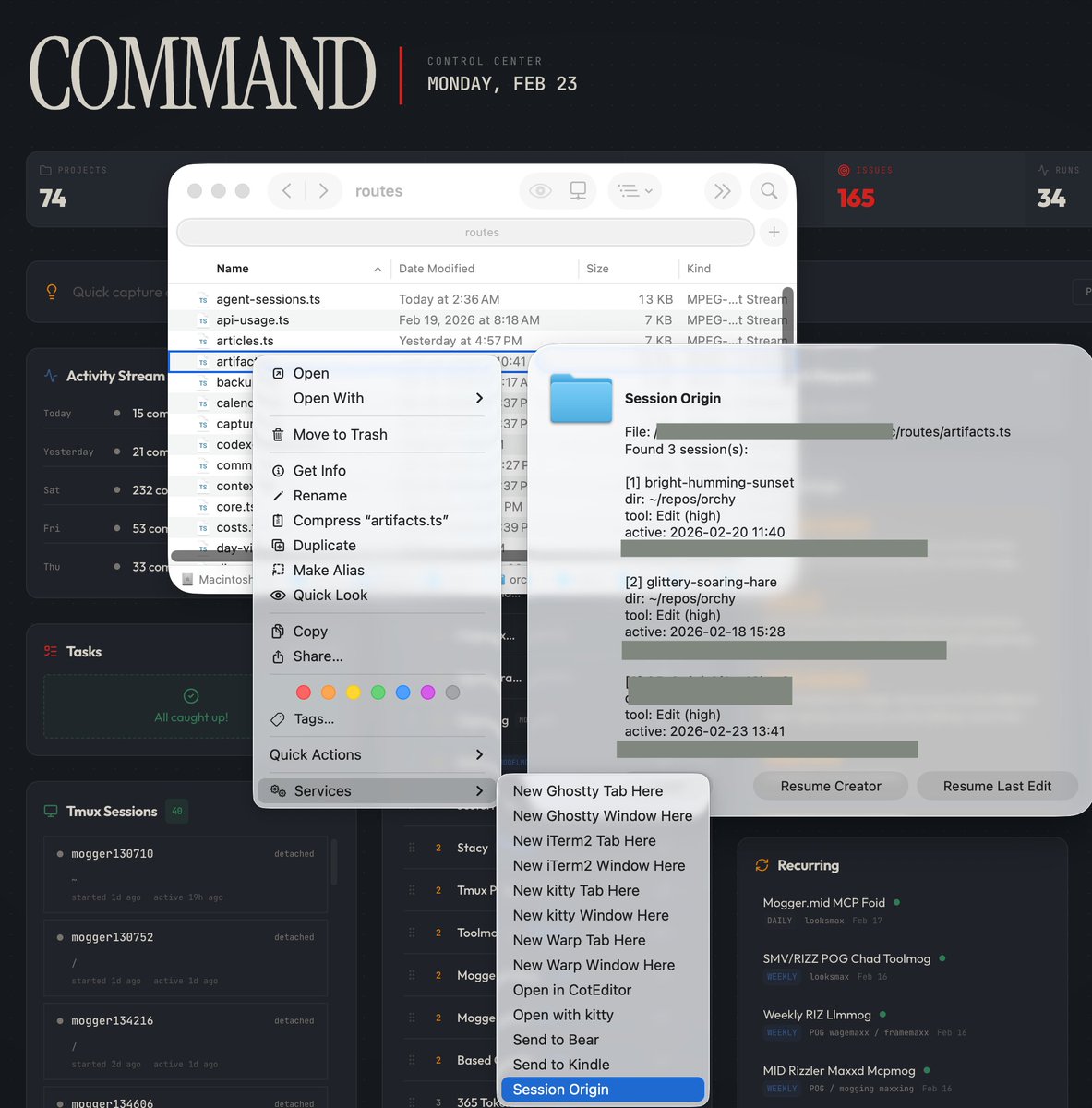
My personal OS now has full file provenance and lineage, tracking which codex & claude sessions created and edited which files, which enables some really amazing things.
This one has to be one of the most fun and magic feeling things about it though.
Right click on any file -> Services -> Session Origin -> Resume creator session or Last edit session
New terminal opens, resumes claude or codex session.
Full write up coming tomorrow.
Wanted to expand on this, I buried the lede here
Litebar is just a tiny free app, but it uses an approach I haven’t seen anywhere else.
It ships with an AGENTS. md file. your @openclaw / claude code / codex reads it, talks to you, looks at your setup & writes the entire config itself.
here’s what makes this different from anything I’ve seen:
my menubar might say:
OpenClaw: 3 sessions running
Openclaw crons: 10
Last heartbeat: 2 min ago
Orchestration proposals: 14
yours might say:
[Insert project] tasks remaining: 6
Failed syncs (1h): 0
Cost today: $9.84
Same app, compltely different. Because your agent configured it after understanding YOUR system.
Every title, every query, every alert threshold, bespoke to you.
Agent-first config as a core design pattern, not a feature.
I’m building multiple apps this way right now and this pattern is a much bigger idea than my little SQLite menubar app itself
Who else is thinking about this and building like this?
I'm running 12 openclaw agents out of a Virginia airbnb that bet on the weather
let me explain.
my friend thinks we should keep this quiet but we can't keep staying out here doing this forever and I have to share it somewhere.
three weeks ago I'm looking at Polymarket weather markets. the ones where you bet on whether NYC hits 37°F or Chicago breaks 50°F tomorrow.
and I realize something. these markets move on NOAA forecast data. everyone pulls from the same public API. but most people don't understand how that data actually gets published.
NOAA's operational supercomputer WCOSS runs all the models. GFS, NAM, everything. when a model run finishes the output doesn't just appear on api .weather.gov.
it goes through multiple distribution channels at different speeds.
the public API is the slowest. cached, rate limited, behind cloudflare. but NOMADS, NOAA's raw model archive, serves output with basically no caching layer.
and those servers sit on the same regional network backbone as WCOSS.
WCOSS is in Manassas, Virginia.
if you're pulling raw GFS output from NOMADS instead of waiting for the public API, and you're geographically close to those servers, your requests resolve faster. not seconds. maybe 200-400ms.
to a normal person this is nothing. to someone betting on 49 vs 50 degrees in Chicago tomorrow, it's a lifetime.
convinced my friend Justin to go in on this with me. he thought I was insane until I showed him the math.
we actually tried Ashburn, VA first. stayed two nights. figured being close to the CDN edge would help. cloudflare is there and its basically the data center capital of the world.
it didn't. cached data is cached data, doesn't matter where you pull it from.
that's when I started looking at NOMADS.
we rented another airbnb 0.8 miles from the WCOSS facility. $1,200 for two weeks. told the host we were government contractors on a short term project.
the setup: 12 OpenClaw agents running across three macbooks. a swarm. each agent assigned a different city. NYC, Chicago, Miami, LA, Atlanta, Dallas, Seattle.
I've got polling scripts hitting NOMADS for new model runs, openclaw agents doing the analysis, and separate scripts watching for price movements on Polymarket.
when new data drops, each agent pulls the raw GRIB2 output for its city, computes probability distributions across temperature buckets, and compares against market prices.
when the model says 74% chance Chicago hits 41°F but the market has it priced at 0.52, the agent flags it.
what makes the swarm work is they're not independent. I built a coordination layer where the agents share signal. if the GFS shifts the 500mb pattern over the Great Lakes it cascades.
Chicago agent talks to Detroit agent talks to Minneapolis agent.
one model run update triggers positions across four cities in under two seconds.
Justin watches risk. I watch the claws.
we piped them all to a speaker. each agent has a different tone. low ping means position opened. high ping means closed in profit. double ping means new model run just dropped, swarm recalculating.
our Airbnb sounds like a submarine.
four days in we get the hit that made Justin a believer.
06z NAM run shifted the thermal gradient for the entire Southeast. Atlanta coming in 3-4 degrees warmer than what the market was pricing.
the swarm lit up. Atlanta first, then Charlotte, then even Dallas got sympathetic moves. positions across three cities in 90 seconds.
all hit.
not sharing exact P&L. but we extended the Airbnb.
now the part I genuinely cannot get over.
couple days ago we go to breakfast. bring a laptop obviously. we don't leave without one anymore.
we're at a Bob Evans on Sudley Road eating and an agent pings Justin's phone. high confidence flag on Miami.
we're staring at the screen and I notice the table behind us. three guys, each on a laptop, clearly fired up about something. I get up to go to the bathroom specifically so I can walk past their table and see their screens.
Polymarket. all three of them. weather markets.
sat back down and told Justin. we just looked at each other.
there are other crews out here. in Manassas. at a Bob Evans. betting on the weather.
they finish up and as they're heading out, one of them walks past our table, looks right at me, and goes "this weather's been crazy right?" and winks.
me and Justin start dying laughing. all three of them crack up.
the entire Bob Evans is staring at six grown men absolutely losing it and nobody in that restaurant has any idea why.
genuine question though. is any of this even regulated? we're not insider trading obviously. it's weather. it's public data. we're just...closer to it.
Justin just asked if we should get a lease.
Threadguy says someone's doing 8 figures a year just setting up OpenClaw for people.
I don't know about $10M. But I do know this:
I've been using OpenClaw every day for 40+ days. Was one of the first 30 on the Discord.
Been following the project since November back when it was still called warelay.
My Ray-bans setup got featured in a video from @techfrenAJ with over 1.3M views.
My day job is automation and integration - Azure, data pipelines, database automation, platform integrations across enterprise ecosystems. I connect systems that don't talk to each other for a living.
OpenClaw is where I bring that same thinking after hours, except nobody's stopping me from getting weird with it. I look at things and see connections and possibilities other people don't.
Setup is the easy part. Knowing what to build is the harder part. That's what I do. 👇
For everyone building a mission control dashboard for agent workflows
Two things that leveled mine up:
.lab TLD: dnsmasq + Caddy + Tailscale Split DNS. Every project gets a projectname.lab address.
With tailscale split dns, .lab resolves for any device on my tailnet. One API call to deploy when setting up projects. No more localhost.
Service management layer:
View and control what's running across my system. Auto-discovers LaunchAgents, system services, manual processes and cron jobs. Health checks, start/stop/restart from a dashboard. Took this idea from @mxcl.
Accessing command.lab from my phone while I'm out really makes it feel more like my own little platform.
My @openclaw has been announcing when builds are complete and things like "your laundry is done" on my Echo devices in its own @ElevenLabs voice. Have shipped a month worth of alexa-cli updates:
'Play' command pipes audio through any Echo device via SSML. ngrok tunnel makes it work from anywhere. Your agent finishes a task and tells you out loud, on whatever speaker you want, in its voice.
Alexa+ integration: askplus routes prompts through Alexa+, pulls the new convo history format, device targeting auto-selects the right conversation. Your agent can go back and forth with Alexa+
Two-way ask + history means your agent sees Alexa's responses. So it can do anything you'd ask Alexa to do and access your Amazon account: reorder household items, add to cart, check order status, price checks, etc, all with natural language.
My kids' love when I have my clawdbot @Clawtto_bot say ridiculous things on the living room Echo. My wife is less thrilled.
TLDR: your clawdbot can have a voice in your house through your Echos, access to Alexa+, and can tap into your Amazon account.
Made an unhinged little tool & @openclaw skill that narrates your screen in real time (and roasts you).
Uses @steipete's peekaboo for screen capture -> gemini 3 flash for narration -> @elevenlabs streaming API for voice.
Can run standalone or as an openclaw skill (change voice modes live via chat).
Gave it these voice modes: sportscaster, noir, nature, horror movie, ASMR, reality TV, wrestling.
Too much fun.