Writer | Pianist | Romanticist | Votary of Gothic literature | Devoted animal lover | Author of A Ride Through Faerie & Other Poems (Gothic Keats Press, 2021).
I was honored to discover yesterday on the 200th anniversary of George MacDonald’s birth that my poem “The Faery Wood” was selected for the Highly Commended Award, one of two prizes given for this year’s MacDonald-themed Brian Nisbet Poetry Award.
Although it’s been years since I first watched the series, I can highly recommend Penny Dreadful to lovers of all things Gothic and Romantic. Besides Clare, you’ll also hear fragments of poems by Keats, Shelley, Wordsworth, Blake, and others. Since the link didn’t “preview”, here it is again: https://t.co/DeL0rPW0iz
Clare’s incredibly moving poem was also recited quite beautifully by Rory Kinnear as Frankenstein’s monster (who went by the alias of John Clare) in the brilliantly Gothic series Penny Dreadful (2014-16). Perhaps something for World Goth Day. #WorldGothDay https://t.co/lfj8hHfjD3
We're remembering the poet John Clare today on the anniversary of his death in 1864. His life was a tragic one, and his last 23 years were terribly sad. This is 'I Am', a poem Clare composed at Northampton General Lunatic Asylum (now St Andrew's Hospital) in 1844-45.
“I am now so depressed that I have not an idea to put to paper—my hand feels like lead—and yet it is an unpleasant numbness, it does not take away the pain of Existence. I don’t know what to write.”
—John Keats, 21 May 1818
'Beatrix Potter's Myriads of Fairy Fungi' looks to be another fascinating talk by Dr Penny Bradshaw. To be held Friday 22 May at the Armitt Museum and Library.
Have a look here https://t.co/BoMNy878fr
I’m reminded of Robert Frost’s poem “Fire and Ice” (1920) today for #FairyTaleTuesday’s theme. I like the idea that the poem was possibly influenced by Dante’s Inferno (the poem’s 9 lines paralleling the 9 rings of Hell, etc.). However, I also like the anecdote that Frost was inspired by a conversation he had with the astronomer Harlow Shapley about how the world might end.
@DemocritusSr I don’t often scroll my timeline (I try to check accounts of friends whenever I log in), but it does seem that the algorithm has been quite a bit off these past couple of weeks or so.
Whatever Frost’s inspiration, it’s a lovely poem with a good bit of music to it. However, the anecdote about it being inspired by ideas of science speaks to me. I’ve been reading Richard Holmes’s latest biography, The Boundless Deep: Young Tennyson, Science and the Crisis of Belief, and learning about how the “new science” of the day influenced and inspired Tennyson’s poetry has been quite fascinating.
An excellent piece on Humanities at the University of Hertfordshire.
“Many of @OGOMProject’s postgraduate researchers emerged out of the undergraduate English Literature programme at Herts, and @DrSamGeorge1’s Gothic modules played a central part here.” https://t.co/apBWUGvIxl
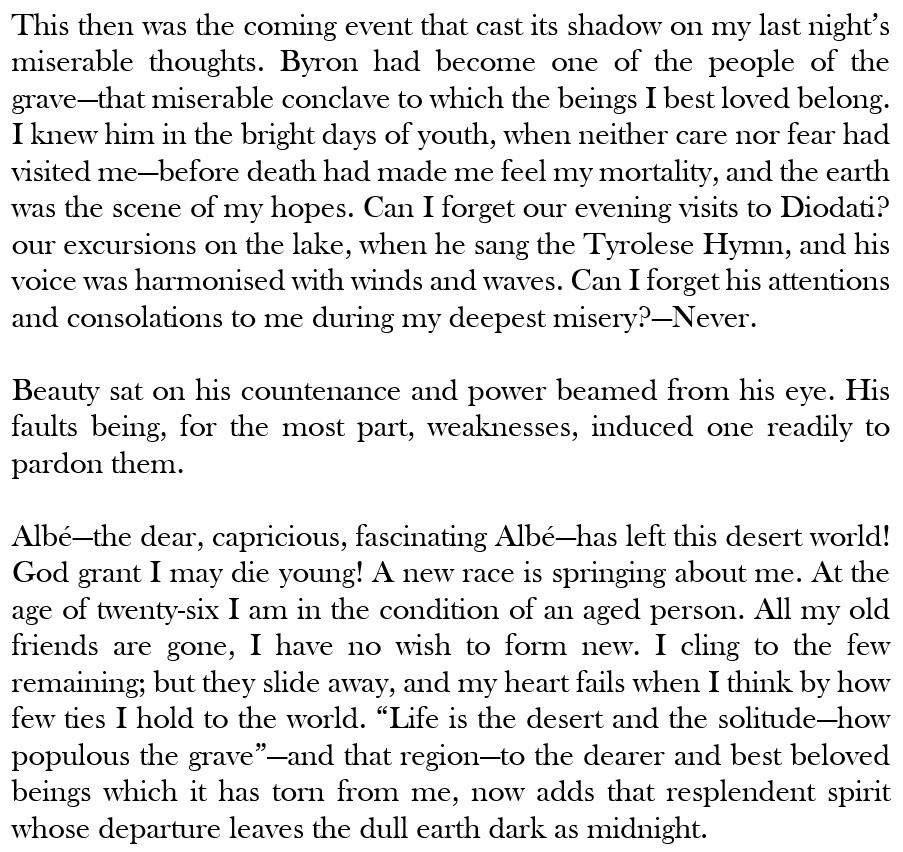
Today, 15 May 1824, Mary Shelley first learns of Lord Byron’s death.
“This then was the coming event that cast its shadow on my last night’s miserable thoughts. Byron had become one of the people of the grave—that miserable conclave to which the beings I best loved belong.”
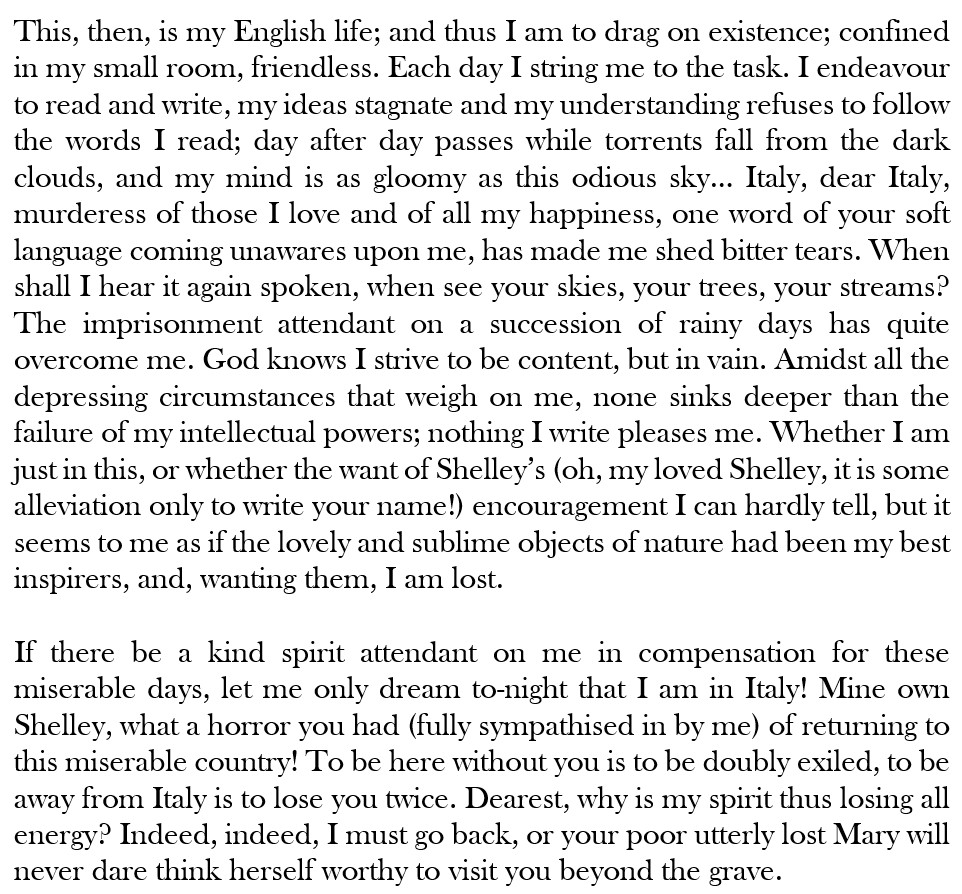
Today, 14 May 1824, Mary Shelley writes how miserable she is in England after a “succession of rainy days”, how nothing she writes pleases her, and how desperately she’s missing Italy and her beloved Percy.
“oh, my loved Shelley, it is some alleviation only to write your name!”
@AnnetteRubery Ah I wish I could cross the great herring pond once again for another visit. I toured Chatsworth in May 2024. A wonderful memory, though I preferred the peace and quiet of Haddon Hall just down the road – it was blessedly free of a single tourist that day.
This looks to be an excellent exhibition currently on at Chatsworth! Besides the gorgeous photos below, including that gloriously illuminated Petrarch (Georgiana’s copy?), there are also 'first and early editions' of Jane Austen, Lord Byron, Charles Dickens, and Charlotte Brontë.
Fascinating talk on 20 May hosted by the University of Hertfordshire that will 'explore the representation of the Ningyo or Japanese human fish Yokai; a creature of genderless hybridity that functions as both a prophecy beast and a Mer Monster.'
Link here https://t.co/cPCZYupbq6
@DrSamGeorge1 Your talk sounds incredibly interesting, Sam. I’ve had a rather strange interest in the folklore of mermaids (especially the tales of Melusine) for many years. It’s a bit early for me across the pond, but I’m going to try to attend.
@GirlsandGoblins A wonderful find indeed, and an excellent birthday present. I adore Walter Crane, and I post his work on Keats quite regularly – especially his 1873 version of Keats’s grave. This may be of interest to @GothicKeats for I know a few of them are great admirers of Crane as well.
@NiftyBuckles So sorry for missing your post last week! I need some new notebooks (just filled up my last one entirely) so I’ll definitely take a look at this. Thanks for thinking of me 🖤
@ThereseTaylor12 Such true words. Radcliffe’s work is bound to be adapted one day… and hopefully in our lifetime! How funny you mention Jane Austen, for the new Bennet Sister series just popped up on BritBox the other day…
“I can linger, with solemn steps, under the deep shades, send forward a transforming eye into the distant obscurity, and listen with thrilling delight to the mystic murmuring of the woods.”
—Ann Radcliffe
From her Gothic novel The Mysteries of Udolpho, 1st published 8 May 1794.