First Nations Energy Summit 2026 Sponsor Announcement: Gigawatt Sponsor
CEBC is pleased to recognize EDF power solutions as a Gigawatt Sponsor of FNES 2026.
EDF power solutions is a global clean energy company with decades of experience developing, building, owning, and operating renewable energy and infrastructure projects across North America and around the world.
In North America, EDF power solutions works across wind, solar, energy storage, transmission, microgrids, smart EV charging, green hydrogen, and operations and maintenance, supporting utilities, governments, municipalities, communities, institutions, and businesses with reliable, low-carbon energy solutions.
With more than 35 years of experience in North America, EDF power solutions brings a broad perspective on renewable energy development, grid integration, infrastructure, and long-term project performance.
We are grateful for EDF power solutions’ support of FNES 2026 and for helping bring together First Nations, industry, government, utilities, and partners from across the sector for two days of discussion, collaboration, and relationship building.
November 30 + December 1, 2026
The Westin Bayshore, Vancouver
Register for FNES 2026 and explore the growing program: https://t.co/34PmmD6bNg
Select sponsorship and exhibitor opportunities are still available. To learn more, contact:
[email protected]
Or explore available opportunities here:
https://t.co/iVeevskunc
Together, we power the future.
First Nations Energy Summit 2026 Project Highlight
CEBC is pleased to announce that Tu Deh-Kah Geothermal, wholly owned by Fort Nelson First Nation, will be featured at FNES 2026 as a project highlight. Tu Deh-Kah Geothermal is one of Canada’s most advanced commercial geothermal projects, with a proven geothermal resource and a goal of providing approximately 7 to 15 MW of clean geothermal electricity in Northeastern BC.
The project is poised to become British Columbia’s first geothermal electricity facility and one of the first in Canada. The development is planned around a binary system using an Organic Rankine Cycle power plant, suited to the site’s lower-temperature geothermal resource.
Beyond electricity generation, Tu Deh-Kah has the potential to strengthen regional energy security and support employment, food production, and new community-led businesses. It also demonstrates what First Nations ownership and leadership in Canada’s clean energy future can look like in practice.
Join us on December 1 for a dedicated conversation exploring the Tu Deh-Kah project, its development journey, and the opportunities geothermal energy can create for communities, regions, and Canada’s broader clean energy transition.
There is so much to talk about at FNES this year.
From First Nations ownership and major clean energy projects to electricity infrastructure, utilities, energy storage, workforce development, and community-led energy solutions, FNES is a place to come together, exchange ideas, build relationships, and shape what comes next.
November 30 + December 1, 2026
The Westin Bayshore, Vancouver
Take advantage of FNES early bird rates before they end October 29, and explore the growing agenda:
https://t.co/pC49bUdWYv
Together, we power the future.
Nominate an Emerging Leader for FNES 2026! Nominations Close Tomorrow!
The Indigenous Youth Emerging Leaders Program is returning for the 2026 First Nations Energy Summit, creating an opportunity for First Nations youth ages 18–35 to attend FNES, build connections, learn from leaders across the sector, and explore pathways into clean energy and related careers.
Selected Emerging Leaders will receive complimentary FNES 2026 registration and eligible travel support, including accommodations, travel costs, and meals, along with opportunities to connect with First Nations leaders, industry, government, utilities, and other sector partners.
Nominees must be a member of a BC First Nation, be 18–35 years of age as of December 1, 2026, and demonstrate an interest in clean energy, electricity, sustainability, economic development, or related career opportunities.
Know an emerging leader who should be in the room? We want to hear about them.
Self-nominations are also welcome.
Nominations close: October 26, 2026
Selected Emerging Leaders notified: October 28, 2026
Learn more and submit a nomination: https://t.co/jz8nwABKrG
FNES 2026 takes place November 30 + December 1 at The Westin Bayshore, Vancouver. Learn more about this year's event and get your tickets while they last! Visit: https://t.co/pC49bUdWYv
Together, we power the future.
Your voice belongs at FNES 2026. Come together. Connect. Shape what’s next.
The First Nations Energy Summit is British Columbia’s premier conference dedicated to First Nations leadership, collaboration, and innovation in the clean energy and electricity sectors.
FNES brings together First Nations, industry, government, utilities, academia, community partners, students, emerging leaders, and professionals from across the sector for two days of conversation, relationship building, and knowledge sharing focused on the opportunities shaping BC’s energy future.
We also offer a range of registration options to help make participation more accessible, including discounted rates for CEBC members and students, complimentary registration for First Nation attendees and designated representatives from BC First Nations, and a reduced Indigenous Professional rate for Indigenous participants attending independently or representing a corporation.
Eligible post-conference travel reimbursement is available for up to two designated representatives from each BC First Nation attending on behalf of their Nation or community, with reimbursement based on location and grid connectivity.
Where capacity and funding permit, travel support may also be available for Métis representatives.
November 30 + December 1, 2026
The Westin Bayshore, Vancouver
Explore registration options and make your plans to join us:
https://t.co/vK3DkOl1rQ
Indigenous Travel Support:
https://t.co/UdjNdjWazm
Together, we power the future.
Last chance for FNES 2026 early bird pricing. Early bird ticket prices end October 29!
The First Nations Energy Summit is British Columbia’s premier conference dedicated to First Nations leadership, collaboration, and innovation in the clean energy and electricity sectors.
This year’s program is continuing to take shape, with a growing lineup of confirmed speakers and panels, and additional workshops, sessions, and announcements still to come.
Join First Nations leaders and representatives alongside government, industry, utilities, academia, community partners, and emerging leaders for two days of conversation, connection, and knowledge sharing focused on the opportunities shaping BC’s energy future.
November 30 + December 1, 2026
The Westin Bayshore, Vancouver
Secure your early bird ticket before October 29 and explore the growing FNES 2026 agenda:
https://t.co/pC49bUdWYv
We can’t wait to welcome you to FNES 2026.
Together, we power the future.
Nominate an Emerging Leader for FNES 2026!
The Indigenous Youth Emerging Leaders Program is returning for the 2026 First Nations Energy Summit, creating an opportunity for First Nations youth ages 18–35 to attend FNES, build connections, learn from leaders across the sector, and explore pathways into clean energy and related careers.
Selected Emerging Leaders will receive complimentary FNES 2026 registration and eligible travel support, including accommodations, travel costs, and meals, along with opportunities to connect with First Nations leaders, industry, government, utilities, and other sector partners.
Nominees must be a member of a BC First Nation, be 18–35 years of age as of December 1, 2026, and demonstrate an interest in clean energy, electricity, sustainability, economic development, or related career opportunities.
Know an emerging leader who should be in the room? We want to hear about them.
Self-nominations are also welcome.
Nominations close: October 26, 2026
Selected Emerging Leaders notified: October 28, 2026
Learn more and submit a nomination: https://t.co/jz8nwABKrG
FNES 2026 takes place November 30 + December 1 at The Westin Bayshore, Vancouver. Learn more about this year's event and get your tickets while they last! Visit: https://t.co/pC49bUdWYv
Together, we power the future.
First Nations Energy Summit 2026 Panel Announcement: Clean Capacity & Long-Duration Storage
As British Columbia prepares for growing electricity demand, energy storage and flexible resources will play an increasingly important role in supporting reliability, renewable integration and the expansion of the electricity system.
This session will bring together leaders working across solar, battery storage and long-duration energy storage to explore where different technologies fit, what it will take to scale deployment, and the opportunities ahead for First Nations participation, ownership and community energy solutions.
Joining the conversation:
Justin Rangooni, Energy Storage Canada, Moderator
Rob Baxter, VREC Solar / SolShare Energy
Geoff Osborne, Capstone Infrastructure
Bruce Herzer, Invinity Energy Systems
Will Patterson, RES Group
Shaheer Aziz, Hydrostor
Monday, November 30 | 1:00–2:00 p.m.
The Westin Bayshore, Vancouver
FNES is getting closer. Get your tickets, explore the full agenda and start planning your time with us in Vancouver!
A discounted FNES room block is also available at The Westin Bayshore for attendees.
Register, explore the agenda and learn more:
https://t.co/pC49bUdWYv
We can’t wait to welcome you to FNES 2026.
Together, we power the future.
Creating space for emerging First Nations leaders to connect, learn and see themselves in the future of British Columbia’s clean energy and electricity sectors is an important part of FNES 2026.
We’re grateful to Urban Systems for supporting two participants through this year’s Indigenous Youth Emerging Leaders Program.
Selected Emerging Leaders will join First Nations leaders, industry, government, utilities and other sector partners at FNES for two days of learning, relationship building and meaningful conversations about the opportunities shaping BC’s energy future.
Participants receive complimentary FNES registration and eligible travel support, including accommodations, travel costs and meals.
Nominations are open to members of BC First Nations who are 18–35 years of age and have an interest in clean energy, electricity, sustainability, economic development or related career opportunities.
Nominations close October 26, 2026. Selected Emerging Leaders will be notified October 28. Self-nominations are welcome.
Learn more and nominate an Emerging Leader:
https://t.co/MmmQJQgAAd
Thank you to Urban Systems for helping support two Emerging Leaders to be part of FNES 2026.
Together, we power the future.
CEBC is pleased to recognize the First Nations Major Projects Coalition (FNMPC) for supporting a place in the Indigenous Youth Emerging Leaders Program at the 2026 First Nations Energy Summit.
With the nomination deadline quickly approaching, now is the time to nominate an emerging First Nations leader who should be part of FNES 2026.
Through its sponsorship, FNMPC is helping support one First Nations youth ages 18–35 to participate in the Summit, connect with leaders and partners from across the clean energy and electricity sectors, and explore future career and leadership opportunities.
Selected Emerging Leaders receive complimentary FNES registration and eligible travel support, including accommodations, travel costs and meals, helping reduce barriers to participation and creating an opportunity to experience two days of learning, relationship building and sector conversations.
Nominations close October 26, 2026. Selected Emerging Leaders will be notified October 28. Self-nominations are welcome.
FNES 2026
November 30 + December 1
The Westin Bayshore, Vancouver
Know an emerging leader who should be in the room? Learn more about eligibility and submit a nomination:
https://t.co/dFS7koYuRf
Thank you to the First Nations Major Projects Coalition for helping create an opportunity for an Emerging Leader to join us at FNES 2026.
Together, we power the future.
First Nations Energy Summit 2026 Speaker Announcement
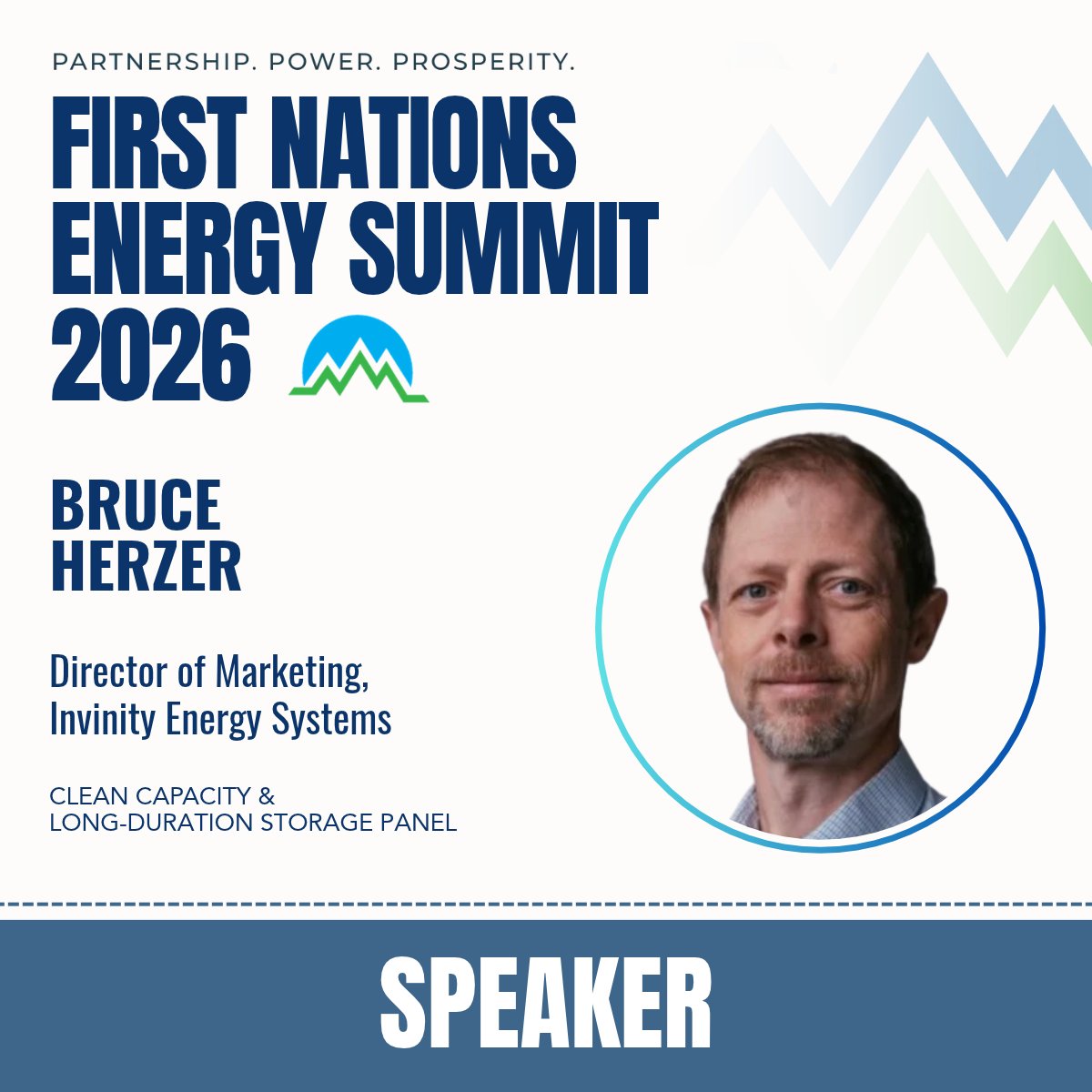
CEBC is pleased to welcome Bruce Herzer, Director of Marketing at Invinity Energy Systems, as a speaker on the panel Clean Capacity & Long-Duration Storage at the 2026 First Nations Energy Summit.
Bruce brings experience across energy storage, solar energy, demand-side management and energy efficiency, with a career focused on technologies and solutions supporting the transition to cleaner and more flexible energy systems.
At Invinity Energy Systems, Bruce leads global marketing for vanadium flow battery technology designed for long-duration energy storage applications. Headquartered in BC with operations and projects around the world, Invinity works with utilities, developers and businesses to deploy energy storage at commercial, industrial and grid scale.
Invinity’s technology is designed to store renewable electricity and make it available when needed, helping address the variability of wind and solar generation while supporting greater grid flexibility and reliability. Its vanadium flow batteries are fully recyclable and avoid materials such as cobalt and rare earth elements. The company is also designing a 1.5 GWh flow battery system for the Swiss electricity grid.
Bruce’s broader experience includes solar EPC operations, behavioural energy efficiency in commercial buildings and demand-side energy management. He holds an MBA with a focus on Sustainable Enterprise from the University of North Carolina and studied Political Science at Queen’s University.
At FNES, Bruce will join Clean Capacity & Long-Duration Storage to explore the growing role of energy storage in supporting renewable generation, strengthening grid reliability and building the clean electricity infrastructure needed for the years ahead.
FNES brings together First Nations, government, industry, utilities, academia, community partners and emerging leaders to exchange knowledge, build and strengthen relationships, and explore the opportunities shaping British Columbia’s clean energy and electricity future.
FNES is getting closer, and now is the time to make your plans to join us!
November 30 + December 1, 2026
The Westin Bayshore, Vancouver
Get your tickets now, explore our growing agenda and speaker lineup, and learn more about Indigenous Travel Support, the Emerging Leaders Program and our discounted FNES hotel room block for attendees: https://t.co/pC49bUdWYv
We can’t wait to welcome you to FNES 2026.
Together, we power the future.
First Nations Energy Summit 2026 Speaker Announcement
CEBC is pleased to welcome Dr. Sue von der Porten, Vice President of Clean Energy Strategy with the First Nations Major Projects Coalition, as moderator of the panel First Nations Utilities: Exercising Sovereignty on the Grid at the 2026 First Nations Energy Summit.
Sue has a Ph.D. in Environment and Resource Studies focused on Indigenous governance and water governance from the University of Waterloo, as well as an MBA and https://t.co/HIvtyNaoNJ. from the University of Victoria. Her postdoctoral research at Simon Fraser University focused on the changing roles of Indigenous coastal Nations, governments and industry in relation to marine conservation.
She is the lead author of the National Indigenous Electrification Strategy and leads FNMPC thought leadership focused on clean energy, electrification, transmission and Indigenous utilities. Her research focuses on environmental decision making and the inherent rights of Indigenous Nations. Sue is also a Research Associate with the Nereus Program and an Action Canada Fellowship Program Alumna.
At FNES, Sue will moderate First Nations Utilities: Exercising Sovereignty on the Grid, bringing together First Nations and sector leaders to explore how Nations are advancing jurisdiction, ownership, decision making and new utility models within British Columbia’s electricity system.
FNES brings together First Nations, government, industry, utilities, academia, community partners and emerging leaders to exchange knowledge, build and strengthen relationships, and explore the opportunities shaping British Columbia’s clean energy and electricity future.
FNES is getting closer, and now is the time to make your plans to join us!
November 30 + December 1, 2026
The Westin Bayshore, Vancouver
Get your tickets now, explore our growing agenda and speaker lineup, and learn more about Indigenous Travel Support, the Emerging Leaders Program and our discounted FNES hotel room block for attendees: https://t.co/pC49bUdWYv
We can’t wait to welcome you to FNES 2026!
Together, we power the future.
Nominate an Emerging Leader for FNES 2026!
The Indigenous Youth Emerging Leaders Program is returning for the 2026 First Nations Energy Summit, creating an opportunity for First Nations youth ages 18–35 to attend FNES, build connections, learn from leaders across the sector, and explore pathways into clean energy and related careers.
Selected Emerging Leaders will receive complimentary FNES 2026 registration and eligible travel support, including accommodations, travel costs, and meals, along with opportunities to connect with First Nations leaders, industry, government, utilities, and other sector partners.
Nominees must be a member of a BC First Nation, be 18–35 years of age as of December 1, 2026, and demonstrate an interest in clean energy, electricity, sustainability, economic development, or related career opportunities.
Know an emerging leader who should be in the room? We want to hear about them.
Self-nominations are also welcome.
Nominations close: October 26, 2026
Selected Emerging Leaders notified: October 28, 2026
Learn more and submit a nomination: https://t.co/jz8nwABKrG
FNES 2026 takes place November 30 + December 1 at The Westin Bayshore, Vancouver. Learn more about this year's event and get your tickets while they last! Visit: https://t.co/pC49bUdWYv
Together, we power the future.
First Nations Energy Summit 2026 Speaker Announcement
CEBC is pleased to welcome Adrien Livingston, Executive Director of the Western Joint Electrical Training Society, as a speaker on the panel Workforce of the Future: Training, Trades & Equity Employment at the 2026 First Nations Energy Summit.
Adrien brings more than 15 years of experience in the electrical trade and has focused much of his leadership on expanding access to training and apprenticeship opportunities across British Columbia.
Through Western JETS, Adrien supports education, training and professional development for electrical workers, with a particular focus on preparing the workforce for growing demand across renewable energy, electrification and emerging technologies. Western JETS programs include training connected to solar, wind, battery storage and other technologies shaping the future of the electrical sector.
Adrien has also played a leading role in developing pathways for people who have historically faced barriers entering the skilled trades. His work helped establish the Workplace Alternative Training Program, which provides practical training and wraparound supports for Indigenous participants, women, newcomers, youth and others entering electrical construction apprenticeships.
At FNES, Adrien will join Workforce of the Future: Training, Trades & Equity Employment to explore how training organizations, employers and industry partners can help build the skilled workforce required for British Columbia’s growing clean energy and electricity sectors while creating stronger and more accessible pathways into the trades.
FNES brings together First Nations, government, industry, utilities, academia, community partners and emerging leaders to exchange knowledge, build and strengthen relationships, and explore the opportunities shaping British Columbia’s clean energy and electricity future.
FNES is getting closer, and now is the time to make your plans to join us!
November 30 + December 1, 2026
The Westin Bayshore, Vancouver
Get your tickets now, explore our growing agenda and speaker lineup, and learn more about Indigenous Travel Support, the Emerging Leaders Program and our discounted FNES hotel room block for attendees: https://t.co/pC49bUdWYv
We can’t wait to welcome you to FNES 2026!
Together, we power the future.
First Nations Energy Summit 2026 Speaker Announcement
CEBC is pleased to welcome HLI HAYKWHL ẂII XSGAAK, Melanie Mark, Director and Senior Strategic Advisor, Indigenous, Government & Stakeholder Relations with Aks Wind Energy, as moderator of the panel Workforce of the Future: Training, Trades & Equity Employment at the 2026 First Nations Energy Summit.
Melanie is a Nisga'a, Gitxsan, Cree and Ojibway matriarch with three decades of experience spanning the nonprofit sector, public service, elected office and entrepreneurship. In 2016, she became the first First Nations woman elected to the Legislative Assembly of British Columbia and later the first First Nations woman to serve in BC’s Cabinet.
From 2017 to 2020, Melanie served as Minister of Advanced Education, Skills and Training, bringing direct experience with the education, training and workforce systems that help connect people with career opportunities across the province. She later served as Minister of Tourism, Arts, Culture and Sport before retiring from politics in 2023.
Today, Melanie continues her work through Aks Wind Energy, HLI HAYKWHL ẂII XSGAAK Consulting and other ventures, with a focus on Indigenous relations, clean technology, economic opportunity and advancing stronger partnerships between First Nations, government and industry. In 2024, she was awarded the King Charles III Coronation Medal.
At FNES, Melanie will moderate Workforce of the Future: Training, Trades & Equity Employment, bringing together leaders from training, industry and workforce development to explore how BC can build the skilled workforce needed for the next generation of clean energy and electricity projects while creating stronger pathways for First Nations, women and other underrepresented workers.
FNES brings together First Nations, government, industry, utilities, academia, community partners and emerging leaders to exchange knowledge, build and strengthen relationships, and explore the opportunities shaping British Columbia’s clean energy and electricity future.
FNES is getting closer, and now is the time to make your plans to join us!
November 30 + December 1, 2026
The Westin Bayshore, Vancouver
Get your tickets now, explore our growing agenda and speaker lineup, and learn more about Indigenous Travel Support, the Emerging Leaders Program and our discounted FNES hotel room block for attendees: https://t.co/pC49bUdWYv
We can’t wait to welcome you to FNES 2026!
Together, we power the future.
First Nations Energy Summit 2026 Speaker Announcement
CEBC is pleased to welcome Ward Prystay, Senior Vice President at Stantec, as a speaker on the panel Regulatory Modernization & Meaningful Process at the 2026 First Nations Energy Summit.
Ward brings more than 30 years of experience supporting major projects through environmental assessment, permitting and regulatory approval processes. Over his career, he has worked across renewable generation, power transmission, transportation, mining and conventional energy, with experience spanning projects valued from $100 million to $40 billion.
His background includes roles as a field biologist, technical specialist, project manager, senior advisor, expert witness and project director. Today, Ward works with Stantec’s Environmental Services team to help proponents navigate complex regulatory processes while advancing environmentally and socially responsible projects.
Ward also serves as Co-Chair of CEBC’s Regulatory Efficiency Committee and is a member of the Business Council of British Columbia’s environment and Indigenous committees, bringing a strong understanding of the regulatory and policy landscape surrounding major project development in British Columbia.
At FNES, Ward will join the Regulatory Modernization & Meaningful Process panel to explore how regulatory systems can evolve to support timely, effective project development while maintaining meaningful engagement, environmental responsibility and strong First Nations participation in decision making.
FNES brings together First Nations, government, industry, utilities, academia, community partners and emerging leaders to exchange knowledge, build and strengthen relationships, and explore the opportunities shaping British Columbia’s clean energy and electricity future.
FNES is getting closer, and now is the time to make your plans to join us!
November 30 + December 1, 2026
The Westin Bayshore, Vancouver
Get your tickets now, explore our growing agenda and speaker lineup, and learn more about Indigenous Travel Support, the Emerging Leaders Program and our discounted FNES hotel room block for attendees: https://t.co/pC49bUdWYv
We can’t wait to welcome you to FNES 2026!
Together, we power the future.
CEBC is pleased to recognize Urban Systems as a supporter of the Indigenous Youth Emerging Leaders Program at the 2026 First Nations Energy Summit.
Through its sponsorship, Urban Systems is supporting two places in this year’s Emerging Leaders cohort, helping First Nations youth ages 18–35 participate in FNES, build relationships across the clean energy and electricity sectors, learn from experienced leaders, and explore future career and leadership pathways.
The Indigenous Youth Emerging Leaders Program is made possible with support from organizations committed to creating opportunities for the next generation of First Nations leaders. We are grateful to Urban Systems for being part of that effort at FNES 2026.
Nominations close October 26, 2026, with selected Emerging Leaders notified October 28. Self-nominations are welcome.
FNES 2026
November 30 + December 1
The Westin Bayshore, Vancouver
Learn more about the program, eligibility and nominations:
https://t.co/PrmWuIf6uV
Together, we power the future.
First Nations Energy Summit 2026 Speaker Announcement
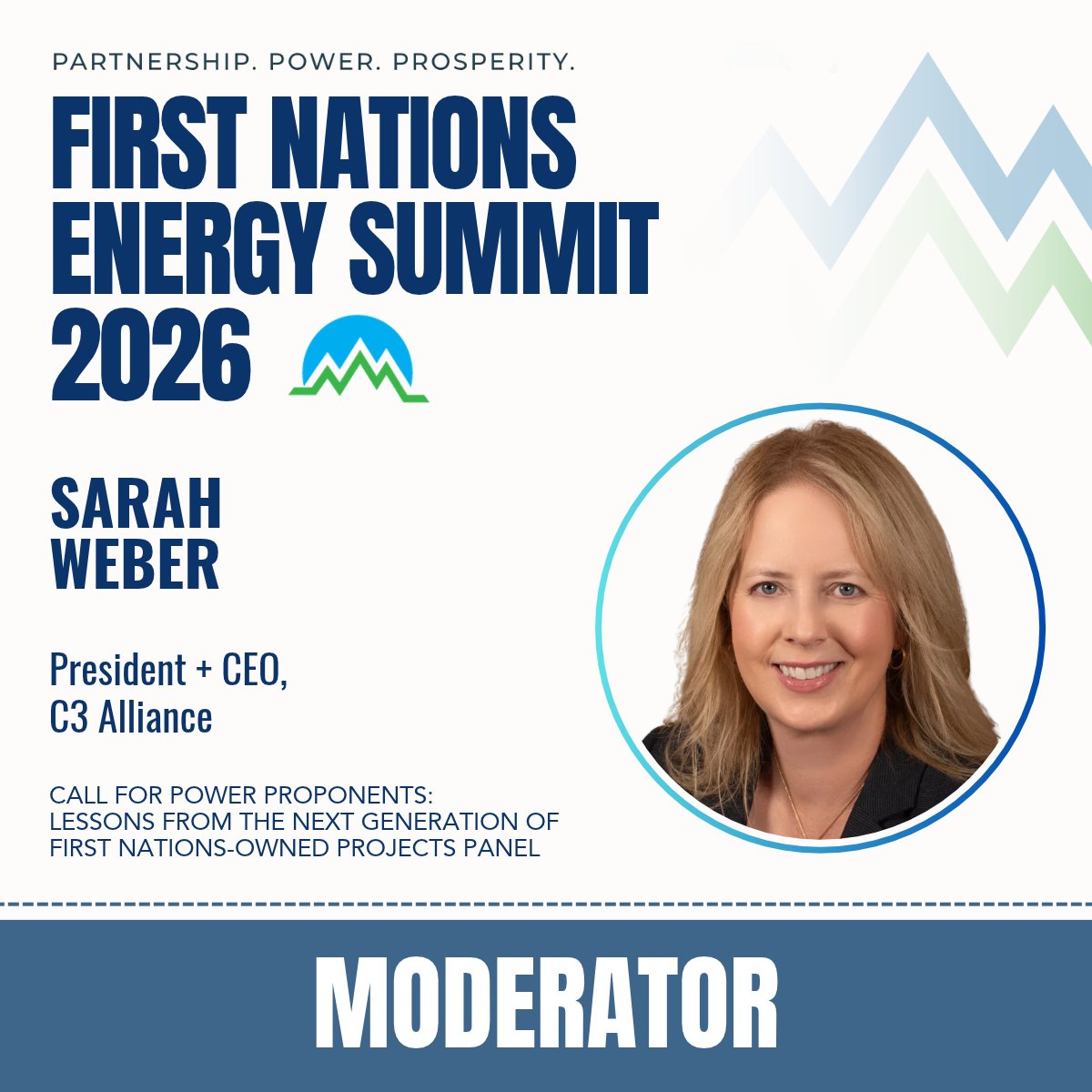
CEBC is pleased to welcome Sarah Weber, President + CEO of C3 Alliance, as moderator of the panel Call for Power Proponents: Lessons from the Next Generation of First Nations-Owned Projects at the 2026 First Nations Energy Summit.
Sarah brings more than 20 years of experience in Canada’s natural resource sector, specializing in strategic advisory, partnership development and engagement among Indigenous Peoples, government and industry. Her work spans executive leadership, policy development, communications, stakeholder relations and advancing complex natural resource projects.
Through C3 Alliance, Sarah advises Indigenous communities and industry partners on engagement, governance, environmental stewardship and economic development, while convening dialogue across First Nations, government, industry and other partners. She also leads initiatives including the BC Natural Resources Forum and the BC Indigenous Resource Opportunities Conference, creating opportunities for relationship building and Indigenous leadership across the resource sector.
Sarah’s experience facilitating complex conversations and building partnerships makes her a strong moderator for Call for Power Proponents: Lessons from the Next Generation of First Nations-Owned Projects. The panel will bring together First Nations leaders involved in successful projects from BC Hydro’s recent Calls for Power to share practical experiences, lessons learned and perspectives on advancing the next generation of First Nations-owned clean energy projects.
FNES brings together First Nations, government, industry, utilities, academia, community partners and emerging leaders to exchange knowledge, build and strengthen relationships, and explore the opportunities shaping British Columbia’s clean energy and electricity future.
FNES is getting closer, and now is the time to make your plans to join us!
November 30 + December 1, 2026
The Westin Bayshore, Vancouver
Get your tickets now, explore our growing agenda and speaker lineup, and learn more about Indigenous Travel Support, the Emerging Leaders Program and our discounted FNES hotel room block for attendees: https://t.co/pC49bUdWYv
We can’t wait to welcome you to FNES 2026!
Together, we power the future.
First Nations Energy Summit 2026 Speaker Announcement
CEBC is pleased to welcome Dr. Curran Crawford, Executive Director of the Accelerating Community Energy Transformation (ACET) initiative at the University of Victoria, as a speaker on the panel First Nations Utilities: Exercising Sovereignty on the Grid at the 2026 First Nations Energy Summit.
Curran leads ACET through the Institute for Integrated Energy Systems at the University of Victoria and co-directs the Pacific Regional Institute for Marine Energy Discovery. His work focuses on community energy planning, renewable energy systems and real-world deployment, including projects supporting remote Indigenous communities as they explore pathways to reduce diesel dependence and strengthen local energy systems.
His research spans energy system modelling, optimization and control, with technology areas including wind and tidal energy, energy storage, microgrids, e-transportation and carbon capture. Across this work, Curran collaborates with Indigenous communities, governments, industry and academic partners to understand both the technical and broader community considerations involved in advancing renewable energy.
Curran brings a valuable research and community energy perspective to First Nations Utilities: Exercising Sovereignty on the Grid. The panel will explore how First Nations are advancing jurisdiction, ownership, decision making and new utility models as communities shape their own roles within British Columbia’s evolving electricity system.
FNES brings together First Nations, government, industry, utilities, academia, community partners and emerging leaders to exchange knowledge, build and strengthen relationships, and explore the opportunities shaping British Columbia’s clean energy and electricity future.
FNES is getting closer, and now is the time to make your plans to join us!
November 30 + December 1, 2026
The Westin Bayshore, Vancouver
Get your tickets now, explore our growing agenda and speaker lineup, and learn more about Indigenous Travel Support, the Emerging Leaders Program and our discounted FNES hotel room block for attendees: https://t.co/pC49bUdWYv
We can’t wait to welcome you to FNES 2026.
Together, we power the future.
British Columbia’s clean energy and electricity landscape is moving quickly, and the First Nations Energy Summit creates a place to bring those conversations together.
FNES connects First Nations leaders and representatives with project developers, utilities, government, advisors, investors, researchers, emerging professionals, and others working across the province.
Over two days, the Summit creates opportunities to share perspectives, build and strengthen relationships, learn from one another, and explore the projects and opportunities ahead.
Join us in Vancouver this November.
November 30 + December 1, 2026
The Westin Bayshore, Vancouver
Learn more and register:
https://t.co/pC49bUdWYv
Together, we power the future.
First Nations Energy Summit 2026 Speaker Announcement
CEBC is pleased to welcome Kara Wilson, Energy Champion with Quatsino First Nation, as a speaker on the panel First Nations Utilities: Exercising Sovereignty on the Grid at the 2026 First Nations Energy Summit.
Born and raised in Quatsino, BC, Kara began working in the clean energy sector through the Cape Scott Wind project and has continued building her experience around community energy planning, renewable energy development and partnerships.
As Energy Champion for Quatsino First Nation, Kara helps lead conversations around the Nation’s energy projects with community members and project partners. Her work has supported the advancement of solar, tidal and wind energy initiatives, with a focus on strengthening energy reliability, reducing costs, creating local opportunities and building greater energy independence for the community.
Kara’s leadership was recognized in 2025 when she received CEBC’s Anitra Paris Female Youth Leadership Award, honouring her contributions to clean energy, environmental stewardship and community collaboration.
Kara brings an important community-level perspective to First Nations Utilities: Exercising Sovereignty on the Grid. The panel will explore how First Nations are advancing jurisdiction, ownership, decision making and new approaches to energy and utility development as communities shape their own roles within British Columbia’s evolving electricity system.
FNES brings together First Nations, government, industry, utilities, academia, community partners and emerging leaders to exchange knowledge, build and strengthen relationships, and explore the opportunities shaping British Columbia’s clean energy and electricity future.
FNES is getting closer, and now is the time to make your plans to join us.
November 30 + December 1, 2026
The Westin Bayshore, Vancouver
Get your tickets now, explore our growing agenda and speaker lineup, and learn more about Indigenous Travel Support, the Emerging Leaders Program and our discounted FNES hotel room block for attendees:
https://t.co/pC49bUdWYv
We can’t wait to welcome you to FNES 2026.
Together, we power the future.