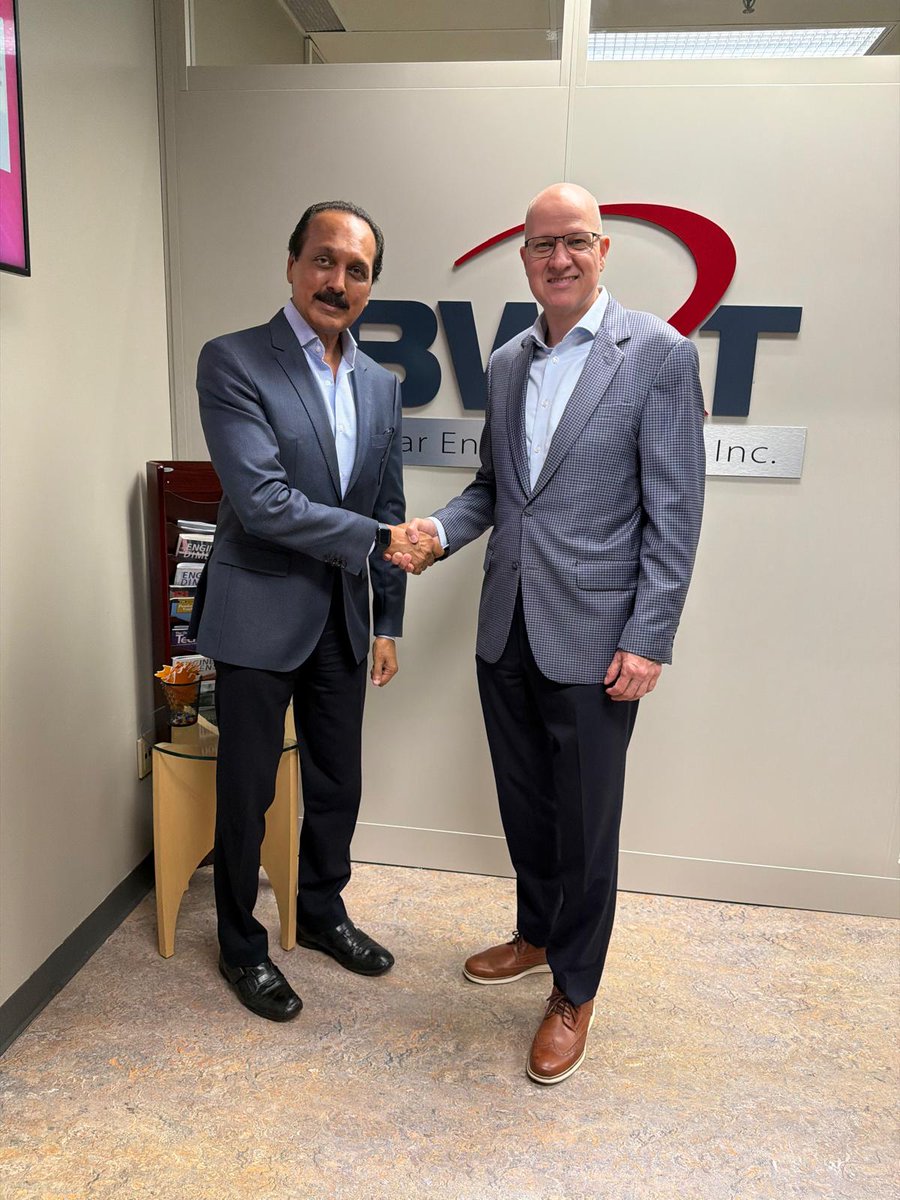
🎉 It’s official! We received our 10 CFR Part 810 “export license” signed by @SecretaryWright and issued by the @ENERGY & @NNSANews 🎉
https://t.co/P2Afu4c1F8
@Jefferies launched nuclear coverage with a striking estimate: ~$55 trillion in nuclear-related capital spending through 2100.
The drivers are familiar: AI and data centre demand, electrification, ageing reactor fleets and the need for reliable power.
But a nuclear buildout of this scale requires investment across the entire value chain, including the fuels that will power the next generation of reactors.
That is the opportunity CCTE is building ANEEL for.
More: https://t.co/PRYWXpIZ3d
Thorium fuel surpasses 60 GWd/MTU in major test ahead of reactor demo
Apart from its significance in terms of performance qualification at high burn-up this capability also means potential net energy gain while producing uranium233.
https://t.co/xcM5EwChI8
CCTE has engaged @KINECTRICS to conduct an independent technical review of the ANEEL fuel qualification programme ahead of commercial reactor demonstration.
The review will assess key aspects of fuel design, manufacturing, safety and regulatory readiness, building on recent progress with @BWXT Canada and @CNL_LNC.
Following the completion of accelerated ANEEL irradiation testing at @INL earlier this year, this marks another important step in advancing ANEEL toward commercial reactor demonstration.
Not every nuclear reactor needs enriched uranium.
Natural uranium contains just 0.7% uranium-235 – too little for most commercial reactors.
PHWRs, including CANDUs, are different. Their heavy-water moderator enables them to sustain a chain reaction using natural uranium without enrichment.
That fuel flexibility also makes PHWRs well suited to advanced fuel concepts, including thorium-based fuels.
Reactor design determines which fuels become possible.
Without neutrons, a nuclear reactor stops.
When a fissile atom splits, it releases energy and new neutrons. Some cause further fission, some are absorbed, and some escape.
A reactor works by keeping that neutron population in balance.
Nuclear energy isn’t just about splitting atoms. It’s about controlling the neutrons that keep the chain reaction going.
🇺🇸 @cleancoreenergy Signs Aneel Fuel Fabrication Agreement With BWXT Canada. #NuclearPower#NuclearEnergy
US company preparing for irradiation in operating #nuclear reactor
👉FULL STORY: https://t.co/M8raoLc8OQ
The nuclear fuel cycle is evolving.
The conventional fuel cycle starts with uranium mining, then moves through enrichment, fuel fabrication, reactor operation and finally spent fuel management.
Thorium adds another pathway.
While thorium-232 isn’t fissile, it can absorb a neutron in a reactor and ultimately become uranium-233, contributing to energy production. That’s why fuels like ANEEL combine thorium with enriched uranium.
The question for next-generation nuclear fuel isn’t just how much uranium we have.
It’s how efficiently we use the nuclear materials available to us.
CCTE ties up ANEEL Fuel Supply Agreement with BWXT Canada to Support Commercial Reactor Demonstration. I wish this had happened in India. https://t.co/sWCjx0s7ek
I strongly agree with dr kakodkar
India is missing a great opportunity to achieve early utilisation of thorium fuel in existing PHWR Nuclear plants without waiting for reaching the third stage of nuclear program DAE should resolve technical controversy and adopt ANEEL fuel
@BWXT Canada joins Clean Core Thorium Energy’s ANEEL commercial reactor demonstration programme.
BWXT Canada will supply fuel bundle hardware for full-scale ANEEL fuel bundles, to be assembled by @CNL_LNC for irradiation in an operating commercial reactor.
Following successful irradiation testing at @INL’s Advanced Test Reactor (>60 GWd/MTU), this agreement strengthens the manufacturing pathway supporting ANEEL’s commercial demonstration.
Commercialising advanced nuclear fuel requires more than strong performance. It requires a supply chain ready to manufacture, qualify and deploy it at scale.
Not every fuel bundle produces the same amount of power.
Even identical fuel bundles perform differently depending on where they are located in the reactor core.
Bundles near the centre experience higher neutron flux and generate more power, while those near the edge operate at lower power.
This is intentional. Engineers carefully design the core’s power distribution to optimise fuel utilisation, burnup and safe reactor operation.
The world’s most common nuclear fuel form: the pellet.
These small ceramic cylinders power most of the world’s commercial reactors.
Stacked inside metal fuel rods, they’re used in PHWRs, PWRs and BWRs.
Fuel changes.
The pellet architecture has remained a foundation of nuclear energy for decades.
Clean Core Thorium Energy has signed an MoU with Quadrant Nuclear Industries to explore a future domestic HALEU supply for ANEEL fuel.
The collaboration will evaluate how HALEU from QNI’s planned reprocessing facility at @INL could support future ANEEL deployment, alongside supply planning, regulatory coordination and logistics.
Building a resilient domestic fuel supply chain is essential to commercialising advanced nuclear fuels.
Our ANEEL technical paper has now been published in Nuclear Engineering and Design (Elsevier), one of the nuclear industry’s Q1 premier publications for nuclear engineering.
Key findings:
– 6× higher discharge burnup
– Lower coolant void reactivity
– Lower predicted LOCA peak fuel temperatures
– Compatible with existing CANDU reactors
Alongside CCTE, this paper was a significant collaboration between the leading institutions on nuclear engineering, thorium, and CANDUs, including @MIT, @CNL_LNC, @StructInt, and more.
Read the paper: https://t.co/ZOthvRRgyZ
What does a reactor physicist actually do?
Their job isn’t just solving equations but predicting how a reactor will behave before anything changes.
They model questions like:
– What if fuel temperature rises?
– Fresh fuel is inserted?
– Coolant flow changes?
– Fuel gradually burns up?
These simulations help validate new fuels, optimise fuel management and confirm safe, stable operation long before changes reach the reactor.
In reactor physics, the goal is simple: know the answer before the question is ever asked.
Why doesn’t a CANDU reactor shut down to refuel?
Because it doesn’t need to.
Instead of replacing the entire core, CANDU reactors add a small number of fresh fuel bundles while operating at full power.
This enables:
– Stable operation
– Better fuel utilisation
– No lengthy refuelling outages
It also makes introducing advanced fuels like ANEEL much simpler, since new fuel can be loaded gradually through the normal refuelling process.
Sometimes the biggest innovation isn’t the reactor. It’s the fuel.
Nuclear innovation isn’t only about new reactor designs. Proven reactor platforms also continue to find new deployment opportunities.
AtkinsRéalis’ decision to begin the US licensing process for CANDU technology highlights the continued relevance of the PHWR platform.
ANEEL builds on that same foundation, delivering higher fuel utilisation and reduced waste while operating in existing PHWR and CANDU reactors without requiring reactor modifications.
https://t.co/GtXQY68BJv
Why are nuclear fuel pellets so small?
A typical nuclear fuel pellet is only about 1 cm long—roughly the size of a small pea.
Making it larger isn’t better.
Heat is generated throughout the pellet and must travel to the surface before the coolant can remove it. Larger pellets mean a longer heat path and a hotter centre.
Pellet size is carefully optimised to balance power output, heat removal and fuel integrity.
In nuclear engineering, every millimetre matters.
Why does fuel geometry matter?
Fuel performance is not determined by material alone.
In PHWRs, fuel bundle geometry directly affects:
• Neutron flux and power distribution
• Coolant flow and heat transfer
• Critical heat flux margins
• Mechanical stability under operating conditions
In nuclear engineering, geometry can be just as important as chemistry.