ClearCap opens on January 4, 2027.
Type a company's name and get one report built from over 125 official US databases, in 1-3 minutes. It covers each company that files with the SEC, and each figure shows its source and date.
Facts, not advice.
Want to test ClearCap before it opens, and help shape it?
In December, we invite 25 testers from the waitlist, with free access for testing. The app isn't finished yet: it may have accuracy or feature issues, and data may change during testing. Waitlist: https://t.co/bh2uBBqOAW
Signing a deal off a company's last annual report? Check it still stands.
In 2025, 149 filings told the SEC that a company's earlier financial statements could no longer be relied on (8-K Item 4.02, due within 4 business days). Source: SEC EDGAR, counted to Nov 3, 2026.
A company's filings say one thing, a government record says another. Would you spot it?
Launching Jan 4, 2027, ClearCap puts any gap on a "Sources disagree" card, with the source and date for each side, so you don't cross-check by hand. https://t.co/bh2uBBqOAW
Your supplier filed an 8-K. Time to worry?
Not always. Item 5.07 reports a shareholder vote; Item 5.03, bylaw changes or a new fiscal year. Read the item number before the headline. Source: SEC Form 8-K item titles.
Vetting a company before you sign? That's a lot of questions, one site at a time.
Launching Jan 4, 2027, one ClearCap report answers over 600 of them from official US records (SEC filings, regulators, courts) in 1-3 minutes.
@TheOwnerTrack Thanks! One detail that trips people up: the UCC-1 is filed in the state where the seller is organized, not where the equipment sits. And a filing lapses after 5 years unless it is continued.
Have you seen an old lien block a deal?
Buying a business? The seller controls the P&L, the references and the data room.
Five public records they don't: UCC liens, court dockets, OSHA records, EPA ECHO and the federal exclusion list. Most are free.
Check them before a $15K diligence bill. https://t.co/dyS8qE3rE6
@tech_lead_bunny The delay notice gets missed most. Under the FTC Mail, Internet or Telephone Order Rule, with no ship date stated, an order must ship in 30 days; if it slips, the buyer must be told and offered a cancel.
Do your stores send delay notices automatically?
Checking a supplier's safety record? A name search at OSHA can miss part of it.
OSHA files each inspection under the site's own name, often a subsidiary's. Launching Jan 4, 2027, ClearCap also checks each subsidiary its 10-K lists, in one report. https://t.co/bh2uBBqOAW
@markedlercpa On those numbers the gap is more than seasonal: $191K average x 25% = about $47.8K of gross profit a month, against $78K of overhead and debt service. That is about $30K short in an average month, not only in winter.
Was the debt sized on peak months?
@HelenGuo_ On #8, the SBA floor is lower: its 7(a) rules (SOP 50 10) set a minimum DSCR of 1.15, and many lenders ask for 1.25 or more. So 1.5 is a lender comfort level, not the SBA rule.
What DSCR did your lender ask for?
@SMBDealGuy Public companies have a rule for this: SEC Regulation S-K Item 404 makes them disclose related-party deals over $120,000 in the proxy or 10-K. A private seller has no such rule, so the standalone P&L is the only check.
Do you ask for the shared-cost list up front?
@markedlercpa To find which part is climbing, split it into days: receivable days + inventory days - payable days. On $10M of revenue, each extra day customers take to pay ties up about $27,000 in cash.
Which of the three moves first for you?
@JonMStoddard The same math at other sizes, on that $100 item with $40 margin: 10% off needs 1.33x the units, 30% off needs 4x, and at 40% off no volume is enough, since each sale earns $0.
Which discount did you pick this year?
@JoeydeWit_ The pass-through line has a rule behind it. Under ASC 606, an agency acting as agent (it never controls the media or goods) books only its fee as revenue. As principal, it books the gross amount, and margins look smaller.
Which way do your contracts read?
@markedlercpa One catch: ROIIC is the change in after-tax operating profit divided by the change in invested capital, and new capital often earns with a lag. Measured over one year, a good expansion can look bad. Many use a 3-5 year window.
What period do you measure it over?
@JonMStoddard Calculators had the same fight. In 1980 the NCTM (US math teachers) urged schools to use them in all grades, and tests changed to match. The hard part is the same now: deciding what a test should still measure without the tool.
Which skill would you still test by hand?
Your supplier's audit firm got a poor PCAOB inspection. Is that about your supplier?
No. PCAOB inspection reports are about the audit firm and its inspected audits, and they don't name the companies. Source: PCAOB inspection reports.
Is your top customer paid by Washington?
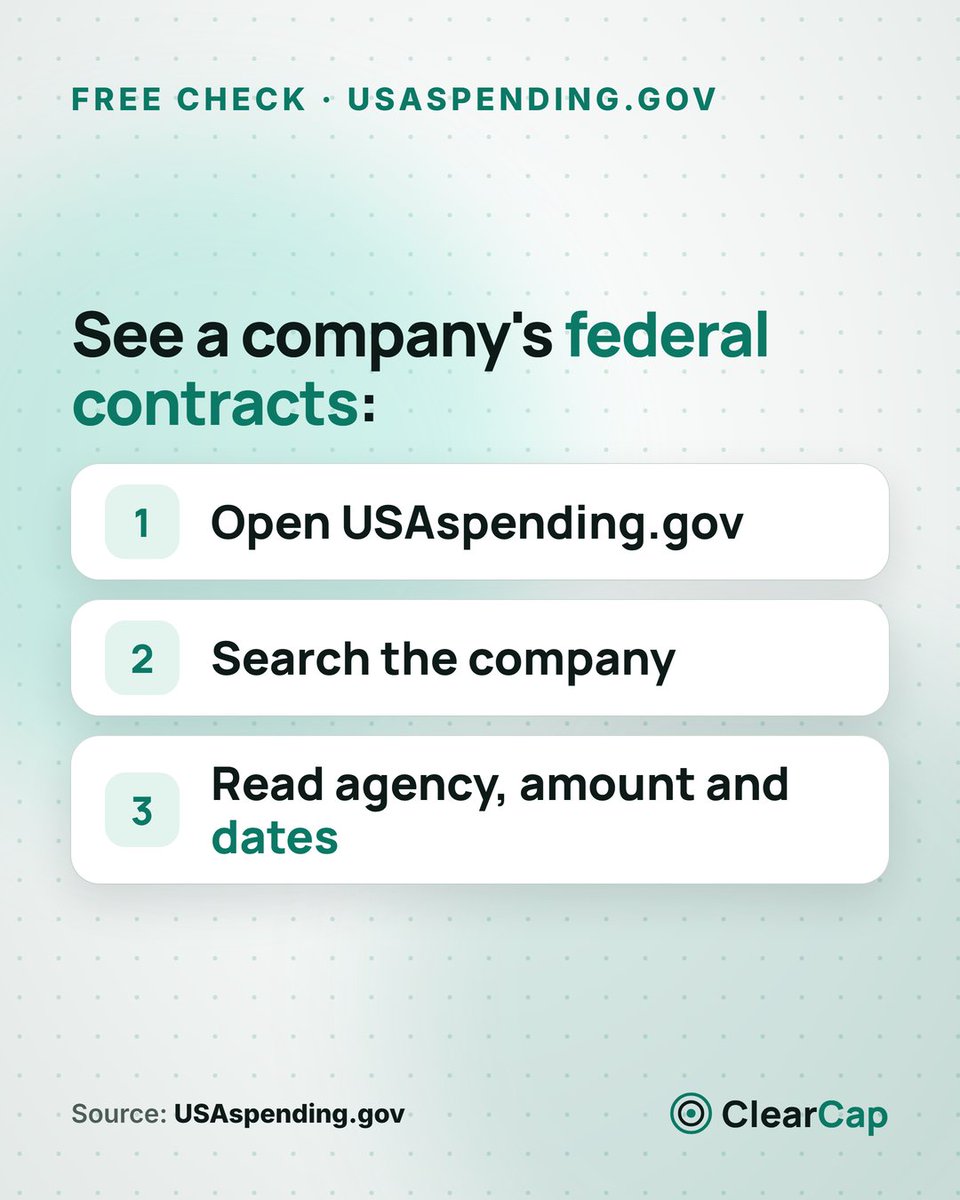
https://t.co/QwBWyr2id3 lists its federal awards. If it is a big share, a budget fight can reach your invoice.
Launching Jan 4, 2027, ClearCap puts them in one report with over 125 official US databases, in 1-3 minutes, not site by site.
Launching Jan 4, 2027, a ClearCap report shows the change date, the reason as the 8-K states it, whether disagreements were reported, the Exhibit 16 letter, and the PCAOB report on the firm, each with a link: one report, not three sites. https://t.co/bh2uBBqOAW
Your supplier just changed its auditor. Which filing do you read first?
On Harborline Logistics (example company, not real data): it files an 8-K, Item 4.01, within 4 business days, saying if the auditor resigned, was dismissed or declined to stand.
Next: the old auditor's letter (Exhibit 16), saying if it agrees with the company. Then PCAOB (the audit firm regulator) inspection reports on the audit firm. Those are about the firm's inspected audits, not about Harborline's.