AI agents will confidently build pipelines that publish the wrong numbers.
We turned one of our internal guards against that into a free write-audit-publish skill for your coding agent.
Declare a data contract → stage the batch → audit every clause → publish only what passes.
Plain Markdown. No email wall.
Works in Cursor, Claude Code, Codex, or whatever agent you already use.
Learn more and try it out: https://t.co/kFMeB0dfPK
Headed to the Photogrammetry, 3D Visualization, and Lidar (P3DL) Community of Practice Conference?
Find CTO Brian Frutchey and Director of Geospatial Solutions Jack Brandy at the tech expo July 27–28.
They'll be on the floor with Belvedere, our agentic data engineering platform for high-trust environments.
Drop us a line at [email protected] to coordinate a meetup.
Event details: https://t.co/zO7m5eOiii
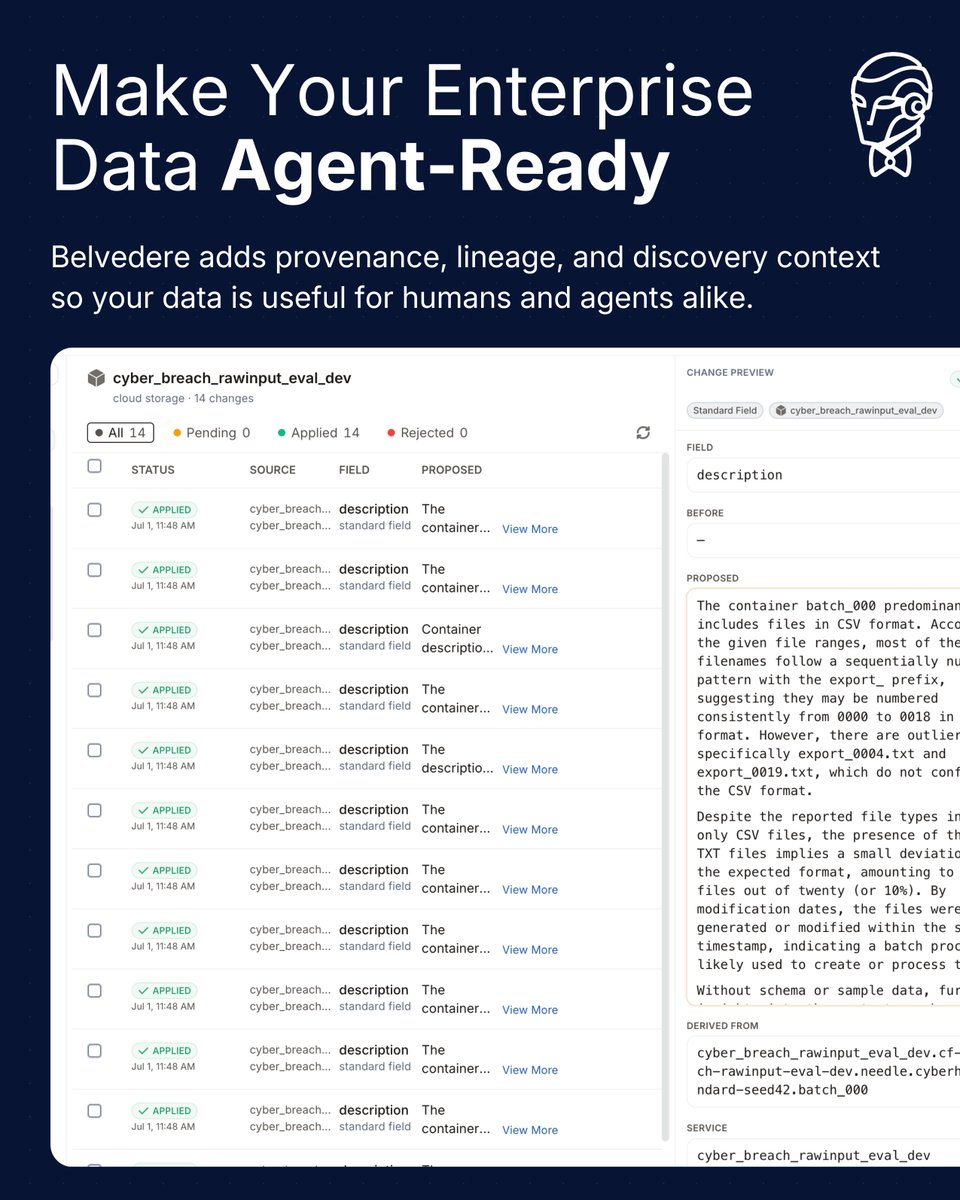
Data is dumb by default.
It can be stored, moved, and queried without ever knowing what it is, where it came from, what changed it, or who depends on it.
That becomes a problem when agents start making decisions from it.
Agent-ready data needs provenance, lineage, and discovery context, not just access.
Belvedere enriches enterprise data with that context, while every proposed change stays in a human approval path.
Get a demo today: https://t.co/npJWfbOKlb
Introducing DeepSearch V2 in Belvedere.
Start with a question for your data enterprise:
"Do we already have access to Synthetic Aperture Radar (SAR) data we could use for global event monitoring?"
DeepSearch inspects the governed collections built from your SharePoint sites, shared drives, and S3 buckets, researches the open web when available, and returns an answer with citations.
The answer shows what sources exist, how to access them, and the steps to operationalize them.
From there, your team turns the cited answer into working data pipelines.
Research feeds a governed build. People stay in the approval path before anything runs.
Get a demo: https://t.co/2gsWxGIRmp
Operations change faster than data pipelines can keep up.
New sensors deploy.
Partner feeds arrive in unfamiliar formats.
Public sources change or disappear.
Every change creates integration work. Analysts wait, engineers get pulled in, and many questions get decided on instinct instead of evidence.
Many AI products try to solve this by putting a model directly in the data path. That adds hallucination risk, compute cost, and no audit trail.
Belvedere takes a narrower approach.
It uses agents to build the pipeline, not to be the pipeline.
Belvedere operates your existing, accredited tools on your behalf: cataloging sources, learning schemas, tracing provenance, and turning plain-language requirements into deterministic pipeline code you own.
For one US Cyber Command mission, Belvedere cut new-source integration from five weeks to ten minutes.
See it in action: https://t.co/npJWfbOKlb
Requirements change. And updating a simple pipeline shouldn't take a sprint.
In this clip, an engineer asks Belvedere to add image OCR and PII redaction to a breach pipeline.
The agent drafts the new pipeline step, shows the proposed change, and waits for approval before shipping deterministic code to production.
Get a demo today: https://t.co/AhEEgwiRGr
Introducing Agentic Schemas in Belvedere!
The agents design your target schemas, grounding them in your knowledge graph and the outcomes you specify.
They reconcile everything into concrete tables, columns, types, and field-level descriptions.
The recent run below produced 9 schemas with over 100 typed columns, all validated against the use case defined.
Every schema is readable, versioned, and re-runnable.
The agents build the pipeline. They don’t become it.
See Belvedere in action:
https://t.co/eA2ranSRLD
Try our new "AI Data Contract Builder" for free on our website: https://t.co/r5RrAmYeOU
It generates ODCS-compliant data contracts from a couple of prompts and some sample data.
--
Why? Because data contracts help you stop bad data before it hits production.
Most teams skip them because they're tedious to write by hand.
Paste a JSON or CSV sample. Describe the dataset in plain English. Set your rules and SLAs. Export a contract in YAML or JSON.
It runs entirely in your browser. Your data never leaves it.
This is the same idea behind Belvedere: agents do the design-time work — read the schema, propose the structure, surface the decisions — then hand you an artifact you own and can edit. Not a black box that runs your data infrastructure for you.
Join Brian Frutchey, CTO of Clear Fracture, on July 29 for a practical session on AI and agentic data engineering in the enterprise.
Brian will show how autonomous AI agents can design, build, validate, and govern production-grade data pipelines while keeping decisions auditable, transformations explainable, and costs lower than AI-only or manual approaches.
The session includes a live demo of an agent building and deploying a trusted intelligence data pipeline from raw sources to governed outputs in minutes.
When AI Agents Build Trusted, Production Pipelines
July 29, 2026 | 2:00-3:00pm ET
CPE credit eligible
Register here: https://t.co/pfKUsnqjSy
We wanted to kick the tires on @flueframework, the new agent framework from the @astrodotbuild team.
So we built the Flue Analyst Org:
- Ten agents
- Six frontier models
- Your dataset
- Your question
It profiles, checks quality, analyzes, critiques, builds charts, and writes an answer.
With the World Cup kicking off in two days, we asked it who is going to win.
Full writeup from Haydn Strauss:
https://t.co/VZ1TvsZ0GK
Try it here:
https://t.co/K6SQQOP7Ax
Note: This is a for-fun test app. Not a product, betting service, or substitute for real analysis.
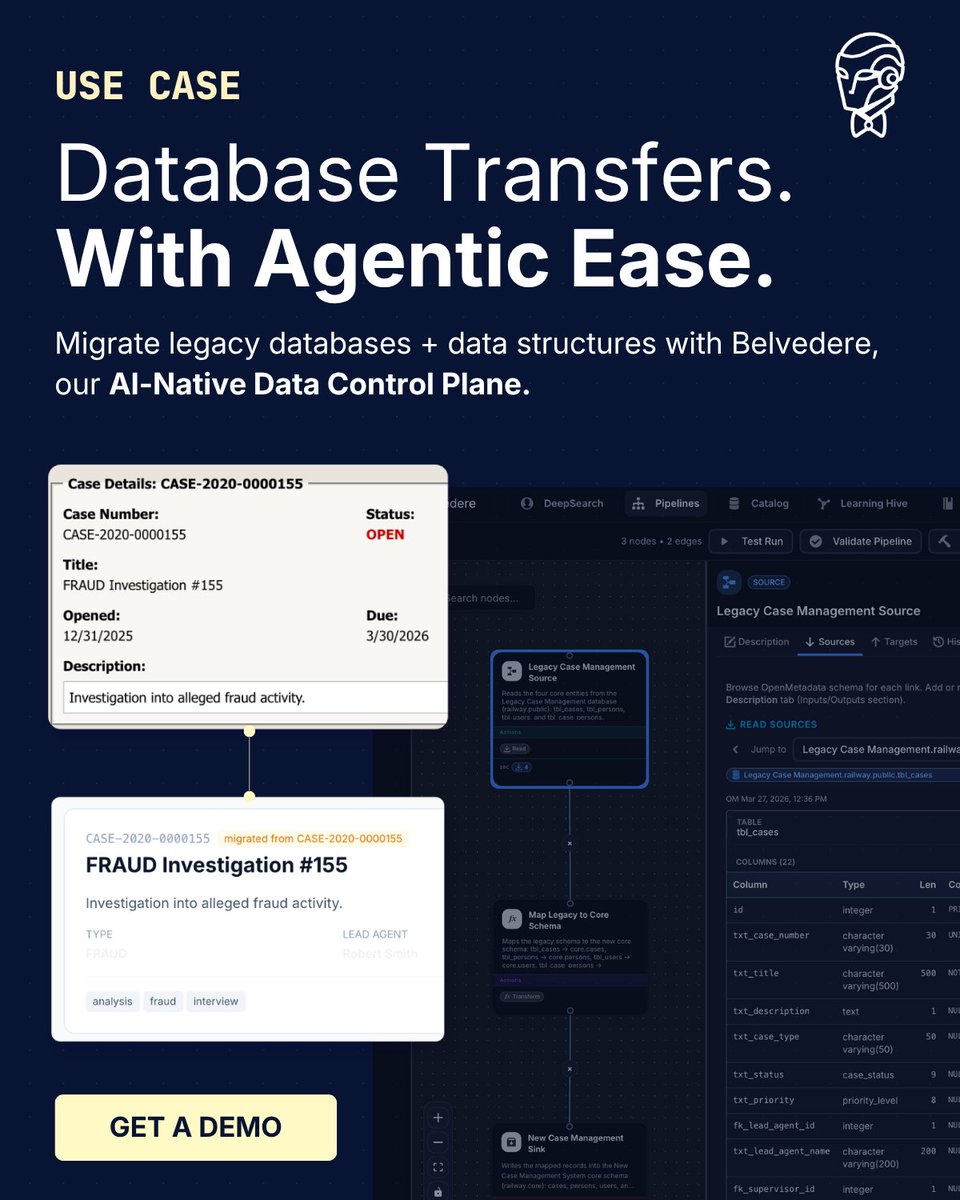
Database transfers can be hard.
Schemas don't line up. Validation is brittle. Audit trails are an afterthought. And the cost of getting it wrong shows up months later, in the data.
Throw a pure agent at it and you get a one-shot black box: no audit trail, no cheap re-run, no visibility into how fields were mapped.
Belvedere uses agents to build the pipeline, not to be the pipeline.
You get a deterministic, inspectable, repeatable pipeline you own — with agent cost paid once at design time, not on every row.
Get a demo: https://t.co/VUQdraWBey