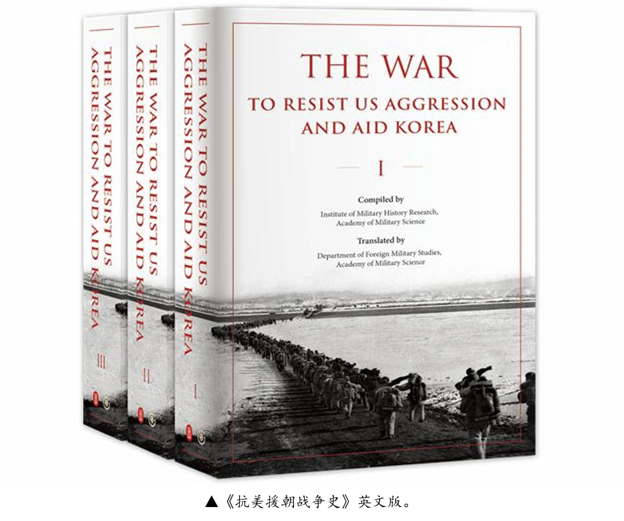
Official English (book):
At 630 on September 15, under the personally command of MacArthur, the 10th Corps began landing operation at Inchon with support of intensive firepower from aircraft and ships.
The 5th Marine Regiment under the 1st Marine Division landed first at the Wolmido Island, where one coast defense gun squadron (with five 75 mm coast defense guns) and one coast defense infantry squadron of the People's Army was stationed as garrison, who fought to the last minute.
At 1000, the Wolmido Island fell.
At 1700 in the afternoon, Inchon was at the full tide.
The main force of the First Marine Division, under support of fire power from ships and aircraft, carried out landing on the south and north flank of the Inchon Harbor.
Relying on the seawall, the garrison troops of the Korean People's Army launched fierce counterattack against the landing US troops.
Under the cover of intensive firepower suppressing the position of the People's Army, the American engineer troops blasted the sea wall and, guided by tanks and amphibious combat vehicles, broke into the position of the People's Army.
The garrison troops had to retreat to the city of Inchon, and launched street battles with the US troops.
After the establishment of beachhead, the follow up US troops landed in a steady flow.
By early morning of the September 16, more than 18,000 US troops got a successfully landing, an occupied Inchon.
译者注:
原文称月尾岛在上午10点被攻陷。
美军陆战队战斗日志显示,对绿滩的攻击从 6点33分持续到 6点55分——共 22 分钟,美军无阵亡,17 人受伤。
书中记录的10点应是指清理隐蔽火力点的扫荡行动结束,以及麦克阿瑟向参谋长联席会议报告第一阶段已完成、并称“局势极佳”的时间。
Translator’s Note:
The source states that Wolmi‑do was secured by 1000 hours, but Marine Corps logs show the assault on Green Beach ran only from 0633 to 0655—twenty‑two minutes—with no U.S. fatalities and seventeen wounded.
The 1000‑hour timestamp refers to the completion of bunker clearing and to MacArthur’s report to the Joint Chiefs that Phase One was finished and the ‘situation is excellent.’
The Inchon Landing, once thought nearly impossible, unfolded in a single day. The book records this pivotal battle as follows:
At 0630 hours on 15 September, X Corps commenced the Incheon landing under MacArthur’s direct command, supported by concentrated naval gunfire and air strikes.
The 5th Marine Regiment, 1st Marine Division executed the initial assault on Wolmi-do, defended by a KPA coastal artillery battery―equipped with five 75‑mm coastal defense guns―and a coastal infantry company.
Enemy forces resisted until overrun; the island was secured by 1000 hours*.
At 1700 hours, during the high‑tide window, the main elements of the 1st Marine Division conducted separate landing operations on the northern and southern flanks of Inchon Harbor.
Sheltering behind the seawall, KPA defenders unleashed fierce counterfire against the landing U.S. forces.
While concentrated U.S. fire suppressed the KPA positions, engineer units breached the seawall and subsequently broke through the KPA defensive line, led by tanks and amphibious combat vehicles*.
Forced to retreat into the urban area, the defenders engaged U.S. forces in close‑quarters street fighting.
With the beachhead established, follow‑on units continued landing at scale.
By early 16 September, over 18,000 U.S. personnel had landed and secured control of Inchon.
Translator’s note:
Historically, MacArthur did not use the image of wagering five dollars to win fifty thousand ― a ten-thousand-to-one return.
His actual remark was: “I realize that Inchon is a 5,000‑to‑1 gamble. I am used to taking those odds.”
Everyone believed the Inchon Landing was far too difficult, but MacArthur saw it differently. The book continues as follows:
My translation:
MacArthur argued that the objections to landing at Inchon would ensure “the element of surprise.”
He judged that the KPA had committed all its main forces to the Nakdong River front, leaving Inchon’s defenses poorly prepared.
Despite the many geographic obstacles, he believed that superior equipment and extensive experience would allow the U.S. Navy to carry out the landing successfully.
He rejected the idea of landing at Kunsan, saying that although the odds of success were higher there, the location offered little strategic value. …
Inchon, by contrast, was decisive: all of the KPA’s rear supply routes converged at Seoul before moving forward.
Capturing Inchon and Seoul would paralyze the enemy’s entire supply system.
The main forces on the Nakdong River front, “due to lack of ammunition and food, will soon fall into a state of helplessness and chaos, and thus be easily defeated."
This, he argued, would allow the U.S. to reverse the battlefield situation completely.
If the landing did not take place, MacArthur warned, American troops in Korea would be trapped “in that bloody perimeter like cattle in the slaughterhouse,” a responsibility no one wished to bear.
He admitted that Inchon landing was a gamble, saying that wagering five dollars could yield fifty thousand.
MacArthur’s confidence reassured Sherman, and Truman approved the plan.
On August 28, the Joint Chiefs of Staff also gave their approval, though with reservations.
Official English (book):
MacArthur regarded all arguments against landing at Inchon as “exactly contributing to a victory by surprise.”
He concluded that all the main forces of the People's Army were directed to the Nakdong River Front, so there must have been no full preparations regarding defense of Inchon.
For all the geographic difficulties in landing at Inchon, advanced equipment and rich experience would help the US Navy make it in the end.
He stood against landing at Kunsan, which he deemed as of no strategic value though with more certainty of success. …
Landing at Inchon made great differences as all the supply routes behind the Korean People's Army converged at Seoul and then extended forward.
Capturing Inchon and Seoul would paralyze the whole supply system of the People's Army.
Consequently, the main forces of the Korean People's Army on the Nakdong River Front “without munitions and food will soon be helpless and disorganized, and can easily be overpowered.”
Thus the US army would radically change the unfavorable situation on the battlefield.
He concluded that without landing at Inchon, the US troops on the Korean battlefield would “stay in that bloody perimeter like a beef cattle in slaughterhouses,” as was such a tragedy that no one would take responsibility for.
He regarded landing at Inchon as a gamble.
He said that cast a bet of five dollars and he would win 50,000 dollars.
MacArthur's statement gave Sherman the same confidence.
At the same time, MacArthur's Inchon Landing Plan won the approval of Truman.
On August 28, though with reservations, the Joint Chiefs of Staff approved the plan.
The Inchon Landing operation is widely regarded as one of the most difficult amphibious assaults in modern military history. The book describes its obstacles as follows:
My translation:
MacArthur’s proposal immediately drew strong opposition from Army Chief of Staff J. Lawton Collins and senior Navy officers.
They agreed that a landing on the People’s Army’s flank or rear was necessary, but rejected Inchon as the site, arguing that its tides, harbor layout, and breakwater conditions made it the least suitable port on the Korean coast.
The tidal range could reach thirty feet, resulting in a 3.2‑kilometer-long mudflat inside the harbor that made movement of vehicles and personnel extremely difficult.
The surrounding islands meant that the port had only one access route—a narrow, twisting channel called “Flying Fish Strait.”
The channel was easy to mine, and the KPA had stationed coastal defense units at its entrance; the sinking of even one American landing craft could block it completely.
In addition, there were only three [sic, two] high‑tide periods each day, each lasting three hours.
Landing craft drew twenty‑three feet of water [sic, height of tide] and landing ships twenty‑nine, so only high tide provided enough depth for them to pass, making it nearly impossible to complete a landing within the three‑hour window.
Even if the landing succeeded, moving equipment and supplies inland would be difficult, and without reinforcements the landing force would struggle to withstand counterattacks.
Even if all obstacles were cleared, the troops would still have to climb a seawall twelve to fifteen feet high, and the port contained many solid structures ideal for defense.
Therefore, the U.S. military faced enormous difficulties in attempting a landing at Inchon.
Official English (book):
MacArthur's plan, after being put forward, was firmly opposed by the Army Chief of Staff J. Lawton Collins and navy officers.
They agreed on landing from the flank or back of the People's Army, but stood against the landing site as Inchon, for they judged Inchon as the least fit port for landing along the Korean coast in terms of tide, harbor and embankment.
The extreme tides fall ranging as much as 30 feet formed a vast mudflat in the harbor extending 3.2 km, which was difficult for either vehicles or human beings to move.
Surrounded by a multitude of islands, the only way in and out of the harbor was a narrow and winding “Flying Fish Strait.”
The channel was easy to be mined, and the People's Army has deployed coastal defense troops at the entrance to the strait, where only one ship sunk of the US landing troops would block out the whole channel.
Besides, there were only three days [sic, two time a day] of full tide lasting for only three hours each time, with the low tide lasting for the rest of the day.
With a draught of 23 feet for landing boats and 29 feet for landing ships, only the full tide could meet the requirement of passing of landing ships, and it seemed impossible for the US landing to be completed within the three hours’ full tide.
Even if they made it, it would be difficult for the equipment and supplies to be forwarded for the landing troops to push inland.
While without reinforcement, it would be hard for the landing troops to stand up to the counterattack of the defense forces.
Even if all the obstacles were cleared, the landing troops had to scale 12 to 15-feet-high sea walls to get ashore and face large number of strong buildings at the port that facilitated the defense of the People's Army troops.
The US troops were faced with tremendous difficulties in terms of landing.
Translator’s notes:
The paragraph uses a classic two‑step rhetorical construction.
First, it inflates collapse (“陷入混乱逃窜”), turning a retreat into a spectacle of disorder. The official English tries to preserve this with “fleeing in disorder,” but the literal phrasing exposes the melodrama intended for a targeted audience.
Then comes the pivot to heroic inevitability. The Chinese frames MacArthur’s assessment as absolute (“唯一办法”). Uncertainty collapses into destiny. The English keeps the determinism (“the only way”), but its stiffness makes the ideological leap more visible.
A small but telling detail reinforces this pattern. The text places MacArthur on the Han River Bridge, even though the bridge had been blown up the day before and he observed the scene, most likely, from the south bank. The choice to put him on the bridge is narrative staging. It gives him a dramatic vantage point from which to witness “chaotic retreat,” sharpening the contrast between disorder and the figure of decisive authority.
In the chapter on the U.S. Inchon Landing, the opening paragraph describing MacArthur’s first visit to the Korean battlefield is a textbook example of how official histories manufacture narrative momentum: first amplify chaos, then introduce a figure of absolute authority.
Official English (book):
On June 29, 1950, just five days after the breakout of the Korean War, MacArthur flew to the Korean battlefield for inspection. Standing on the bridge of Hangong, he witnessed the South Korean troops fleeing in disorder. At that time, US have already committed air and naval forces to support the South Korean army. But he insisted that the only way to reverse the situation was to commit ground forces, and the only way to win the war was to land on the flanks or back of the People's Army.
My translation:
On June 29, 1950—only five days after the outbreak of the Korean War—MacArthur flew to the Korean battlefield for an inspection. Standing on the Han River Bridge, he witnessed the South Korean army falling into chaotic retreat. At that time, the U.S. had already committed air and naval forces to support the South Korean troops. Yet MacArthur maintained that the only way to reverse the situation was to commit ground forces, and that the way to win the war was to carry out a landing operation on the KPA’s flank or rear.
Official English (book):
As for the question of whether we were able to win the war, the education was focused on comparison between the capacity of China and the enemy. First, the Americans were fighting a war of injustice, and it was difficult for the US army to fight across the ocean with a manpower shortage and downing morale, though with an edge in weapons and equipment. The Chinese army was fighting abroad to aid the Korean people to resist aggression and protect the security of China in a war of justice. The nature of war guaranteed the support from people all over the world who loved peace. Besides, though the Chinese army was inferior in terms of weapons and equipment, the decisive factor for victory of war had never been weapons or equipment, but man. Chinese army was superior in both quality and quantity of manpower, and enjoyed full support of both the Chinese and Korean people as well as world people who loved peace. What's more, Chinese army, though with inferior equipment, had always been defeating enemies with superior equipment. Some officers who had once associated with American troops, and some soldiers who had been fighting alongside with American troops in Yunnan and Burma during the Anti-Japanese War, provided some information about the US troops, confirming that the edge of the US army in equipment was not as decisive as the stories went, and that they were even inferior to the Japanese army regarding strong will and combat effectiveness. Chinese army had defeated the Japanese army, so would it definitely defeat the US army. The education removed the fear of some officers and men for the equipment superiority of the US armed forces, stabilized and inspired the troops, greatly increased their courage and confidence in defeating the US invaders, and ensured a high morale for the troops to make war preparations.
Continuing from the last passage:
My translation:
As for whether we could win the war, the political education emphasized comparing China’s strength with that of the enemy. It argued first that Washington was waging an unjust war: although the U.S. possessed superior weapons and equipment, its inadequate manpower and low morale made transoceanic operations difficult. By contrast, the Chinese people were fighting a just war abroad—to help the Korean people resist aggression and to safeguard China’s security. The just nature of the struggle ensured support from peace‑loving people around the world. Furthermore, although Chinese forces were disadvantaged in terms of equipment, the decisive factor in warfare had never been matériel but manpower. The Chinese army enjoyed advantages in both the quantity and quality of its personnel and had the full support of the Chinese people, the Korean people, and peace‑loving people worldwide. Moreover, even with inferior equipment, Chinese troops had repeatedly defeated better‑armed enemies. Officers who had previously encountered U.S. forces, as well as soldiers who had fought alongside American troops in Yunnan and Burma during the Anti‑Japanese War, provided intelligence on the U.S. military. They confirmed that America’s equipment advantage was not as overwhelming as rumored and that in terms of willpower and combat effectiveness, U.S. troops were in some respects inferior even to the Japanese. Since the Chinese army had been able to defeat the Japanese*, it would certainly be able to defeat the Americans. This round of education dispelled some soldiers’ fear of the U.S. military’s superior equipment, stabilized morale within the ranks, and strengthened their fighting spirit. It greatly increased their courage and confidence in defeating the American aggressors, laying a solid foundation of morale for preparing the units for combat.