Al jaren probeer ik algoritmes op het verkeerde been te zetten. Ook toen ik nog niet op Twitter zat.
Of me dat gelukt is, laat ik ter beoordeling aan mijn volgers.
https://t.co/qXQjsQTId3
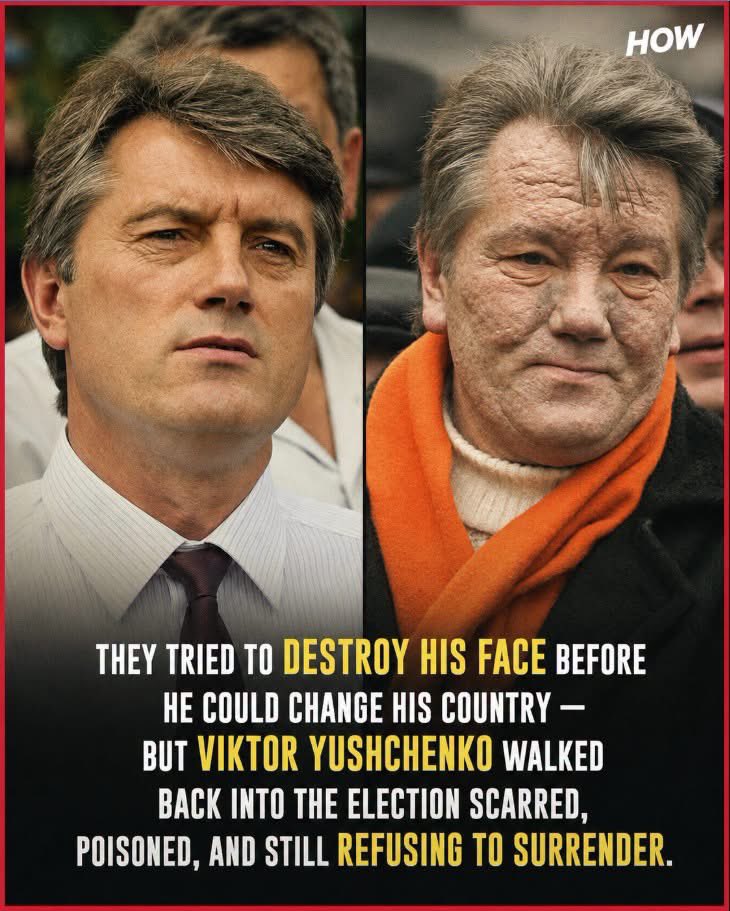
In 2004, Ukraine was standing at a turning point.
The country was caught between two futures. One path pulled it closer to Moscow and the old post-Soviet system. The other pointed toward Europe, reform, and a more democratic national identity.
At the center of that battle stood Viktor Yushchenko.
He was a presidential candidate, a former prime minister, and the leading opposition figure against the government-backed candidate Viktor Yanukovych. To many Ukrainians, Yushchenko represented a chance to break away from corruption, intimidation, and political control.
Then, during the campaign, he suddenly became violently ill.
At first, the symptoms were confusing. He suffered terrible pain, swelling, weakness, and internal damage. His body seemed to be collapsing without a clear explanation. When he appeared in public again, the change was shocking.
His once recognizable face had become swollen, scarred, and disfigured.
Doctors later confirmed he had been poisoned with dioxin, one of the most toxic chemical compounds known. The poisoning caused severe chloracne and left visible damage across his face. It was not just a medical emergency. It looked like an attempt to remove him from the political race.
But Yushchenko survived.
And instead of hiding, he returned to the campaign.
His face became a symbol of what was at stake. Every scar seemed to tell Ukrainians that the election was no longer just about politics. It was about fear, control, and whether a nation could choose its own future.
Yushchenko and his family believed the assassination attempt was connected to Moscow, because he was pushing for closer ties with Europe and challenging pro-Russian influence in Ukraine. That allegation has never been fully proven in court, but the poisoning became one of the most infamous political attacks of the modern era.
The election itself became a national crisis.
When Yanukovych was first declared the winner after a disputed runoff, millions of Ukrainians believed the vote had been stolen. People flooded the streets wearing orange, the color of Yushchenko’s campaign. The protests became known as the Orange Revolution.
For days, crowds stood in the cold demanding a fair vote.
The pressure grew so strong that Ukraine’s Supreme Court ordered a new runoff election because of widespread fraud concerns. In that repeat vote, held in December 2004, Viktor Yushchenko won.
He entered the presidency carrying the physical marks of the attack against him.
His victory did not erase the pain. It did not restore his health overnight. It did not answer every question about who poisoned him or why. But it proved something powerful.
The poison changed his face.
It did not silence him.
Viktor Yushchenko’s story remains one of the most dramatic political survival stories in modern history — a reminder that sometimes a scar becomes more powerful than the weapon meant to destroy the person carrying it.
Poisoned, disfigured, and nearly destroyed — Viktor Yushchenko survived the attack and still won the presidency.
Source: History of the world
Damn, Iran did not waste a second, they had this diss track ready to go, with the exact final score, after trump's cheating ways jinxed and screwed our US Men's Soccer Team.
He's turned the whole world against us.
The song is 🔥, tho.
Trump on Balogun: "I saw the play, and I'm a person that loves sports ... that wasn't a foul. That wasn't even an infraction ... this referee, who is a little bit suspect if you check his past. He made a call that nobody could believe ... he's our best player, or one of our best players. And he gave him a red card. I didn't know what that meant ... yes, I asked for a review by FIFA."
Trump on Balogun: "I saw the play, and I'm a person that loves sports ... that wasn't a foul. That wasn't even an infraction ... this referee, who is a little bit suspect if you check his past. He made a call that nobody could believe ... he's our best player, or one of our best players. And he gave him a red card. I didn't know what that meant ... yes, I asked for a review by FIFA."
De vernietigende conclusie van de Israëlische holocaust-wetenschapper Omer Bartov in @nrc vandaag.
‘Het zionisme is daarmee volgens Bartov rijp „voor de vuilnisbelt van de geschiedenis, waar andere genocidale ideologieën zich bevinden”.’
The need for greater cooperation amongst Christians in the face of today’s challenges - peace, the proper use of new technologies and care for creation - stems from the Gospel of Jesus Christ itself. Our responsibility for the life and dignity of every human being, especially the youngest and most needy, is the criterion that will determine our present and eternal destiny (Mt 25:31–46). #ChristianUnity
We stand with a pope who refuses to mistake nostalgia for fidelity — who understands that the Church is not a museum of 1962 but a living body called to walk toward the poor, the migrant, and the forgotten in every age. https://t.co/J1Yqz7ZvEm
Since the start of the full-scale war, the Russian army has been given as many as 15 deadlines for capturing our Donetsk region. Russia’s political leadership remains obsessed with Donbas. They have entertained this delusion – that they would fully capture Donbas – 15 times already.
In 2022, the deadlines were March 31, then May 9, June 1, September 15, and December 31. In 2023, Putin set two more deadlines for capturing Donbas: March 1, and then, when that failed again, they moved it to December 31. In 2024, there were again two such deadlines.
In 2025, when the Russians tried to convince President Trump that Ukraine would supposedly fall, there were already three final dates for capturing the Donetsk region, namely, September 1, December 1, and December 25.
Already this year, the Russians have again pushed back the date for the capture of the Donetsk region. At first, they had set a deadline of March 31 of this year, then September 1, and now the deadline is December 31.
If Russia does not end its war, they will have to move this deadline again as well. If Putin wants to sacrifice another million of his soldiers to keep smashing against this wall, then the million Russians who have not yet been mobilized into the Russian army and are arguing in gas lines should think about what awaits them next.
Kellogg: Putin is trying to figure a way out. He is soliciting help from the United States through negotiations to bring this to a close.
It ends when he decides he's had enough and goes home. These people will not give up. They will fight tooth and nail to the end. 2/
Another morning starts with both morning coffee and Russian skies an inky black. ☕️
The refinery in Slavyansk-on-Kuban is burning fiercely with a smoke plume over 100km in length, and the fuel shortages will keep getting worse.
Putin's swansong is getting closer. 🩰🦢🦢🦢🦢
De wekelijkse kijk op Europa door @CarolineGruyter in @nrc .
Ik weet niet of ze het ooit beleefd heeft, maar het is alsof je GBJ Hilterman hoort praten.
These days have strengthened my hope. Not only because of what we shared, but because of the way we did so. In a time marked by polarization, even the way in which the Church listens and engages in dialogue becomes part of her proclamation. If we are able to continue seeking the will of the Lord together, allowing ourselves to be guided by the Holy Spirit, I am certain that our communion will become ever more fruitful for the mission of the Church and for service to the entire human family.
#ExtraordinaryConsistory
https://t.co/cf74bXd7Hf