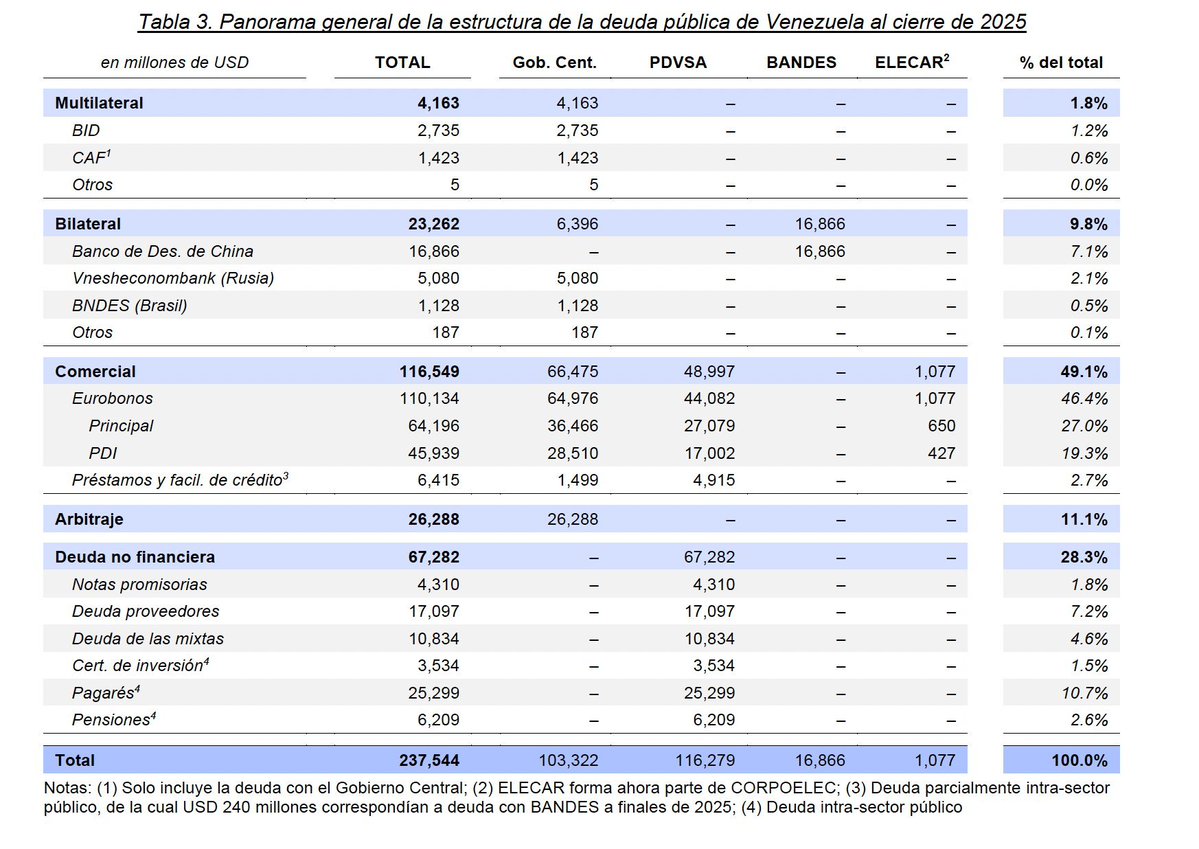
Amanecimos con una noticia: Venezuela debe 237.544 millones de dólares.
La mala noticia es que estamos arruinados.
La peor, que los deseos no empreñan.
La insoportable, que por muchos años el gobierno no tendrá otra cosa que hacer que pagar.
En resumen: 242 % del PIB como deuda no es solo un número altísimo; indica que la deuda, que es lo únicoque nos hereda el chavismo-diosdado-madurismo, es estructuralmente impagable en las condiciones actuales y que cualquier recuperación económica sostenible requerirá una reestructuración de gran escala, de las mayores de la historia reciente de la deuda soberana.
¿Y saben sobre qué hombros se carga ese peso? Sobre todos los venezolanos, sobre todo los mas vulnerables. Por eso necesitamos todas las inversiones posibles y reducir ya el tamaño del estado. El país debería concentrar sus esfuerzos públicos en lo básico: salubridad y educación básica.
Esto también significa que hay muy poco espacio para el discurso providencialista e irresponsable que promete cambios de un dia para otro.
🚨 La deuda pública de Venezuela asciende a 237 mil millones de dólares.
Dilapidaron la mayor bonanza petrolera de nuestra historia, no construyeron nada, expulsaron a un tercio del país y condenaron al otro tercio a la pobreza.
Y no contento con eso, nos endedudaron por varias generaciones.
El chavismo es la mayor historia de saqueo en nuestra historia, en el continente y uno de los mayores, sino el mayor, en la historia de la humanidad.
Profundamente indignante.
"Comfort women" is a euphemism used during World War II for tens of thousands and by many estimates up to 200,000 or more—of women and girls forced into sexual slavery by the Imperial Japanese military between 1932 and 1945. Held in military-run or military-regulated brothels known as "comfort stations" across Japanese-occupied territories, the victims came largely from Korea and China, as well as Taiwan, the Philippines, Indonesia, Malaysia, Burma, Japan, and other areas...
Military comfort stations began around 1932 and expanded sharply after atrocities such as the 1937 Rape of Nanking. Military leaders claimed the stations would boost troop morale, curb sexually transmitted diseases, and reduce random assaults and international criticism. While some women were trafficked through existing commercial networks early on, many were abducted or lured with false promises of jobs as factory workers, waitresses, or nurses. Women were confined to comfort stations, subjected to strict schedules and repeated sexual violence, monitored for disease, and rarely allowed to leave without permission.
. . .
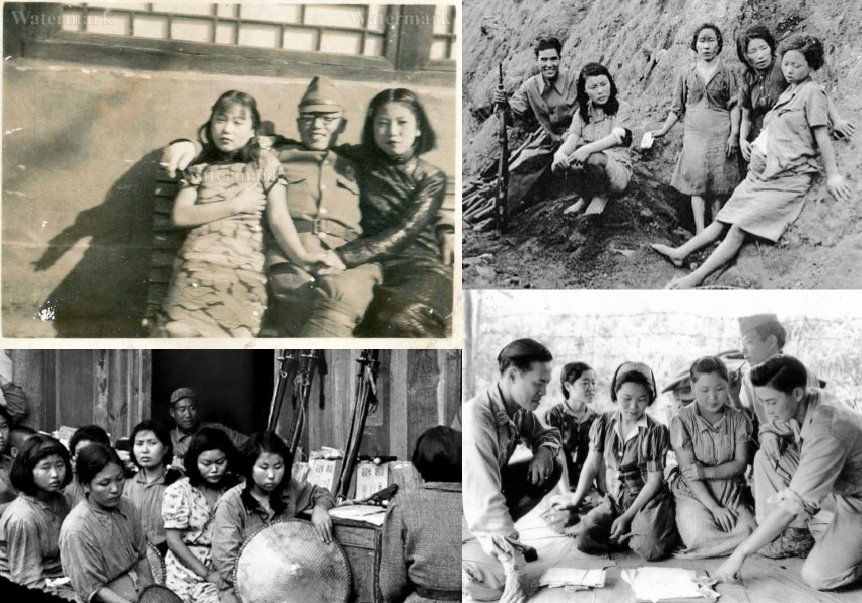
During Japan’s war in China and across Asia, women and girls were placed in a system of military sexual slavery created for Japanese troops. Some were deceived. Others were abducted or taken through coercion and violence. Chinese women were among its victims.
Photographs from that world can be unsettling precisely because they often look so ordinary.
A soldier stands beside women. People look toward a camera. There may be no battlefield, no visible wound, nothing in the frame that immediately announces what existed beyond it.
But survivor testimony tells another story.
Chinese women later described being taken from their homes, confined in military “comfort stations,” beaten and repeatedly sexually assaulted. Some were still teenagers. One survivor, Li Xiumei, testified that she was 15 when Japanese soldiers seized her from her home. She said her mother later died by suicide while Li remained captive. Li survived with lasting injuries.
For many women, surviving the war did not end the suffering.
Some returned carrying physical injuries, infertility, trauma and the stigma attached not to the men who had abused them, but to the women who had been abused. Many victims died from disease, violence, suicide, or wartime combat. Survivors—including women enslaved as children or young teenagers, such as Narcisa Claveria in the Philippines and Peng Zhuying in China—endured lasting physical and psychological trauma.
For decades after the war, many survivors hid their pasts due to shame, fear, and social stigma in their home communities. Public testimonies beginning in the early 1990s brought global attention to the issue. While Japan issued official statements and agreements—such as the 1993 Kono Statement and a 2015 bilateral arrangement with South Korea—disputes over historical responsibility, apologies, reparations, and textbooks continue to affect regional diplomacy and advocacy.
That is what makes photographs associated with the “comfort women” system so difficult to look at.
We see a few seconds preserved by a camera.
What the photograph cannot show is what happened before the shutter opened, what happened after it closed, or how many years some of these women carried those moments in silence.
And sometimes the most haunting thing about a historical photograph is not what we can see.
It is everything the people inside it survived that the camera could not record.
#archaeohistories
It’s genuinely insane how the Islamic Republic can publicly sentence a woman to 74 lashings for not wearing a hijab and the EU, UN, and media just let it slide.
@luzmperdomo@PoleoRafael Asi es! Y ademas las vivencias y noticias de primera mano que muy pocos venezolanos hoy dia son capaces de poseer. Es extraordinario poder sobre las cosas que el publica.. No se si habra publicado algun libro.