The William L. Clements Library houses original resources for the study of American history and culture from the fifteenth through the nineteenth century.
The Clements Library is saying goodbye to X/Twitter. While we will no longer be active on this platform, we invite you to connect with us on Bluesky, Instagram, Facebook, LinkedIn, YouTube, and our website for the latest news, events, and highlights from our collections.
Thank you for following us, and we look forward to engaging with you in our new online spaces!
With the development of color printing processes and new ideas about childhood and education, the 19th century made it possible and profitable to mass-produce games and toys with a focus on practical skills, moral lessons, and entertainment. Enjoy these vintage images, on exhibit through December, at @ClementsLibrary #MichiganToday
https://t.co/M7P2vwz4dG
Thanks to U-M's @ClementsLibrary, over a century of Michigan history — captured in more than 66,000 postcards — is now available online. https://t.co/MKF0sWV8Ns
With help from over 4,000 volunteers, @ClementsLibrary recently made available a digital database of more than 66,000 postcards from the David V. Tinder Collection that feature locations from around the state of Michigan. https://t.co/1q9pYYIoxC
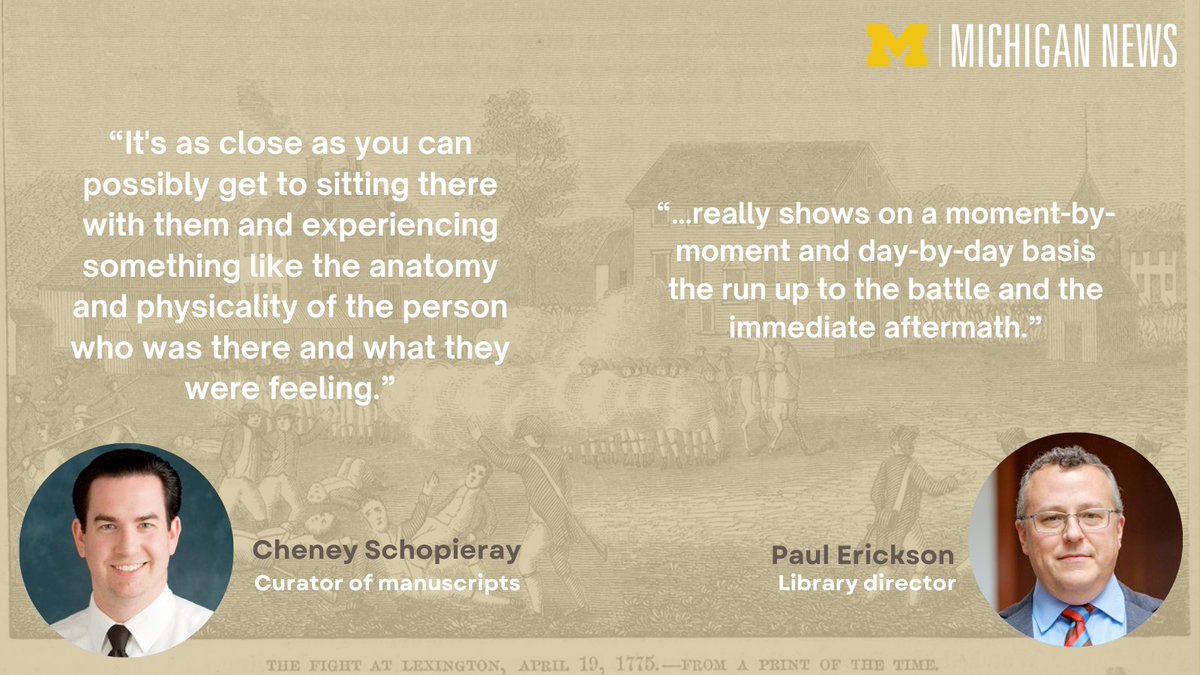
Cheney Schopieray, curator of manuscripts, on the @ClementsLibrary "Bloody Work: Lexington and Concord 1775" exhibit. Library director Paul Erickson said while many exhibits nationwide are celebrating the 250th anniversary of the American Revolution, this one is special. via @detroitnews: https://t.co/AYqgCg2Ynh
250 years ago, the first shots of the #RevolutionaryWar rang out at Lexington & Concord—set in motion by draft orders now housed at @ClementsLibrary. See history come alive in their exhibit "Bloody Work."
Dive deeper: https://t.co/NxRf8lFVnM
Don't forget to sign up for ALA 105 - Digital Research: Critical Concepts and Strategies. This 1-credit course teaches you how to find the best sources for class projects — with online search strategies, research tips, and critical evaluation techniques. https://t.co/2SxA4LYiaz
Clements acquires vast collection of industrial engineering history. So pleased that @umichlibrary could partner with @ClementsLibrary on this acquisition that will benefit UM researchers and beyond! https://t.co/qAMW6JWGhG
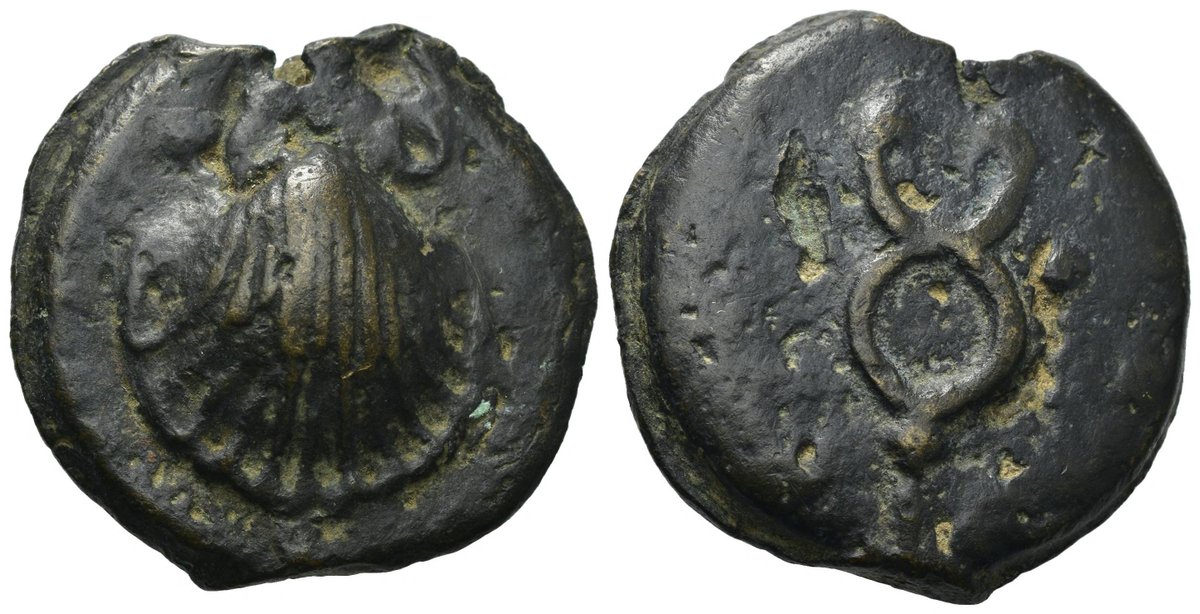
The @kelseymuseum holds thousands of ancient coins, and you can browse a few hundred of them in the digital collection "Kelsey Coins." The Roman coins shown here are from 280-276 BCE. Check out the online collection! https://t.co/u9rE9e4htG
It’s officially here—#GivingBlueday has begun! The link to donate is now open, and every gift helps support the Clements Library Instruction Fund, bringing hands-on history to students and researchers.
Make an impact today at: https://t.co/Hzixrs1FOk
📸: Marc-Gregor Campredon, Office of University Development, Regents of the University of Michigan
Join us on zoom this afternoon at 3p for a Historic Petite Pi(e) Day chat!
Part of the 7th annual Great Library Pie Bake-Off #GLPBO
Find more details on the Pi(e) Day guide!
https://t.co/1aYESWZ8ws
#PieDay#GLPBO2025#UnPieDay
On a trip down the Potomac River on #ThisDayInHistory in 1844, Captain Stockton of the USS Peacemaker fired a gun ironically named “the Peacemaker” multiple times to entertain his guests which included President John Tyler and many other politicians.
Tragically, there was a mishap with the gun the last time that Stockton went to fire it. This caused a small explosion which killed six people including two sitting cabinet members and an enslaved African-American man.
This fateful moment was depicted in lithographer N. Currier’s print “Awful explosion of the ‘Peace-Maker’ on board the U.S. stem frigate Princeton, on Wednesday, 28th Feby., 1844 : by which melancholy accident the Secy. of State, Mr. Upshur, the Secy. of the Navy, Mr. Gilmer, Com. Kennan, Mr. Kennan, Mr. Gardner of N.Y. & Mr. Maxcy were instantly killed - Capt. Stockton & 12 of the ships’ company wounded” which notably does not include an illustration or mention of Armistead, the enslaved man who died that day.
On #ThisDayinHistory in 1836, the Siege of the Alamo began as the Mexican Army, under General Santa Anna, surrounded the mission in San Antonio. For 13 days, a small but determined group of Texan defenders held their ground, fighting for independence until the final assault on March 6, 1836.
The legacy of the Alamo lived on in history in music and memory. Pictured here is the 1895 sheet music for "The Alamo: In Memory of the Fallen Heroes of Texas," a tribute to those who fought and sacrificed.
Join us tomorrow morning over Zoom for a conversation with Laura Helton, author of “Scattered and Fugitive Things: How Black Collectors Created Archives and Remade History.”
Register here: https://t.co/oWsLrS99Xt
#AmericanHistory#BlackHistory#BlackHistoryMonth#BHM
From the diary of a member of the Midland Baseball Club of Oxford to the papers of British Consul-General James Colquhoun, the Manuscripts Department has made a wide variety of collections available for research this month.
Happy Presidents’ Day! While there is a plethora of materials at the Clements pertaining to our leaders throughout the years, we’d like to celebrate by highlighting this charming board game from the 1870s —Chiromagica, or the Hand of Fate—created by the McLoughlin Brothers of New York.
This game features three different themed layouts with a variety of portraits, locations, and written answers laid in a circle, with each layout corresponding to a question wheel. Players then choose a question from the wheel and place it in the center of the board with the corresponding layout around it, and the mystical Hand of Fate spins, landing on the correct answer!
One version of the layouts is about the presidents and U.S. Capitol—challenging players with questions like "Who was the first president of the U.S.?" With a spin of the hand, the game reveals the correct answer—George Washington!
Happy Valentine’s Day from the Clements Library!
This handmade valentine, likely from the 1850s-1870s, is part of the extensive Norton Strange Townshend Collection, primarily dealing with abolitionist, politician, and agricultural educator, Norton S. Townshend (1815-1895). This is a beautiful and clever example of how people would use scrapbook stickers, intricate lace paper, and other embellishments to make valentines.