Anthropic just dropped a 13-page PDF on Agent Memory - 5 layers that cut token cost 90% and make your agent actually learn:
here's the 5-layer memory architecture:
layer 1 → working memory - the context window. everything the agent sees right now. when it fills up, old context dies. most agents stop here and wonder why they're broken
layer 2 → episodic memory - what happened. full interaction logs with timestamps. the agent recalls that the deploy failed Tuesday at 3am because the migration script had a typo
layer 3 → semantic memory - what is true. facts, entities, relationships stored as a knowledge graph. "user prefers TypeScript" lives here. doesn't expire when the session ends
layer 4 → procedural memory - how to do things. the agent tried 3 approaches, one worked. that method becomes a reusable skill. next time it skips straight to what worked
layer 5 → forgetting - what to delete. an agent that never forgets accumulates contradictions. old preferences override new ones. the user moved cities but the agent still recommends restaurants in the old one
the result: Mem0 stores 1,800 tokens per query instead of 26,000. Snowflake added one ontology layer - 20% better accuracy, 39% fewer tool calls. memory pays for itself on day one
this 13-page PDF is what separates a chatbot from an agent that actually learns
don't scroll past this one ↓
i wrote about this in more detail but basically i think we should treat most of the markdown files as a neural net
when agents execute the markdown files, it's a forward pass through the neural net. most people only do this
but to continuously improve the neural net we actually need backward passes to train them
the way i do it is through https://t.co/DkM9b4SF9s which scans all the transcripts, analyze which rules led to a good vs bad outcome, then figure out how the markdowns should be changed to reinforce the gains while reducing the losses
every time i run it i always get pleasantly surprised
found a gem - good recommendation from Keith here
it's a video walking through the basics of firstmate, many of the key principles behind the whole stack, and Hal's own thoughts
i just watched it and honestly felt like i couldn't have made a better one myself
herdr + firstmate is indeed a great combo. that's my daily driver too
herdr provides the lifecycle management and organization of all the agents
firstmate serves as a single point of contact to orchestrate all of them without going insane
Help agents write relevant Golang code with our new set of AI skills – Modern Go Guidelines.
They cover the most useful features from Go 1.0 to 1.27, including everything in the `modernize` analyzer, and instruct your agents to write modern idioms 👇
https://t.co/nDhA32CMny
introducing: Auto Knowledge Gap Finding for Your Docs
Your docs probably don't know what shipped, and no one remembers to keep them up to date.
Every release creates the same cleanup job: search the docs, decide what is missing or stale, find the evidence, and write the update.
Most teams discover the gap when a customer asks a question the docs should have answered.
So we built Knowledge Gaps in https://t.co/v9uBX1hXUz.
Compare GitHub releases, RSS feeds, or changelog entries against your customer and internal documentation.
See missing, stale, hard-to-find, and needs-triage findings with the release evidence and every documentation page BuildBetter checked.
Approve the real work, copy a ready-to-use prompt into your agent, or attach the finding to a project.
Happy building!
many people asked me how to write CLAUDE.md or AGENTS.md, and i see lots of bad advice flying around
so i took some time to write down a guide in https://t.co/v9rrkWKEFr
tl;dr
- handwrite your user level AGENTS.md
- for project level ones, you don't write it. you train it like a neural net
i also open sourced my private solution "backpass" at https://t.co/DkM9b4TcZ0 - it samples your past agent sessions for a repo, distill key learnings and losses, synthesize them, and produce a gradient descent step as a proposal that you can review and apply to improve your AGENTS.md and project level skills
easiest way to run it is just "npx -y backpass" in your repo
hope it helps! please share with whoever you think can benefit from it
Andrej Karpathy spent 8 years at OpenAI and Tesla
Last week, he packed everything he knows into one free 2-hour lecture
Agents → Loops → Graphs → Self-Improving Systems
People pay $15K for bootcamps that teach less than this
This lecture is better than most paid AI engineering courses
You probably don't have 2 hours right now
Don't let this disappear from your feed
Watch it
Then read the guide below
6 months ago: laptop open all day, typing into Claude Code, waiting.
Today: I write a spec, go to the gym, and my phone only pings when an agent needs a decision. 95% of my work runs itself.
Full breakdown so you can build your own 👇
Is your AGENTS.md helping AI coding agents do their best work?
A well-structured AGENTS.md gives agents the right context without overwhelming them. @mattpocockuk shares why keeping instructions focused, using progressive disclosure, and organizing documentation can improve agent performance while making AGENTS.md easier to maintain.
Read the complete guide: https://t.co/66SZrbHvrO
You asked, we delivered! Thank you for suggesting ponytail as our next skill to test!
It's the first skill in the series to show real results, cutting code by roughly 15% and cost by 10%.
Check out our findings → https://t.co/GIHRyfxtoN
New in Claude Code: your sessions can now message each other.
Instead of having to re-explain yourself in another session, you can now tell Claude to do it. It sends a summary (not your history or files), and the other session picks it up mid-task.
Experimenting with a rare addition to my global CLAUDE.md:
"Always talk in ASD-STE100 Simplified Technical English. Always read CONTEXT.md files, and use their ubiquitous language."
I know I've reposted this before, but it's worth re-emphasizing.
If you want to get good at using AI, GET GOOD AT THE THING YOU'RE USING IT FOR
This is a great illustration of why:
/wayfinder lets you plan your most ambitious projects ever
You can give it a destination and it will:
- Figure out the frontier of things that can be decided now
- Uncover the route ahead as you go
- Research, prototype, and discuss with you
- Maintain a map in an issue tracker of your choice (GitHub, Linear, etc.)
It's revolutionised how I plan coding work - and I'm even using it outside of coding.
Get it for free:
npx skills add mattpocock/skills
Here's the breakdown:
We removed ~80% of the Claude Code system prompt for our newest models, this is what we've learned about writing system prompts, skills and Claude.MDs for them. https://t.co/6DZwSrZjE9
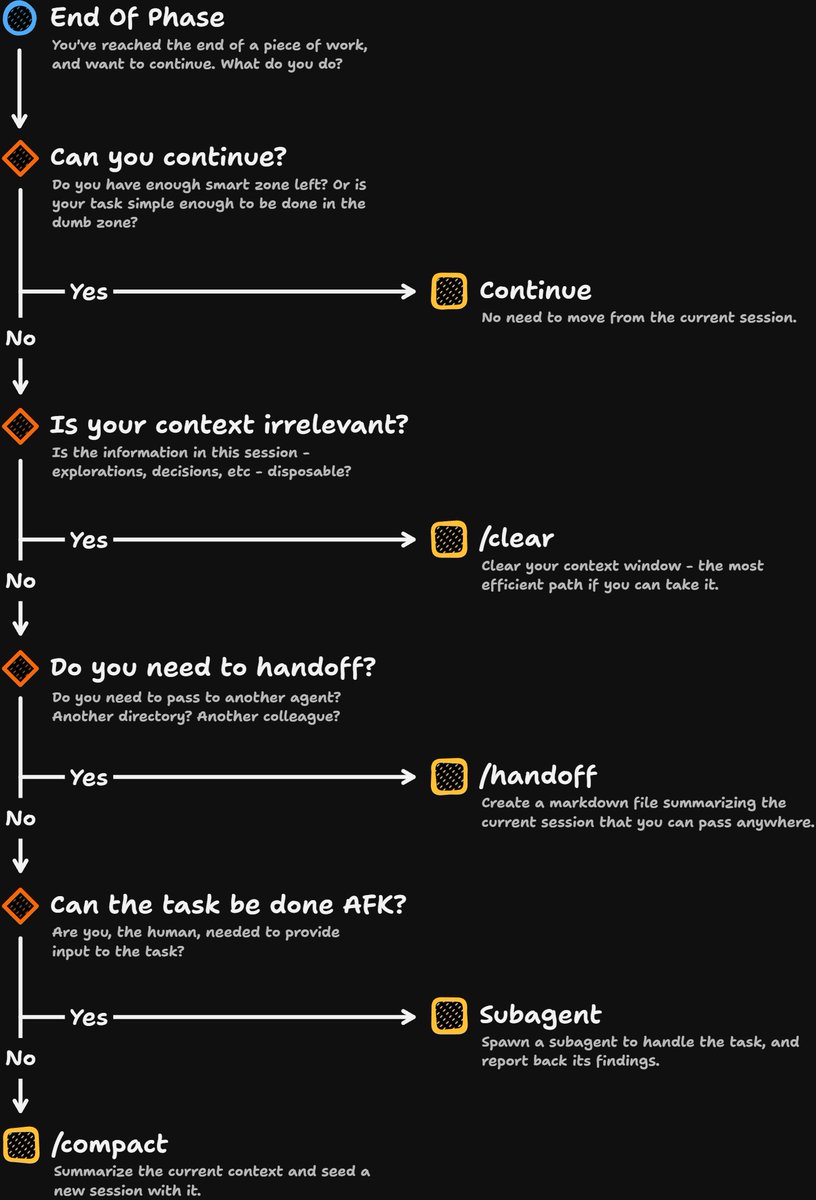
Here's a decision tree for when you get to the end of a piece of work, and you're not sure how to continue:
- Continue in the current session
- /clear
- /handoff
- Use a subagent
- /compact
Posting for feedback. Which parts are confusing? What questions does it raise?
Andrew Ng just released a 1-hour course on building agentic knowledge Graphs from scratch:
• 00:00 - Introduction to agentic knowledge Graphs
• 03:07 - Construction of agentic Graphs
• 14:00 - Architecture of multi-agent systems
• 23:00 - Building agentic graphs with Google ADK
• 01:06:03 - Why Graphsare the future of agentic AI
Worth more than 10 articles on loop engineering.
Watch it today, then read how to become a graph engineer in the article below.