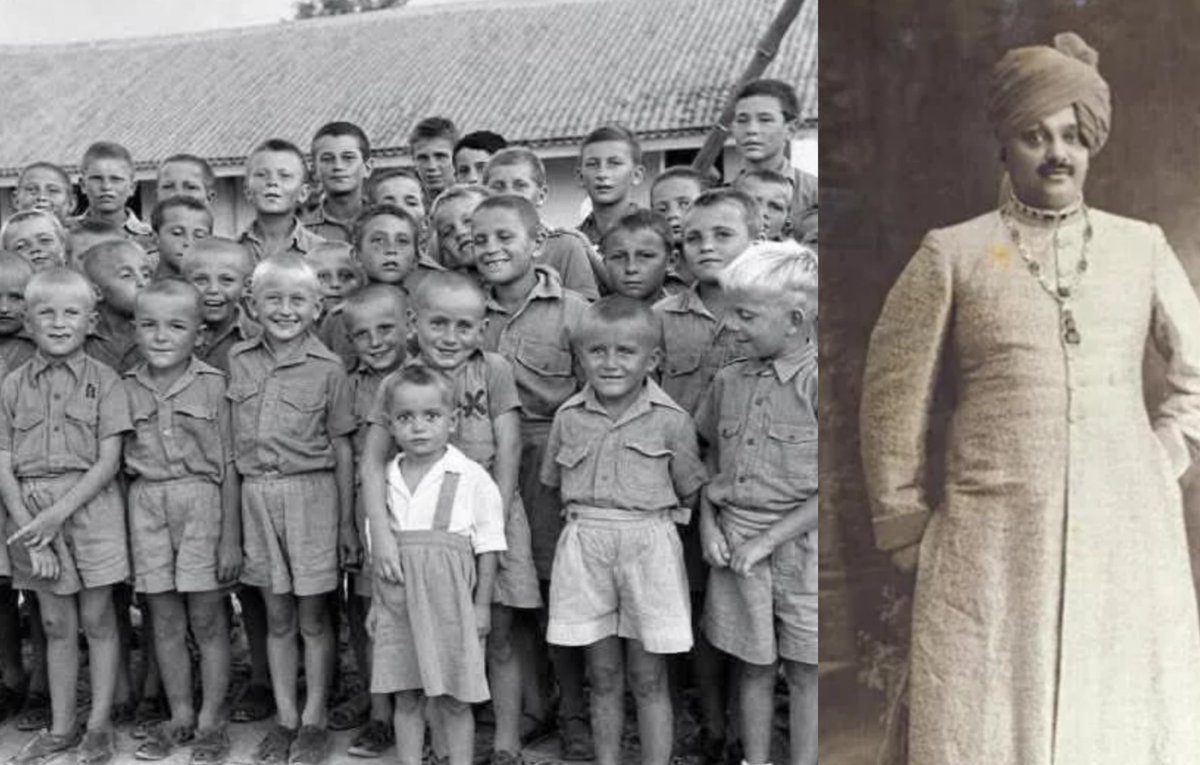
When 740 children were about to die at sea and every country said “no,” one man who had every reason to remain silent said “yes.”
It was 1942.
A ship was drifting in the Arabian Sea like a floating coffin.
On board were 740 Polish children. Orphans. Survivors of Soviet labor camps, where their parents had died from illness or starvation. They had escaped through Iran, only to face another terrible fate.
No one would accept them.
The British Empire, the most powerful force of the time, refused entry at port after port along the Indian coast.
“This is not our responsibility. Go away.”
Food was almost gone. No medicines. Time was running out.
Twelve-year-old Maria held the hand of her six-year-old brother. She had promised her dying mother she would protect him. But how do you protect someone when the whole world turns against you?
Then news reached a small palace in Gujarat, India.
The ruler was Jam Sahib Digvijay Singh Ji, the Maharaja of Nawanagar (Jamnagar).
When his advisors told him that 740 children were stranded at sea after being denied entry to all Indian ports by the British, he asked just one question:
“How many children?”
“Seven hundred and forty, Maharaj.”
He paused and calmly said:
“The British may control my ports, but they do not control my conscience. These children will dock at Nawanagar.”
The advisors warned him:
“If you defy the British”
“Then I will,” he replied.
He sent a message to the ship: You are welcome here.
When British officials protested, the Maharaja stood firm.
“If the powerful refuse to save children,” he said,
“then I, the weak, will do what you cannot.”
In August 1942, the ship struggled into Nawanagar port under the blazing summer sun.
The children walked like ghosts, exhausted, hollow-eyed, many too weak to walk. They had learned not to hope. Hope had become dangerous.
The Maharaja was waiting for them at the dock.
Dressed simply in white, he knelt so he could be at eye level with them. Through interpreters, he spoke words they had not heard since their parents died:
“You are no longer orphans.
Now you are my children.
I am your Bapu, your father.”
He did not build a refugee camp.
He built a home.
At Balachadi, he created something extraordinary, a little Poland in India. Polish teachers who understood trauma. Polish food flavored with memory. Polish songs in an Indian garden. A Christmas tree under a tropical sky.
“Suffering tries to erase you,” he said. “But your language, culture, and traditions are sacred. Let us preserve them here.”
Children who had been told they had no place in the world finally found a home.
They laughed again. They played again. They returned to school. Maria watched her brother chase peacocks in the palace gardens, and her body remembered what safety felt like.
The Maharaja visited them often. He remembered names. Celebrated birthdays. Watched school plays. Comforted children who cried for parents who would never return. He paid for doctors, teachers, clothes, and food from his own money.
For four years, while the world was torn apart by war, 740 children lived not as refugees, but as a family.
When the war ended and it was time to leave, many cried. Balachadi had become the only home they truly knew.
The children grew up and spread across the world, becoming doctors, teachers, engineers, parents, grandparents. And they never forgot.
Warsaw’s Good Maharaja Square stands in Poland. Schools bear his name. He was awarded Poland’s highest honor.
But the true memorial was not made of stone.
Its value was measured in 740 saved lives.
Even today, 80 years later, they still gather. They tell their grandchildren about an Indian king who refused to turn compassion into political calculation.