It's time for Day 2 of ClickHouse Open House 2026!
Today is all about the ecosystem, our partners, and 10 years of open source.
Follow this 🧵 for the keynote highlights.
And for the Day 1 highlights, check out the recap blog: https://t.co/WlykSVJPa1
Every database has a "real-time analytics" page. Few actually deliver it.
https://t.co/ceoUsnRIhH
Pick the wrong one, and it shows up in customer dashboards running on stale data, AI agents making decisions on outdated signals, or fraud systems reacting seconds too late.
We wrote about the six architectural requirements that make it genuinely real-time.
India's developers are building some of the most data-intensive systems on the planet. We want you in the room, building something real. What will you build?
Click-a-thon 2026 is ClickHouse's first in-person hackathon in India. Bengaluru, August 1–2. Teams of 2 to 4. 24 hours. ₹10,00,000 prize pool.
Four tracks: Real-Time Analytics, Observability, Data Warehousing, and Agentic AI & Analytics.
Applications close June 25.
Read more here 👉️ https://t.co/DW80cMstiw
The tricky part of distributed tracing in .NET isn't the traces - it's getting logs to correlate across service boundaries without threading correlation IDs everywhere. OTel handles it, and this post shows the setup with ClickStack.
https://t.co/8TjGrwscne
Microsoft's Aspire shows you what's happening right now, and ClickHouse shows you what happened and why.
New post: building a .NET API gateway that uses both, with live OTLP telemetry in Aspire and durable request history in ClickHouse. Three lines of AppHost C# to wire it all up.
https://t.co/54kRU9UvY7
New free lab: migrate Snowflake to ClickHouse Cloud with dbt, end to end.
Workload analysis, architecture design, Terraform provisioning, dbt pipeline rebuild, and a live benchmark across both systems.
Free. Self-paced.
https://t.co/9q0DjqMf2k
Yesterday we showed the result.
Today we show the engineering behind it.
ClickHouse is 26× faster on TPC-H SF100 after two years of focused join work:
• correlated subqueries
• runtime filters
• lazy column replication
• statistics-based join reordering
https://t.co/ZWC7Dgu3FB
May 2024: “From now on, you will see JOIN improvements in every ClickHouse release.” — Alexey Milovidov
May 2026: ClickHouse is 26× faster on TPC-H SF100. Cloud ranks #1 on cost-performance vs Snowflake, Databricks, BigQuery, and Redshift.
SF10: 2.9s, $0.009. Christmas is saved.
https://t.co/LammIUeg1h
🚀 Build with the fastest database on the planet.
Introducing Click-a-thon 2026 - ClickHouse's first in-person developer hackathon in India.
24 hours · ~120 developers · ~30 teams
📅 1–2 August 2026 · Bengaluru
Pick your track:
➡️ Real-Time Analytics
➡️ Observability
➡️ Data Warehousing
➡️ Agentic AI & Analytics
Top 3 teams hit the main stage at ClickHouse Open House Bengaluru on 22 September.
Registrations open 👇
https://t.co/sNWtw5taMH
One of the most-requested ClickHouse Cloud features just hit public beta: executable UDFs.
Write a Python function, zip it, deploy it to your cluster, call it like a built-in. A single DDL statement binds your Python to the data layer.
https://t.co/NCRyJdKUML
We're not entirely sure Alexey sleeps. He traveled through Asia, flew to San Francisco for Open House, and still ended up as the biggest contributor to ClickHouse 26.5.
https://t.co/HF5O9f8oUh
ClickHouse has min/max metadata at the granule level. For Top-N queries, it uses that to skip entire blocks before reading.
https://t.co/K2viOY6l7A
5–10× faster queries, 10–100× less data read. Especially valuable on object storage.
"You can't really tune something you don't know the mechanics of." — Tony Burke, SolarWinds
https://t.co/ZRlA9tRlTE
3M telemetry messages/second. 76ms → 28ms. Index memory: 10GB → 320GB. Merge times up 50%. Query time down 60%.
Congratulations to @AnthropicAI on raising $65bn.
When Claude 3.5 launched, their engineers asked Claude which database to use. Claude recommended ClickHouse.
Fast forward a year and we launched ClickHouse Agents. powered by Claude. Here's to building together.
https://t.co/nuosoc1JsZ
Metrics aren't dying. But their role in observability is shifting.
https://t.co/hQwamdJnbW
When you can roll up raw events on demand, metrics stop being the source of truth and become a performance optimization.
5 countries. 6 cities. 12 days. 1 ClickHouse 🌏
Last month, our CTO and the creator of ClickHouse, Alexey Milovidov, hit the road across APJ - Mumbai, Bengaluru, Singapore, Jakarta, Seoul, and Tokyo - meeting customers, keynoting Confluent's Data Streaming World Tour, hosting community meetups, and officially launching ClickHouse in Japan 🇯🇵
Why in person? Because the questions you get from a data engineer face-to-face aren't the ones you get on a Zoom call. And APJ is one of the fastest-growing regions for ClickHouse - that feedback loop only works when the creator of the database is in the room.
Huge thanks to every customer, partner, and community member who showed up.
Full recap on the blog 👇
https://t.co/wRhSvzkjzt
#ClickHouse #RealTimeAnalytics #APJ #DataEngineering
That's a wrap! Thank you to everyone who joined us at Open House.
Day 2 of Open House showcased what the community, partners, and customers are building on top of it.
🔹 Fivetran GA with 500+ sources
🔹 First community dbt Labs Fusion adapter
🔹 Sigma connector in public beta + first target for Sigma's ETL Cache Layer
🔹 Google Cloud Dataflow Pub/Sub template GA
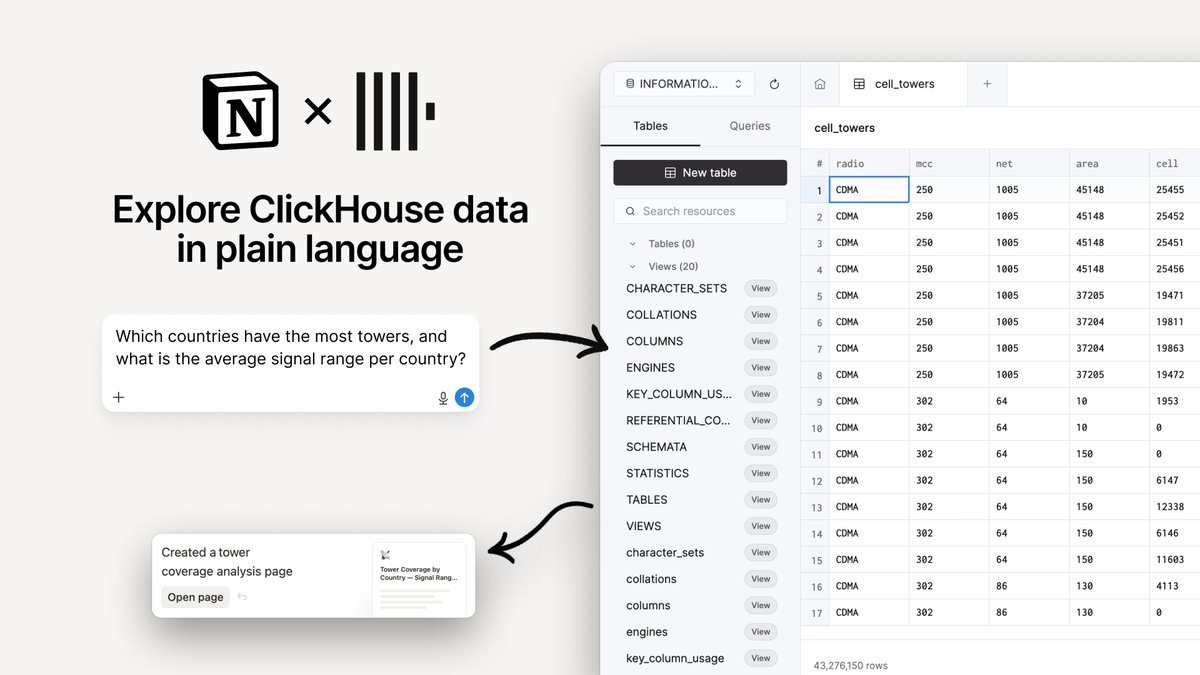
🔹 Notion integrating the ClickHouse MCP server
🔹 Vercel AI SDK v7 + Langfuse for agent observability
🔹 Python client v1.0 with native async
🔹 Native Apache Airflow provider
🔹 Full .NET stack on NuGet
🔹 ...... and more!
We also launched House Mates with 60+ partners, and shipped AI Notebooks and the ClickStack MCP server for observability.
Full Day 2 recap blog: https://t.co/FID6MLoIb8
It's time for Day 2 of ClickHouse Open House 2026!
Today is all about the ecosystem, our partners, and 10 years of open source.
Follow this 🧵 for the keynote highlights.
And for the Day 1 highlights, check out the recap blog: https://t.co/WlykSVJPa1
The observability panel with @mipsytipsy, Alexey, Vijay, and @tbragin converged on one idea: AI doesn't replace engineers; it raises the bar for instrumentation discipline.
Standard schemas, OpenTelemetry, every column queryable, no pre-aggregation traps.
Three words for the state of o11y today: messy, diverse, and fragmented.
The fix is convergence on open standards, so the next wave of agents has clean ground to stand on.