🚨 Just 2 days to go until "AI Agent Mass Production from 0 to 100" in Taipei!
Ready to take your AI agents from PoC to real-world production?
We're co-hosting this event with SIRAYA Technologies, @PingCAP, @dify_ai, and @arizeai, featuring a great lineup of speakers.
Event Details:
November 25 | 14:00–17:00
Taipei New Horizons Building, Xinyi District
Haven't registered yet?
Register here: https://t.co/0JoZAY6fss
Is your team looking to take AI agents from PoC to production? We look forward to seeing you there! 👋
Decision models, decision models everywhere!
And now, they're coming to data infrastructure!
We've been using traditional LLMs for almost every AI task, even when all we need is a simple decision.
But do we really need an LLM to decide whether a transaction is fraudulent, which team should handle a support ticket, or which model should process a request?
That's where decision models like Jev come in.
Unlike traditional LLMs designed for open-ended text generation, decision models are purpose-built for making structured decisions with much lower latency and cost.
They take unstructured inputs and return structured answers and probabilities through three core question types:
- Yes / No: Evaluate whether a statement is true and return a probability.
- Choice: Select an option from a predefined list.
- Score: Evaluate an input against an ordered scale.
And now we're seeing this shift across major data platforms.
At RisingWave, we've been building toward a unified real-time compute engine for agentic AI, bringing together stream processing, Iceberg analytics, full-text and vector search, and low-latency decision-making.
With AI_DECIDE(), we enable you to run decision models directly on streaming events, allowing AI agents and applications to make decisions based on live data rather than stale data.
That's the vision behind what we're building at RisingWave:
Intelligence at the Speed of Your Data.
Stay tuned for more updates on AI_DECIDE() in RisingWave!
RisingWave is heading to AWS re:Invent 2026 for the very first time!
We've been building RisingWave for many years now, but we're more excited than ever to show you what RisingWave has evolved into: a unified real-time compute engine for agentic AI.
One engine: stream processing, Iceberg analytics, full-text and vector search, and low-latency decisioning on live data.
That's the vision behind what we're building at RisingWave: Intelligence at the Speed of Your Data.
Visit us at Booth #608 to meet our team for:
- Live demos showcasing the latest RisingWave features
- Conversations with our team about stream processing, lakehouse architectures, search, and AI agent-native infra
- Exclusive swag for booth visitors
See you at AWS re:Invent 2026! 👋
RisingWave is your unified streaming data & AI platform!
Traditional data stacks require separate systems for stream processing, Iceberg analytics, search, and low-latency decision-making.
Each additional system introduces more complexity, connector plumbing, operational overhead, and delays.
But what if you could bring all these capabilities together in one platform?
That's the vision behind what we're building at RisingWave: Intelligence at the Speed of Your Data.
Here's how it works:
1. Stream: Stream processing
Continuously ingest and process data from Kafka, CDC, and data lakes using Postgres-compatible SQL to power your real-time applications and AI agents.
2. Analyze: Streaming lakehouse
Continuously write streaming data to Apache Iceberg and query fresh data using our Apache DataFusion-based OLAP engine.
3. Search: Real-time search
Enable full-text and vector search over continuously updated data for AI agents that need high-concurrency, low-latency access, with an object-storage-native architecture for cost efficiency.
4. Decide: Low-latency decisioning
Run decision models directly on streaming events to enable AI agents and applications to make decisions based on live data rather than stale data.
One platform: stream, analyze, search, and decide!
Want to query and process your data streams using SQL without setting up a separate stream processing engine and dealing with a lot of connector plumbing?
RisingWave partners with StreamNative to bring a similar developer experience to Kafka and Pulsar through SQL Workspace in StreamNative Cloud.
Instead of:
Kafka + separate stream processing engine + connector plumbing
You can have:
Kafka + Postgres-style stream processing in one place.
Watch this Data Streaming Summit session in which Qiang Zhao and our CPO, @ProductPasha, show how to query your data streams using Postgres-style SQL and build materialized views on top of them, all using SQL.
Your data keeps changing. How can your AI applications keep up?
Catch “Building Rich Context on Live Data with StreamNative and RisingWave” from #DSS2026 for a look at bringing live data into the context your applications need.
🎥 https://t.co/CuIeXm4AZZ
#DataStreaming #RealTimeData #AgenticAI #StreamNative #RisingWave
Inside Apache Iceberg v3: How Deletion Vectors (DVs) and Puffin Files work together!
One of Iceberg v3's biggest improvements is the introduction of Deletion Vectors.
With Deletion Vectors, Iceberg can delete rows without creating separate position delete files.
Instead, a DV uses a compact bitmap to mark deleted row positions in a specific data file.
This makes row-level deletes and updates more efficient by reducing frequent data-file rewrites.
But where are these Deletion Vectors stored?
That's where Puffin files come in.
Puffin is a specialized file format for storing auxiliary information, such as indexes, statistics, and Deletion Vectors, separately from Iceberg manifests.
In Iceberg v3, DVs are stored as deletion-vector-v1 blobs inside Puffin files using Roaring bitmaps.
Here's how it works:
Parquet files store the actual data.
Deletion Vectors mark deleted row positions using compact bitmaps.
Puffin files store DVs as blobs, with each file capable of containing multiple blobs.
Blob metadata identifies the referenced data file and the number of deleted rows.
Iceberg readers use DVs to skip deleted rows during queries.
Together, DVs and Puffin files enable more efficient row-level deletes and updates while keeping Iceberg metadata lightweight.
Apache Iceberg v3 support is another step toward our vision of making RisingWave a unified streaming data platform for agentic AI.
One platform: Analyze, search, and make decisions on streaming data with low latency.
Your AI agent works great in a PoC. But what happens when it's time to move beyond experimentation and into real-world production?
Making that transition comes with its own set of challenges, and that's exactly what we'll be exploring at "AI Agent Mass Production from 0 to 100," an event we're co-hosting in Taipei with Siraya, @PingCAP, @dify_ai, and @arizeai.
We'll focus on the practical deployment of AI agents from PoC to production, with real-world applications and industry use cases.
Along with a great speaker lineup, our very own Sam Hu will present a session on how to process data in real time so that AI and business systems can access the latest information, followed by a live demo featuring finance and fintech scenarios.
Register here to attend: https://t.co/0JoZAY6fss
If your team is pushing AI agents from PoC to production use cases, we look forward to seeing you there! 👋
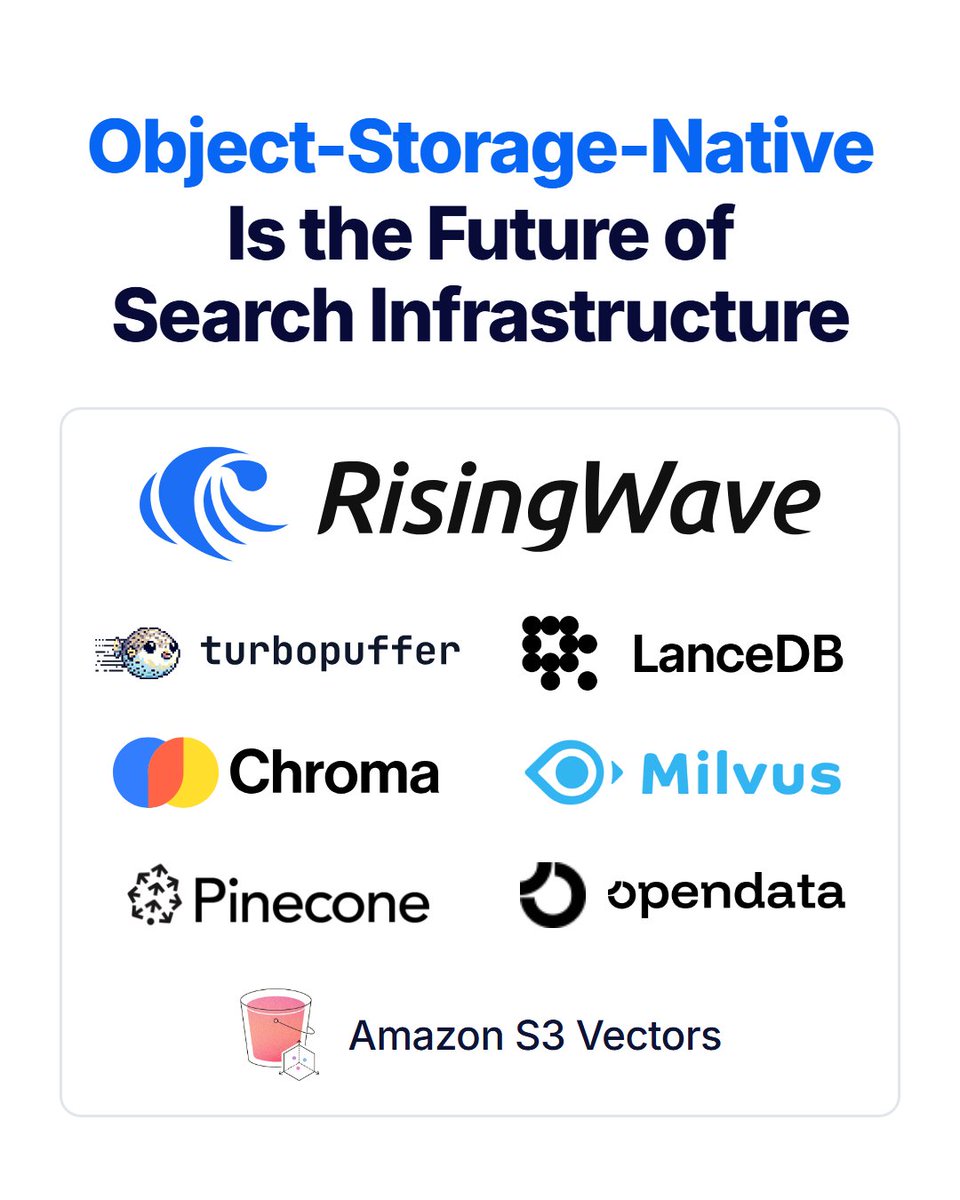
Elasticsearch is dead, long live Elasticsearch!
Object-storage-native is the future of search infrastructure, and that's why it has become the foundation of modern search projects like turbopuffer, LanceDB, Chroma, Milvus, Pinecone, and OpenData Vector.
By object-storage-native, we mean object storage as the primary storage layer, not merely as a backup or cold-storage destination.
But object storage doesn't have to be part of the direct execution path for every operation.
In this case, the hot path is accelerated by:
- Memory and local SSD/NVMe caches
- Metadata caching
- Asynchronous prefetching
- Intelligent indexing and data locality
That's how you get both:
- Cloud-scale economics
- High performance
At RisingWave, we've been investing in native search capabilities for quite some time, including full-text and vector search over streaming data.
We're building these capabilities for AI agents that require high-concurrency, low-latency queries, all powered by an object-storage-native architecture.
Stay tuned for more exciting updates!
The future is:
- S3-native
- Cache-native
- Disaggregated
- Intelligent data locality and movement
Object storage is the durable storage layer.
Caching is the performance layer.
That's the architectural shift happening across the data infra space.
Current 2026 is over, and it was great to participate alongside our partner, StreamNative.
Huge thanks to everyone who visited us at Booth #101 and for all the great meetings, chats, and discussions.
Also, thanks to @confluentinc for organizing it. Great work.
Now, something really exciting!
This year, we'll be participating in AWS re:Invent!
Really excited to see you all there! 👋
Rust, Rust everywhere! 🦀
Memory safety. Performance. Correctness. Compiler feedback. Agent-friendly development. Community.
These are the reasons why more and more projects are choosing Rust.
Five years ago, RisingWave chose Rust, and that decision turned out to be really successful. Today, RisingWave is the #1 Rust-based streaming platform.
Love Rust? So do we. Use RisingWave for:
Low-latency computation
Streaming lakehouses
Real-time agentic AI & applications
Stop by Booth #101 at Current 2026 and connect with our RisingWave and StreamNative teams! 👋
We'll have live demos and exciting conversations about:
Data streaming
Stream processing
Real-time infra for AI agents
Streamhouse Initiative
And some cool swag, too!
🚀 #Current2026 kicks off today!
📍 Visit StreamNative at Booth #101 to talk about real-time data and AI agents.
🎤 Our sessions:
Nov 4, 2 PM — Lakestream Catalog for Agents
Nov 5, 1:30 PM — Server-Side Filtered Reads for Agent Context
See you there!
#Current2026#DataStreaming #AIAgent
The RisingWave November Newsletter is here!
Read it to catch up on all the exciting product updates, upcoming events, and community highlights. https://t.co/TpDASHb2KM
🚨 Just two days to go until Current 2026!
Current 2026 is happening November 4–5 in San Francisco.
We're really excited for this year's Current, and we'll be there together with our partner, StreamNative.
Attending Current 2026?
Come by Booth #101 for a chat with the RisingWave and StreamNative teams about:
Data streaming
Stream processing
Real-time infra for AI agents
The exciting new Streamhouse Initiative
Still haven't registered?
Register for free for Current 2026: https://t.co/s96hC2Iw1p
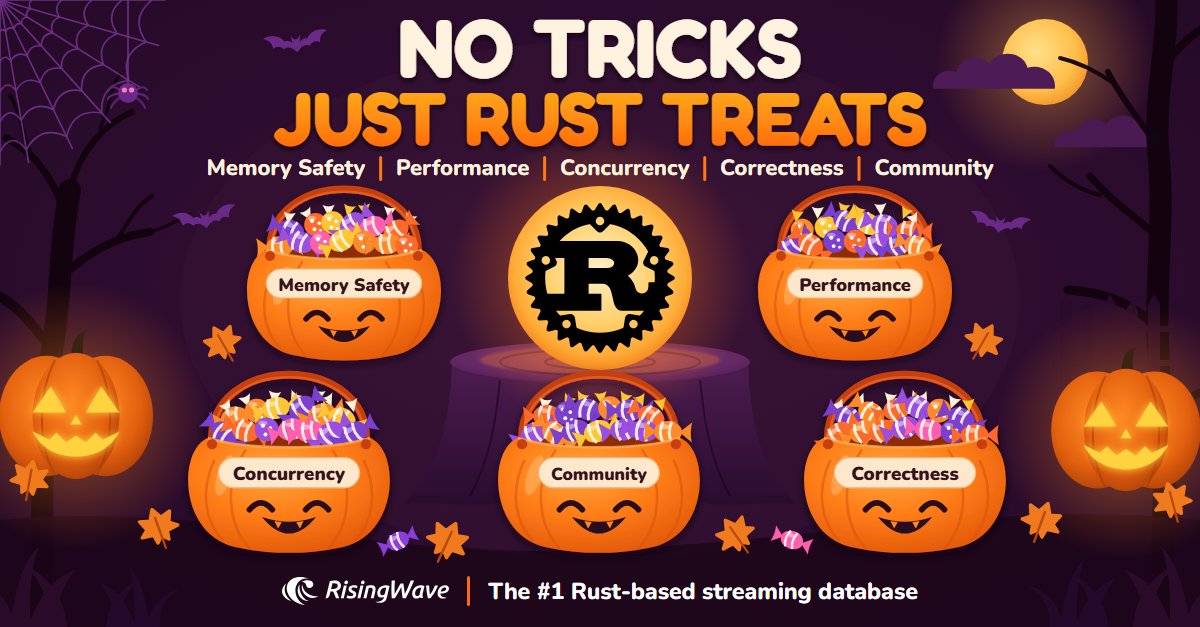
No tricks. Just Rust treats! 🎃🦀
Memory Safety. Performance. Concurrency. Correctness. Community.
Five reasons why Rust is becoming the language of modern data infrastructure.
What's your favorite thing about Rust?
Happy Halloween from RisingWave! 👻