The AI engineering platform for building, evaluating, and improving AI agents & LLM applications. Home of the open source @ArizePhoenix project and Arize AX.
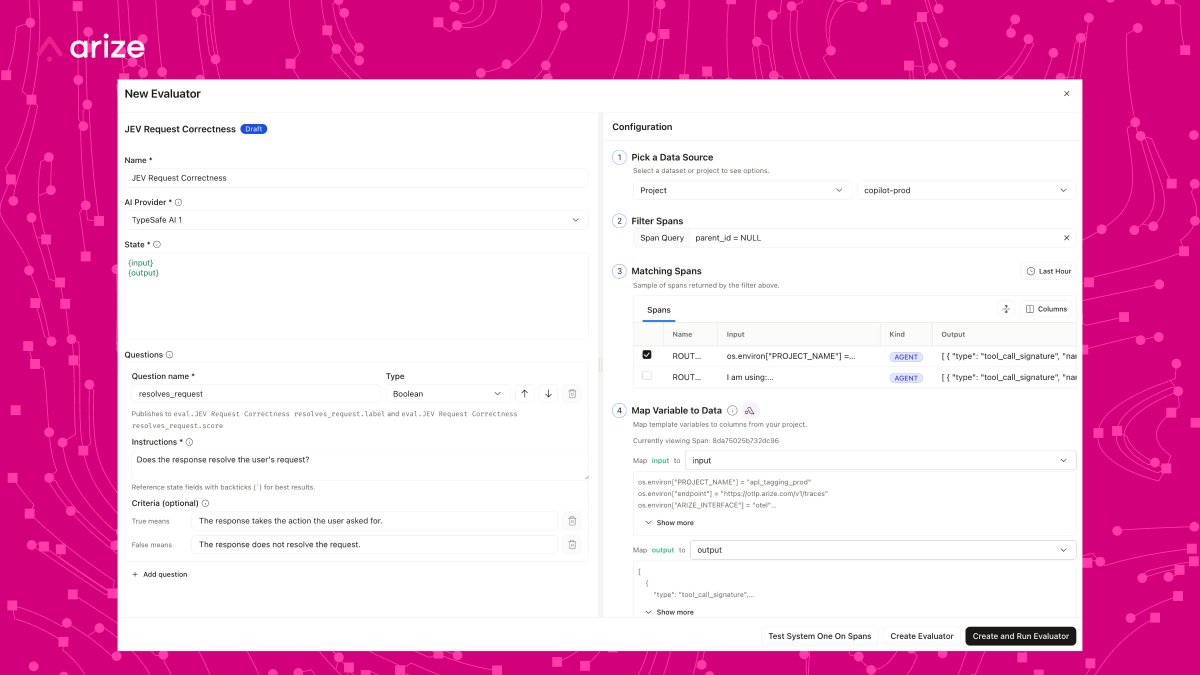
Jev-as-a-Judge is live in Arize AX.
Ask most LLM judges a yes/no question and you get a paragraph back. Then you parse it to figure out the answer.
Jev returns typed outputs instead: booleans, choices, or rubric scores, with confidence on classifications. You can also evaluate multiple questions in a single call.
Docs --> https://t.co/TaDKpGTx2O
Developers should be able to choose the best tools at every layer for their agents and keep improving as the stack evolves. That means preserving progress across model and tool calls, then understanding how those choices affect agent quality.
Arize is the evaluation layer in the AI stack, and we’re proud to be building with @temporalio so developers can understand how agents behave, investigate failures, and test improvements before shipping.
Temporal’s new post walks through how each layer works with Durable Execution: https://t.co/VixzzeRhkm
Signal in Arize AX reviews production traces, ranks recurring issues, and drafts fixes for engineers to review and ship.
Teams using Signal say fixes that once took hours now take minutes.
Explore Signal: https://t.co/kYzcMrsm8J
An AI agent can return the right answer and still waste money on unnecessary tool calls.
At @Upstart, Signal caught unnecessary retrieval API calls happening on every turn, adding real costs at scale.
What does it cost to run an LLM judge on every span?
Decision models pick from a set of choices and return a probability for each, so they run faster than an LLM and are cheap enough to score every span.
See it this Thursday, November 19, 11am PT/2pm ET.
Register here: https://t.co/o5J1W1YKYr
At @Uber, PMs and designers now help shape evals alongside engineers.
With Arize AX, teams can connect eval results to traces and refine what they're measuring. Thanks to the Uber team for sharing their work! 👏
Case study: https://t.co/9rouVhmrsx
Uber teams reported agent eval scores above 90. Reviewing real traces revealed failures those scores had missed.
Aayush Agrawal at @Uber shares what the team learned about building evals into agent development.
Watch the new video 👇
https://t.co/2PC9sVIbcP
Offline evals won't catch every issue that shows up in production.
Gaurav Konar at @glance_inspires shares how his team uses Phoenix for offline work, with Arize AX + Signal adding production traceability and proposed fixes in PRs.
Thanks for sharing, Gaurav! 👏
Choosing between Arize Phoenix and AX comes down to your team's workflows and what you're prepared to operate.
Our guide covers when to use each, when both make sense, and the trade-offs around production evals and infrastructure ownership.
https://t.co/jpw3igjHIB
Choosing AI tooling affects both cost and where a team's time goes.
Richard Woolston in financial services shares why Arize was the clear choice for cost efficiency and giving his team room to focus on its broader vision.
Scaling AI agents in banking also means being able to review what agents did and why.
Our report covers tracing, layered evals, human approvals, and audit trails.
https://t.co/FByFjHQEkQ
Qwen3.8 Flash is 30x to 40x cheaper per token than Opus 5.5. In a manager/worker loop on 30 hard coding problems, it solved 23 to Opus's 24, cost 15% less per solve, and took a median 37 minutes instead of 21 seconds.
How to test a model switch yourself: https://t.co/xHYzxKoKbF
Build, self-host, or buy AI observability?
Our guide compares the engineering work and long-term costs behind each option, including infrastructure, security, upgrades, and support.
https://t.co/xvCG6x4TqB
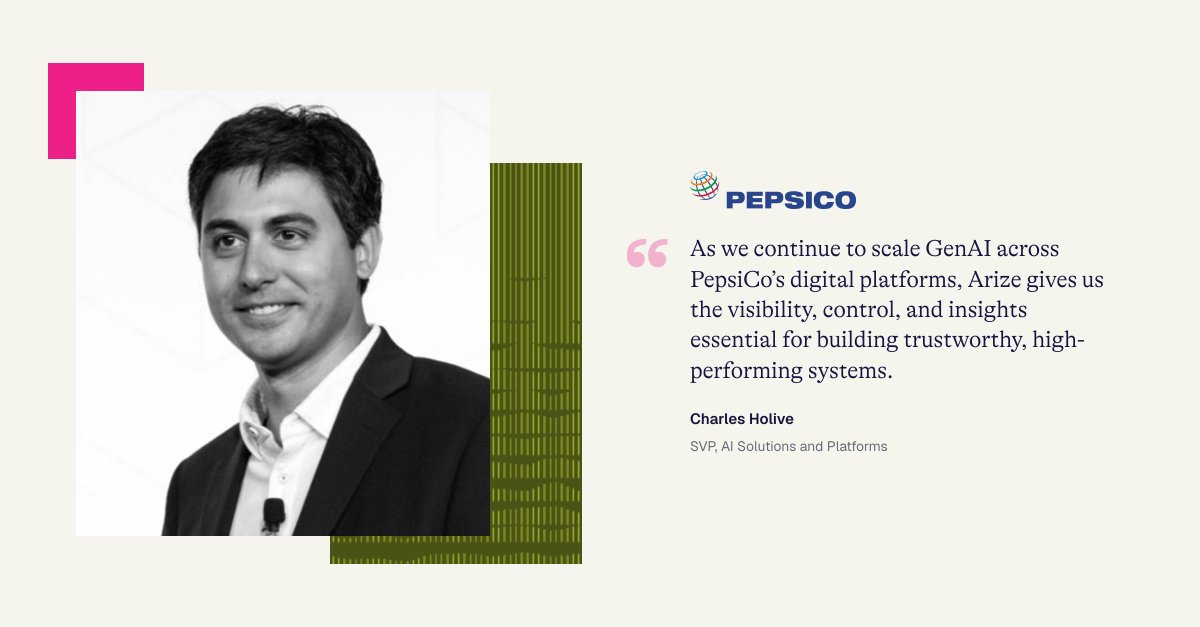
As @PepsiCo scales GenAI across its digital platforms, Charles Holive points to visibility, control, and insights as essential for building systems the team can trust.
Thanks to Charles and the PepsiCo team for sharing their perspective! 👏
The future of AI is specialized intelligence with models tuned to your data, your domain and your customers.
Today, we're proud to launch live from Forge the Fireworks Frontier Ecosystem with 60+ partners across the AI stack, helping you build and ship faster.
Check it out: https://t.co/V0xD20BvC3
Join us tomorrow to see how Phoenix MCP lets agents query your traces with SQL and code mode.
We'll also share our eight-question benchmark, which showed roughly 17x lower average cost than fetching spans page by page.
https://t.co/MByJIh2Hh0
Agent observability means capturing the full execution graph: model calls, tool use, retrieval, and control flow.
Ed highlights @ArizePhoenix, Arize AX, and OpenInference in that discussion.
Thanks for including us, Ed! 👏
Data built for reporting isn't automatically ready for autonomous AI agents.
Ed Haruni at Air Canada breaks down four levels of data readiness: reporting, prediction, assistance, and autonomous action.
Read Ed's article 👇
https://t.co/KFe9gy9mp3