Welcome to @CliffRadarHQ | Cliff Radar Capital
We built a tactical ETF allocation model designed to adapt to changing macro conditions — rotating between sectors as market risk shifts — with the goal of reducing drawdowns during recessionary environments.
Powered by our proprietary Edge Market Pulse (EMP) model, which scans macro indicators daily and signals allocation changes, which are rule-based and emotion-free.
Back-tested across multiple major market cycles since 2000. Past performance is not indicative of future results. All investing involves risk, including possible loss of principal.
Follow our live model portfolio and mirror it automatically in your own brokerage account:
https://t.co/nSjrLY7JSB
This is not investment advice. For informational and educational purposes only.
#Investing #PortfolioStrategy #RiskManagement #WealthBuilding #ETFs
Last month, a lot of high-flying portfolios — the ones loaded up on the hottest AI and momentum names with no plan for the downside — fell anywhere from 30% to 70% off their highs.
Ours held steady.
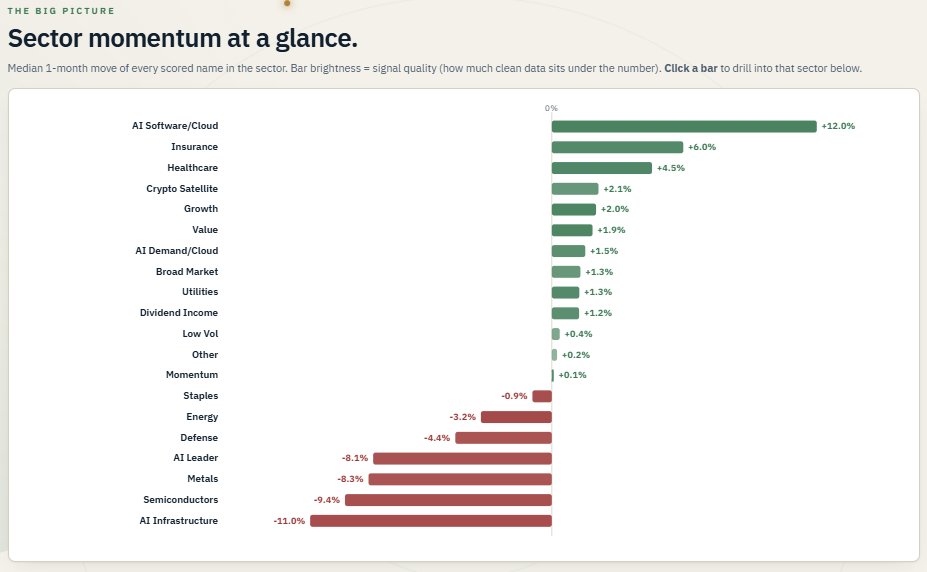
That's not luck. It's the entire reason Cliff Radar Capital exists: protect capital first. While the market ran hot, our PAM model kept us deliberately defensive — broad-market and low-volatility core, staples, healthcare, utilities, a little gold for ballast — and shifted us to take profits instead of chasing the crowd.
But here's what we're proudest of: we're never satisfied. Every day we test, audit, and run shadow models against our live strategy, hunting for ways to invest our own money — and yours, if you ride alongside us — a little smarter than yesterday.
We didn't build this to gamble. We built it to endure.
See it for yourself. We publish our positioning, our risk posture, and how the models are thinking — in plain language, updated regularly — at https://t.co/M2a4spMpQk. Come look under the hood, follow the strategy in real time, and decide if investing alongside us makes sense for you. This is what disciplined, transparent investing actually looks like.
Explore our low-risk, medium-risk, and high-risk portfolios on @joinautopilot. Search "Tactical Radar" on their app to see all three.
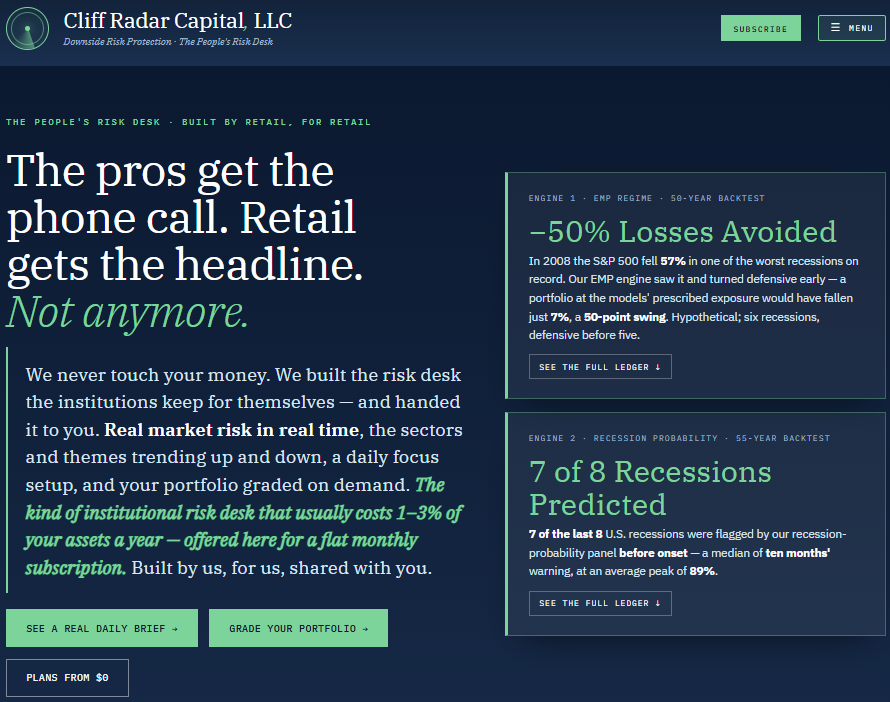
Your financial advisor, who manages your money, likely charges you 1–3% per year and can't assign a value to today's market macro risk. We can. To the decimal.
We're an engineer and a CPA who got tired of getting the headline after the damage was done. So we built the risk desk institutions keep for themselves — macro regime scoring, an AI-bubble watch panel, 836 names across 161 themes, scored every trading day. Built for us, and shared with you.
Today, our quantitative model moved to a more aggressive posture.
Take Profits → Stay Invested
85% → 91% invested. Cash 15% → 9%.
Why: June PPI printed 5.5% (from 6.5%). June CPI 3.5% (from 4.2%). Two soft inflation reads in three days crossed a line we drew in advance — so the model moved. We didn't.
We never touch your money. You make the call. You finally get to make it with the same tools they have.
By retail, for retail.
https://t.co/jdu4zWyADK
The tape is green this morning. CPI cooled, PPI surprised to the downside, Big Tech is leading, and everyone's feeling good. Apple just hit an all-time high. BlackRock beat. The mood is risk-on, and the conversation on Fintwit is basically "why are you even holding cash right now?"
Here's why.
The model's health score sits at roughly 65% of full strength. One risk flag is still live — valuations are stretched against earnings yields in a way that's historically uncomfortable, and the model doesn't ignore that just because the tape is green. Six points separate us from a shift in posture. Six. We re-ran the numbers this morning. Same answer. So we hold the posture: mostly in the market, powder dry, trim into strength, don't chase.
That said — the system found a call today, and it's a good one.
$CVLT. Commvault Systems. Enterprise data protection and cyber resilience — the infrastructure layer that keeps companies from losing everything when (not if) they get hit. It's not a flashy AI pitch. It's the boring, critical stuff that procurement budgets don't cut, even in a downturn.
Cybersecurity is earning its keep right now. The sector's been one of the cleaner trending spaces in the market, and within it, Commvault is one of the names doing the actual work — not just riding the theme. The model scored it 84 out of 100. I run 800+ names through this every morning; 84 puts it near the top of the board. The trend is locked in and strengthening, not extended or exhausted. Volume is confirming the move. Three-month return is sitting at +62%, and the setup still reads as buyable — not something to chase after a run, but a runner with room. That combination is rare enough that when the model surfaces it, I pay attention.
Personally, what I find interesting is the timing. The macro backdrop has money rotating out of the most stretched corners of tech and into things that actually have earnings floors. Cyber fits that rotation without requiring you to buy into an AI multiple. My own money runs on this. I don't post things I'm not willing to hold.
One name I'm watching but not posting: $NVTS. Down 45% today — sharpest drawdown on the board in Power Semiconductors. Could be nothing systemic, probably is specific. But when something drops that fast, I treat it like an incident report: find the failure mode before assuming it's a buy.
So that's the desk today. Mostly invested, some cash, one clean call, one name I'm watching from a distance.
We at Cliff Radar Capital use our quantitative models to score macro risk in the market and across 800+ stocks daily with a systematic, three-pillar scoring system — no hunches, no hype, no emotion, just data-driven market and stock analytics. Today, our models selected $CVLT as our focus stock setup. As of today, our focus setups have an 82% hit rate and average a 7.6% gain 30 days after our calls. We are now, and will forever be, fully transparent about our calls and their results. That's why we include a track record on our website that updates every day our models run. You can find it here. At Cliff Radar Capital, we are retail. Built by retail for retail. https://t.co/4zHCbGhrJc
$CVLT
Every trading day, we run 800+ stocks through our quantitative risk and position models and rank them by conviction. One stood out, $TGTX, as our Focus Setup of the day.
$TGTX. TG Therapeutics is a commercial-stage biotech focused on blood cancers and autoimmune disease — its lead drug is an approved therapy for multiple sclerosis and B-cell malignancies. Biotech has been a quiet winner in this environment: defensible revenue, pipeline catalysts, and insulation from the oil-driven inflation noise that's been whipping industrials and energy names.
What made $TGTX the top name on the board: the trend is locked in and strengthening, not exhausted. Volume is confirming the move — not fading into it. The 3-month return is +63%, and the model's conviction score is 84 out of 100. When I run names that are up big and check whether the move is getting long in the tooth, this one keeps passing. The setup says the structure is still buyable, not extended.
My own money runs on this machine. I don't post things I'm not willing to hold. $TGTX is the call.
$TGTX
San Diego. Las Vegas. Tampa. Denver.
Waymo confirmed. Coming weeks.
$GOOG off 1.69% to $357.47 today — the market shrugged.
When a mobility network adds 4 metros and the stock yawns, someone's wrong about the value.
The question is who.
You can't predict the next headline out of Iran. Neither can we.
So we don't try. Tactical Radar + our EMP macro risk model simply scores the whole macro picture daily and keeps you positioned for the current risk regime—automatically, through every shock.
See it in action 👇
https://t.co/nSjrLY7JSB
When the ceasefire narrative breaks, the market's first move is rarely the right size.
Which side of this are you on — fade the oil spike as a headline overshoot, or hold it as the start of a sustained risk repricing?
Follow for the daily desk brief.
Energy names ($XOM $CVX $OXY $FANG) look like the obvious hedge, but the trade gets crowded fast. The real question is whether you're buying the geopolitical premium or a durable supply shock — those are very different positions with very different exits.
So here's the question worth arguing about: Is index inclusion alpha already fully arb'd away by the time retail hears about it — or does the float dynamic still create a tradeable edge? Drop your take. Follow for the daily desk brief.
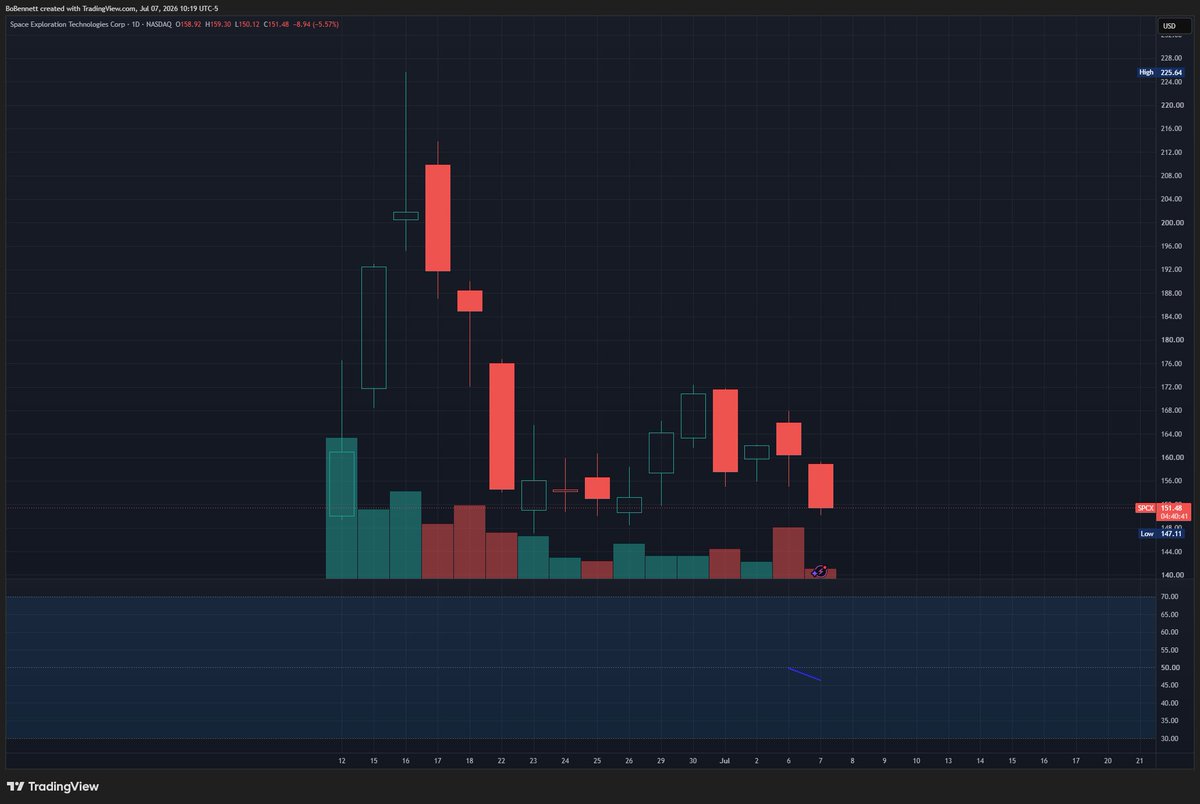
When an index adds a stock, passive funds don't have a choice. They have to buy. That forced buying is the whole story with $SPCX today — and most people are misreading the setup. 🧵
The concept to pocket: index inclusion = known, scheduled demand. Sophisticated traders position BEFORE the event. By inclusion day, much of the move is already priced in — sometimes more than the move itself.
So here's the question: when a high-expectations sector disappoints on a BEAT, do you
A) fade the relief rallies, or
B) use the dip as a re-entry?
Drop your take. Follow for the daily desk brief.