I'm delighted to be speaking at #CarbonUnboundEurope in London on 21 & 22 October!
👉 Learn more and register: https://t.co/g38zG5RJVn
See you there!
#CarbonUnbound
Already today!
Tune in to learn why the #LULUCF sink is shrinking, and what we can do about it.
Guest: the amazing Asger Strange Olesen.
https://t.co/vBbrc38RdQ
#CDRscoop#CarbonRemovals
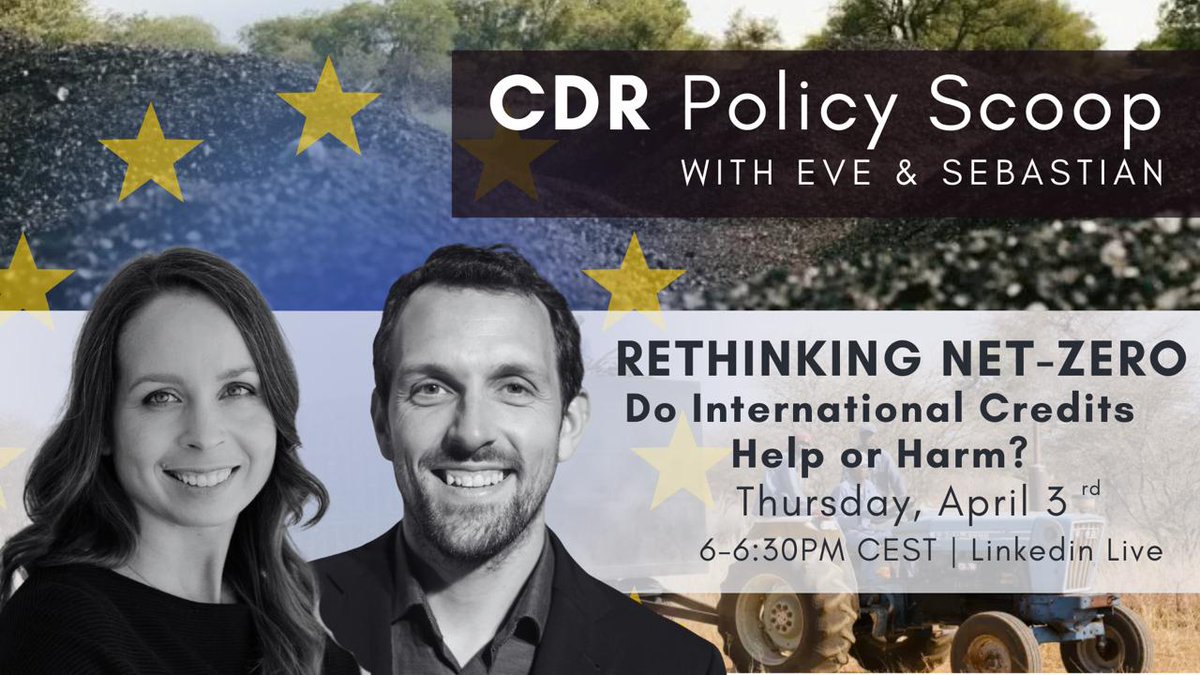
The one and only Danny Cullenward will join the CDR Policy Scoop to share his insights on #PACM#Article6.4 draft rules on non-permanence / reversal with Sebastian Manhart and me.
Join Wed 30 July 9am PDT 🇺🇸 / noon EDT 🇺🇸 / 6pm CEST 🇪🇺
https://t.co/JiAcCnzwqy
There are three options for the role of #CDR in the #SBTi draft net-zero standard.
What if there was a fourth one?
@RobertHoglund put it forward at the latest CDR policy scoop.
The whole 30-min live session:
https://t.co/omHu032Y6N
https://t.co/mViZnC5YMg
#CDRscoop
What does the new #SBTi standard mean for #CarbonRemoval?
* Does it require companies to start buying #CDR immediately?
* Leave it as a voluntary activity until 2040?
* Or push companies away from the SBTi due to costs?
https://t.co/J2TT0saR1m
#CDRscoop
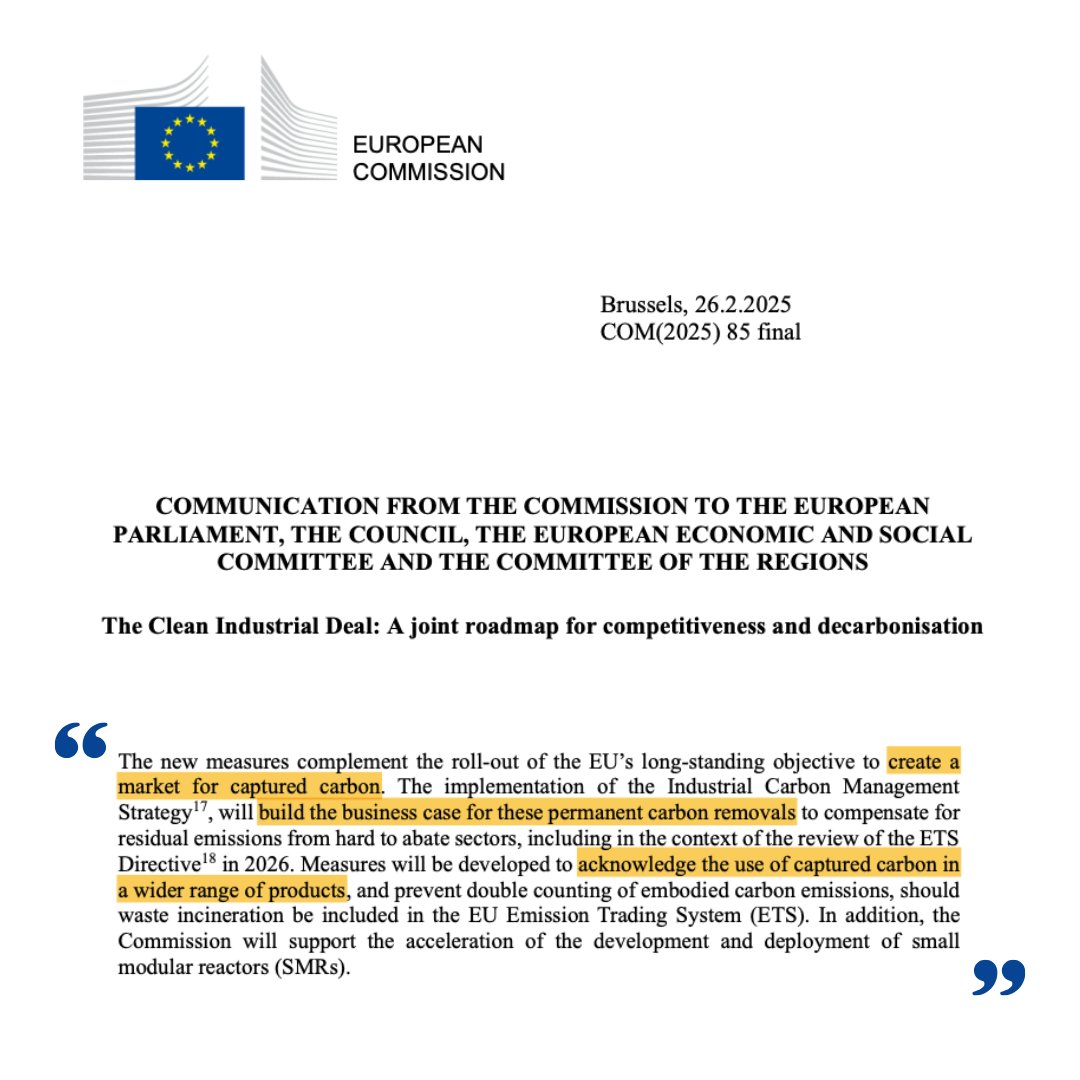
The long-awaited Clean Industrial Deal is finally out!
The specific section mentioning #CarbonCapture and #CarbonRemoval is below for your analysis.
Some elements that stood out:
• The framework builds on the 90% net GHG reduction by 2040 (note that the proposal is not out yet) and climate neutrality by 2050.
• Implementation should lead to new markets for captured carbon
• Acknowledges the critical role of permanent hashtag#carbonremovals for hard-to-abate sectors
• The #CBAM will be simplified while maintaining its impact, with a comprehensive review in 2025 examining scope extension to additional ETS sectors and downstream products
• Public procurement will be leveraged through the new Industrial Decarbonisation Accelerator Act with non-price criteria for sustainability and resilience to foster demand for low-carbon products
• The proposed Industrial Decarbonisation Bank aims to mobilize €100 billion in funding based on #InnovationFund resources and #EUETS revenues to support carbon reduction projects across sectors
Many question marks, as always, when it comes to Commission communications. How? When? etc. But it's a start.
Check it out:
https://t.co/jJNaVTxNGG
There was record interest in our yesterday's CDR Policy Scoop with Noah Deich @TheCarbonSink.
And we delivered!
Check out Noah's sharp take below on the necessary narrative change for #CDR in the US.
And this is just a sample. The session was filled with insightful and actionable advice.
What should the VC-funded start-ups do (or not)?
What should #CarbonRemoval project developers do (or not)?
What works in this new reality in the US, and what doesn't?
Thank you so much, Noah! This was precisely what the CDR community needed.
If you missed the session, check out the whole fast-paced 30-min live recording here:
https://t.co/vNgd8cP4Pn
Or find CDR Policy Scoop on your favourite podcast app (subscribe and leave a review!) and listen on the go:
Spotify: https://t.co/88Kl0lfzjO
Apple Podcasts: https://t.co/jfbueRPZPe
Generic link: https://t.co/asLzvtW5FP
#CDRscoop
I read the 333-page report on #CarbonRemovals – here’s my take.
First, I feel for all of you who need to consume it quickly. It serves much better as an evergreen resource to explore chapter by chapter over time.
Second, kudos to everyone at the European Scientific Advisory Board on Climate Change and beyond who were involved in drafting this comprehensive paper. Exceptional work!
We will discuss the report in depth at our upcoming CDR Policy Scoop with Sebastian on Tuesday, 4 March, at 6 PM CET. Sign up for the session:
https://t.co/w8NdPgfwub
Here is what stood out to me.
Well done:
• Exceptionally well-structured with clear readability. Excellent visuals. From communication and outreach perspectives, it is an invaluable resource for policymakers.
• It covers almost everything you can wish for. We now have a European #CDR primer, but so much more from its policy content side. Rich with Europe-specific data and policy context, building on recent literature, primarily from the 2020s.
• It is reassuring to see the numbers proving that the maximum volume of removals that is adjusted to environmental risks is in the same ballpark as what is needed in 2040 and 2050. Just need the right policies.
• The @esabcc_eu also outlines twice higher need for #BECCS & #DACCS in 2050 (233-256 Mt CO2) compared to the Commission's estimation (119 Mt CO2).
• Appreciate the serious consideration of policy instruments beyond the #EUETS.
• Great to see policy sequencing and dynamic policy mix as part of it.
Areas of improvement:
• Lacks clarity regarding CO2 versus other GHGs in definitions, targets, and relevant removal balancing from a policy design perspective.
• Disagree with the framing that policy choice is either targets or price signals. Carbon pricing is implemented to achieve targets – targets precede pricing mechanisms.
• The focus on ETS and #LULUCF. What about the ESR? Has it been determined obsolete post-2030? It remains a viable tool with the potential for new incentives. Reality check - BECCS removals are currently reported as information items in national GHG inventories under ESR. The report sidelines it and suggests BECCS potentially under LULUCF.
• Given the report's depth, I expected more analysis of activity-based versus inventory-based accounting improvements. The relationship should be nested, not complementary. The challenge of the scope of removals to be included in the 2040 target due to a lack of accounting rules is not mentioned at all.
Obvious (but minor) mistakes:
• Since when is the forest offsets programme under CARB the world’s largest compliance market? What about the EU ETS?
• The definition of carbon markets is incorrect. These are not only about carbon credits but also emission allowances - very distinct tools.
I look forward to sharing more during the 4 March #CDRscoop. Make sure to sign up!
https://t.co/w8NdPgfwub
And here is the ESABCC report again:
https://t.co/hSJMEmU6Bx
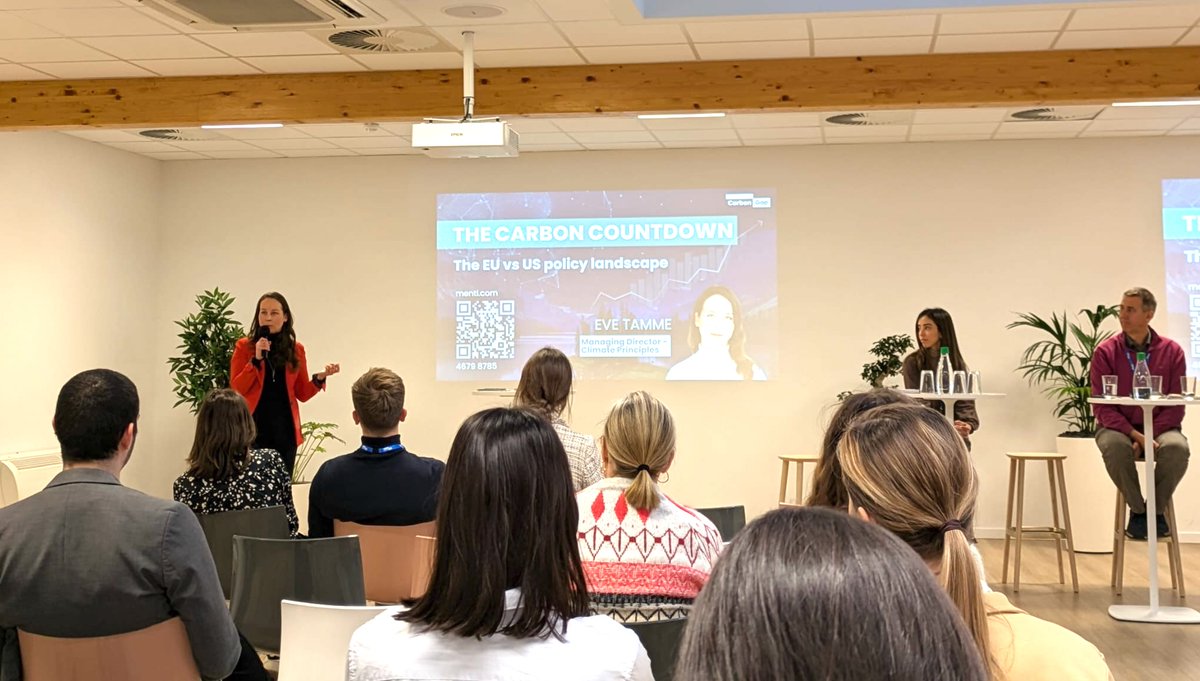
Big thanks to @CarbonGap for this week's engaging Policy Tracker 2.0 launch.
When I first heard of their plans for our session, I thought it was a risky move.
Instead of the usual panel discussion, we experienced something very different: an interactive session where the panellists provided live commentary on the audience's feedback.
We should do this much more often.
Getting everyone engaged, combined with the compelling visualisation by @Mentimeter, made a huge difference.
When the tracker was first announced, we learned it would outline 500 funding mechanisms in Europe.
That number climbed to 600 (!!!) on launch day - fantastic progress.
Make sure to explore all policies and funding related to #carbonremoval in Europe:
https://t.co/x9lmStaffh
It was lovely to see everyone, reconnect and discuss the latest in #CDR policy.
#CarbonRemovals in the #EUETS.
Good idea? Bad idea?
It depends.
I first wrote about removals in early 2022 when only two seminal papers had been published on the topic.
Last year, issuing reports on integrating removals into ETS became so popular that it gave me a flashback to when writing reports on CDR (methods, potential) was the big thing everyone was doing.
The output is increasing, but fresh insights are rare.
The stage seems set: stakeholders have figured out their stance, there is plenty of lobbying going on, and we're all watching the clock tick towards the 2026 legislative proposal. The preceding public consultation should reveal which way the wind blows.
We can explore the removals-ETS integration from many angles:
* The usual – quality, quantity, timing, market design, access and governance principles that I've elaborated on previously.
* ETS integrity first – what will success look like?
* Removals industry first – what drives scale?
(and many more that I won't cover here)
The debate often gets stuck in details that don't matter if the overarching approach doesn't have integrity. It's all about HOW.
Reality check: The EU's industry won't hit zero emissions by 2039, so the EU ETS needs compatible removals.
Meanwhile, removals need ETS's demand signal. But the devil is in the details.
We're tweaking a carbon market that took 15+ years to optimise.
The challenge? Everyone has a different vision they would like to see materialise.
If we "start with the end in mind" when considering removals, then what should this "end" look like? What are we optimising for?
I will debate this topic live with Sebastian Manharat at our CDR Policy Scoop next Monday, Feb 17, 18h CET:
https://t.co/BQXwzRLXZu
Join us for the live session and bring your questions and comments.
For background, here is what I have previously written on the topic:
Early 2022 https://t.co/PZvU4zSq4z
Mid-2023
https://t.co/UhlZWfI5vX
Seeking to make sense of the patchwork of #CarbonRemoval funding in Europe?
@CarbonGap will solve your problem within a week!
Join me and Carbon Gap as we unveil the brand-new Carbon Removal Policy Tracker, which covers funding and policy developments.
What to expect?
A database of over 500 (!) funding opportunities, a deep dive into 20 EU funding programmes, nine comparative country analyses, and an updated design.
All this will be unveiled on Feb 18 during a hybrid event in Brussels.
To celebrate the launch, Carbon Gap is gathering thought leaders, policy-makers and carbon removal experts to discuss the current state of #CDR in Europe and how to catalyse national-level funding to boost these technologies.
Register: https://t.co/qoAE9WNedV
See you in Brussels!
The EU's #CarbonRemoval and #CarbonFarming regulation has been adopted.
What is still missing?
@IETA's new position paper covers it all.
1) A clear timeline for implementation - how and when will the rules for certification bodies, certification schemes, the Union registry, and the methodologies be issued?
2) Design the CRCF registry to be compatible with the #EUETS registry to make potential future integration of permanent removals easier.
3) Make the best use of existing market infrastructure and best practices.
4) Make the CRCF units fungible with other EU policies (EU ETS, #CRSD).
5) Prevent any unnecessary administrative burden and regulatory duplication.
6) Provide project developers with clear information on the administrative processes to transfer to EU CRCF certification.
7) Facilitate demand! Bring forward clear proposals on the use cases. And clarify the role of CRCF units in the context of the ag ETS, #CORSIA (for EU-based airlines), corporate climate-related claims incl the #GreenClaims Directive.
8) Clarify the economic case for temporary crediting #carbonfarming.
Check it out:
https://t.co/bptXSxXJWz
Who says fighting climate change can't be fun?
Here is a special moment from our last #CDRscoop with Sebastian Manhart and @RobertHoglund. Enjoy!
Thank you for the fantastic feedback so far, and the tips for future topics and guests - keep them coming.
Here is the full live recording:
https://t.co/H6RLQDd2fH
Don't forget to subscribe + rate our podcast on your favourite app if you prefer an audio version:
https://t.co/EeH7xYNb04
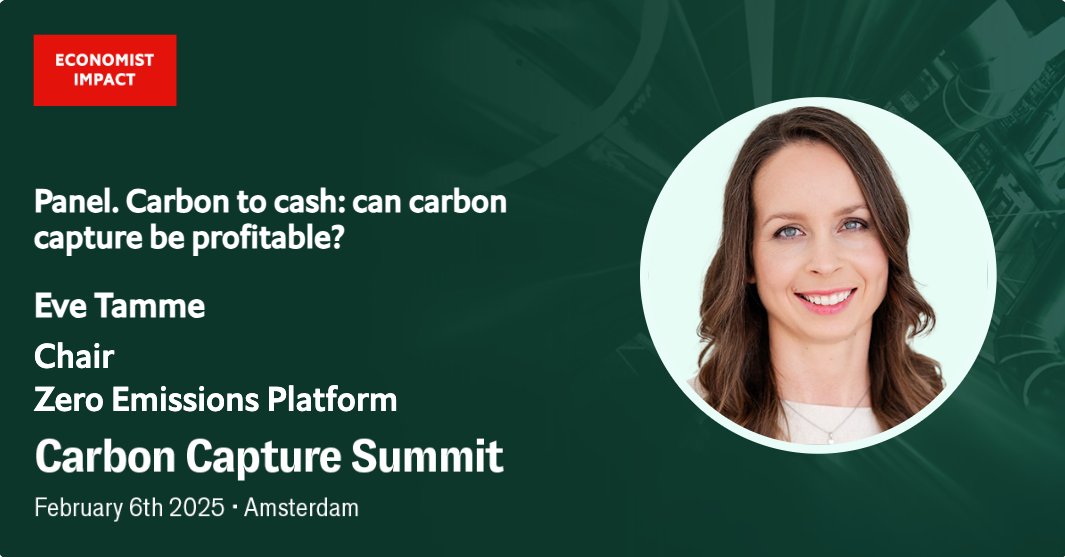
How can we make #CarbonCapture profitable?
Can't wait to explore further what needs to happen, especially from the policy side.
Thrilled to represent @EUCarbonCapture at the upcoming Carbon Capture Summit by @TheEconomist, and discuss this topic with a stellar panel:
• Wilfried Klein from @LyondellBasell
• Katrine Stenvang from @Orsted
• Yvonne Lam, from @RystadEnergy, and
• Roze Wesby from @Holcim
Moderated by @VVVijayEconBiz, @TheEconomist.
Hope to see you in Amsterdam this Thursday, 6 February
https://t.co/jJQO3mgZ9c
#CCUS #CarbonRemoval #EconCarbonCapture
What's behind the like-for-like principle?
Typically discussed in the context of balancing fossil emissions with durable #carbonremovals, which means that emissions from the biosphere can be balanced with nature-based removals.
Why is it so complex when one starts exploring it from first principles?
@RobertHoglund will join Sebastian Manhart and me for a punchy, insightful, and - almost certainly - heated debate on this topic at the next CDR Policy Scoop.
Tune in on Wednesday, 5 Feb, 11.30 am CET
https://t.co/FqmcNoe731
#CDRscoop