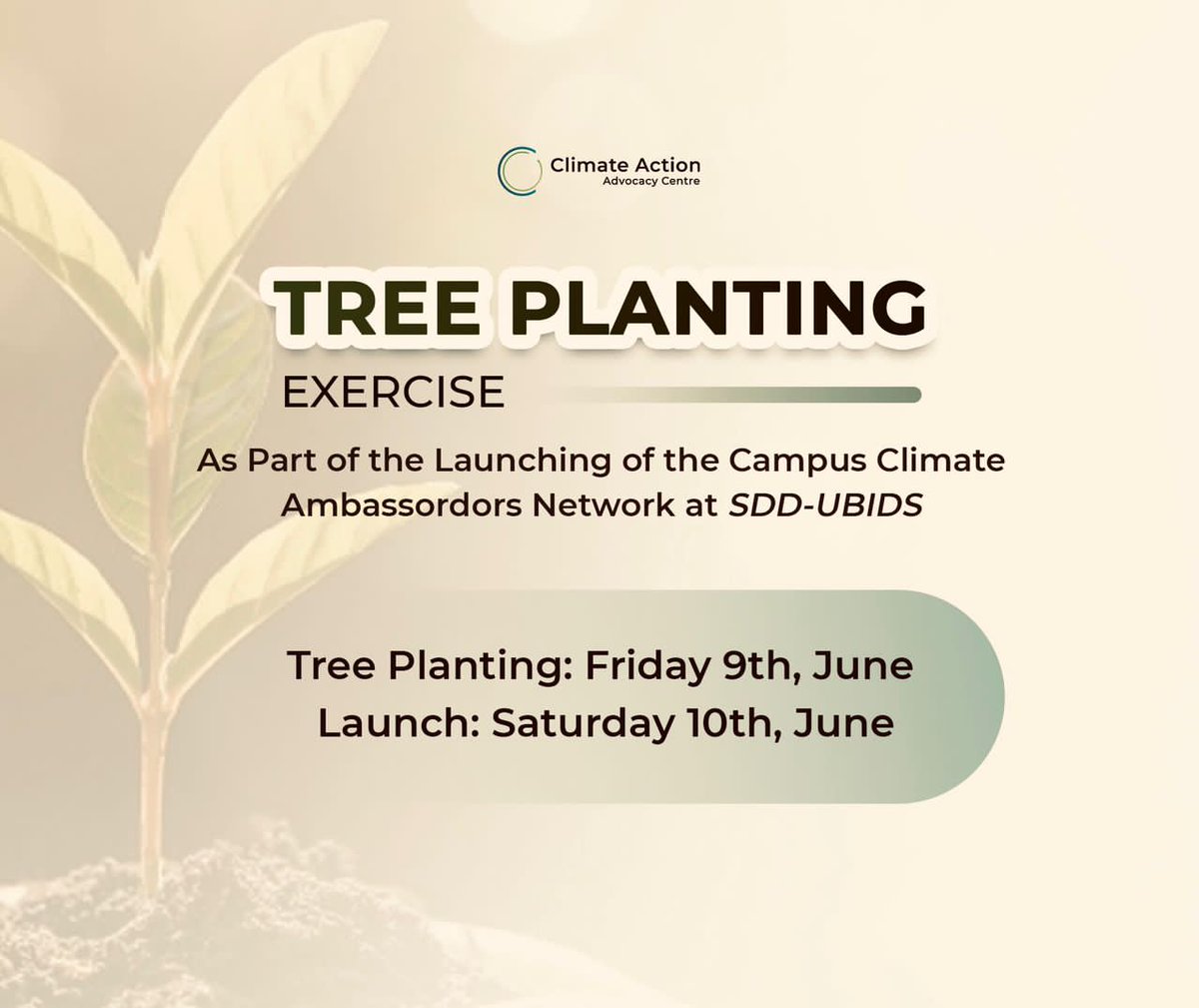
On the 9th of June, 2023, members of the Simon Diedong Dombo University of Business and Integrated Development Studies (SDD UBIDS) sector of the Campus Climate Ambassadors Network (CCAN) joined the Youth Parliament of SDD UBIDS and other organizations to plant trees
at various places on the SDD UBIDS campus as part of the Green Ghana Day 2023 exercise.
Campus Climate Ambassadors Network (CCAN) is a campus-based climate action and advocacy network of the Climate Action Advocacy Centre - CAAC.
Prior to launching the Campus Climate Ambassadors Network (CCAN) at Simon Diedong Dombo University of Business and Development Studies (SDD-UBIDS) on 10th June, 2023,
the Climate Action Advocacy Centre - CAAC will join the Youth Parliament of Simon Diedong Dombo University of Business and Development Studies (SDD-UBIDS) and other organizations to plant trees within the environs of UBIDS as part of the #GreenGhanaDayInitiative.
Follow us for more updates on the activities of the Campus Climate Ambassadors Network (CCAN)
https://t.co/WTZ8X16ukH
[email protected]
Climate Action Advocacy Centre-CAAC on all social media platforms
The Climate Action Advocacy Centre-CAAC under its Campus Climate Ambassadors Program will be launching the Simon Diedong Dambo University of Business and Integrated Development Studies (SDD-UBIDS) branch of the Campus Climate Ambassador Network (CCAN).
#Climatechangeawareness
The goal of the Campus Climate Ambassadors Program is to develop the next generation of #climatechange ambassadors who will serve as change agents in their communities.
As we celebrate world environment day, we wish to highlight the importance of inclusiveness and transparency in international diplomacy toward addressing climate change and environmental sustainability.
Happy World Environment Day from the team at Climate Action Advocacy Centre
International decision-making processes usually follow the form of unanimity and simple majority rule, where decisions made by the majority of member states become the rule.
The construction of buildings for residential and commercial usage accounts for (40%) of carbon dioixide emissions. This is because most of these buildings are primarily responsible for using the country’s energy for lighting, heating, cooling, and appliance operation.
The shift in climate globally has been intense, leading to rising sea levels and incessant wildfires. Cities contribute about 75% of these greenhouse gases, with the built environment being one of the most significant contributors.
Between the built environment and climate change, two relationships can be sufficed. The first has to do with how the construction of buildings and infrastructures can lead to climate deterioration. The second involves leveraging their construction to address climate change.