In a galaxy far, far away...
Hubble found that a blowtorch-like jet from the galaxy M87's black hole is causing nearby stars to erupt along its trajectory.
Discover more: https://t.co/myjZhgu0Ll
When powerful space telescopes work together to combine their powers, you end up shattering records. The JWST and Chandra telescopes, combined with the power of gravitational lensing, have unveiled the most distant gargantuan black hole, with the mass of 10-100 million Suns!
This supermassive black hole, lensed by a galaxy cluster called Abell 2744, is a lot more massive than the one at the center of our own galaxy, which is 4 million suns. The kicker here, though, is that it's ancient, existing when the Universe was only 470 million years old. A universe so young that already hosts such a massive black hole; how outrageous is that?! This must mean that these massive black holes formed not from the death of stars, but rather, something else.
One possibility is the direct collapse of pristine gas in the early universe. In this scenario, under just the right conditions, massive clouds of gas could collapse directly into supermassive black holes, skipping the intermediate steps of star formation. This recipe requires specific ingredients and conditions, making these black holes very rare.
Another possibility that excites me as a researcher who works on Self-Interacting Dark Matter (SIDM) is the gravothermal collapse of SIDM halos. SIDM proposes that dark matter particles, through their own interactions, could trigger a catastrophic inward collapse at the core of a dark matter halo, leading straight to black hole formation. And you get this almost for free, simply with dark matter self-interactions! Because it depends on the particle properties of dark matter only, it seems more natural to me to form massive black holes in this way.
This discovery challenges our understanding of the universe and black hole formation during its infancy, and opens up exhilarating possibilities for the nature of dark matter and black hole formation.
Very excited about what's to come, and to find more massive black holes in the early universe with the power of our space telescopes!!
Image credit:
Image by X-ray: NASA/CXC/SAO/Ákos Bogdán et al.; Infrared: NASA/ESA/CSA/STScI; Image Processing: NASA/CXC/SAO/L. Frattare, K. Arcand
@UN@brb1954@antonioguterres 2. very large portion of fund that UN receives is coming from nothing but war business that donor countries have made, including USA and the Europe.
@UN@brb1954@antonioguterres 1. conflict is underlying character of nature. fight, struggle and bloody wars are those that actually have driven the propagation of all biological species included human, and human civilizations.
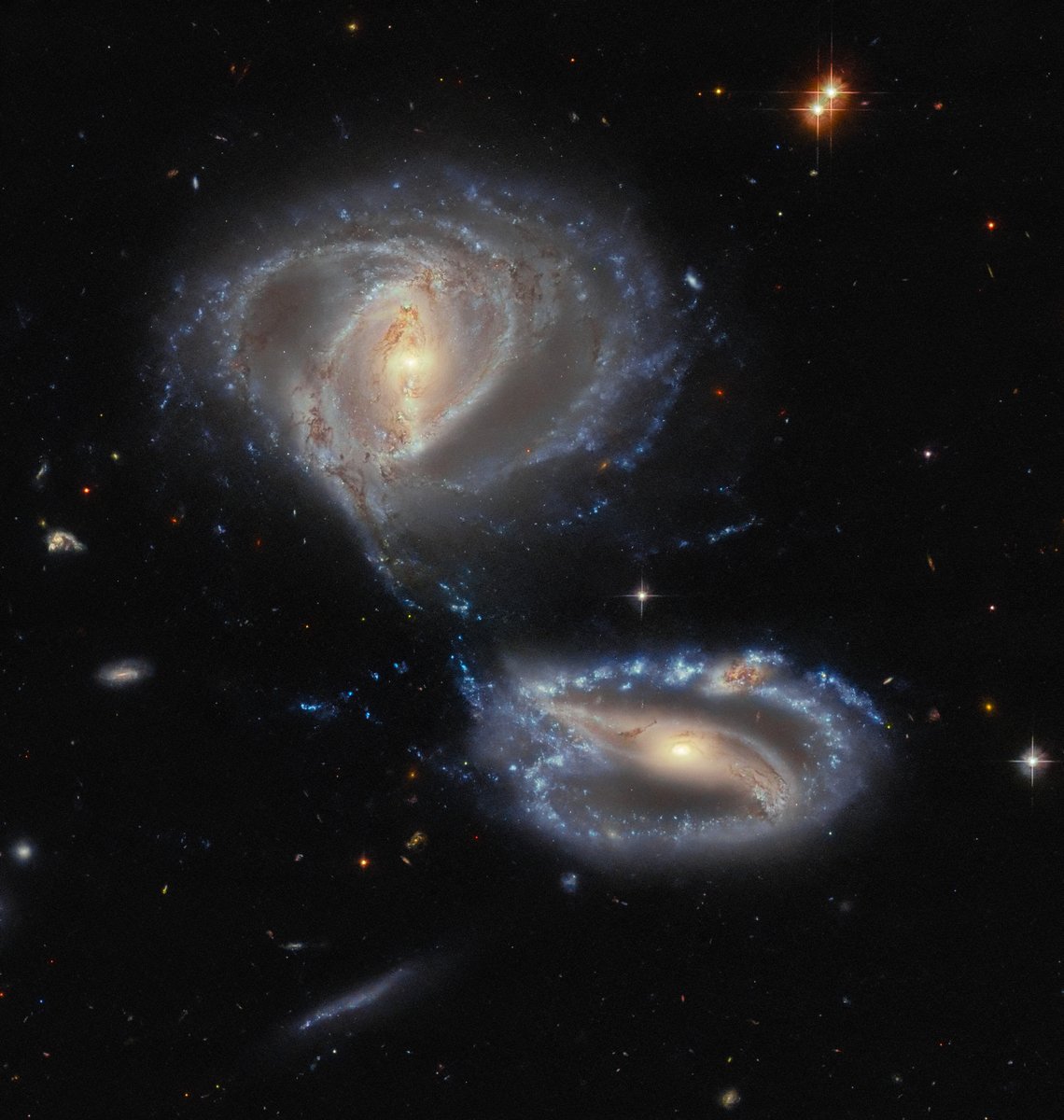
A galactic tango! This #HubbleFriday image captures the galaxy group Arp-Madore 2339-661. There are three galaxies interacting here; the third is visible in the upper arm of the lower-right galaxy, looking like part of the same object at first: https://t.co/AL8ElOjWkS
@DhakalSaurav@mneupanejum सानु जमात मा होला। तर सार्वजनिक खर्च मा दिइने सुबिधा सेवा र सुरक्षा चैं भनेको जस्तो पाइन्न । किनकि निर्वाहमुखि संग पैसा हुन्न (ट्याक्स पनि तिरिंदैन र सारो बिरामि पर्दा वा छोरा छोरी लाइ पढाउंदा उठिबास लाग्छ) ।
@DhakalSaurav@mneupanejum यो चित्र मा देखाइको जटिल जार्गन ले भरिएको मोडल हाम्रा बाजे बराजु ले सयौं बर्षदेखि गरिराका थिए । तर पनि एउटा सींगो पुस्ता ले यो सबै छोडेर हिंडे, कीनकि येसले निर्वाहमुखि जिवन बाहेक अरु दिएन ।