Interested in the response of convection to climate and air pollutions changes in global km-scale models?
We are looking for a post-doctoral researcher in the @HorizonEU project @CleanCloud_HE with collaborators across Europe.
Apply by 31 January:
https://t.co/sFYwwM6S3j
Considering to apply to our Intelligent Earth @IntelliEarth graduate school in AI for the Environment?
Over 80 supervisors from Oxford's AI and Environmental Science departments are now listed on our webpage!
https://t.co/oa8bJGCYl5
Considering to apply to our Intelligent Earth graduate school in AI for the Environment?
Applications are now open for the 2024 entry! We offer 20 fully funded PhD studentships per year.
The recording and presentations from our open day are now online: https://t.co/W6VN4ZHsf8
We are looking for a post-doctoral researcher to work on geospatial foundation models for analysis and compression of atmospheric data to advance our understanding of clouds. @HorizonEU project Embed2Scale, with @IBMResearch, @DLR_en,... Apply by 15 Jan: https://t.co/8yWcgak9fo
Applications for our Intelligent Earth graduate school in AI for the Environment are now open for the 2024 entry!
We offer 20 fully funded PhD studentships per year.
Check out our webpage https://t.co/YJMLOxQtL1 and register for our virtual open day on 30 Nov at 9:30 GMT.
Our UN @ITU#AIforGood series on #AIforClimateScience continues!
Join us tomorrow 14:00 CET, 8:00 EST for a talk by
Sara Shamekh @Columbia on machine learning insights into precipitation: Implicitly Learning Cloud Organization for Improved Predictions! https://t.co/54MwzJjUsu
⏰️7 days left to the hybrid UN @ITU@AIforGood AI Global Summit 6-7 July in 📍Geneva
✨️ELLIS Jena / Oxford pre-Summit workshop ➡️ July 5
Curators: @Reichstein_BGC, Gustau Camps-Valls (@isp_uv_es), @PhilipStier, @DWatsonParris https://t.co/FJtuCxTbNp
Join us for another talk in our @AIforGood#aiforclimatescience series today at 17:00 CEST | 10:00 CDT | 23:00 CST for a talk by Pedram Hassanzadeh @turbulentjet!
Opening the neural networks’ black box for climate science https://t.co/2fpr9RjUyu
Time for #AIforClimateScience@AIforGood ahead of Easter!
We are super excited to host Bill Collins @UCBerkeley@BerkeleyLab to speak about the fantastic opportunities of huge model ensembles provide by the use of surrogate models!
Join us at 17:00 CEST, 08:00 PDT, 23:00 CST!
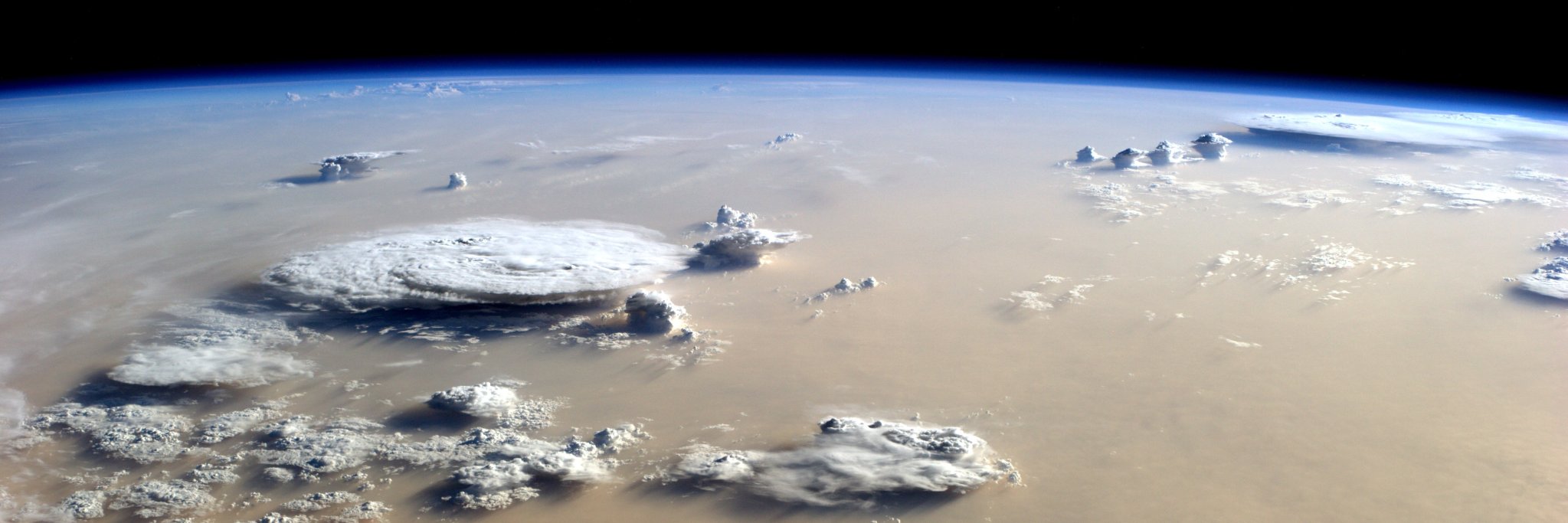
Tracking deep convective storms over Africa using a novel method described in our new paper https://t.co/1ocnYTgef2 with @PhilipStier and @mattchri, supported by @ERC_Research@FORCeS_H2020
And if you are really interested in cloud tracking consider joining our cloud tracking workshop in Oxford 17-21 April 2023, ahead of the @EuroGeosciences general assembly:
https://t.co/CftKliW5b4
And our @AIforGood sessions on #AIforClimateScience sessions continue strong with Tom Beucler @unil and Marie McGraw @ColoradoStateU on AI for tropical meteorology. Join us tomorrow 8 March 2023 at 19:00 CET | 09:00 EST | 08:00 CST!
And our @AIforGood sessions on #AIforClimateScience sessions continue strong with Tom Beucler @unil and Marie McGraw @ColoradoStateU on AI for tropical meteorology. Join us tomorrow 8 March 2023 at 19:00 CET | 09:00 EST | 08:00 CST!
Our @AIforGood#aiforclimatescience sessions are back!
Join us tomorrow 22 Feb at 17:00 CET, 08:00 PST, 00:00 CST for a talk by Mike Prichard @SciPritchard@UCIrvine and @NVIDIA.
Talks will resume biweekly with a fantastic lineup: https://t.co/ew9q7eEyjx
Check our our article summarising recent research with @PManshausen @DWatsonParris in the @ConversationUK: Air pollution cools climate more than expected – this makes cutting carbon emissions more urgent https://t.co/iaFGftIsjZ @iMIRACLI_ITN@FORCeS_H2020@ERC_Research
Climate models are computationally expensive so policy makers rely on approximations for global mean temperatures, which ignores regionality of climate change. Fast emulators of climate models provide full complexity. Our paper led by @DWatsonParris outlines a way forward...
‼️Our new work on ‘Invisible Ship Tracks’ has been published in @Nature🤯
What are Invisible Ship Tracks? 👻🚢
And what can they tell us about future warming of the earth? 🌥️ 🌍
🧵
👉https://t.co/IGpFIpPw4G
And the second paper, led by @PManshausen, is now out in @Nature, reveals that invisible tracks from ship emissions show a large cloud sensitivity - with significant implications for aerosol-radiative effects. @iMIRACLI_ITN@ERC_Research@FORCeS_H2020
https://t.co/B6sv54ObIA
Quantification of the radiative impacts of aerosol-cloud interactions remains a key climate science challenge. Opportunistic experiments, e.g. emission tracks of ships, provide a laboratory to study these effects. Get ready for two exciting papers from our @ClimateProc group...
The radiative effects of black carbon plumes depend strongly on the location - why?
Our @NatureClimate paper led by @AndrewIWilliams sheds light into the underlying physical mechanisms. Nice way to kick off his PhD!
@ERC_Research@NERCscience
https://t.co/DSjzqTl7UO