Clinical Neuropsychology and neuroscience education. Not therapy, assessment, or advice. No professional relationship. For care, see a licensed clinician.
This account is general education on clinical neuropsychology and neuroscience.
Not therapy, assessment, diagnosis, treatment, or consultation. Following or replying does not create a professional relationship.
@NTFabiano Worth adding: this was cross-sectional (n=672), and the authors call the differences "extremely subtle" and needing validation. An association, not a direction. Host factors like alcohol and bowel habits are known to confound microbiome studies.
Kim 2018 Brain Behav Immune
@PsyPost For anyone who has kids and works from home knows that it is nearly impossible to get any real quality work done with the constant interruptions our little ones create.
@FlutoShinzawa@ChrisNowinski1 Our clinical understanding of CTE is in its infancy, so any increased attention and research will go along way toward better elucidating this condition.
Board-style question: which cognitive domain tends to be relatively spared in chronic kidney disease?
Question in the image. Answer below, source in thread.
#neuropsychology
Berger, I., Wu, S., Masson, P., Kelly, P. J., Duthie, F. A., Whiteley, W., Parker, D., Gillespie, D., & Webster, A. C. (2016). Cognition in chronic kidney disease: A systematic review and meta-analysis.
Answer: A. Per the authors, construction and perception were unaffected, though the perception estimate is imprecise.
Best foil, B: attention and orientation were among the most affected domains.
Berger et al., 2016
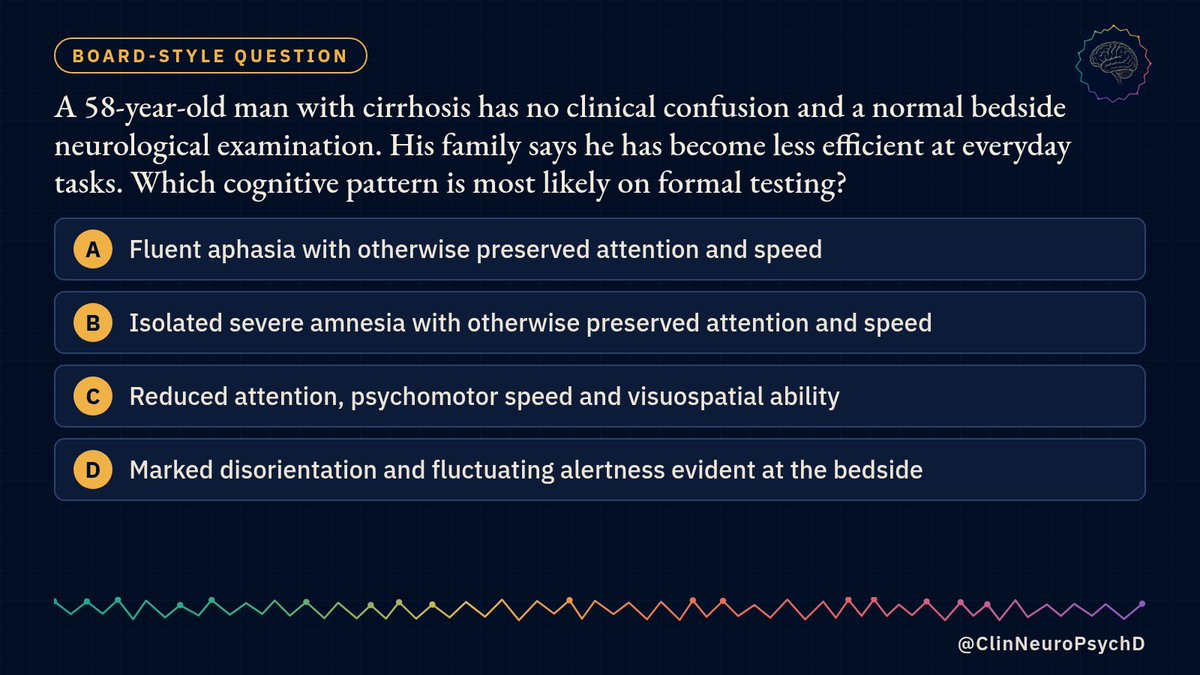
Board-style question: in cirrhosis with an unremarkable bedside examination, what cognitive pattern can formal testing show?
Question in the image. Answer below, source in thread.
#neuropsychology#cirrhosis
Answer: C. Per the review, minimal hepatic encephalopathy alters attention, speed and visuospatial performance without clinical manifestations.
Best foil, D: marked disorientation and fluctuating alertness describe overt, not minimal, encephalopathy.
Ridola et al., 2018
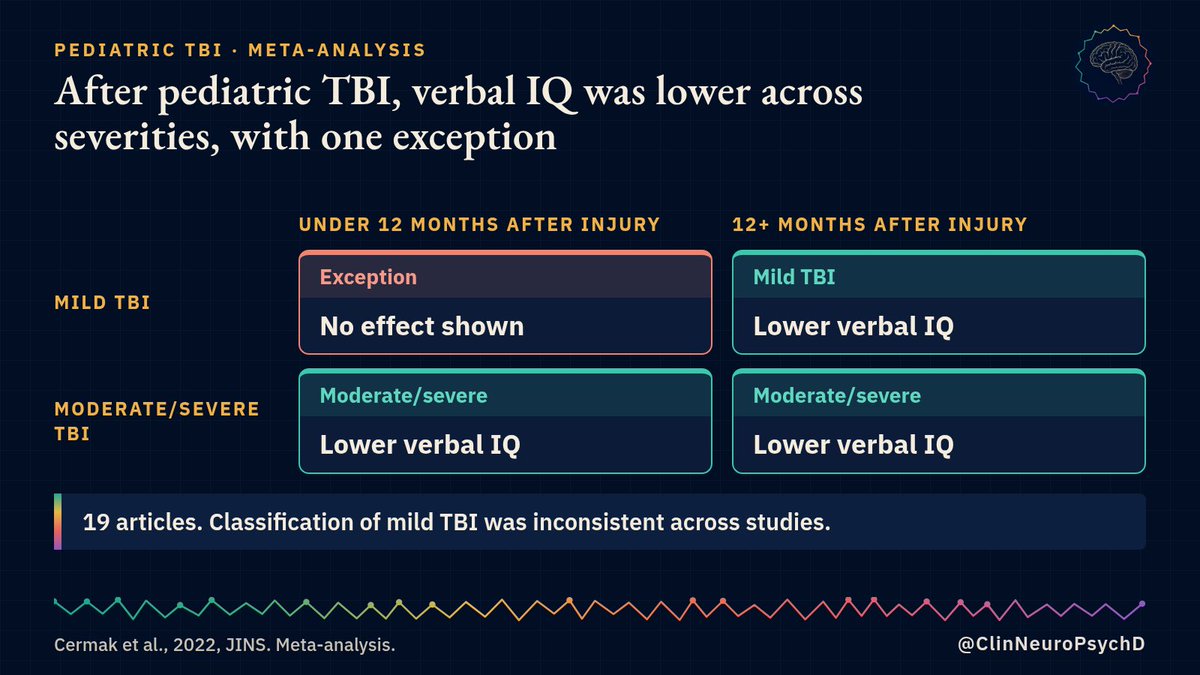
Lower verbal IQ after pediatric TBI persisted 12+ months after injury; the exception was mild TBI in the first 12 months.
A meta-analysis of 19 articles. Severity and time since injury both matter; one "TBI" label is not one prognosis.
Cermak et al., 2022
#Neuropsychology#TBI
Cermak, C. A., Scratch, S. E., Reed, N. P., Kakonge, L., & Beal, D. S. (2022). Effects of pediatric traumatic brain injury on verbal IQ: A systematic review and meta-analysis.
Kandel, E. R. (1989). Genes, nerve cells, and the remembrance of things past. Journal of Neuropsychiatry and Clinical Neurosciences, 1(2), 103-125. https://t.co/twqgjJplFa (paywalled)
Learning is biological: Kandel argued it changes neuronal architecture via changes in gene expression.
His 1989 prediction: psychotherapy, as learning, should cause anatomical changes visible on imaging. Prediction, not finding.
Kandel, 1989
#Neuropsychiatry#Neuropsychology
Galioto, R., Dhima, K., Berenholz, O., & Busch, R. (2020). Performance validity testing in multiple sclerosis. Journal of the International Neuropsychological Society, 26(10), 1028-1035. https://t.co/Jjyi0Y9tOR (paywalled)
In MS referrals, nonvalid performance validity scores tracked disability-benefit seeking and depression, not MS severity or lesion load.
Roughly 1 in 7 to 1 in 5 had nonvalid scores, depending on criterion. A diagnosis does not explain them away.
Galioto, 2020
#Neuropsychology