Clinical reasoning for physicians and medical learners. Cases, podcasts & practical insights. Recognize the pattern. Find the danger. Choose the next step.
Sharp chest pain after a viral illness. The ECG points in a different direction.
What would you do next? Make your call before the answer in C2C 001.
Visit https://t.co/caLthuTZ9y.
#ClinicalReasoning#chestpain#medicaleducation
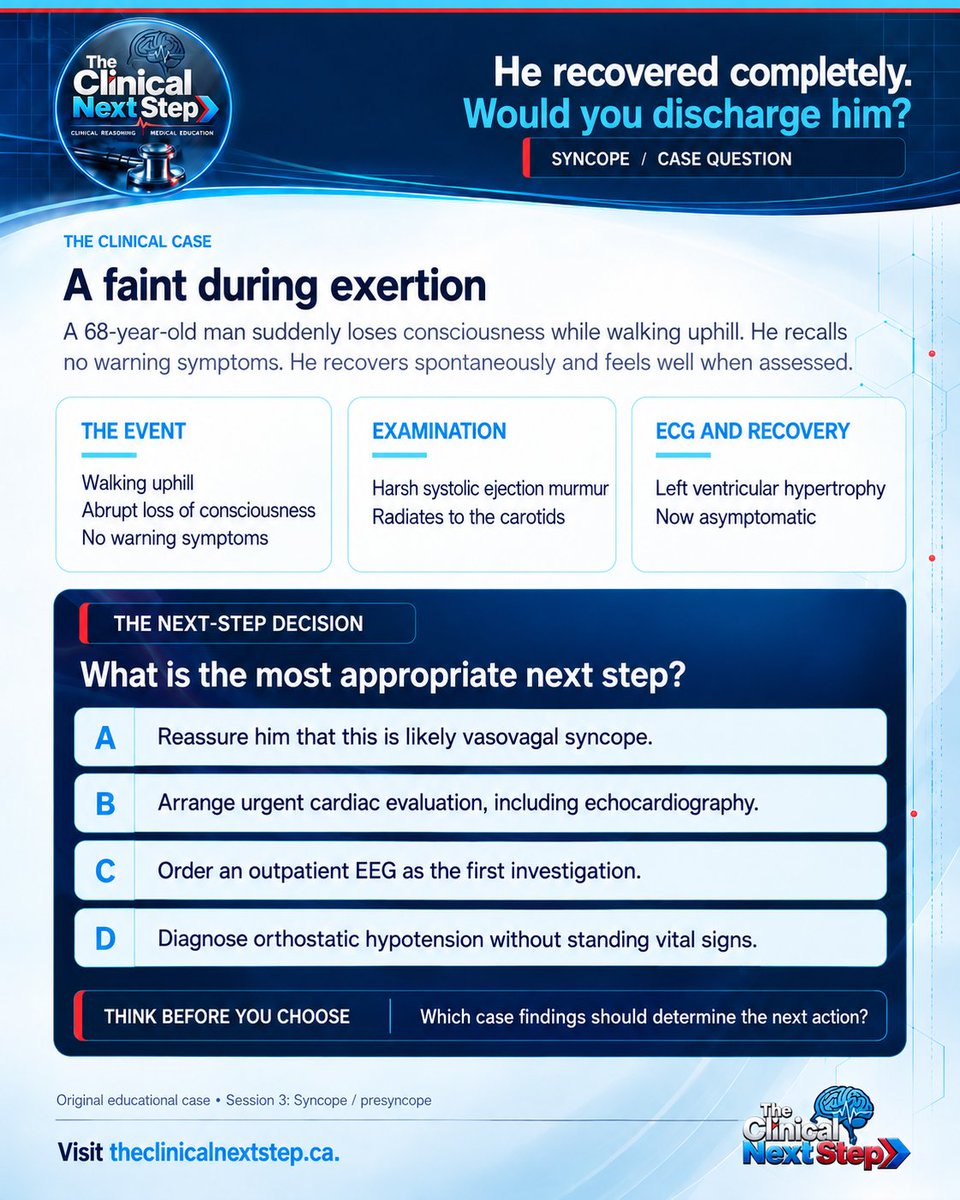
4/4 Recovery tells us the episode ended. It does not explain an exertional faint or an abnormal cardiac exam. Which finding would most change your plan? Current TCNS case: https://t.co/bn6CAxXqvi
1/4 A man faints while walking uphill. Minutes later, he feels well. Would you let the recovery decide his disposition? The event—not just the recovery—carries the signal. #Syncope
3/4 The next step in this case is urgent cardiac evaluation, including echocardiography. Recheck vitals and ECG; determine monitoring and disposition from the full assessment.
2/4 There was no warning prodrome. A harsh systolic ejection murmur radiates to the carotids; ECG shows LVH. These findings raise concern for a cardiac or structural cause. They do not, by themselves, prove aortic stenosis.
Feeling well after syncope is not clearance. Exertional onset, no prodrome, and a murmur radiating to the carotids point to B: urgent cardiac evaluation, including echocardiography. Aortic stenosis is suspected, not yet confirmed.
Exertional syncope without warning, then complete recovery. A 68-year-old has a harsh systolic murmur radiating to the carotids and LVH on ECG. Does feeling well now make discharge safe? Choose the next step on the card. https://t.co/caLthuTZ9y
CHEST PAIN DEBRIEF
Answer: C - continue monitored assessment with repeat ECG and serial hs-cTn.
Why? The ischemic pattern remains possible, and one early troponin cannot show a rise or fall. The acute rule-out sequence is unfinished.
What clue blocked discharge?