The Smithsonian Castle reopened to the public last week in celebration of the 250th anniversary of the American Revolution.
ClioVis intern Evelyn covers the history of the Smithsonian Institute, from its original creation to the opening of future museums.
Want to learn more? Check out the link to her timeline: https://t.co/mHDFk9bcYe
Over the past semester at UT-Austin, students in Professor Isabelle Headrick's American Jewish History course used ClioVis to support their research projects.
The platform pushes students to draw analytical connections between ideas, visualize their reasoning, and strengthen their critical thinking skills.
Interested in using ClioVis in your own classroom? Get started at https://t.co/7hquTYnig2.
Did you know the government just opened the Pacific Remote Islands Marine National Monument (PRIMNM) to commercial fishing?
ClioVis Intern Evelyn Jackson maps the history of the PRIMNM to understand what led to the decision, and why it might actually help reduce illegal fishing practices.
Learn more: https://t.co/HPl047nj19
#ClimatePolicy
Team ClioVis is excited to introduce the first in our new series, "Mapping New Books,” where our interns work with scholars and create interactive timelines from their new books.
For our first video in this series, Blaze Gaona maps Professor David Igler’s book All Species of Knowledge: A Voyage of Discovery, Failure, and Natural History in the Pacific Ocean, published by Oxford University Press.
Igler’s book reframes the ‘failed’ Rurik expedition as a case study in how imperial powers, naturalists, and Indigenous peoples produced knowledge during the Age of Exploration.
Congrats to Professor Igler on such a fantastic new book!
Watch the full video: https://t.co/9e0SJUP789
Check out the timeline: https://t.co/nkDqnCvj2s
Get Igler’s new book: https://t.co/BN94A27u1a
Happy Earth Day! 🌍 🌞
ClioVis intern Eleanor reflects on 14 female activists' efforts to protect the environment over the past century.
Celebrate our planet today by learning more at Eleanor's timeline: https://t.co/KMvAjBjOqL
#EarthDay#Ecofeminism
How has ping-pong shaped US-China diplomatic relations?
ClioVis intern Logan Kelt examines how a US ping pong player forgetting his bus in China reshaped global power.
Check out Logan's timeline: https://t.co/bmoe0kf4eR
How can you best retain learning? ClioVis Intern Evelyn Jackson highlights her research which explores an answer.
Her study found that connecting new words to meaningful associations dramatically improved people's ability to recall them. Shallow tasks, like counting letters, made almost no difference at all.
Learn more on her interactive timeline: https://t.co/wjkPwsMpp7
#StudySmarter #LearningScience
Happy Women’s History Month! ClioVis intern Evelyn highlights the incredible contributions of Katherine Johnson.
Johnson was one of NASA’s “hidden figures” whose calculations were critical to the Space Race, including the first crewed orbit around Earth.
Explore the full timeline: https://t.co/AP0jRyPP45.
Remember our video about schemas? The idea that connected knowledge sticks better in memory?
This video covers how ClioVis asks students to connect ideas, justify those connections, and visually organize their thinking. Basically, building schemas.
Interested in ClioVis? Contact us to get started: [email protected]
Do you ever feel like your students forget everything you just taught them? Creating lessons that have students build schemas can help address that issue.
Students remember content when they connect new ideas to concepts they already know. Some easy activities that activate schemas include concept maps, reciprocal teaching, and having students write a summary of content in a certain number of words.
What led to Singapore's foundation? Why did the island country separate from Malaysia? 🔎 ❓
Logan Kelt, a ClioVis Intern, answers these questions using a ClioVis timeline. Learn more at https://t.co/P58wLiinQG
Have you ever designed a lesson that was creative and engaging but students walked away having learned almost nothing?
Jennifer Gonzalez calls this a Grecian urn, an activity that looks impressive but doesn’t require students to do much intellectual work. The solution isn’t to eliminate creativity. It’s to structure thinking into creative work.
Using ClioVis, students can build visually engaging timelines and tools like connections and categories require them to organize, label, and justify relationships between events. The creativity stays but the thinking becomes inescapable.
Interested in using the software? Learn more at [email protected].
In ClioVis' last teaching tip, we discussed the importance of designing lessons that make students think. Cognitive science shows that when students think about content, rather than just regurgitate it, they are more likely to remember it.
This week we highlight how ClioVis pushes students to think because of its design. When students build timelines, they aren’t just placing events, they are deciding what belongs, what connects, and why. Features like 'connections' and 'categories' push students to articulate relationships and organize their ideas.
Interested in using ClioVis in your classroom? Email [email protected]
🎒ClioVis Teaching Tip #1: Design Lessons that Require Thinking, Not Just Recall
Designing lessons that truly make students think sounds obvious, but it is harder than it seems. Many well-planned lessons still focus on rote retention, a form of learning that cognitive scientist Daniel Willingham describes as “devoid of all meaning.” Memory, Willingham argues, is not built by exposure alone; it is built through thinking.
To help students remember what they learn, lessons must prompt them to build relationships within the content at hand. ClioVis is designed around this principle. By using timelines, connections, and categories, students are required to sort, relate, and contextualize information as they work.
Stay tuned for weekly teaching tips from our ClioVis interns. Ready to make the switch to ClioVis? Email [email protected].
Team ClioVis is beyond proud to share that UT System Chancellor John M. Zerwas recently inducted Dr. Erika Bsumek into the UT System Academy of Distinguished Teachers. The academy, which is the only system-wide university teaching academy in the country, honors the best and brightest leaders within the system for their dedication to teaching excellence.
This honor is an important recognition of Dr. Bsumek's dedication to student learning. As Associate Vice Chancellor of Academic Affairs said of the new academy fellows, “They are thought leaders at their institutions and beyond." Team ClioVis could not agree more. Congrats, Dr. Bsumek!
Have you ever heard of the 1970 postal strike? Do you have memories of going to the post office? Let us know in the comments.
Aidan—a ClioVis intern—mapped the history of this strike. The timeline shows how poor working conditions, conflict within the National Association of Letter Carriers, and President Nixon's proposed changes to the Post Office Department led to a shutdown of much of the country's postal system.
Check out the full timeline here: https://t.co/HeURDLAdVh
Interested in ClioVis? Email [email protected]
#USPS #DigitalHumanities #PublicHistory #HistoryFacts #LaborHistory
What’s the history of Greenland? Why is it of geopolitical interest? Review this timeline that one of our interns made last year for some historical context: https://t.co/mBcoxu6UZC #greenland#denmark#trendingnews
👀 Looking for ways to BEAT students' AI use this coming semester? Look no further! ClioVis’ non-AI timeline platform forces students to map ideas and their connections, rather than giving them answers.
Three key features challenge student AI use. First, the connections features requires students’ critical thinking as they create and articulate the connections between various events. Second, event nodes encourage source analysis. When students engage directly with a source, they must move beyond AI analysis in order to explain its significance in relation to other events. Finally, students must visualize their thinking with ClioVis. As they create a map of events, students essentially map their thinking.
Learn how to use the ClioVis web platform (LMS compatible) in your classroom: [email protected]
Dr. Jimena Perry shared some of her students' timelines from her 'A Semester at the Museum' fall course...and they are awesome!
She wrote, "ClioVis offers powerful advantages in the classroom: it helps students visualize historical connections, strengthens digital skills, and allows them to present their research in a clear and engaging way."
Learn how to use the ClioVis web platform (LMS compatible) in your classroom: [email protected]
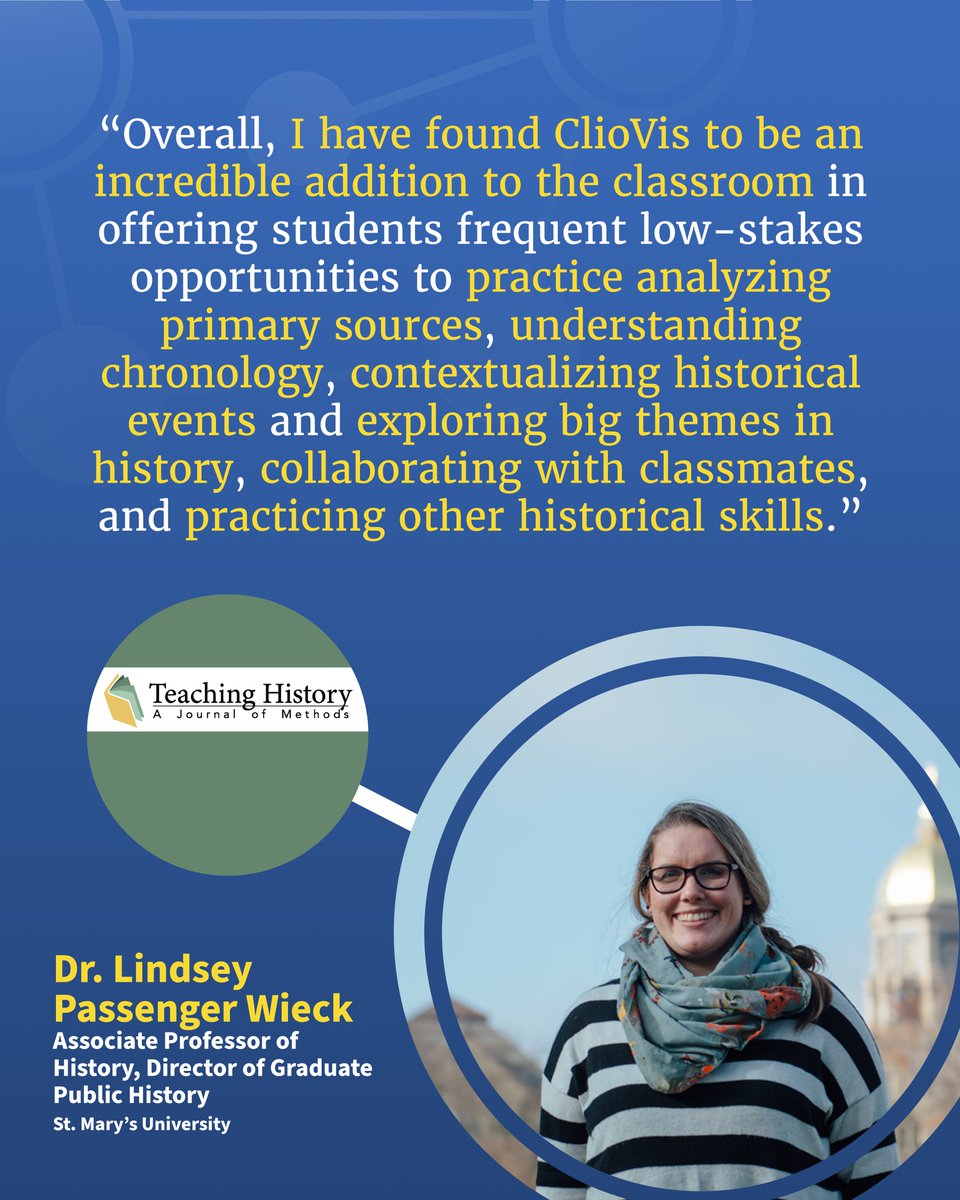
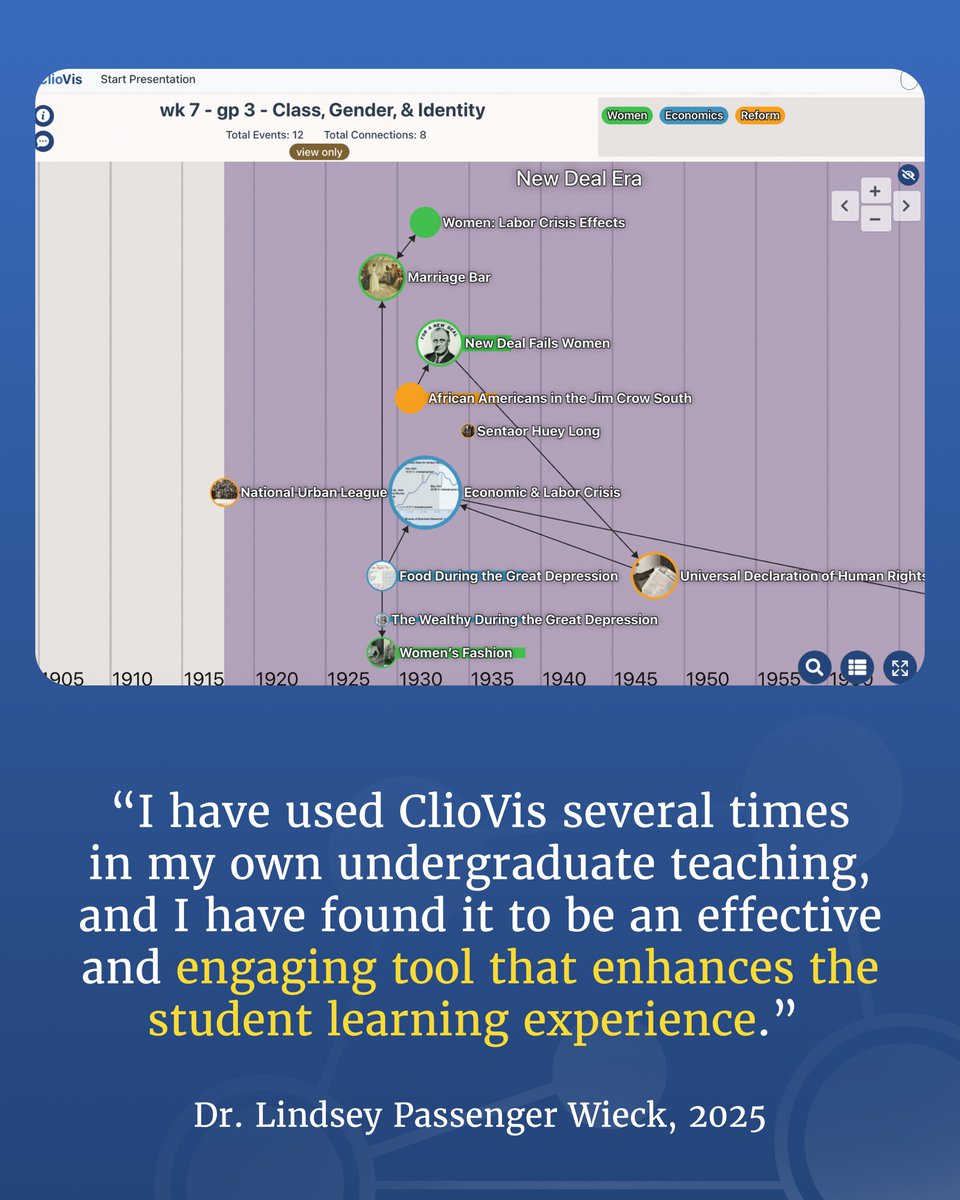
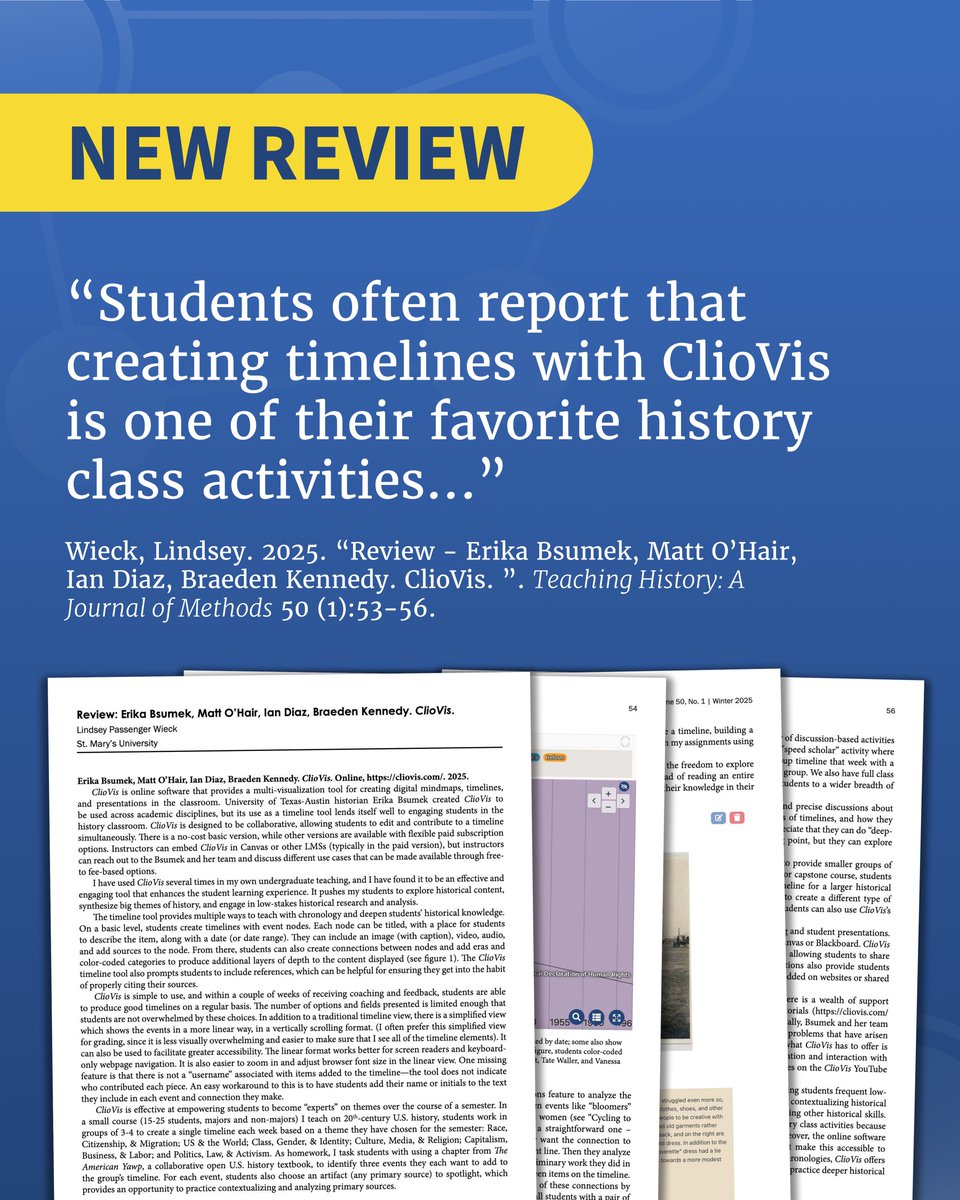
🚨 New ClioVis Review! Dr. Lindsey Passenger Wieck wrote that "Students often report creating timelines with ClioVis as one of their favorite history class activities..." and believes that ClioVis is an "...engaging tool that enhances the student learning experience."
Wieck is an Associate Professor of History and Director of Graduate Public History at St. Mary's University. She wrote the review the journal 'Teaching History: A Journal of Methods.'
Professors like Wieck bring ClioVis' mission of fostering student-centered learning to reality. Learn how you can use ClioVis in your own classroom: [email protected].