My new book "The Practical CISSP Study Guide" is about to be launched soon
If you are interested in getting a free copy upon launch then feel free to sign up below and get notified
https://t.co/7cZdspBuJQ
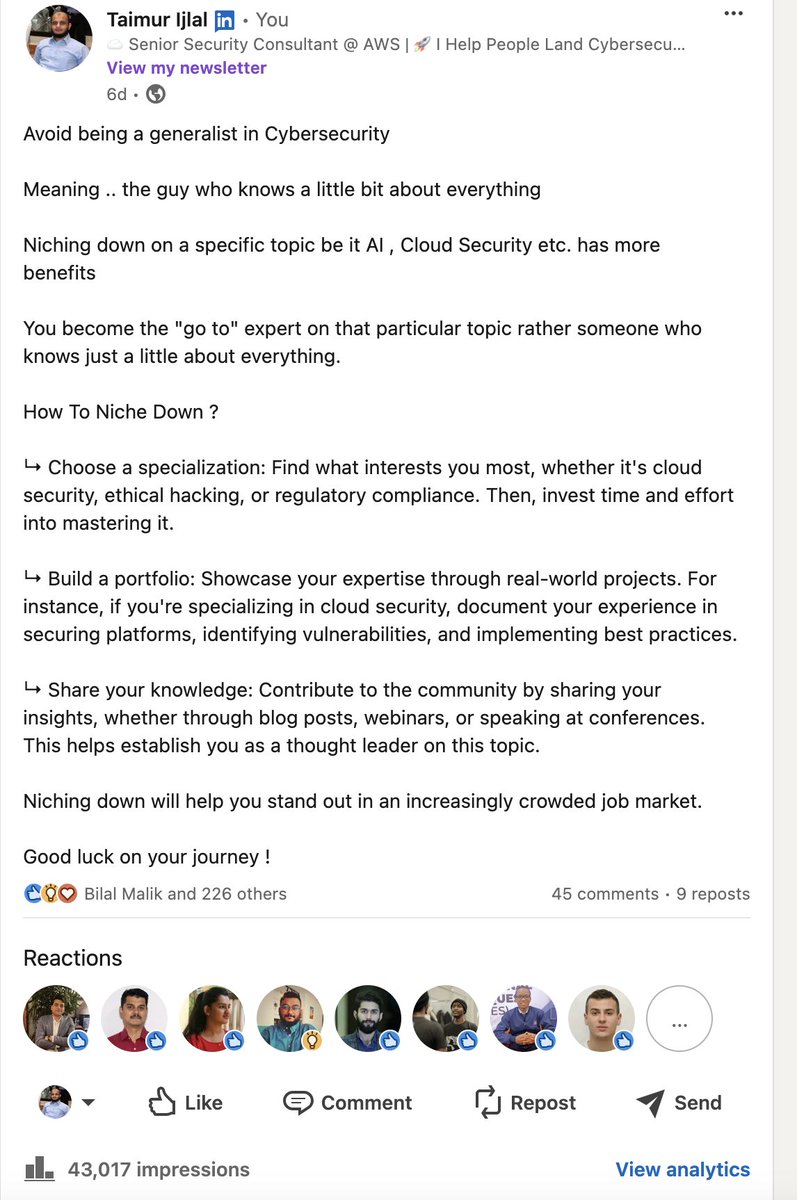
This simple LinkedIn post went mini-viral
Boosted my following greatly BUT a lot of feedback was negative
A lot of people accused me of rage-baiting which was hilarious
Just goes to show you cannot please everyone :)
3 reasons to become a mentor in Cybersecurity
1 - Give Back to the Community
2 - Improve Your Own Learning
3 - Expand Your Professional Network
Becoming a cybersecurity mentor is a great way to create a knowledge-based legacy
Good luck on your journey !
How To Step Out of Your Comfort Zone in Cybersecurity ?
1. Learn to code. Nothing tests you more than coding
2. Share Your Knowledge via blogs or videos
3. Mentor someone new to Cybersecurity
4. Speak at conferences instead of just attending
How To Avoid Being Overwhelmed in Cybersecurity ?
1 - Create a learning plan
2. Focus on credible sources: Do not trust everything on YouTube or LinkedIn. Stick to trusted resources like the SANS Institute, NIST, and thought leaders in cybersecurity.
3. Prioritize topics
1 - Choose a specialization
2 - Build a portfolio
3 - Share your knowledge
Niching down will help you stand out in an increasingly crowded job market.
Good luck on your journey !
Avoid being a generalist in Cybersecurity
Meaning .. the guy who knows a little bit about everything
Niching down has more benefits
You become the "go to" expert on that particular topic rather someone who knows just a little about everything.
How To Niche Down ?
Tech skills are not enough in Cybersecurity
Learn these skills to move up the ladder
- Risk Management
- Budgeting
- Project Management
- Vendor Management
- Report Writing
These will help you talk with non-technical stakeholders i.e. the people who are about business
Are you a newcomer to Cybersecurity or Cloud ?
Do not jump straight into the CISSP or CCSP certs !
These certifications are high in demand but made for those with significant experience in the field
Focus on hands on skills over certs at this stage
You do not need tools to learn Threat Modeling ..
It is a skill that you can get started with just a pen and paper
The key step is to systematically thinking through potential threats to your systems.
Effective threat modeling starts with understanding your environment.
Risk assessments are not just about filling in an Excel sheet
Too often, I see risk assessments treated as a checkbox exercise
Or something done to pass an internal or external audit
Risk assessment is a key part of cybersecurity
Do it properly or risk a compromise !
Failing A Cybersecurity Cert Exam Is Not The End ..
1 - Find out what went wrong.
2 - Revise Your Study Plan.
3 - Join a Study Group.
4 - Take Breaks and Stay Positive:
5 - Practice, Practice, Practice:
Embrace the setbacks, learn from them, and come back stronger.
Having an entrepreneurial mindset in Cybersecurity is a massive plus
It can show you how to break away from the 9 to 5 grind and start your own one-person company.
It will also make you more resilient to technological disruptions like AI.
Check out my newsletter on this 👇
No AI can “read a room.”
It cannot replace the human touch needed to communicate complex security issues to non-technical stakeholders.
Being able to explain cybersecurity risks in a way that others can understand is a skill everyone should develop ASAP
AI augmented roles are the future of Cybersecurity
Working with AI instead of being replaced by it
Pure tech skills will go down in value
The ability to make sense of AI generated insights will be in high demand !
Thinking "AI cannot replace Cybersecurity Analysts" is a mistake
Yes AI makes mistakes . .but it is improving rapidly
Soon it will become "good enough"
Once that happens companies will start thinking about replacing analysts with AI
https://t.co/XvPD99uNrM