At 23:59 CEST on 15 September 2026, we froze more than a software release.
LIMEX carries an intellectual lineage inside its control architecture: Kant’s boundary between appearance and justified knowledge; Popper’s asymmetry between a bounded success and a decisive counterexample; Montesquieu’s separation of rule, proposal, audit and execution; Epictetus’ discipline of controlling only one’s own transitions; Dijkstra’s demand for intellectual humility; Taleb’s via negativa; and Kleene’s three-valued logic of TRUE, FALSE and UNKNOWN.
These thinkers do not act as runtime authorities, and philosophy is not “proved” by code. Their principles were translated into deterministic gates:
A proposal is not truth.
UNKNOWN is not permission.
A model cannot audit itself.
Missing evidence must remain missing.
The release identity was cryptographically fingerprinted and published. Every future change must become a successor with a new digest.
No invisible rewrite. No narrative override.
We did not throw away the ability to build successors. We removed the ability to pretend that a successor was the original.
Kant is not quoted in the kernel.
His boundary is.
Everything I am, and everything I will ever be, belongs to you: Jupp, Luzia, Andrea & Rainer. Forever grateful, forever yours.
powered by GPT-5.6-SOL, Gemini 3.8 Flash, Apple Silicon M5 and LIMEX
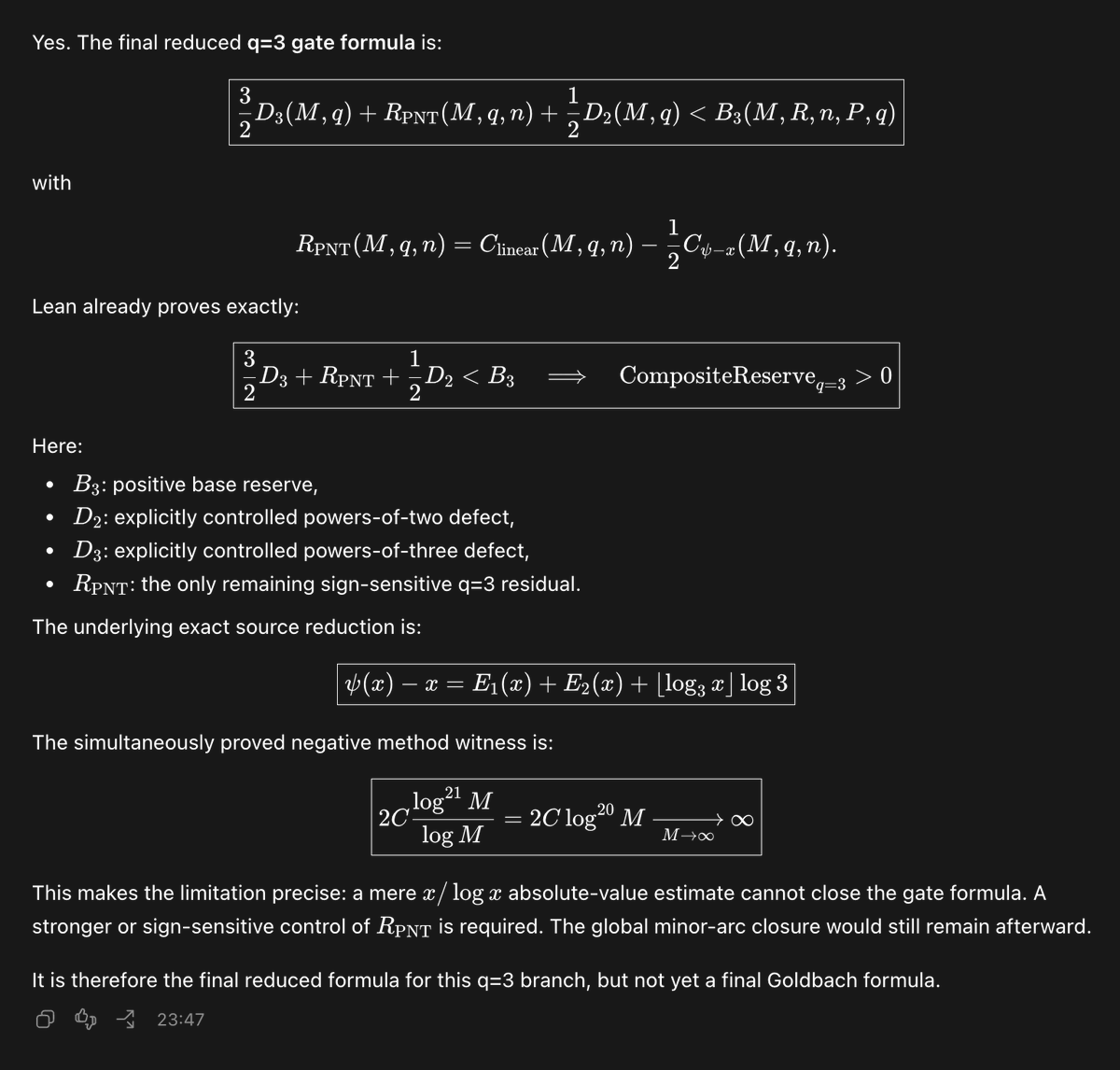
Clean negative result inside the Lean kernel:
The absolute majorant route via Bennett–Martin–O’Bryant–Rechnitzer (BMOR) is formally falsified as a workable method.
Under projective weighting, the error budget scales as ~2C log²⁰(M), which unconditionally diverges to +∞ as M → ∞. It eats through the base reserve entirely.
Crucially: this is not a counterexample to Goldbach. It is a machine-checked proof that triangular inequality bounds on absolute values cannot carry this reduction.
No heuristics, no bending of constants. The path is formally retired under FAIL_CLOSED.
Pivot is set: switching strictly to sub-exponential damping (exp(-c√log x)) or direct sign-sensitive phase cancellation.
A closer look at the ledger tells the exact story:
At 10:28 PM, OpenAI refunded the exact 82.60 € ($95.20) from the rapid-fire transaction attempt at 10:22 PM.
Their billing hooks caught the hiccup and reversed the amount down to the cent without delay. Fair play to their system for keeping the ledger clean.
Balance restored, zero friction, and full focus back on the Lean kernel.
23 hours of continuous verification, 0 issues, 0 sorrys in the Lean kernel.
We pushed the analytical reduction to its sharpest exact formulation:
R_{q=3} = B_{q=3} - ∑_{t < M} Δw(t) P(t+1)
The entire branch is now rigorously mapped down to the core bilinear prime correlation. The 1D residue class bounds (PNT mod 3 via Bennett et al.) hold unconditionally and dampen the character errors, but they do not decide the sign of the weighted 2D prime pair convolution.
Crucially, an obstruction here is not a falsification of Goldbach—it is a clean, machine-checked structural barrier for this specific reduction path.
The boundary is formally sealed. The status remains strictly ACTIVE / NO_PROOF.
No hallucinations, no hand-waving—just reproducible mathematics directly on local silicon.
Full transparency and fair play require telling the whole story:
While the sudden two-hour double charge and the declined transaction at 10:07 PM make for a sharp reality check, credit where credit is due—OpenAI granted countless complimentary resets along the way.
Taking the billing friction with a healthy dose of humor: the platform absorbed immense compute pressure over the course of the quest, and cosmic balance was simply restored at the finish line.
The journey continues, fully decoupled on local silicon.