BROTHER RICHARD FRANCIS BURTON: THE PILGRIM OF MECCA
In the summer of 1853, a remarkable English Freemason undertook one of the most daring expeditions of the Victorian age. Captain Richard Francis Burton, soldier, linguist, and explorer, resolved to enter the sacred cities of Medina and Mecca, whose sanctuaries were forbidden to non-Muslims.
Burton had studied Eastern languages, customs, and religion with extraordinary diligence. Assuming the identity of a Muslim physician and traveller, he journeyed through Arabia, eventually joining the great pilgrimage caravan bound for Mecca.
Across burning deserts, amid armed escorts, suspicious companions, and the constant danger of discovery, Burton maintained his assumed identity through his command of language and intimate knowledge of Islamic observances.
At length, he entered Mecca and beheld the Kaaba, the sacred centre toward which Muslims throughout the world turn in prayer. He observed the pilgrimage ceremonies and recorded the architecture, customs, and religious life of the city with remarkable precision.
His celebrated Personal Narrative of a Pilgrimage to El-Medinah and Meccah, published in 1855–1856, established his reputation among the foremost explorers of his generation.
Burton was among the best-documented European visitors to Mecca. His expedition remains an extraordinary chapter in the history of geographical exploration, linguistic scholarship, and Victorian intellectual curiosity.
GEOMETRY AS THE LANGUAGE OF SACRED ORDER
Throughout the great religious monuments of Islam, geometry attains a remarkable dignity as an expression of sacred order. Across the walls of mosques, the vaults of domes, and the intricate surfaces of carved stone and glazed tile, the measured repetition of stars, polygons, and interlacing lines gives visible form to principles of unity, proportion, and harmony.
Within Islamic religious art, geometric ornament has often been understood in relation to the divine unity, tawḥīd. The multiplication of forms within a coherent design suggests an intelligible order governing the whole. Each figure occupies its appointed place, each line participates in a greater symmetry, and each repetition extends the pattern beyond the limits of the individual element. The inexhaustible variety of creation is thus contemplated through the discipline of mathematical proportion. Such ornament gives religious expression to order without requiring the representation of living figures.
Freemasonry approaches geometry through a distinct philosophical and moral tradition. The square, the compasses, and the architect's measured design furnish emblems of rectitude, self-government, and the cultivation of virtue. As the builder governs his work by established principles, so the Mason is called to regulate his conduct according to conscience and moral law.
These traditions preserve their respective theological foundations and historical development. Islamic geometric ornament belongs to a religious and artistic civilization shaped by Islamic belief, craftsmanship, and intellectual inquiry. Masonic geometry belongs to a symbolic discipline concerned with the formation of moral character.
Yet both demonstrate the extraordinary capacity of geometry to render abstract principles intelligible to the human mind. Through repetition, measure, and harmonious proportion, the visible world becomes an instrument of contemplation. The ordered pattern directs the intellect toward unity, while the disciplined hand gives material expression to the conviction that beauty and order are worthy of reverence.
The Sacred Book stands among the most solemn emblems of the Masonic tradition, representing that higher law by which human conduct must be measured and the conscience brought into harmony with the principles of justice, truth, and virtue.
Throughout the history of civilization, mankind has committed its highest conceptions of duty and divine order to the written word. Sacred texts have preserved the moral instruction of generations, giving enduring expression to those principles by which the individual may govern his passions, regulate his conduct, and discharge his obligations toward his fellow man.
Within Freemasonry, the Sacred Book offers a profound image of this governing principle. As the architect submits his designs to the laws of proportion and geometry, so must the moral builder submit his character to a standard higher than personal inclination. The passions of the moment, the demands of ambition, and the preferences of the individual must yield before the enduring requirements of conscience and duty.
Universal Co-Masonry upholds liberty of conscience, recognizing the dignity of sincere spiritual conviction and the individual's responsibility in approaching questions of ultimate truth. The sacred writings of humanity express distinct religious traditions, each deserving of consideration according to its own teachings. Freemasonry cultivates reverence for moral law while respecting these differences of belief.
The Sacred Book thus directs our contemplation toward one of the highest purposes of human existence: the deliberate government of the self according to principles worthy of obedience.
For the true Mason, liberty finds its noblest exercise in the willing discipline of conscience, and character acquires its strength through fidelity to the Good, the True, and the Just.
NUMBER, IMAGE, AND THE ORDER OF THE COSMOS
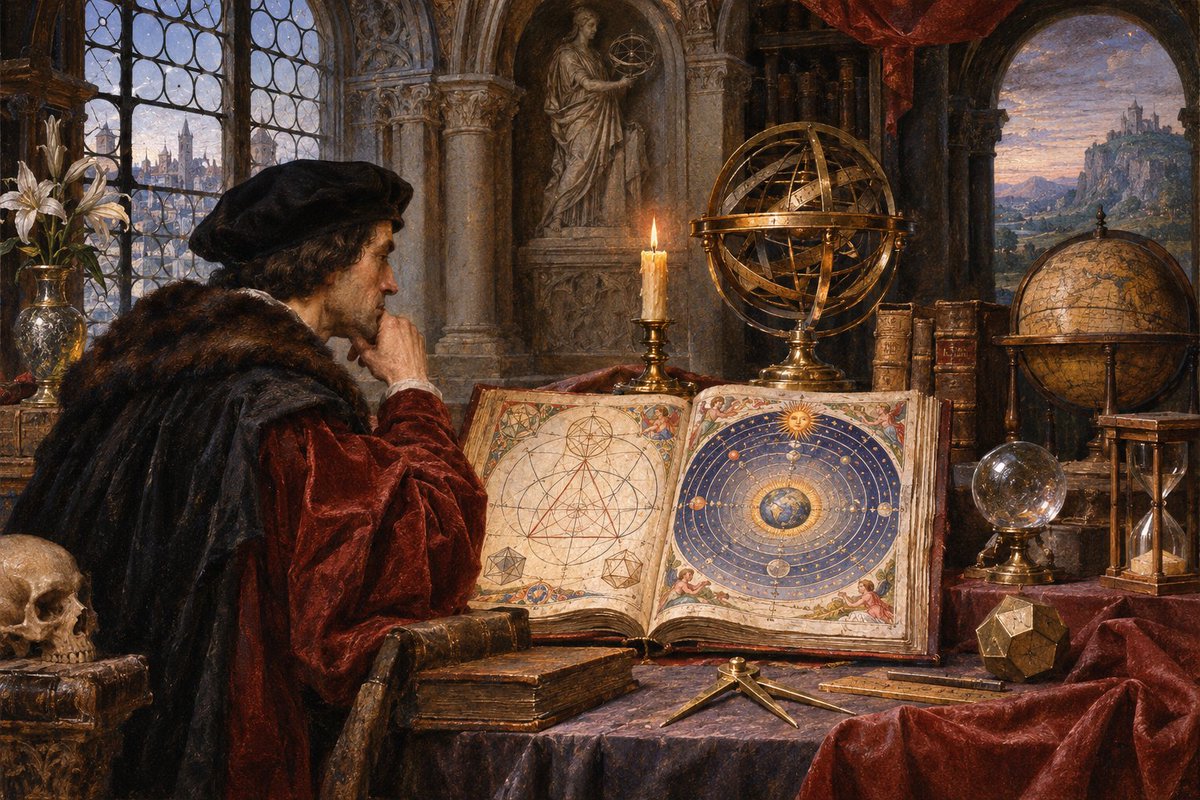
The Renaissance conception of the universe rested upon a profound conviction that creation possessed an intelligible order, expressed through number, proportion, harmony, and correspondence. Within this intellectual tradition, mathematics became a language through which the philosopher sought to comprehend the relations uniting the terrestrial world, the celestial spheres, and the higher principles of existence.
Heinrich Cornelius Agrippa, in his Three Books of Occult Philosophy (1533), gathered the doctrines of natural philosophy, Neoplatonism, Hermeticism, astrology, and Christian Cabala into an elaborate system of cosmic correspondences. Number expressed the proportions of creation; geometric figures represented its underlying principles; and symbolic images embodied relationships believed to exist between earthly substances and celestial influences. Agrippa understood these correspondences as possessing actual operative powers within nature. His philosophy thus joined intellectual contemplation to claims of magical efficacy.
Later thinkers, including Robert Fludd, continued to represent the universe through elaborate diagrams of celestial harmony, mathematical proportion, and the correspondence between the human being and the greater cosmos. Their engraved circles, spheres, and architectural figures expressed a conviction that the visible world could be studied as a coherent and ordered whole.
Within the later symbolic philosophy of Freemasonry, geometry likewise acquired a distinguished moral and intellectual significance. The square, compasses, columns, and geometrical diagrams furnished a vocabulary through which the principles of measure, rectitude, proportion, and order could be impressed upon the understanding. The tracing board gave visible form to abstract instruction, presenting the moral life through the familiar instruments and architecture of the builder.
These traditions occupied a common inheritance of mathematical philosophy and symbolic representation, although their purposes and historical development remained distinct. Renaissance learned magic frequently attributed causal powers to images and correspondences. Masonic symbolism employed geometry principally as an instrument of moral contemplation, ethical instruction, and philosophical reflection.
In both intellectual environments, the measured figure testified to humanity's desire to discover order within apparent complexity. The circle suggested unity, the square established measure, and the temple presented the image of a world whose parts were governed by intelligible proportion. Through the disciplined contemplation of these forms, the mind could apprehend the principles of harmony and apply their lessons to the cultivation of virtue.
THE SQUARE AND COMPASSES
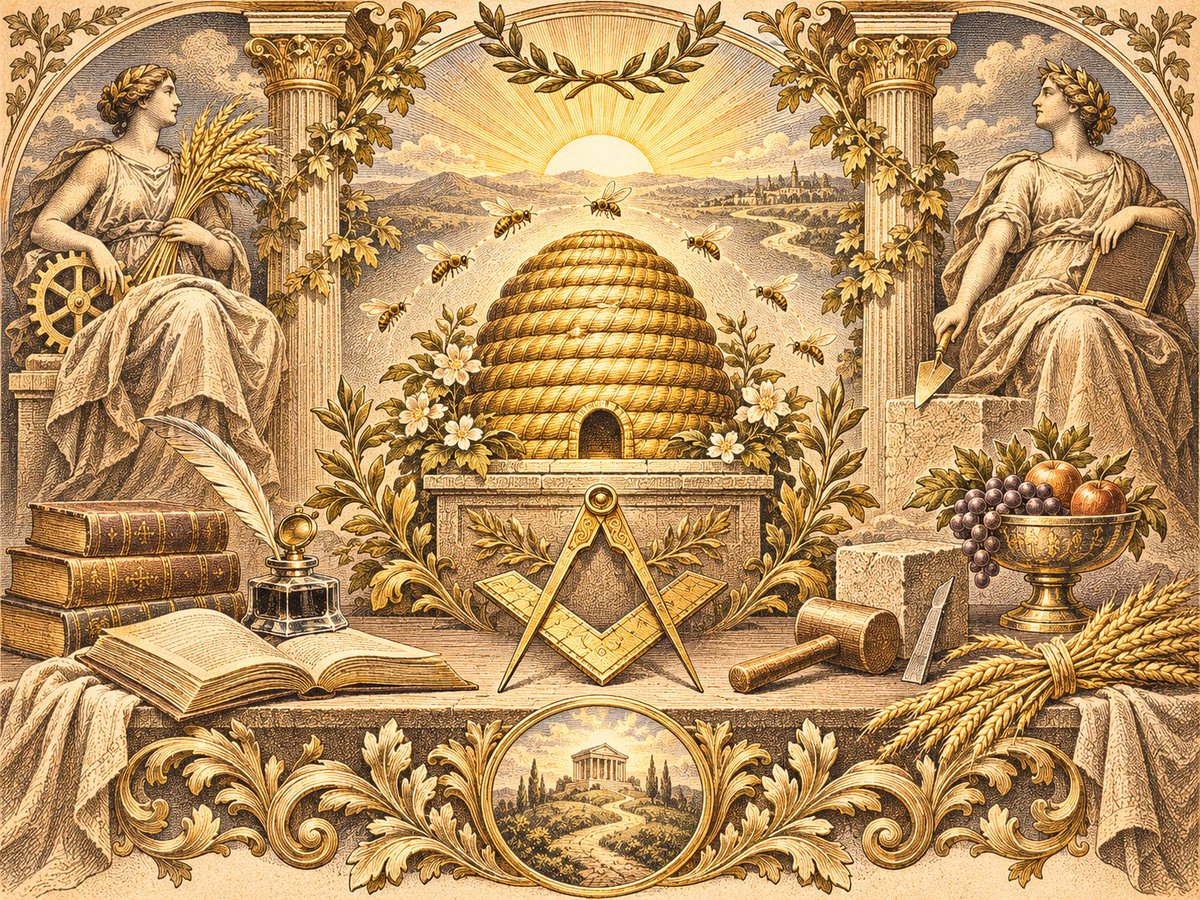
The Square and Compasses stand among the noblest emblems of Freemasonry, expressing in familiar instruments the great principles of moral rectitude and self-government.
The Square teaches man to regulate his conduct by justice, to deal uprightly with his fellow creatures, and to establish every action upon the firm foundation of duty. The Compasses teach him to prescribe wise limits to his passions, to govern his appetites by reason, and to preserve within his soul that harmony upon which true liberty depends.
United, these instruments present a sublime conception of human character: a life squared by virtue and circumscribed by discipline. For he who governs himself with wisdom acquires the strength to act with justice, and he who walks uprightly among men contributes to the moral elevation of mankind.
THE CATHEDRAL AND THE MASONIC IDEAL
The great cathedrals of medieval Christendom stand among the noblest expressions of man's endeavour to bring the material world into harmony with the spiritual. Raised through generations of disciplined labour, these mighty temples united the skill of the craftsman, the solemnity of Christian worship, and the profound symbolism of sacred geometry in enduring monuments of stone.
Their pointed arches, vaulted ceilings, and ordered proportions embodied a conception of the universe governed by intelligible law. Geometry supplied the builder with the principles of measure, symmetry, and structural harmony, while theological imagination invested number, light, and architectural form with spiritual significance. Beneath these soaring vaults, the very disposition of matter became an instrument of religious contemplation.
The later Masonic imagination inherited and enlarged this architectural language, finding in the builder's art an emblem of moral cultivation. The shaping of stone suggested the refinement of character, while the construction of the temple represented the patient establishment of virtue within the human soul.
Thus, the cathedrals of Europe remain magnificent witnesses to a civilizing principle: that the human spirit may be elevated through the deliberate ordering, proportioning, and beautification of its material surroundings.
THE TWENTY FOUR INCH GAUGE
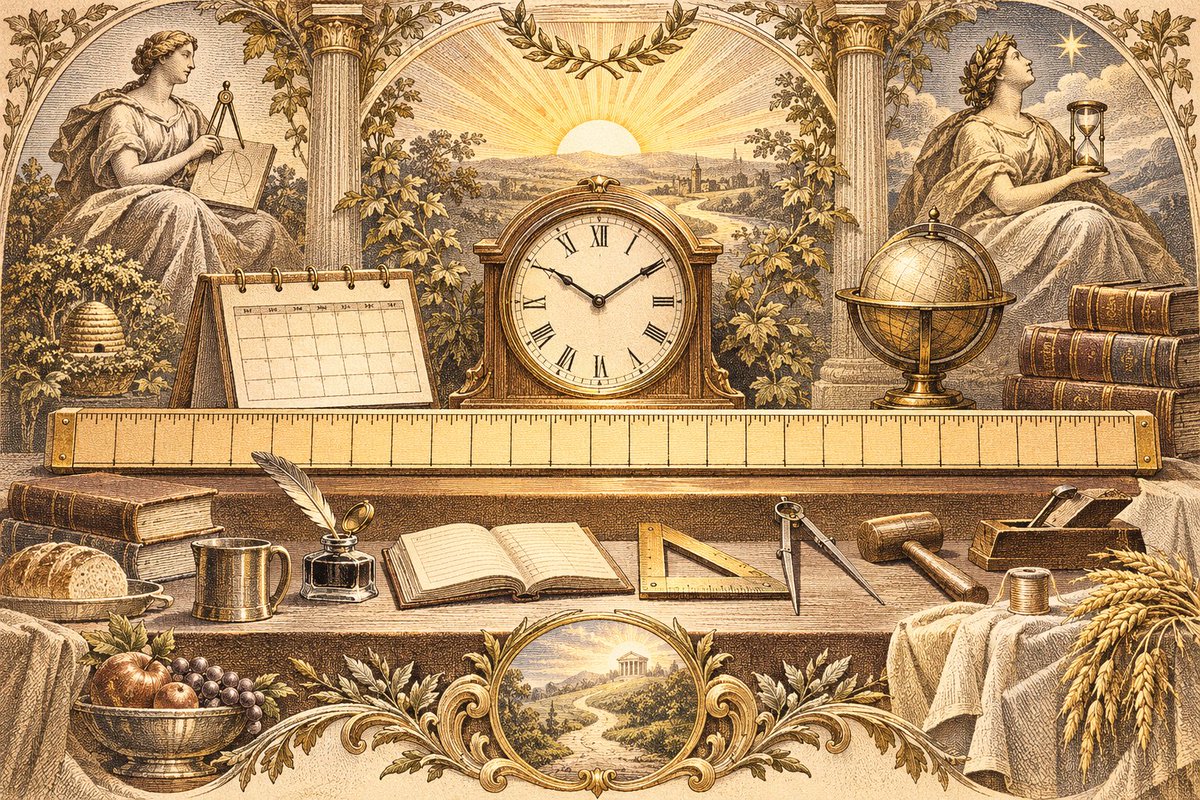
A rule divided into twenty-four equal parts presents to the contemplative mind an image of the measured day, whose hours are entrusted to man as a finite and solemn possession. Each division marks a portion of that precious inheritance, and each demands its proper employment according to the obligations of duty, the necessities of life, and the cultivation of virtue.
The twenty-four inch gauge thus becomes an emblem of moral regulation. As the architect assigns to every stone its appointed place, so must the disciplined man establish a just proportion among his labours, his studies, his repose, and his service to others. For the day possesses its own sacred geometry, and its proper arrangement contributes to the harmony of the whole life.
There is a quiet and redeeming power in order. Discipline strengthens the will, regulation preserves the faculties, and habitual fidelity to appointed duties gradually raises the character toward its noblest form. The scattered energies of the soul, gathered beneath the government of reason, acquire the strength of a united purpose.
Thus does the humble rule instruct us in the architecture of a virtuous existence. Every hour faithfully employed becomes a stone well fitted to the temple of character, and time becomes a moral resource when it is consciously ordered.
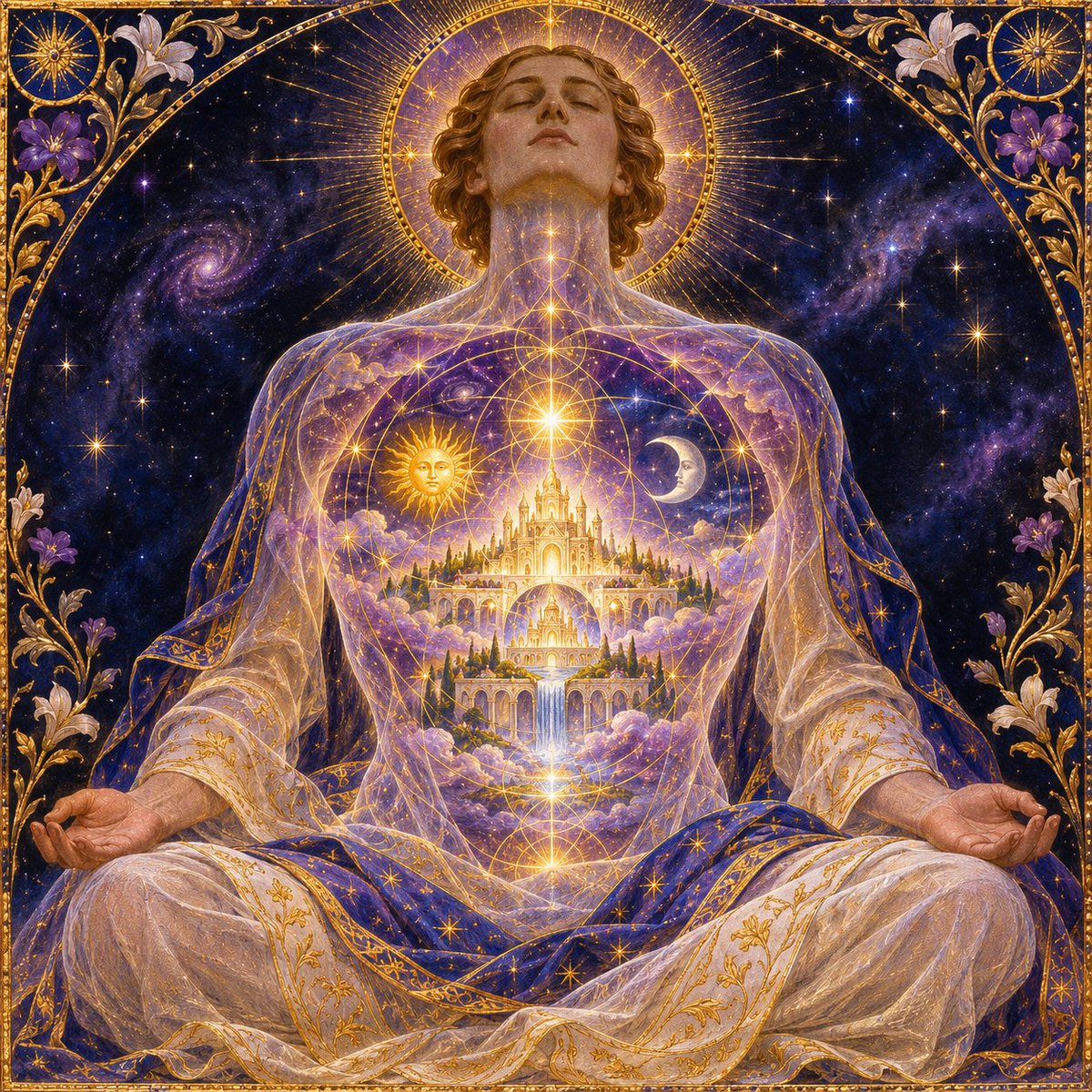
The Hermetic philosophers regarded the human being as a microcosm, a lesser world whose structure reflected the order of the greater cosmos. Renaissance thinkers developed this correspondence through the proportions of the body, the geometry of the temple, and the measured motions of the heavens.
Masonic symbolism approaches a related principle through architecture. The square, compasses, column, and perfected ashlar express an intelligible order by which human conduct may be examined and disciplined. As the architect governs his work by proportion and measure, so must the individual govern his faculties by reason and moral law.
The principle of correspondence has a long philosophical history, extending through Platonic, Hermetic, and Renaissance thought. Its significance rests in analogy: the visible order of nature supplies a language through which the soul may contemplate its own proper arrangement. It establishes no mechanical law by which thought compels external events.
The body supplies the measure, the temple gives that measure enduring form, and the heavens present the wider order within which human life unfolds. Their correspondence directs the mind toward harmony, proportion, and the deliberate cultivation of virtue.
THE CHISEL
The Chisel, among the simplest instruments of the operative mason, affords a profound illustration of the power of intelligence directed toward a definite and worthy end. In the hands of the craftsman, it becomes the means by which the rude and shapeless stone is gradually brought into conformity with the proportions prescribed by the architect. Its office is to remove that which is superfluous, to correct irregularity, and to prepare the material for its appointed place in the structure.
The force of the mallet, however considerable, accomplishes little without the discriminating edge of the Chisel. The one supplies the necessary energy; the other determines its application. Their united action represents a fundamental principle of moral cultivation: that strength must be governed by intelligence, and exertion directed by judgment. The unregulated blow may fracture the stone, whilst the measured stroke, guided by a knowledge of its nature and the requirements of the design, advances the work toward perfection.
In its speculative interpretation, the Chisel may therefore be regarded as an emblem of education, through which the faculties of the understanding are sharpened and the imperfections of character subjected to deliberate correction. As the sculptor must first conceive the form concealed within the rough material, so must the moral labourer possess some clear apprehension of the virtues he intends to cultivate. Without such an ideal, effort becomes uncertain, discipline arbitrary, and correction liable to exceed its proper bounds.
There is also conveyed in this instrument a lesson concerning the exercise of discrimination. The skilled workman distinguishes between that which must be removed and that which must be preserved. Every stroke involves an act of judgment, for the stone once severed cannot be restored by any subsequent exertion of the tool. Thus the Chisel admonishes us to exercise prudence in the formation of opinions, restraint in the correction of others, and circumspection in the government of our own conduct. Zeal, unsupported by knowledge, may destroy the very qualities which wisdom would have sought to preserve.
The improvement of character proceeds by a similar discipline. Habits long indulged acquire the hardness of stone, and the removal of their irregularities demands perseverance, attention, and repeated exertion. The impatient workman may attempt by violence what patient skill would accomplish by degrees. Yet the perfection of the ashlar depends upon the accuracy of innumerable smaller operations, each governed by the proportions of the intended whole. So too does moral excellence arise through the daily correction of conduct, the cultivation of reason, and the gradual establishment of virtue as a settled principle of life.
The Chisel thus presents to the contemplative Mason an image of intelligent force acting under the authority of a preconceived design. Its edge represents the discerning faculty of the mind; its action, the application of knowledge to the correction of imperfection; and the finished stone, that ordered character which has been formed through education, discipline, and conscientious labour.
For the Temple of human virtue is raised through the faithful government of the faculties entrusted to us, and each well-directed stroke upon the rough material of our nature contributes something toward the strength, symmetry, and enduring dignity of the whole.