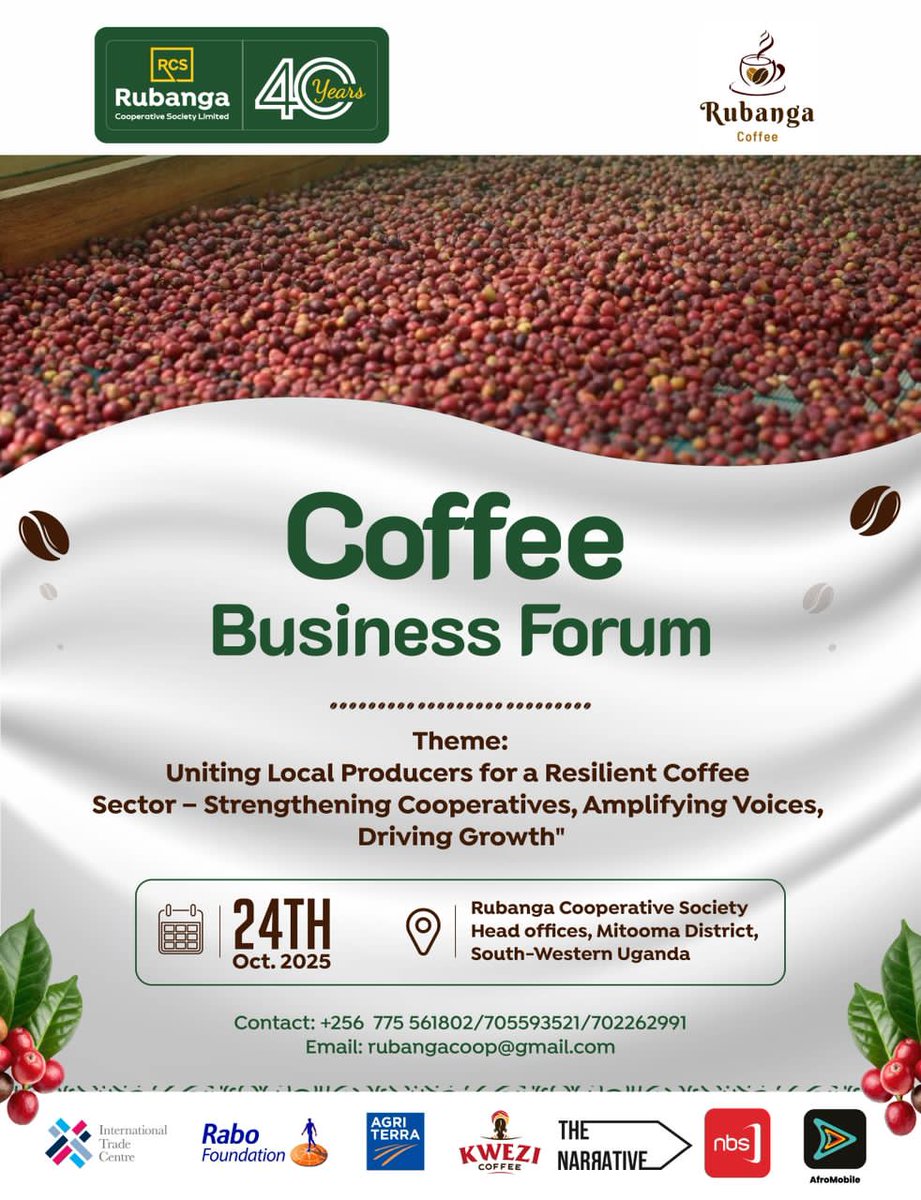
Rubanga Cooperative Society is honored to announce the Coffee Business Forum, taking place on 24th October 2025 in Mitooma District.
We invite all coffee champions to join us in shaping the future of Uganda’s coffee sector.
#CoffeeBusinessForum#Rubanga40#UgandaCoffee
Unlike public gatherings where social distancing and human contact is hard to control, coffee farms encourage spacing and reduces the risk of disease transmission. Happy Martyr's Day to all our coffee stakeholders. Be safe.
Are you a coffee Farmer in and around Mitooma District? Rubanga Cooperative Society SACCO together with @RubangaCoffee is here for you. Imagine 1% interest rate. Impacting the lives of households indeed.
Behind every quality coffee bean is dedication, patience and passion for farmers'hard work. That's why cooperatives like @CoRubanga make their faces smile by offering premium so as we can strengthen their resilience and sustain production. " Premium coffee, sustainable future".
On my regular visits to @CoRubanga and @RubangaCoffee , it’s become clear to me that the story in coffee is shifting.
Farmers here aren’t just delivering cherries and waiting on the next payout. They’re reinvesting their earnings into a new processing unit, setting up internal quality labs, and training younger members on grading and cupping. The goal is simple: keep more value at the farm level instead of losing it down the chain.
When farmer groups and cooperatives are given real ownership and access to finance, you see what’s possible. Better quality, stronger incomes, and a generation that actually wants to stay in coffee.
This is the kind of investment that changes the sector from the ground up @FrankTumwebazek@jamesmuhangi@rkabushenga
Climate change refers to the long-term alterations in average weather conditions. This is largely driven by human and natural factors which negatively affects coffee production at different stages of growth. @CoRubanga we offer Climate-Smart resilient coffee varieties. Order now.
The idea that farmers consistently earn “less than 10% of final value” can be misleading without accounting for costs, quality differentials, processing, logistics, compliance, and market risks absorbed along the chain.
Also, value addition at source alone will not automatically translate into 2–3x farmer incomes unless issues of productivity, aggregation efficiency, financing, and market access are addressed simultaneously.
The real challenge is less about a simple value gap narrative and more about building a balanced, efficient value chain where each actor including farmers capture value proportionate to their input and risk.
Today, aBi Finance met with a delegation from the @DKinUganda to review progress on our 2024–2028 strategic plan — Accelerating Adoption of Green and Inclusive Finance (AAGIF).
At the midpoint, we are making steady progress towards our targets:
🌱 Expanding access to green and inclusive finance for over 1 million farmers and agribusinesses across Uganda
💰 Disbursing UGX 1 trillion in loans. Of this, 75% will be allocated to green loans, 40% to women, 40% to Northern and Eastern Uganda, 30% to youth, and 5% to refugees.
We are delivering on these targets by:
1. Unlocking credit and de-risking agricultural lending for underserved groups and climate-smart projects.
2. Building the capacity of financial institutions in ESG integration, digitalisation, and management information systems.
We look forward to hosting the delegation later this week as they engage directly with our financial institution partners and the smallholder farmers and agribusinesses we serve.
When Ugandan farmers face difficult seasons due to climate-related issues, the impact ripples beyond their farms. It reaches the institutions that serve them, the communities that depend on them, and the economy that grows with them.
With over 70% of Ugandans depending on agriculture for their livelihoods, the financial sector plays a direct role in building the resilience that keeps these farmers and agribusinesses stable through uncertainty. This resilience is built through strong governance, a deep understanding of client risks, and financial products designed to perform in both good and bad seasons.
aBi Finance, through its FSD and BDS support, works with financial-sector partners to institutionalize Environmental, Social, and Governance (ESG) practices in business operations and service delivery, providing a strong foundation for resilient portfolios that ultimately strengthen smallholder farmers and agribusinesses.
Watch the video 🔽 to learn more about our Financial Services Development and Business Development Services support.
Tonight we are targeting Young generations towards the vast opportunities in Agricultural sector. How can unemployed youth tap into Agricultural value chain for fully paid and sustainable job. @CoRubanga@RubangaCoffee