Approximately 60% of all @NCAADII student-athletes who enter the transfer portal each year “do not find a new team and effectively retire or never play competitively again!”
This is referred to as the #D2 Retirement Rate.
LET YOUR WORK SPEAK
You don't need to announce every goal or explain every sacrifice. Let your preparation show, let your consistency speak, and let your performance tell the story.
Where in the world are the FALCONS?
This week, we’ve hit the recruiting trail and are searching for the next generation of Falcons who will embrace the culture we’re building right here in the Permian Basin.
#MAXOUT#ONTHEHUNT
PARENTS: Learn the language of college football recruiting.
A lot of confusion happens because players hear one word and assume it means something completely different.
Here are the terms you need to know:
• Offer — A school has expressed that it wants the player, but you still need to know exactly what kind of offer it is.
• Committable Offer — The school is ready to accept your commitment RIGHT NOW and has a roster/scholarship spot for you.
• Non-Committable Offer — You have been “offered,” but the school is NOT currently prepared to accept your commitment. They may be waiting on other players, evaluations, grades, roster numbers, etc.
• Verbal Offer — An offer communicated by a coach. Most early offers are verbal and are not binding.
• Written Offer — Written scholarship/financial-aid information from the school. A graphic posted on social media is NOT the same thing.
• Commitment / Verbal Commitment — The player publicly tells a school he plans to attend. It is not the same as being officially signed.
• Silent Commitment — The player has privately told the coaching staff he is coming but has not announced it publicly.
• Decommitment — A player backs away from his previous verbal commitment.
• Flip — A committed player changes his commitment from one school to another.
• Preferred Walk-On (PWO) — A player is recruited to join the program but does not initially receive an athletic scholarship.
• Walk-On — A player joins or tries to join the team without an athletic scholarship.
• Full Scholarship — Athletic aid covering the amount offered by the school under its current scholarship/roster structure.
• Partial Scholarship — Athletic aid covers only part of the player’s college costs. Common at some levels/divisions.
• Official Visit (OV) — A recruiting visit that the college can financially support within NCAA rules.
• Unofficial Visit (UV) — A campus visit where the prospect/family generally pays their own expenses.
• Game-Day Visit — A prospect visits campus for a game. This does NOT automatically mean the player is a priority recruit.
• Junior Day — A recruiting event bringing prospects to campus for tours, meetings, workouts and presentations.
• Camp Invite — A school wants you at its camp. This is NOT automatically an offer or proof you’re a priority recruit.
• Evaluation — Coaches are still studying your film, size, athletic ability, academics, character or live performance.
• Board / Recruiting Board — The internal list/ranking of prospects a coaching staff is recruiting at each position.
• Take — A prospect the staff is currently willing to accept a commitment from.
• Priority Recruit — A player the staff is actively pursuing near the top of its recruiting board.
• Plan B / Backup — A recruit the staff likes but may be behind other players at the position.
• Offer Pending Evaluation — The staff likes the player but wants more film, camp work, academics, measurements or senior-season evaluation before making a final decision.
• Contact — Legitimate communication between the college staff and prospect within recruiting rules.
• Interest — A school communicating with you does NOT necessarily mean you have an offer.
• Questionnaire — A school collecting your information. Filling one out does NOT mean you’re being recruited.
• Graphic Edit — A recruiting graphic is marketing/content. It is NOT proof of a scholarship offer by itself.
• Coach Follow — A coach following you on social media does NOT automatically mean you’re being recruited.
• DM — Communication can be meaningful, but a DM alone does NOT equal an offer.
• Position Offer — Understand WHAT position the school is recruiting you to play. It may not be the position you play in high school.
• Roster Spot — A place within the program’s roster structure. Scholarship availability and roster availability are not always the same thing.
Some of his strategies included incorporating calorie-dense foods like ice cream and oil, eating staples like ground beef and rice, setting alarms every couple of hours to stay on schedule, and leaning on teammates for accountability.
His mindset? "Eat big to get big.”
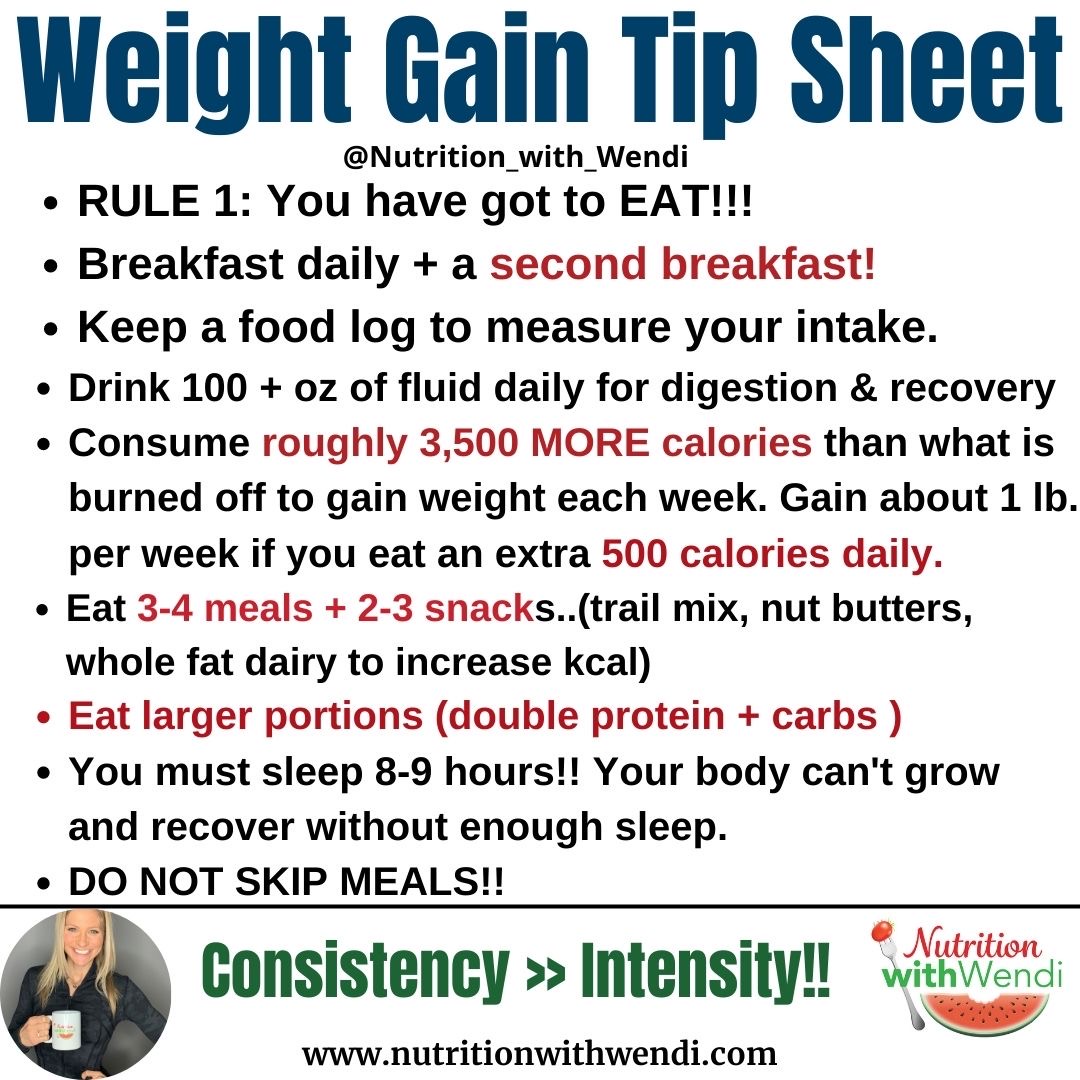
As a sports dietitian, these are five principles I emphasize with athletes who need to gain weight:
1. CONSISTENCY IS KING.
You have to eat! Don't skip meals, don't rely on hunger cues alone, and don't expect to gain weight if you're consistently underfueling. Set a schedule and stick to it.
2. EAT MORE FREQUENTLY.
Aim for 4-5 meals and 2–3 snacks throughout the day. Breakfast plus a second breakfast can make a significant difference when your calorie needs are high.
3. CREATE A CONSISTENT CALORIE SURPLUS.
For many athletes, starting with an additional 300–500 calories above maintenance is a reasonable approach. Monitor progress and adjust intake based on individual needs and goals.
4. INCREASE PORTIONS AND CHOOSE CALORIE-DENSE FOODS.
Think larger portions of protein and carbohydrates. Incorporate foods like ground beef, rice, whole-fat dairy, nut butters, trail mix, and smoothies. Liquid calories can also help athletes increase intake without adding as much food volume.
5. PRIORITIZE RECOVERY AND ACCOUNTABILITY.
Nutrition doesn't stop when practice ends. Get 8–9 hours of sleep when possible, stay adequately hydrated, follow a progressive strength-training program, and track your food intake and weight trends to measure progress.
A few additional reminders:
- You need adequate protein AND carbohydrates to support muscle growth and training demands.
- Weight gain should be intentional, not rushed. The goal is to build muscle while supporting health and athletic performance.
- Your calorie needs, rate of gain, food preferences, and training demands are unique to you.
I've worked with athletes for 15+ years, and one of the biggest things I see is athletes who WANT to gain weight but aren't consistently eating enough to make it happen.
You cannot out-train underfueling. Consistency > Intensity.
If you're an athlete, parent, or coach struggling with healthy weight gain, remember: a structured nutrition plan can make all the difference.
HUMILITY KEEPS YOU HUNGRY
Celebrate progress, but never become satisfied with yesterday's work. Stay humble enough to learn and hungry enough to keep improving.
🚨 MICHAEL HAWKINS JR. IS ON THE VERGE OF MAKING EVEN MORE WVU HISTORY!
Hawkins is just 99 passing yards and 76 rushing yards away from becoming the first QB in WVU history to record 2,000 passing yards and 1,000 rushing yards in a single season.
He could make history Saturday against Kansas.
PARENTS: College coaches will walk away from your talented kid just to avoid the circus around them.
If a coach has to negotiate through all these random NIL reps just to talk to your child, they’ll move on to the next 4-star prospect who has a clean, professional setup. They got 105 scholarships to manage.