Last night, I got a call from President Trump. During the call, I asked about how the Pentagon had reclassified my faith. He said he would look into it. This morning, he told me it had been fixed. Thank you, President Trump.
We can disagree on whether "Mormons are Christian." That's not what disturbed me about this. I don't want the GOVERNMENT classifying religions. That creates a dangerous tool that shouldn't be in the hands of ANY government.
I don't believe that was Hegseth's goal. But what happens if the power shifts and the "Jesus was nonbinary" camp takes over? Will they recategorize conservative Christians? The Biden administration already tried to link Catholicism to domestic terror.
If that possibility troubles you, then you understand my problem with this whole thing. I don't want the government to declare me a Christian. I want them to stay out of it.
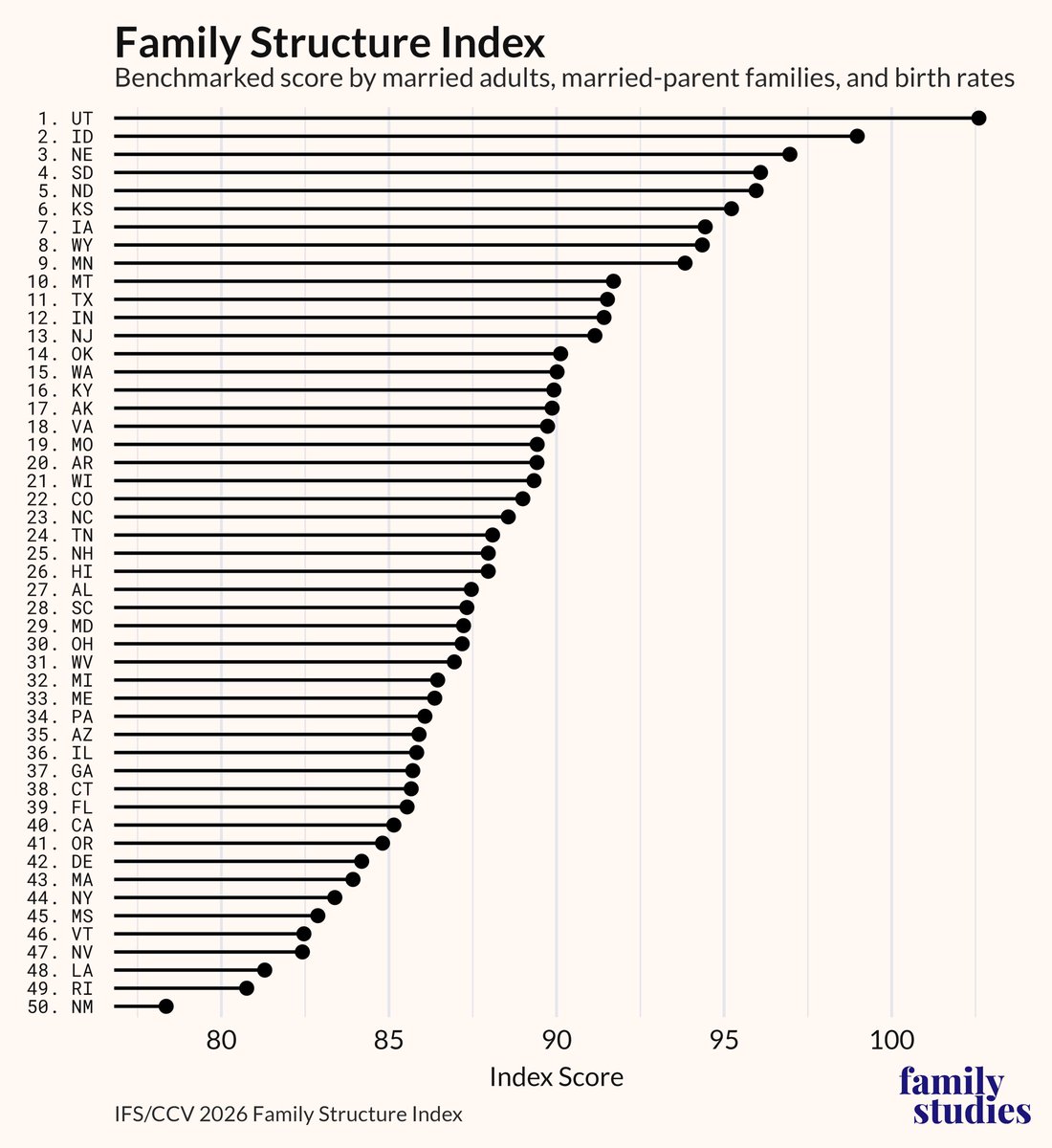
New report ranks Utah #1 in family structure index, based on high marriage rate, high percentage of children in two-parent households, and high fertility rate.
Utah is also the #1 state for:
– Volunteerism
– Economic Outlook
– Births to Married Mothers
– Weekly Church Attendance
– Donations to Charitable Causes
Utah has the lowest childhood poverty rate in the country and the lowest rate of households receiving public assistance or SNAP benefits.
For the fourth consecutive year, U.S. News and World Report has named it the best state in the nation.
It’s reasonable to say that Utah is the greatest success story of the American experiment.
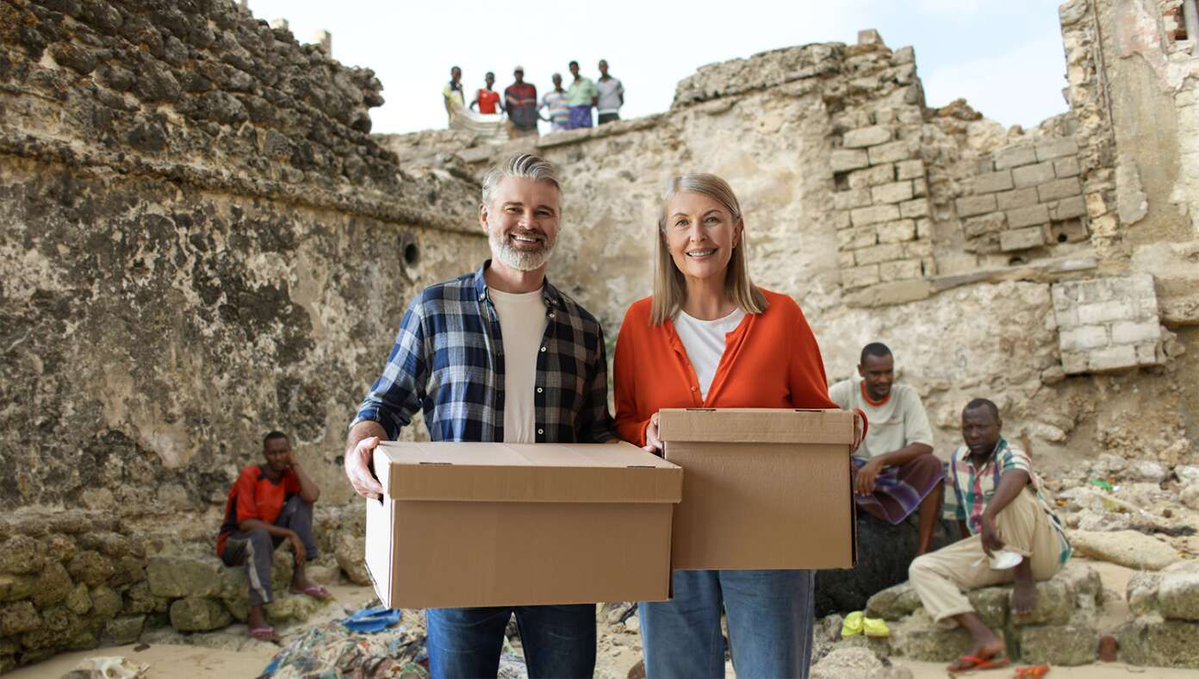
I read today that The Church of Jesus Christ of Latter-day Saints had $1.54 billion in humanitarian aid expenditures in 2025, including 37 million pounds of food donated.
I’m reminded of Megan McArdle’s attempt to describe the scale of the Church’s relief operations:
“I found that it's hard to even get a complete picture of how Utah combats poverty, because so much of the work is done by The Church of Jesus Christ of Latter-day Saints, which does not compile neat stacks of government figures for the perusal of eager reporters.
The Church did, however, give me a tour of its flagship social service operation, known as Welfare Square. It's vast and inspiring and utterly foreign to anyone familiar with social services elsewhere in the country. This starts to offer some clue as to why Utah seems to be so good at generating mobility - and why that might be hard to replicate without the Latter-day Saints.
Many charity operations offer a food pantry or a thrift shop. Few of them can boast, in addition, their own bakery, dairy operation and canning facilities, all staffed by volunteers. The food pantry itself looks like a well-run grocery store, except that it runs not on money, but on "Bishop's Orders" spelling out an individualized list of food items authorized by the bishop handling each case. This grows out of two features of Latter-day Saint life: the practice of storing large amounts of food against emergencies (as well as giving food away, the church sells it to people for their home storage caches), and an unrivaled system of highly organized community volunteer work.
The volunteering starts in the church wards, where bishops keep a close eye on what's going on in the congregation, and tap members as needed to help one another. If you're out of work, they may contact small business people to find out who's hiring. If your marriage is in trouble, they'll find a couple who went through a hard time themselves to offer advice.
Utah's incredible levels of integration, of community solidarity and support, of trust in government and in each other, enable it to build something unique in America, something a bit like Sweden might be, if it were run by the U.S. Chamber of Commerce. Where the best ideas of conservatives and liberals came together in one delicious package: business friendly, opportunity friendly, but also highly committed to caring for the needy and helping them get back on their feet.”
When The Church of Jesus Christ of Latter-day Saints announced it spent $1.58 billion on humanitarian aid in 2025, critics quickly compared the figure to the Church's total assets.
The implication: measured against that wealth, $1.58 billion is unimpressive.
But this critique overlooks a fundamental reality of global development. Giving money away effectively is often harder than earning it.
In development economics, the primary constraint on aid is rarely a lack of cash. It is absorptive capacity. There is a persistent myth that the solution to global suffering is simply to write the check. In reality, flooding a fragile region with capital without the necessary infrastructure often does more harm than good, fueling corruption, destabilizing regional markets, or creating permanent dependency.
Effective humanitarian work requires logistical networks capable of moving 37 million pounds of food across 196 countries, trusted local partners to ensure aid reaches the last mile, and oversight systems that prevent funds from disappearing to administrative graft. These structures take decades to build. The church's steady climb from $906 million in 2021 to $1.58 billion in 2025 reflects an institution scaling its infrastructure, not just its generosity.
Most global NGOs face a structural dilemma: to distribute billions, they must hire thousands. The Gates Foundation, one of the world's most sophisticated philanthropic organizations, once spent roughly $1 billion on operations to distribute $3.7 billion in aid.
The Latter-day Saint model attempts something different. In 2025, members contributed 7.4 million volunteer hours, the equivalent of 20,000 hours of service every single day. By leveraging a global lay ministry and local volunteers, the system multiplies the impact of every dollar without the corresponding bureaucratic overhead.
The most persuasive argument for a measured approach is the focus on long-term independence. Short-term aid stabilizes families. Long-term skills create independence.
The outcomes from free self-reliance courses offered in more than 100 countries make the case concretely. Within six months of completing a course, 41% of participants improved their ability to provide for their families, 47% found new or better employment, and 61% started or expanded a business. Whether it is a woman in the Philippines launching an enterprise that now employs her neighbors, or a refugee in Croatia learning English to enter the tourism industry, the goal is the same: moving people from the humanitarian column to the self-sufficient one.
Critics frame the church's financial reserves as a hoard. But the institution manages them through the logic of perpetual stewardship, the same logic that governs Harvard's $50 billion endowment or the Gates Foundation's long-term capital strategy. Institutions designed to endure for centuries do not manage resources the way a five-year project does.
For a global religious institution, reserves serve two essential functions: crisis readiness, the ability to respond immediately to unpredictable disasters without waiting for a fundraising drive, and institutional durability, ensuring the safety net does not vanish during the next global economic depression.
If $1.58 billion is dismissed as unimpressive, the critique has stopped being analytical and become ideological. What number would satisfy it?
The more relevant question is whether a system built on steady expansion, volunteer labor, and a deliberate focus on independence actually helps more people over time than a one-time liquidation of reserves ever could.
Measured against the standard of deliberate, sustainable impact, a billion-dollar trendline is not a failure of generosity. It is evidence of a system built to last.
KAROLINE LEAVITT: "Seven of the top ten safest cities in the United States cooperate with ICE, and we have seen historic turnaround in safety in cities that have chosen to cooperate with ICE."
"The murder rate in Washington, DC has plummeted as a result... Nobody was tragically killed as a result of that level of cooperation between federal and local authorities."
"That's all the president is asking for in Minnesota."
REPORTER: "You just made claims that the individual posed a threat to law enforcement..."
SEC NOEM: "That is no claim. It is the facts."
"...This individual showed up to a law enforcement operation with a weapon and dozens of rounds of ammunition. He wasn't there to peacefully protest. He was there to perpetuate violence."
"And he was asked to show up, and to continue to resist, by a governor who is irresponsible and has a long history of corruption and lying."