Keys when manipulating slot 🎰
Here are several keys when changing your slot ⬇️
- Prioritize layback and extension for velocity.
- Keep head still
- Let off-side lower with slot and then keep off-side steady in center of chest during acceleration phase.
Common Misconception with Modern QB Training‼️
“There should be no linear force production.”
From a biomechanics perspective, that is simply not possible (especially in games). Any time a QB strides there is going to be some sort of linear force production, even with quick striding.
I am a huge proponent of rotational throwing, but I believe the emphasis should not be on completely eliminating linear force production but focusing on the transition between linear to rotational force.
The transition occurs when the stride step gets into the ground. This is why quick stride is essential.
When lunging into the throw, there will often be little to no rotational force. On the flip side, when the front foot gets into the ground quickly and firmly the hips can begin to rotate.
I teach to get the front foot into the ground before or at the end of the pull. This allows an efficient transfer of energy up the kinetic chain and gets the hips and torso rotating out in front of the arm.
Stability throughout the front foot, ankle, and knee is essential to properly turn linear force into rotational force.
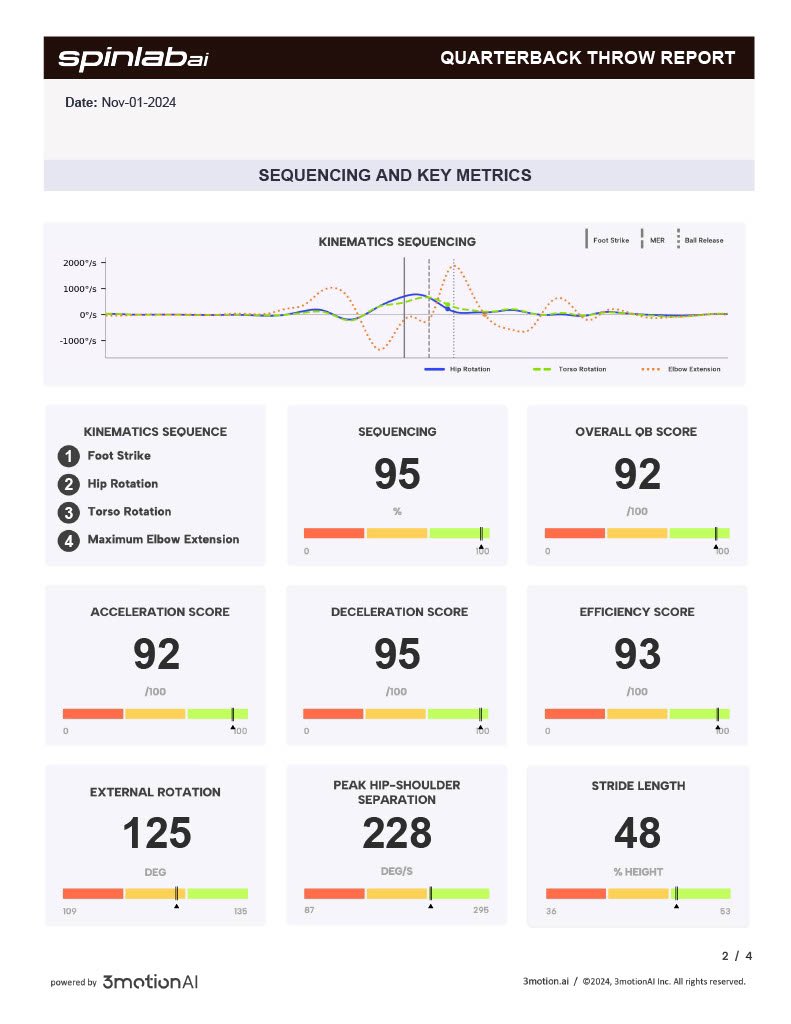
Biomechanics Report 🦾 @spinlabai
What report includes ⬇️
Page 1: Still images at different phases during the throw, peak arm speed, release time, peak hip rotation speed, peak torso rotation speed.
Page 2: Graph of angular velocity measurements for sequencing score, maximum external rotation in throwing shoulder, peak hip/shoulder separation, stride length (as % of height), and scores for sequencing, overall rating, acceleration, deceleration, and velocity efficiency.
Page 3: Graph of joint angles for upper and lower body including: elbow extension, shoulder horizontal abduction, shoulder abduction, shoulder external rotation, trunk flexion, trunk rotation, lead knee flexion, pelvis rotation, and hip/shoulder separation. These graphs have visual markers at foot strike, maximum external rotation in shoulder, and release.
Page 4: Graph of joint velocities for upper and lower body including: elbow extension, shoulder horizontal abduction, shoulder abduction, shoulder external rotation, trunk flexion, trunk rotation, lead knee flexion, pelvis rotation, and hip/shoulder separation. These graphs have visual markers at foot strike, maximum external rotation in shoulder, and release.
Page 5: Tabular data view of all metrics that are being measured during the throw.
Hip/Shoulder Separation (HSS) Deep Dive ⬇️
HSS is a key component of velocity in throwing athletes. This refers to the difference in angle between your hips and shoulders.
Ideally, QBs want their hips to start rotating while their shoulders stay closed to generate a degree of separation between the hips and shoulders.
How does this help with velocity? ⬇️
✔️ Increases torque that can be exerted during rotation of the torso. A high degree of difference creates stored elastic energy that can then be used to rotate the torso through explosively, similar to a rubber band stretching before it snaps forward.
✔️ Increases acceleration and efficiency of the arm path. By optimizing rotation of the hips and torso, the stress is taken off the arm. When taking stress off the arm you often also eliminate unnecessary compensatory motions that would cause inefficiencies in the path of the arm. High rotational force will often “whip” the arm through.
Common pitfalls that impact HSS ⬇️
❌ Early rotation of the torso. When the front side opens prematurely the torso will open at the same time as the hips or just slightly behind it greatly reducing HSS and subsequent power/velocity.
❌ Delayed or inefficient rotation of the hips. Hips not rotating early greatly limits the power that can be exerted up the kinetic chain and into the torso.
❌ Poor mobility. To create true HSS you must have great mobility in the upper and lower body to allow the hips to rotate out in front of the torso.
❌ Inefficient arm path. A poor arm path, specifically a shortened pull or poor layback, does not allow time for the hips to get out in front of the torso.
#qb #qbtraining
This is critical.Its easy for QBs to overlook the stride step as a cause for slow throws and inefficient movement.
@mohrperformance with a killer breakdown 🔥
Stride step stability is essential for velocity & accuracy🦶
The stride step serves as an anchor allowing the body a stable point during rotation ⚓️
Timing of stride step ⬇️
Hip rotation cannot begin until the stride step is firmly in the ground. Therefore, it is essential to get the foot in the ground quickly. Ideally, you should still be in your pull phase or just at the end of the pull as the foot is getting into the ground. By doing this, you can more efficiently sequence up the kinetic chain.
Stability of stride step ⬇️
The stride step braces the rotation and transfer of energy. A strong stride step helps both accelerate and decelerate the body during the throw. A strong stride step has a strong foot/ankle complex and bend in the front knee. The bend in the front knee should remain constant from stride step to release.
Stride step and transition of linear to rotational force ⬇️
The stride step serves as the main transition point between linear force production and rotational force production. As you start to stride, there is slight production of linear force. The key is not to eliminate any linear force but to be able to efficiently transition that energy into rotational force. You must have a firm foot/ankle complex that strikes the ground to quickly transition force.
The stride step is one of the most important parts of the throw and is often overlooked. Perfect your stride step to improve your accuracy and velocity 💪
Hip / Shoulder Separation ⬇️
Hip/Shoulder Separation & Acceleration
- This creates stored energy in the trunk which can be used to accelerate the torso forward creating a “whip” effect.
- A larger degree of separation = more potential for velocity.
- This is largely influenced by the ability to rotate the hips forward while using the front-side hand/arm to keep the torso initially closed.
- This is a combination of mobility, strength, and fundamentals.
Hip/Shoulder Separation & Deceleration
- “Closing the gap” refers to getting the angle of separation close to 0 on release. This means there was proper deceleration with the hips allowing the torso time to “catch up”.
- The goal is to have the hips rotate first while the torso stays closed to create a large angle of separation. Then, the hips must decelerate and stop squared while the torso rotates forward to close the gap of separation.
Keys for optimal hip/shoulder separation
- Accelerate hips forward while keeping the torso closed.
- Keep off-side steady/closed during the pull phase while hips are rotating.
- Turn and rotate hips, do not push hips forward.
- Stop hips squared to target.
Common pitfalls
- Torso flies open early.
- Off-side pulls wide away from the body.
- Hip rotation is late.
- Poor front-side stability.
- Hips push forward instead of rotating.
- Head pulls to the side.
- Hips over-rotate.
Good luck to everyone starting up their seasons tonight.
Be present & have fun.
Worrying about past plays or future ones steals your energy & focus from the present moment.
Focus on being 100% present and give each play your best.
Give full energy, effort, & focus all game.
Excited to announce the waitlist is open! Been 2+ years in the making 👀
This is a comprehensive biomechanics platform that transforms a 2D phone recording into 3D data 📈
We are measuring over 20 key metrics for quarterbacks including various scores essential for each part of the throw.
Our platform includes a live worldwide leaderboard so you can see how you stack against the competition 🏆
You will have access to over 130 videos from experts in their fields to help you become a better QB in all aspects 💪
https://t.co/eFh2Rukcoi