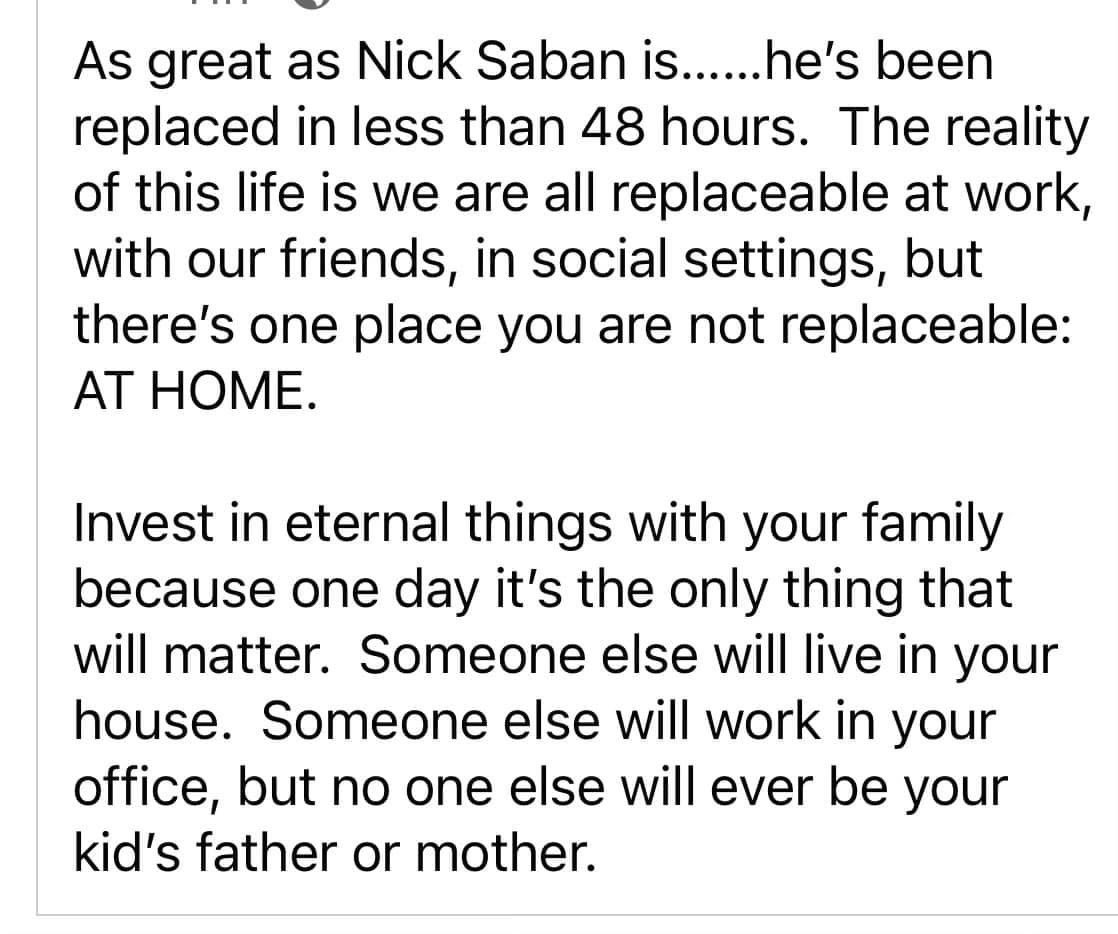
@sfmcguire79 Has lowering the standard ever worked? The only programs I have ever seen have sustained success are the ones where the standard is the highest. After listening to over 600 episodes of The Learning Leader podcast by @RyanHawk12 I understand the importance of that word “sustained”
I appreciate @RyanHawk12 for putting in the work and having people like Will Guidara on his show so people like me can learn from the best in the business. Here is to bringing “Unreasonable Hospitality” to education this year!
Jason Kelce talking about the importance of fathers in his retirement speech: "I think one of the best things a person can be in this world is a father. A father who is present, devoted, and loving is the greatest gift a child could ask for in our society."
@arkansas_rural@nathanw_morris Someone make it make sense 🤷♂️ I understood different rules when private schools weren’t getting public money, but now….
“I can tell you the analytics say ‘go for it.’ The ‘samalytics’ say don’t. And I went for it.” -Sam Pittman on regretting going for it on fourth-and-1 from the UA 34-yard line on the first drive of the second half. #wps
Leadership means making tough choices. If it doesn't cost someone something to criticize you, then that criticism doesn't mean anything. Easier said than done, especially when your job is a school leader, but great advice nonetheless. #edchat#edutwitter#education#K12
“Leaders that can’t be questioned end up doing questionable things.” Jon Acuff
I believe this applies to listening to people higher AND lower on the proverbial totem pole. Most leaders listen to those above them, but they don’t all listen to those under them. #education#edchat
Addressing the elephant in the room isn't always easy, but it's necessary to be elite. We should all aspire to be the leader that doesn't leave challenges under the table. The Twin Thieves is one of the best books I've read. #edchat#k12#education#teachertwitter#lrnchat
As the new school year kicks off we need to all remember we are impacting young people. Every day is an opportunity to build them up, teach them how to navigate differences, and how to make a positive contribution to their community. #k12#education#hackingleadership#edchat
When he was 14, Wayne Gretzky moved from his small hometown to play in a more competitive hockey league in Toronto.
He was undersized and during the first practice, he got pushed around.
After practice, his coach pulled him aside.
“When you go home tonight,” the coach said,
“the Toronto Maple Leafs are playing the Philadelphia Flyers—watch Bobby Clarke play.”
Bobby Clarke was an undersized player on the Flyers who went on to be inducted into the NHL Hall of Fame.
“He's not very big,” Gretzky’s coach told him, “but he's very smart.”
“And I studied him and I studied him and I studied him,” Gretzky said.
“I would take out a piece of paper and draw a rink and then without looking at the paper, I’d watch the hockey game on TV, and I would take my pen and I’d follow the puck.”
When Clarke got off the ice, Gretzky would look down at the paper and look for patterns.
He began to notice two things.
First, that Clarke “played the game mostly out of the corners.” Second, that players almost never went behind the net.
So, Gretzky said, “I started playing out of the corner and from behind the net…I started using the net as a decoy. Consequently, I wasn’t standing in front of the net, getting knocked over, and being on my keister the whole time.”
Takeaway 1:
In his books and on his podcast, Tim Ferriss talks about the question he likes to ask when setting out to learn a new skill:
“Who is good at this despite being poorly built for it?”
The idea is to study those, like Bobby Clarke, who found ways to excel even without the prototypical characteristics or advantages.
Then you yourself can use what you learned and, like Gretzky, excel even without the prototypical characteristics of advantages.
Takeaway 2:
Early in his career, in his lab, the neuroscientist Andrew Huberman kept a list of the scientists he loved and admired. “I would read that list over and over,” he said, “I didn’t realize it at the time, but this is what is called introjection.”
In psychology, "introjection" is the process of absorbing the qualities and behaviors of others.
If you regularly listen to so-and-so’s podcast, Huberman explains, “the nervous system begins to ask questions like, what would so-and-so do? That’s a very real thing, and we’re not always consciously aware of it.”
As he regularly watched and doodled the play of Bobby Clarke, Gretzky introjected Clarke’s style, stopped spending so much time on keister, as he put it, and consequently, went on to set 61 NHL records—many of which he still holds—including most career regular-season goals (894), assists (1,963), and points (2,857).
- - -
“I started playing out of the corner and from behind the net because nobody had ever done that before…and by the time they sort of kind of figured it out, I’d retired.” — Wayne Gretzky
Follow @bpoppenheimer for more content like this!
"It's not just a building and some land. It really is a place for people to disconnect and reconnect to who they are and to whose they are," Mount Eagle executive director Katelyn Hiatt said. "This is a very special ministry."
More on the retreat:
https://t.co/vRU7DarFyi