Most leadership teams don't lack ideas, they lack candor.
What looks like alignment is often silence, and leaders end up making decisions with filtered information-without realizing it.
I wrote about this dynamic and how to break it.
https://t.co/rDLkL6OjXX
🚨 UNITED PASSENGER CATCHES INSANE NASA ROCKET LAUNCH FROM PLANE WINDOW — FLIGHT ATTENDANT LOSES IT MID-AIR
A United flight just turned into a front-row seat to history.
A woman captures the exact moment NASA’s Artemis II rocket launches… straight from her window at 30,000 feet.
And then you hear the flight attendant:
“15 years of flying… I’ve been praying to see something like this.”
• Rocket blasting through the clouds
• Crew calling it a “once in a lifetime” moment
He said he flew to Florida multiple times just to see a launch…
Canceled. Every time.
And then this happens midair.
What are the chances you randomly look out your window… and see history taking off?
Every leader runs two systems: the one on the org chart—and the one beneath it. This piece explores how unspoken beliefs subtly shape culture, silence intelligence, and determine what actually grows inside organizations. https://t.co/8DWJMDTdno
Seven years into this work, I paused to write about what starting Dudash Executive Coaching has taught me -about courage, mindset, and change that goes far beyond work.
I shared the full reflection in the comments.
Walt Disney once told Charles Schulz he wasn't good enough to draw background art.
Form letter. Very polite.
"We only hire the very finest artists."
Sparky wasn't one of them.
His yearbook rejected his cartoons. His school gave him a zero in physics. He failed every subject in eighth grade.
Every. Single. One.
The other kids called him "Sparky" — after a horse in a comic strip.
They were calling him an animal.
Paul Harvey said it best:
"Sparky wasn't actually disliked by the other youngsters. No one cared enough about him to dislike him."
So this invisible boy did something strange.
He didn't try to prove Disney wrong.
He wrote his autobiography in cartoons instead.
Named the main character after himself.
Charlie Brown.
A kid whose kite never flies. Whose team never wins. Whose crush never notices him.
Then Schulz did something the network executives hated.
He put Luke 2 at the center of his Christmas special.
"Fear not: for, behold, I bring you good tidings of great joy..."
They told him to cut it.
Too religious.
He refused.
Christmas Eve, millions of families will watch that scene.
A loser became the messenger.
Disney said he wasn't good enough.
God said otherwise.
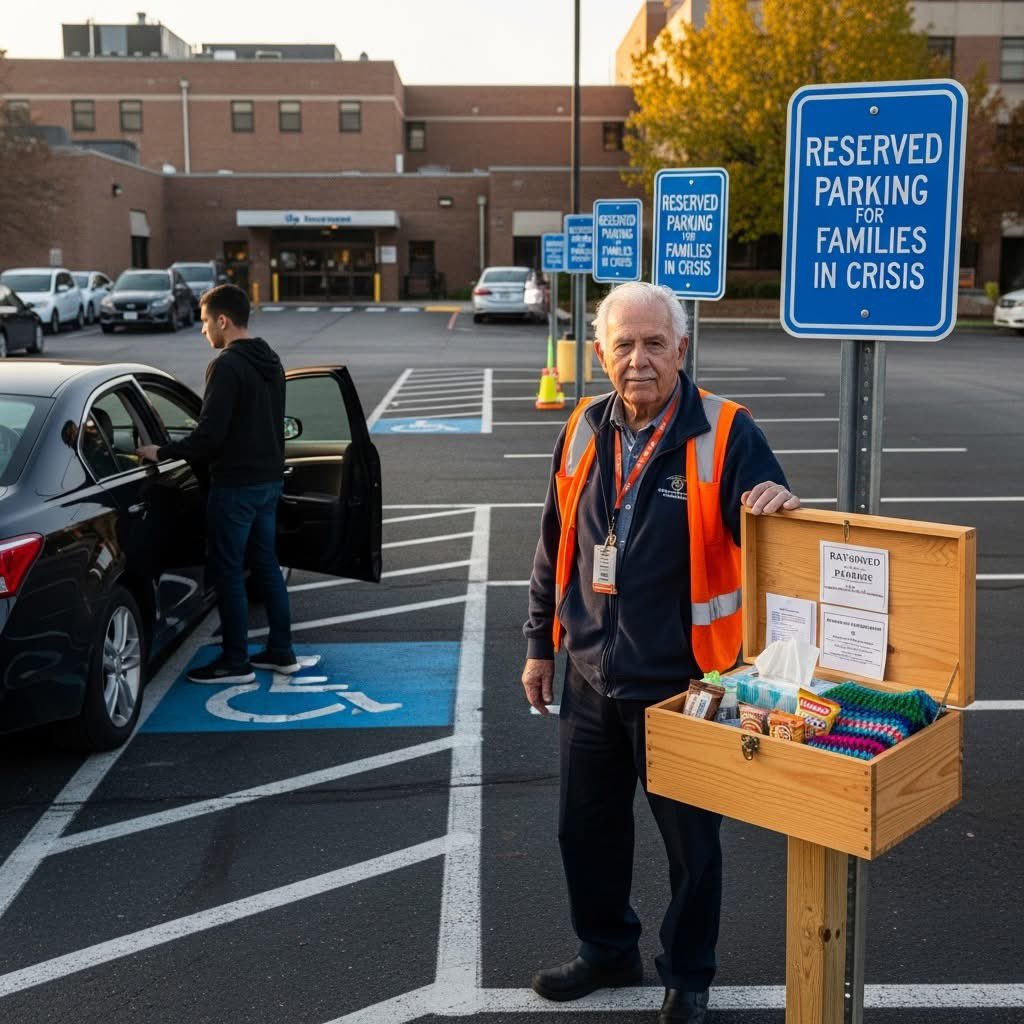
"My name's Raymond. I'm 73. I work the parking lot at St. Joseph's Hospital. Minimum wage, orange vest, a whistle I barely use. Most people don't even look at me. I'm just the old man waving cars into spaces.
But I see everything.
Like the black sedan that circled the lot every morning at 6 a.m. for three weeks. Young man driving, grandmother in the passenger seat. Chemotherapy, I figured. He'd drop her at the entrance, then spend 20 minutes hunting for parking, missing her appointments.
One morning, I stopped him. "What time tomorrow?"
"6:15," he said, confused.
"Space A-7 will be empty. I'll save it."
He blinked. "You... you can do that?"
"I can now," I said.
Next morning, I stood in A-7, holding my ground as cars circled angrily. When his sedan pulled up, I moved. He rolled down his window, speechless. "Why?"
"Because she needs you in there with her," I said. "Not out here stressing."
He cried. Right there in the parking lot.
Word spread quietly. A father with a sick baby asked if I could help. A woman visiting her dying husband. I started arriving at 5 a.m., notebook in hand, tracking who needed what. Saved spots became sacred. People stopped honking. They waited. Because they knew someone else was fighting something bigger than traffic.
But here's what changed everything, A businessman in a Mercedes screamed at me one morning. "I'm not sick! I need that spot for a meeting!"
"Then walk," I said calmly. "That space is for someone whose hands are shaking too hard to grip a steering wheel."
He sped off, furious. But a woman behind him got out of her car and hugged me. "My son has leukemia," she sobbed. "Thank you for seeing us."
The hospital tried to stop me. "Liability issues," they said. But then families started writing letters. Dozens. "Raymond made the worst days bearable." "He gave us one less thing to break over."
Last month, they made it official. "Reserved Parking for Families in Crisis." Ten spots, marked with blue signs. And they asked me to manage it.
But the best part? A man I'd helped two years ago, his mother survived, came back. He's a carpenter. Built a small wooden box, mounted it by the reserved spaces. Inside? Prayer cards, tissues, breath mints, and a note,
"Take what you need. You're not alone. -Raymond & Friends"
People leave things now. Granola bars. Phone chargers. Yesterday, someone left a hand-knitted blanket.
I'm 73. I direct traffic in a hospital parking lot. But I've learned this: Healing doesn't just happen in operating rooms. Sometimes it starts in a parking space. When someone says, "I see your crisis. Let me carry this one small piece."
So pay attention. At the grocery checkout, the coffee line, wherever you are. Someone's drowning in the little things while fighting the big ones.
Hold a door. Save a spot. Carry the weight no one else sees.
It's not glamorous. But it's everything."
Let this story reach more hearts....
Credit: Mary Nelson
Most of leadership happens in the space between stimulus and response. This reflection explores Viktor Frankl’s timeless insight & how the pause connects our inner world to our outer impact—refining leadership from the inside out.
Read the full reflection: https://t.co/bEyTi3chKF