For years, cadets at the U.S. Air Force Academy walked past the quiet old janitor who mopped their floors and cleaned their showers. Most of them gave him little more than a passing nod.
In the fall of 1976, a cadet named James Moschgat was reading a book about the fighting in Italy in World War II. On one page he found the story of Hill 424, and a Private William Crawford from Colorado.
He turned to his roommate. "Holy cow... I think our janitor is a Medal of Honor winner."
On September 13, 1943, near Altavilla, Italy, Private Bill Crawford's company was pinned down by German machine guns. He went forward alone and destroyed the first gun with a grenade. Then he went after the second and destroyed it too. At the third, he killed one gunner, the rest ran, and he turned their own machine gun on them.
Soon after, he disappeared. The Army believed he had been killed. In 1944, his father accepted the Medal of Honor in his place.
He was alive. He spent about 19 months as a prisoner of the Germans and survived a forced march in the winter of 1945.
After the war he went back into uniform. He retired in 1967 as a master sergeant and took a job as a janitor at the Air Force Academy in Colorado.
He never told the cadets.
The following Monday, Moschgat brought the book to him and asked.
"Yep, that's me."
"That was one day in my life and it happened a long time ago."
Word spread. The man with the mop had never had the medal placed around his neck by a president.
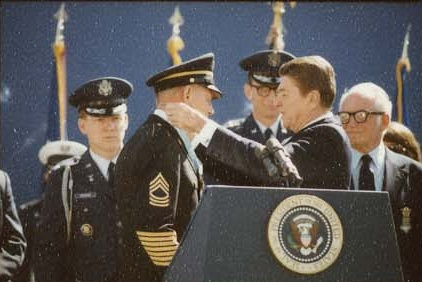
On May 30, 1984, at the Academy's graduation, President Ronald Reagan told the stadium about a private on Hill 424 whose father had accepted his medal for him.
"Nearly 40 years have gone by, and it's time to do it right."
Then the President of the United States hung the Medal of Honor around the neck of the old man who used to clean the cadets' bathrooms.
Moschgat went on to fly fighters for 30 years and retired as a colonel. On his graduation day, the janitor had told him, "Good luck, young man."
Bill Crawford died in 2000. He is buried at the Academy where he once mopped the floors.
Tomorrow is Veterans Day. Look twice at the quiet old man with the broom.
Some of them already gave this country a day it can never repay.
The United States Navy has a warship whose bow was made from the World Trade Center.
The men who built her lost their own homes in the middle of building her.
They did not stop.
In 2003, twenty-four tons of steel pulled from the wreckage of the Twin Towers were trucked south, out of New York, to a small foundry in Amite, Louisiana. Population about 4,000. The steel was to be melted down and poured into the bow stem of a new amphibious warship. The Navy had already chosen the name.
USS New York.
The men at the Amite foundry were metalworkers. They had melted steel their entire lives. Scrap is scrap. It goes in the furnace.
This did not go in the furnace like scrap.
Witnesses said the workers handled it the way people handle relics. Some of them reached out and touched it as they walked past, gently, the way you would touch a coffin. Nobody told them to. Nobody could have explained to an outsider why grown men in a foundry in rural Louisiana were laying their hands on twisted beams from a building fifteen hundred miles away.
One man who had worked at that foundry for forty years was scheduled to retire before the pour. He postponed his retirement so he could be there when the towers went into the fire.
On September 9, 2003, they poured. Seven and a half tons of World Trade Center steel became the stem of the bow. The leading edge. The part of the ship that touches the ocean first.
The ship was built at the Avondale shipyard in New Orleans. Keel laid in August 2004. Twelve hundred Louisiana workers. Welders, pipefitters, electricians, shipwrights.
Then, in August 2005, Hurricane Katrina came up out of the Gulf and drowned the city they lived in.
Their houses were under water. Their neighborhoods were gone. Some of them lost family. The shipyard itself was hit. There was every reason on earth for the work to stop.
The twelve hundred came back.
Men who were sleeping in shelters, in trailers, in cars, showed up at the yard and went back to work on New York's ship.
A firefighter from New York who came down for the christening said it out loud, the thing everyone in the yard already knew. This ship shows the strength of the country, past 9/11, past Katrina.
Two cities, two disasters, one hull.
She was christened on March 1, 2008, at Avondale, with the families of 9/11 victims in the stands.
In the fall of 2009 she sailed for the first time, down the Mississippi and out into the Gulf and up the East Coast.
On November 2, 2009, she came up the Hudson River into New York Harbor.
She stopped in front of Ground Zero.
The crew manned the rails in dress uniform. The ship rendered honors, a 21-gun salute, to the empty sky where the towers had stood, from a bow made out of them.
Five days later, on November 7, she was commissioned into the Navy in New York, in front of thousands.
Her crest shows a phoenix rising out of two gray towers. Her motto is on the crest.
"Strength forged through sacrifice. Never forget."
She is 684 feet long. She carries 800 Marines. She has deployed all over the world since. And at the very front of her, below the waterline, cutting through every wave she has ever met, is seven and a half tons of the World Trade Center.
The steel that fell on September 11 was twisted, black, and buried.
Louisiana dug it out, melted it, and sent it back to sea.
Pointed forward.
Hitting the waves first. 🇺🇸
Nine months after September 11, a village in Kenya with no electricity, no running water, and no roads gave America the most valuable thing it had.
Fourteen cows.
This is not a joke. It is one of the most serious gifts this country has ever received.
Kimeli Naiyomah grew up in Enoosaen, a Maasai village near the Tanzanian border. His family was so poor they owned no cattle. Among the Maasai, that is the bottom. A family without cows is barely counted as a family.
At fourteen he ran away to a school where the lessons were held under a tree. He walked. He had no shoes, no books, no money. He asked to be let in anyway.
Years later he was a student at Stanford, in California, studying to be a doctor.
On September 11, 2001, he happened to be in New York City.
He watched the towers fall.
He was a Maasai warrior. Warriors are trained from childhood to run toward danger. He wanted to run to the pile. He could not help there. He did not know what to do with what he had seen.
Months later he went home to Enoosaen.
The elders had heard something on the radio. Vaguely. A place called New York. Buildings. Some of them had not heard at all. Nobody in the village had ever seen a skyscraper. Nobody had been on an airplane. The idea of a building a hundred stories tall, full of thousands of people, falling down, was not something the language had words for.
Kimeli sat with them and explained. Slowly. What a tower was. How many people. What it looked like when it came down. He told them what he had seen with his own eyes.
The elders listened. When he finished, one of them asked a question.
"What can we do for these poor people?"
Kimeli had already decided. He had saved money in America. He wanted to buy a cow, the first cow his family had ever owned, and he wanted to give it to the United States.
To the Maasai, a cow is not livestock. A cow is life. It is wealth, food, standing, survival. An elder explained it to a reporter in one sentence. A cow is the handkerchief we Maasai use to wipe away tears.
Kimeli asked the elders for their blessing to give his one cow to America.
Then, one by one, the elders stood up.
They wanted to give too.
In the end, fourteen families pledged fourteen cows. In a community of about ten thousand people who owned almost nothing else.
On June 3, 2002, the United States chargé d'affaires in Kenya, William Brencick, traveled to Enoosaen. A flight, then more than half a day by road across terrain that barely counts as road. When he arrived, hundreds of Maasai in red robes were waiting. Some held hand-lettered banners.
"To the people of America, we give these cows to help you."
The elders presented the fourteen cows. Brencick accepted them on behalf of the United States. He called it the highest expression of regard and sympathy.
Then there was a practical problem. How do you ship fourteen sacred cows to New York?
The answer the two sides arrived at was better than shipping them.
The cows would stay in Kenya. They would belong to the United States of America. The Maasai would care for them, forever, as America's herd.
They are still there.
The original fourteen have multiplied into dozens. Each one carries a mark carved into its ear, the outline of two towers. Their offspring fund scholarships for the children of the village. The U.S. embassy built a school there, and a water project.
When the story reached America, forty thousand people wrote letters to the village. A painting of the fourteen cows hangs in the 9/11 Memorial Museum. A children's book about them became a national bestseller.
Kimeli's own explanation was the shortest.
To heal a sorrowing heart, give something that is dear to your own.
A village that had never seen a skyscraper, that could not have found New York on a map, that owned almost nothing, gave America the one thing it valued most.
Somewhere in Kenya tonight, there are cows with towers carved into their ears.
They are ours.
They were given to wipe our tears. 🇺🇸🇰🇪
Six New York City firefighters survived the collapse of the North Tower because a 59-year-old bookkeeper could not walk any faster.
The ones who ran past her, faster, stronger, wearing lighter gear, are dead.
The ones who stopped for her are alive.
Her name was Josephine Harris. She was one week from her 60th birthday. She was a bookkeeper for the Port Authority. A few weeks earlier she had been hit by a car and was still walking with a limp.
On September 11, when the plane hit the North Tower, Josephine was on the 73rd floor.
She started down.
Alone. Injured. One step at a time. She got herself down more than fifty flights before her legs gave out.
Six firefighters of Ladder Company 6 out of Chinatown were doing the opposite. They were carrying 100 pounds of gear each, and climbing.
Their captain, Jay Jonas, had already turned to his men on the way in and told them the truth. "Firemen will die today." Nobody argued.
At the 27th floor, they felt the building shudder and heard a roar they did not understand. Somebody on the radio told them. The South Tower had just fallen. Their own building was next.
Jonas gave the order to go down. Now.
At the 20th floor, in the doorway of Stairwell B, they found Josephine standing there. Crying. Unable to move.
Firefighter Tommy Falco turned to his captain. Seven words.
"Cap. What do you want to do with her?"
Jonas said it later exactly the way he felt it in that second. Every fiber in his being was screaming to get out of the building. He knew, cold, that stopping was probably a death sentence for all of them.
He gave the order anyway.
"We take her."
Bill Butler and Tommy Falco each took an arm. Sal D'Agostino and Mike Meldrum went ahead to clear the way. Jonas and Matt Komorowski moved in behind.
The descent was agonizing. Josephine's legs kept collapsing under her. Other people passed them on the stairs, moving fast, telling them to get out. Firefighters passed them. Civilians passed them. Everyone was faster than Josephine.
Almost none of those faster people made it out.
At the 4th floor, Josephine dropped to the ground. She could not go on.
"Leave me," she said. "I'm okay. Just leave me."
They said no.
Butler tried to lift her. Jonas ran off the stairwell into the 4th floor to search for a chair, anything with wheels, anything they could use to carry her. There was nothing.
He turned around and walked back toward the stairs.
And then, at 10:28 a.m., the North Tower started to fall.
A hundred and ten stories of steel and concrete came down on top of them. Jonas saw the ceiling collapse. He heard the roar. He heard Josephine screaming.
Then, nothing.
They were buried.
The building had crushed itself flat everywhere around them. But the tiny section of Stairwell B where those men had stopped for a woman who could not walk, held. It did not fall.
They were the only people found alive in any stairwell of the North Tower.
Fourteen human beings survived inside the collapsed tower. Almost all of them were in that pocket, standing where they were because of Josephine's pace.
There were others. A Port Authority K-9 officer named David Lim who had gone up to help. Members of Engine 39. A chief who lost his life on the radio calling for help.
In the dark, buried, one of them got a radio through. Jonas gave his coordinates. "Ladder 6, Tower One, Stairwell B."
The voice that came back was his old friend Cliff.
"Captain Jay Jonas, this is Cliff. We're coming for you, brother. We're coming for you."
Firefighters who spend their careers on the giving end of that promise are not used to being on the receiving end. Jonas would later say he chokes up just repeating it.
For three and a half hours they clawed at concrete. Then a shaft of sunlight cut through the dust. The sun.
They climbed out.
All six firefighters. Josephine. David Lim. Fourteen people in total. Not one of them with life-threatening injuries. Buried under a hundred stories of building, and every one of them walked away.
Meanwhile, everyone who had rushed past them on those stairs was gone.
The firefighters started calling Josephine their guardian angel. They meant it literally.
They had a green firehouse jacket embroidered for her.
"Josephine, Our Guardian Angel."
Sal D'Agostino later explained it in one sentence.
"Without us, Josephine would not have made it. And we feel without Josephine, we would have died."
One of them named his firstborn child after her.
The baby was born nine pounds, eleven ounces. 9/11.
They meant that literally too.
Josephine died in 2011 of a heart attack in her Bushwick home. She was 69. Nothing to do with the towers. She had lived a full ten years that she should not have had.
The six men who saved her carried her coffin.
Two weeks ago, on September 1, 2026, Josephine's sister walked into that Chinatown firehouse holding the green jacket. The family had kept it fifteen years.
She handed it back to Ladder 6.
Sal D'Agostino was there. So was retired Deputy Chief Jay Jonas. And Bill Butler. And Matt Komorowski. And the others.
Same men. Older. Gray now.
They put the jacket in a frame. It will hang in the firehouse forever.
Every new generation of Ladder 6 will walk past those five embroidered words.
Josephine, Our Guardian Angel.
The fastest people in the stairwell died.
The slowest woman in the stairwell saved six firefighters, and she did it by not being able to walk. 🇺🇸
At Ground Zero, after the last living person was pulled out, the search dogs stopped eating.
So the police did something nobody had written down in any manual.
They climbed into the rubble, lay down, and pretended to be alive.
More than 300 dogs worked the World Trade Center site. They came from every corner of the country, on trucks and in cargo holds, with handlers who had been trained to do one thing. Find people who are still breathing under the ground.
That is what a search and rescue dog is built for. Not bodies. Life. They are trained on live human scent. When they find it, they bark, they dig, they light up, and the handler rewards them, and the whole thing means something.
The last living person recovered from Ground Zero was a woman named Genelle Guzman-McMillan. She had been buried for 27 hours. A dog found her.
She was the last.
After that, the dogs kept going out on twelve-hour shifts, across sixteen acres of smoldering steel, at temperatures that burned their paws, and they found nobody.
Nobody.
Day after day.
The handlers noticed it first. The dogs were changing. Their tails were down. They were not eating. They would come off the pile and lie flat and not look at anyone.
A veterinarian named Cindy Otto, who spent ten days there working night shifts to care for the animals, put it plainly. The dogs had been sent to find life, and every day they were finding the opposite.
It was breaking them.
An NYPD officer named Famiglietti described what happened next.
They pulled everybody off the rubble. Then they asked for volunteers.
The volunteers, police officers, went out into the debris and hid themselves. Under beams. In voids. Curled up in pockets of concrete. They were told to lie down like they were hurt. Then the handlers sent the dogs in.
Picture that.
A grown man with a badge, a man who had spent the last week pulling friends out of that same pile, lying down in it on purpose. Face down. Holding still. Waiting for a dog.
And the dog comes over the top of the wreckage, and catches the scent, and barks, and digs, and finds a person who is warm and moving and alive.
And the handler says good girl, good boy, and the whole team celebrates.
They called them mock finds.
They did it for the dogs.
They did it so the dogs would remember what they were for.
One of those dogs was a two-year-old golden retriever named Bretagne. She came from Texas with her handler, Denise Corliss. It was her first deployment. They worked ten days at Ground Zero. They found no survivors.
But firefighters would come off the pile, stone-faced, not speaking, and see the dog, and something would break open in them. They would kneel down. They would put their face in her fur.
One day a man walked up to Bretagne and started petting her. He told Corliss his best friend loved golden retrievers.
Corliss asked where his friend was.
The man pointed at the pile.
"He's in there somewhere."
He kept petting the dog.
Bretagne went on to work Hurricane Katrina and Rita. She retired at 10. She was the last known surviving search dog of 9/11.
On June 6, 2016, at age 16, she was carried into a veterinary office in Texas to be put to sleep.
Outside, a dozen firefighters from her fire department stood in a line in their dress uniforms, in the heat, and saluted as she went past.
They draped her in an American flag on the way out.
Three hundred dogs went into that pile looking for the living.
They found one.
And when they could not find any more, the men they worked beside laid down in the rubble and let themselves be found, so the dogs would not lose heart.
That is the whole story of Ground Zero, really.
Nobody could save the dead.
So they saved each other. 🇺🇸
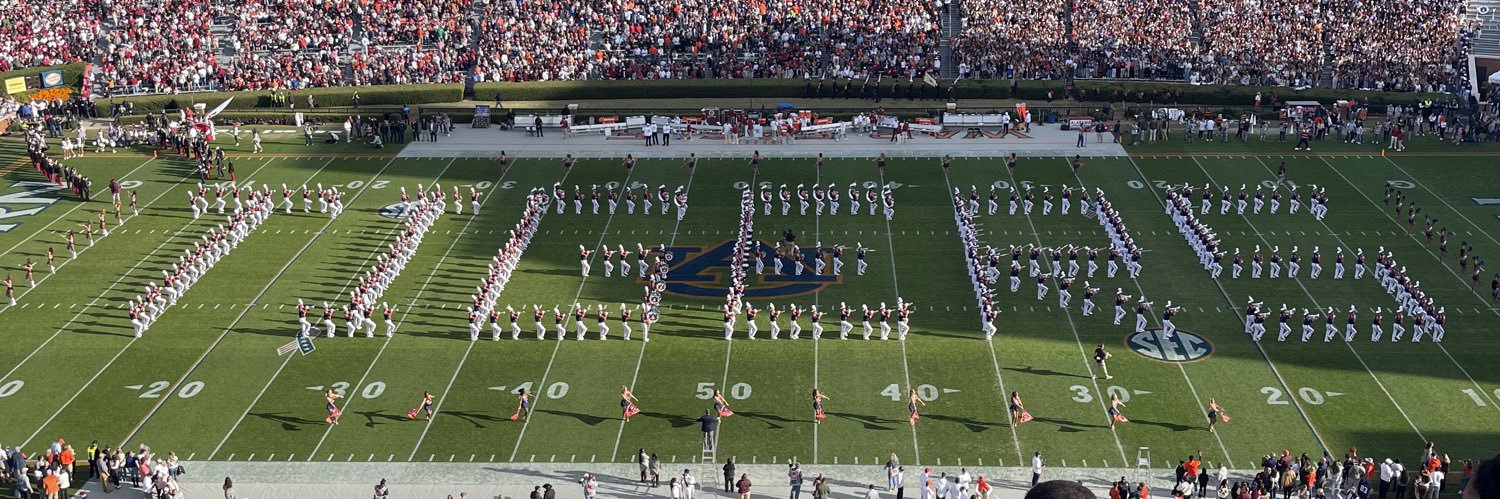
Auburn is the BEST! 🏆🦅
No. 1 in four USA TODAY Readers’ Choice Awards:
🥇 Best College Football Stadium
🥇 Best College for Sports Fans
🥇 Best College Mascot
🥇 Best College Sports Tradition
🔗 https://t.co/ExijP3JOj8
#WarEagle
One of my buddy’s sons skipped college and became an electrician at 18.
He was told either college or military were his only two options.
His parents weren’t exactly excited when he went to trade school. Actually they were a little embarrassed.
Most of their friends’ kids were going off to universities. Their son was showing up to job sites at 6am.
By 21 he was making $90k
By 24 he had his master electrician license making over $120k
At 27 he started taking his own jobs on the side for a total of $200k
Last year at 29 his little “electrician business” did $1.8M with 4 vans.
Funny how that works.
His parents used to explain why he didn’t go to college.
Now they tell everyone he owns an electrical company.
We need more 18-year-olds to know this path exists.
Day 229 tagging @mikeroweworks until more parents start bragging about trade school too.
Consider to RT if you agree.
Nicklas Nilsson förklarar skillnaden mellan höger och vänstermänniskor i klockren text på Facebook:
"Om en högerpolitisk person är bög, så är han det, och bryr sig inte om vad andra tycker.
Om en vänster är bög, så kräver han lagändringar, protesterar mot allt och alla, och gör det till en politisk kamp.
Om en höger är vegan, så äter han helt enkelt inte kött.
Om en vänster är vegan, så vill han förbjuda kött, stoppa matproduktionen och protestera utanför bondgårdar och hönsfarmer.
Om en höger inte gillar vapen, så köper han inga.
Om en vänster inte gillar vapen, så försöker han förbjuda dem, hindra alla andra från att äga ett, och hatar dem som har.
Om en höger oroar sig för klimatet, så flyger han mindre, kör elbil om det passar honom och sorterar sitt avfall.
Om en vänster oroar sig för klimatet, så vill han förbjuda fossilbilar, flygresor och kött för alla andra, protestera utanför fabriker och kräva att staten tvingar fram förändringen.
Om en höger vill ge sina barn en bra skolgång, så flyttar han till ett område med bra skolor, eller väljer en privatskola eller engagerar sig själv.
Om en vänster vill ge sina barn en bra skolgång, så kräver han mer skattepengar från alla, lika resultat för alla, förbud mot friskolor och protesterar mot varje skillnad.
Om en höger klagar på sitt jobb eller arbetsplats.. det gör han det inte. Han byter jobb eller startar ett eget företag.
Om en vänster klagar på sitt jobb – så är det chefen, företaget eller kollegorna det är fel på. Han kräver kollektivavtal, strejk, förändringar för hela orten och protesterar mot företaget så att det ska passa honom.
Om en höger är missnöjd med sin bostad eller hyra, så flyttar han, renoverar eller köper något annat.
Om en vänster är missnöjd med sin bostad eller hyra, så kräver han hyresstopp, mer bidrag, regleringar för alla och protesterar mot hyresvärdar och politiker.
Om en höger misslyckas med en affär eller en investering som går snett, så reser han sig upp, dammar av sig och försöker igen imorgon.
Om en vänster har slut på pengar den 24:e, så skyller han på att de rika har för mycket och måste bidra mer, skyller på att lotterivinsten inte gick hem förra veckan och muttrar att han har så himla otur.
Om en höger ser det här – så skickar han det till några kompisar för ett gott skratt.
Om en vänster ser det här – så försöker han argumentera emot, få det bortplockat och radera mig från Facebook."
"Auburn, Alabama is a special place to me. Nobody ever wants their career to end. But if mine had to end, then it ended on the Plains in Auburn, Alabama." - legendary NC State coach Elliott Avent concludes his career
📽️: @AuburnBaseball#NCAARegionals#Auburnbaseball@abc3340
🚨 OLYMPIAN RYAN LOCHTE: "We started watching these people getting baptized, and something came into me, something so pure."
"I'm going to start crying. It felt so real watching these people get baptized."
"And I asked [my girlfriend], 'What is this?'"
She said, "They're washing away their sins. They're getting a fresh start publicly."
"And I was like, 'Honey, I want that.'"
"And so, I got baptized. I washed away my sins, and trust me, I had a lot!"
"... To put your life in front of God and give it to God has changed everything for me."
"I'm finding who I am."
"I am being a better father, a better person, and I just love the person that I've become now, and I owe it to God."
@SatAmericaFNC@FoxNews ⬇️
“First things first, I want to thank my Lord and Savior Jesus Christ. And secondly, I want to thank all the amazing Sacramento Kings fans in the area.”
-Dylan Cardwell’s remarks right after the Kings 124-118 victory over the Warriors
Dylan Cardwell is a national treasure. While I'm in the middle of my report, Cardwell comes over and interjects some wisdom.
"At the end of the day, what the Lord has for you is greater than anything you can imagine for yourself...I'm living the dream." - Cardwell
NEW: While other singers drop F bombs and virtue signal about ICE, Jelly Roll praises Jesus Christ at the Grammys.
“I know they're gonna try to kick me off here, so just let me try to get this out.”
“First of all, Jesus, I hear you and I'm listening, Lord. I am listening.”
“I want to tell y'all right now, Jesus is for everybody. Jesus is not owned by one political party. Jesus is not owned by no music label. Jesus is Jesus and anybody, everybody can have a relationship with him…”