"Winning is fun... Sure. But winning is not the point. Wanting to win is the point. Not giving up is the point. Never letting up is the point. Never being satisfied with what you've done is the point."
- Pat Summitt
PLAYERS: Your coach shouldn't have to beg you to be unselfish, provide energy, have a good attitude, or give your best effort. Those are all things you can control. That is what a winning teammate brings to a team. Great teams have great teammates.
Congratulations to Ellie Burdick, Annie Small and Ryan Hapgood on being named to the @ILWomen Power 100 Freshman Rankings!
🔗: https://t.co/91Z4pusRjv
#GoBigGreen
The @Big12Conference is coming to women's lacrosse!
The conference announced today its plans to add WLAX next fall with @CUBuffsWLax, @SunDevilWLax, and @GoBearcatsLAX as the first three members!
READ: https://t.co/fhhhVVDuGj
Team Culture is Fragile.
It takes daily attention.
Here are 10 things that can DESTROY a Team Culture
Drip by Drip.
1: Showing up Late
Being late tells your team that ME > WE. This is a dangerous place to go. Respect your teammate's time. Respect your coach's time. Be on time.
2: Skipping Reps
Every rep creates a habit. Skipping reps is how you get worse as a player. This is how you get worse as a team. This is a culture killer.
3: Not Holding others Accountable
All teams need leaders. If leaders don’t hold others accountable. The team culture loses. The team loses.
4: Bad Body Language
Body Language screams. Want to destroy a culture. Bring negative energy with bad body language.
5: Taking Plays Off
Can I Trust you as my teammate? Not if you take plays off. If you play when you want to play. You will kill your culture.
6: Complaining about your Role
Not happy about your role? Want to hurt the team? Complain about your role. This will eat away at your culture and hurt your team.
7: Bad Mouthing Your Teammates
Easy way to hurt your team and kill your culture. Talk bad about your teammates. It will eat at your culture every time.
8: Sloppy Practices
Sloppy practices = sloppy games. They create bad habits. They eat away at culture. Mediocrity follows.
9: Not Focused on Details
Details win games. Not focusing on details loses games. Skip details and impact your culture.
10: No Eye Contact
This tells the coach you don’t care. It tells your teammates you don’t care. It tells the team it is all about you. Note: there are some cultures where this is accepted. Know your players.
——
Follow me @gregberge for actionable ideas on coaching, leadership, culture, and teams.
Join thousands and subscribe to my free weekly newsletter, Great Teams Better Leaders 123. Link in my profile.
Think you are working hard this Summer?
Check out Caitlin Clark’s off-season workout ⬇️
Conditioning
Ball-Handling
100 3-Point Attempts
100 Mid-Range Shots
100 FT Attempts
She works on all the basic fundamentals at game speed!
Parents:
If you’re sending your kids to 4-5 different lacrosse trainers a week, your kids will never learn what it means to take a bucket of balls on their own and go explore & put in the work
It’s one thing to get different perspectives, it’s another to get too many to the point of confusion
They’ll also never learn to self adjust and self critique if they only ever listen to others tell them what to do.
Lacrosse pays dividends to players who can think for themselves 🫡
PLAYERS: When you're on the bench, you never know when Coach will put you into the game. It is important to be an active observer, stay mentally (and physically) ready, and learn as much as you can by watching. Don't make mistakes that a teammate might have previously made.
Women’s lax needs stringent & consistent reffing around the world. Rules shouldn’t be for interpretation, games should be called as defined in rule books to ensure player safety.
In this clip from playing in Lisbon, a player clearly targets my neck/head area. She got a yellow.
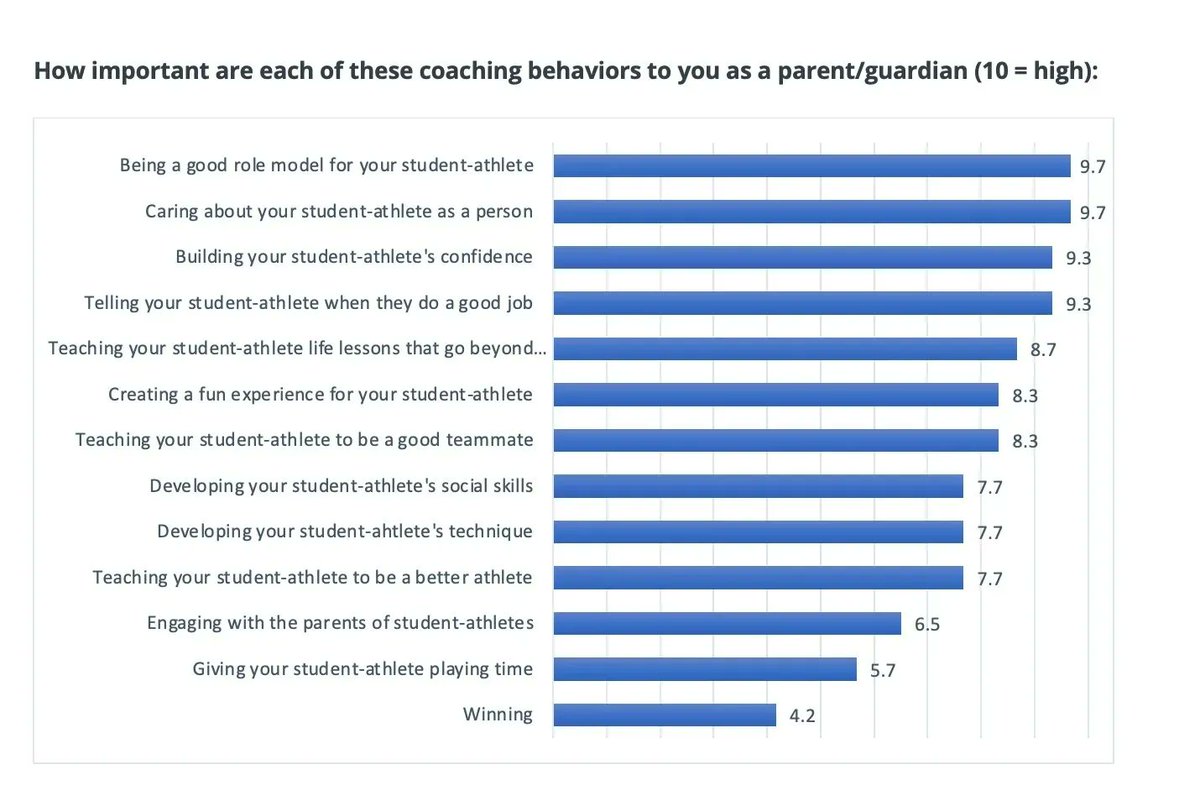
What do Parents want in a Coach?
▪️Be a Positive ROLE MODEL
▪️Show that you CARE
▪️Build their child’s CONFIDENCE
▪️Give POSITIVE REINFORCEMENT
▪️Teach LIFE LESSONS
Credit to @EcsellSports for the research and graphic.
Why are so many talented coaches getting out of coaching?
One reason is because the coaching portion of their job is now just 1% of the position.
A large part of coaching is adapting to the rapidly changing landscape of athletics including:
*Roster management
*Student-athlete needs
*Engaging boosters/stakeholders
*Conflict resolution
*Academic advising and monitoring
*Working with administration
*Program marketing
*Staff management
*Creative solutions and vision
*Budgeting and logistics
*Creating and managing expectations with players, staff, administration, parents, and community (this includes managing and working through politics)
The job is more comprehensive than ever and is becoming less about coaching and more about creating and managing. The head coach is essentially a CEO of a small business.
Coaching isn’t different than other industries though. For example, many restaurant owners opened their restaurant because they love cooking and are very talented in the kitchen. However, once their business gets going they are often in the kitchen less and focusing more on the restaurant operations as a whole. They didn’t open their restaurant with a passion of engaging with unruly customers, managing workforce turnover, working with food vendors on increased pricing due to inflation, or managing costly building repairs. However, all of these things are paramount to running a successful restaurant.
Many coaches say the player-coach impact/relations as well as X’s and O’s are the things they love most about coaching. It’s the reason why they got into coaching. Much like the restaurant owner, coaches need to adapt to and embrace the many things that aren’t their direct passion to be able to be successful.
Embrace the required 99% so you get to do the 1% you love.